Mariana Martins, Vitor Fernando Pereira, Francisco José De Castro Moura Duarte (2025). Safety in end-of-life offshore oil platforms. In: Safety Management and Human Factors. AHFE Open Access, vol. 189, pp. 136–144. https://doi.org/10.54941/ahfe1006579
In the 1970s, there was a significant drive for the construction of offshore installations, and a substantial number of platforms and subsea infrastructures have been built since then. Although many of these installations have exceeded their original expected lifespan, estimated between 15 and 30 years, a growing number are reaching the end of their productive lives and require removal in a manner that meets safety standards. A resilient safety culture is essential for reducing incidents in high-risk industries, such as oil and gas. Progress toward a resilient culture becomes even more relevant in the context of aging platforms or those undergoing decommissioning, where the inherent risks of operations are often exacerbated by factors such as the degradation of installations, the absence of procedures for new tasks, and the perception of job instability. In this context, this research aims to analyze the safety culture on three offshore platforms of a Brazilian oil and gas company that are at the end of their service life, identifying the main constraints faced by the resident workforce. In light of the concepts of the activity ergonomics approach, this study adopts the case study method. Evidence collection followed a mixed-methods approach, combining quantitative and qualitative methods. In the quantitative phase, homogeneous groups were formed among onboard teams, and customized safety questionnaires were applied, with data analysis using an adapted Likert scale. In the qualitative phase, focus groups were organized to validate and enrich the results, encouraging the exchange of practices and values related to safety. The main findings of the research include: (1) The perception of worsening job instability on platforms in the decommissioning phase, with consequent detrimental effects on the psychological well-being of the resident workforce; (2) Design issues on older platforms, related to the lack of incorporation of real work aspects into the designs; (3) Lack of trust in the system, caused by the degraded condition of the platforms due to accumulated wear and operational life extensions beyond the original design. This state negatively impacts both the safety of professionals and the reliability of the installations. Based on these results, several recommendations were proposed, such as the integration of ergonomics into platform engineering design, going beyond technical specifications, and based on the feedback from existing situations for designing new conditions. Other recommendations include structuring retraining plans for workers on decommissioning platforms and creating new employment opportunities in related sectors. Finally, the practical contribution of this research is highlighted, addressing a field demand for studies focused on safety in platforms at the end of their service life, as well as its theoretical contribution by expanding the understanding of new risks inherent to offshore oil and gas platforms in the decommissioning phase, with a focus on real work.
In 2023, global oil consumption totaled 100.2 million barrels per day, following a 2.6% increase (2.5 million barrels per day) compared to 2022. Regarding global oil production, the volume in 2023 grew by 2.2% relative to 2022, rising from 94.3 million barrels per day to 96.4 million barrels per day (ANP, 2024). Brazil ranked ninth in global oil production after an 11.8% increase in production volume, reaching 3.5 million barrels per day (3.6% of the global total) (ANP, 2024). These data highlight the relevance and growth of the oil and gas sector both nationally and globally.
In the 1970s, there was a push for the construction of large offshore installations, leading to the development of a significant number of platforms, along with an extensive subsea infrastructure and tens of thousands of wells. Although many facilities have exceeded their original lifespan of
15 to 30 years, an increasing number are now reaching the end of their productive life and must be decommissioned in compliance with safety standards (IOGP, 2021). According to the Brazilian National Agency of Petroleum, Natural Gas, and Biofuels (ANP), approximately R$ 64.39 billion will be invested in decommissioning activities in Brazil between 2024 and 2028. Zhang et al. (2021) emphasize that removing a large offshore structure is a highly complex process that presents significant safety challenges. Additionally, under Decision 98/3 of the Convention for the Protection of the Marine Environment of the North-East Atlantic (OSPAR), comparative assessments of decommissioning options must address safety concerns related to removal and disposal, incorporating occupational health and safety evaluation methods.
Safety culture has received considerable attention across various industries in recent years (Fleming et al., 2018). A resilient safety culture, in which safety is embedded in daily practices and the workforce plays an active role in reducing incidents and promoting safety, is essential for minimizing accidents in high-risk industries such as oil and gas (Aderamo et al., 2024). Advancing toward a resilient culture is even more critical in the context of aging and/or decommissioning platforms, where operational risks are often exacerbated by facility degradation, the absence of procedures for new tasks, and job instability due to uncertainties regarding career continuity (Durbin et al., 2001). Considering this context and the purpose of the project in which this research is embedded—promoting the development of a Safety Culture within oil and gas sector units—and recognizing that a significant portion of Brazilian oil fields, particularly those in deep-water environments, have been in operation for over two decades and are thus approaching production maturity (Energia, 2022), this study aims to analyze the safety culture on three offshore platforms at the end of their operational life, identifying the main constraints faced by their workforce.
METHOD
In light of concepts from the activity ergonomics approach, this study applies the case study method following the procedure proposed by Yin (2015). The research question examines the compatibility of the theoretical framework on industrial safety in aging platforms with the actual situation of Platforms A, B, and C, located in the Campos Basin. Regarding the units of analysis, three platforms were selected as part of the project Human and Organizational Factors of Industrial Safety, a partnership between the research center of the company where the study is conducted and the Federal University of Rio de Janeiro. This project aims to assess the maturity level of safety culture in 18 units of a Brazilian oil and gas company. A research protocol was developed for the study units based on the categorization proposed by Rocha et al. (2023), which established a classification derived from the literature on safety culture and prior knowledge of the oil and gas industry. For data collection, multiple data sources were used, combining quantitative and qualitative methods. In the quantitative phase, discussion groups were
formed, and a customized questionnaire was administered, with data analysis based on an adapted Likert scale. In the qualitative phase, focus groups were organized to validate and enrich the results, fostering the exchange of practices and values related to safety. The description of the study units was supported by a document analysis of materials provided by the units. The data analysis phase follows the pattern-matching technique, which compares an empirically based pattern with the pattern predicted before data collection, contributing to the internal validity of the case study (Yin, 2015). Therefore, the study is based on activity theory and human factors, comparing the results obtained from the theoretical framework with the data experienced in the project.
Quantitative Phase The quantitative phase of the research involved applying a Safety Culture questionnaire based on the literature and customized for the context of the study units, with adjustments made in collaboration with platform managers. The questionnaire contained fifty-six statements divided into eight sections: demographic variables, safety management system, safety priority, compliance behavior requirements, proactive behavior development, safety training, integrity, and risks and accidents. The research was conducted in compliance with ethical principles, ensuring participant anonymity and data confidentiality. Participation was voluntary and based on informed consent. Additionally, data collection respected the homogeneous groups previously defined by the researchers and validated by unit representatives.
The stratification of homogeneous groups followed three criteria: a) same area of expertise; b) same hierarchical level; c) same employment status (contractor or direct employee). Based on these criteria, eight homogeneous groups were established, considering the total number of workers on each platform: 1) Own leadership (platform manager, production coordinator, vessel coordinator, and maintenance coordinator); 2) SMS and Health (safety technicians and nurses); 3) Own supervision; 4) Own operations; 5) Contracted supervision; 6) Contracted operations; 7) Cargo handling; 8) Hospitality. The sessions were conducted in person by the safety technicians and lasted approximately 60 minutes. The number of applications in each homogeneous group was sufficient to statistically ensure a confidence interval (CI) of 95% with a margin of error (ME) of 2% for each platform.
Qualitative Phase Following the quantitative evaluation, focus group meetings were conducted to validate the previously collected data and encourage case discussions on different safety-related themes. For this purpose, the research team boarded Platforms A, B, and C on June 24–26, 2023, March 22–25, 2024, and July 17–21, 2024, respectively. For each homogeneous group, the most representative response graphs for each theme were presented, and participants were asked whether they agreed with the findings. Additionally, workers were encouraged to share real-life cases, which were subsequently
Safety in End-of-Life Offshore Oil Platforms 139
discussed and analyzed in depth to support perceptions related to each safety theme.
This process was facilitated by a climate of trust established between the research team and the entire workforce. Ethical procedures were strictly followed: the study was conducted with formal authorization from the company and its managers; all workers involved were informed in advance about the objectives and procedures of the study and provided their consent to participate; personal and identifiable information was kept confidential and not disclosed at any stage of the research.
THE STUDIED UNITS Platform A is a Floating Production Storage and Offloading (FPSO) unit located in the Campos Basin. The platform began operations in August 1999, while the permanent production shutdown occurred in June 2021. The decommissioning of Platform A is part of the Revitalization Project, which plans to install two FPSO-type platforms to replace the units currently comprising the Field Production System.
Platform B is a floating unit for the production, processing, and transfer of oil and gas, of the semisubmersible (SS) type, also located in the Campos Basin. The platform is situated 175 km off the coast of Campos dos Goytacazes, at an average water depth of 1,080 meters. The unit was built in 1978, but its conversion took place in 2000. According to data from the Petroleum and Natural Gas Production Bulletin provided by the National Agency for Petroleum, Natural Gas, and Biofuels (ANP), in October 2024, Platform B produced 10,875 barrels per day (bbl/d) of oil and 213 million cubic meters per day (Mm3/d) of natural gas.
Platform C is an FPSO-type unit located in the Campos Basin. The platform began operations in November 2004. According to data from the Petroleum and Natural Gas Production Bulletin provided by ANP, in October 2024, Platform C produced 10,718 bbl/d of oil and 258 Mm3/d of natural gas.
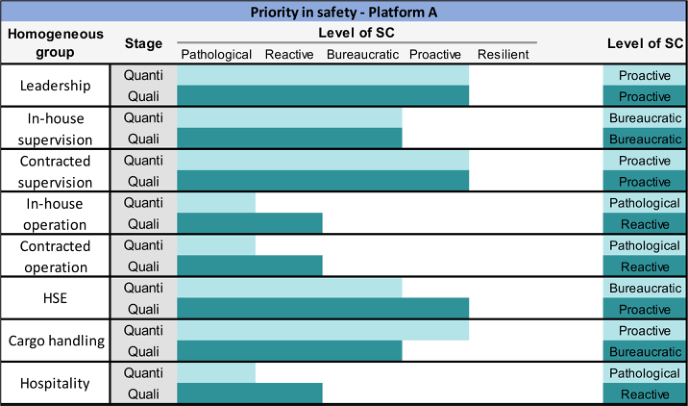
Safety Perception on Platform A The interviewed groups presented different perceptions of safety on the platform, highlighting the contrast between direct employees and contractors. The leadership believes that safety issues are openly discussed and that there is adequate monitoring of the facilities. However, they acknowledge that contractual factors impact the perception of fairness. The direct supervisors point out that the difference in perception between leadership and operations is natural due to the inherent risks of operational work, whereas the contracted supervisors emphasize the prioritization of production in certain situations and the differences in habitability conditions as factors influencing contractor safety.
The contracted operators express dissatisfaction with the hierarchical decision-making process and the lack of space for dialogue, as well as fear of retaliation when exercising their right to refuse unsafe work. The SMS team recognizes weaknesses in the integrity of the facilities but downplays the
risks due to the decommissioning phase. The cargo handling group highlights the insecurity caused by contract instability and the lack of investment in platform maintenance. Meanwhile, the hospitality team considers that contracted workers, especially those in hospitality, receive less recognition regarding safety and face more precarious living conditions, exacerbated by the degradation of the facilities.
Figure 1 presents the results of the safety culture (SC) maturity level found in both phases (quantitative and qualitative) for the analyzed theme on Platform A.
Figure 1: Maturity level of the SC by homogeneous group on Platform A (author, 2024).
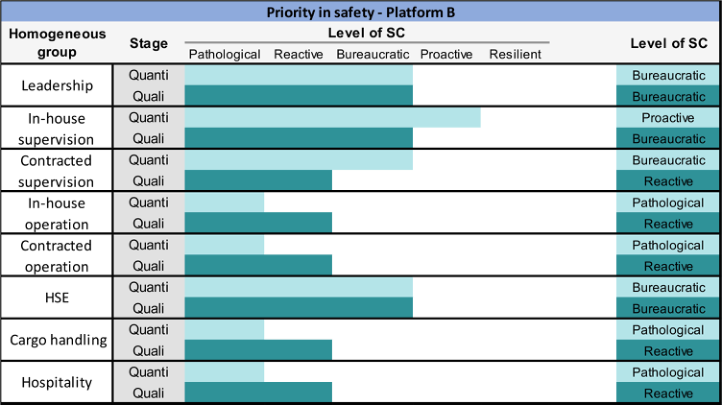
Safety Perception on Platform B The leadership of Platform B acknowledges divergences between the technical and safety teams and points out that inadequate demand sizing can affect workers’ health and safety. The SMS group highlights that leadership encourages safety and that the priority is not production but the safe execution of activities, without the need for rigid rules. Meanwhile, the in- house supervision reinforces leadership engagement and attributes accidents more to human error than to the integrity of the facilities. However, the in-house operations team mentions pressures both from the organization, for efficiency, and from contractors, for more services, resulting in work overload. Additionally, they criticize the loss of experienced professionals due to salary reductions in new contracts.
The contracted supervisors argue that the right to refuse unsafe work is analyzed before relocating a worker but avoid deeper discussions about the coherence of the onboard team’s decisions, suggesting organizational silence. On the other hand, the contracted operators believe that production is prioritized over safety and that the right to refuse is not respected, as
Safety in End-of-Life Offshore Oil Platforms 141
workers are replaced without proper evaluation of their refusal. The cargo handling group sees contradictions between organizational discourse and practice, mentioning high work demand, pressure against the right to refuse, and integrity issues within the unit. The hospitality team acknowledges leadership’s consistency regarding safety but identifies facility degradation as one of the main risk factors for serious accidents. Figure 2 presents the results of the safety culture (SC) maturity level found in both phases for the analyzed theme on Platform B.
Figure 2: Maturity level of the SC by homogeneous group on Platform B (author, 2024).
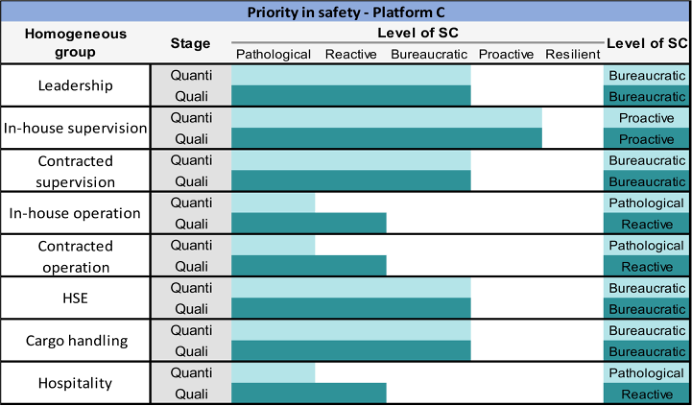
Safety Perception on Platform C The unit’s leadership believes that safety is prioritized and formally discussed, although they acknowledge structural limitations in addressing all demands, leading to the prioritization of more urgent risks. Additionally, they highlight that human factors, such as salary and contractual issues, have only recently been considered. However, they point out that, in practice, organizational silence is still present. The in-house supervision criticizes decontextualized safety decisions and a lack of trust between hierarchical levels, emphasizing high turnover as an obstacle to embedding a safety culture. They also report that workers avoid reporting incidents for fear of retaliation.
The contracted supervision exposes contradictions between official discourse and the unit’s reality, mentioning cases where production is prioritized over safety. They point to structural and operational issues, such as poor living conditions and a lack of transparency in flight cancellations. The in-house operations team criticizes the platform’s deteriorating integrity and hierarchical decision-making, noting that while some workers feel safe, others perceive constant risks. Contracted operators and cargo-handling workers state that safety standards are equivalent for all employees, but poor living
conditions and a lack of benefits negatively impact outsourced workers’ well-being. Meanwhile, the SMS team reinforces that risks are the same for everyone but acknowledges structural differences and criticizes the lack of incident information sharing. The hospitality team believes that safety is not fully integrated into the organizational culture and that, despite the availability of PPE, more effective protective measures are needed. Figure 3 presents the results of the safety culture (SC) maturity level found in both phases for the analyzed theme on Platform C.
Figure 3: Maturity level of the SC by homogeneous group on Platform C (author, 2024).
DISCUSSION
The study analyzed critical issues related to the safety and reliability of oil platforms undergoing decommissioning, highlighting three main themes: heightened contractual instability, lack of trust in the system, and design flaws in aging facilities.
The uncertainty generated by decommissioning was evident in an incident on Platform A, where a subcontractor initially took over operations, but another company, originally selected, later contested the contract. This unexpected change caused psychological instability among workers, directly impacting workplace safety. Contractual instability, exacerbated by the decommissioning phase, raised growing concerns, as many workers associate this stage with the end of their careers. Additionally, the loss of experienced professionals was identified as a critical factor, making adaptation to new operational conditions even more challenging. This lack of predictability affects not only the workers directly involved but also the operational dynamics of the unit.
The lack of trust in the system stems from the deteriorating state of the facilities. On Platform C, an operator reported that a pneumatic actuator failure nearly caused an accident, reinforcing the perception of
Safety in End-of-Life Offshore Oil Platforms 143
widespread insecurity. On Platform A, a worker suffered an eight-meter fall due to floor corrosion, highlighting structural precariousness and negligence in preventive maintenance. Furthermore, reports indicate that facility deterioration has been ongoing for years, with fragile structures and recurring failures in essential equipment. Workers perceive that as platforms approach decommissioning, investments in safety and maintenance decrease, increasing the risk of serious incidents.
Design flaws were also highlighted, particularly in the kitchen of Platform A, where high-voltage outlets are positioned close to the floor, leading to frequent short circuits during cleaning. This design flaw endangers workers, who fear being held responsible for accidents resulting from this condition. Similar issues were reported on Platform B, including outdated installations, difficulties in food storage and handling due to a lack of cold chambers, and inadequate climate control in living quarters. These limitations directly impact worker comfort and safety, underscoring the need for a thorough review of designs to prevent operational risks and improve working conditions aboard.
This research reinforces the need for an ergonomic approach to mitigate risks and improve safety conditions on platforms. The implementation of preventive measures, the appreciation of operational experience, and cooperation between different specialties are essential to ensure worker safety and facility reliability during decommissioning. Furthermore, applying ergonomic concepts can help anticipate and mitigate design issues, ensuring that future platforms are safer and more efficient. Thus, the study highlights the importance of integrating engineering and ergonomics in offshore platform management, particularly during critical operational and decommissioning phases.
CONCLUSION
This study assessed the maturity level of safety culture in three offshore platforms and identified the main constraints faced by the workforce in aging platforms. It also raised critical issues related to the safety and reliability of these facilities, such as heightened contractual instability, lack of trust in the system, and design flaws in aging installations.
As a practical contribution, the research provides insights into onboard teams’ perceptions of platform safety and proposes actions to transform existing practices in the analyzed units, fostering the development of a safety culture. In terms of theoretical contributions, the study seeks to expand the understanding of emerging risks in decommissioning offshore oil and gas platforms through a work-centered approach.
One limitation of this study is the time constraints for implementing the proposed actions. For future research, it is suggested that these actions be implemented and monitored to promote the transformation of safety practices in aging units, contributing to the development of a local safety culture.
ACKNOWLEDGMENT
This study received financial support from the Human Resources Training Program for the Oil, Natural Gas, and Biofuels Sector (PRH-ANP 15.1), with funding for Research, Development, and Innovation, in accordance with ANP Resolution No. 50/2015. The authors express their gratitude to PRH-ANP 15.1 and the oil and gas company where the research was conducted.
REFERENCES
Aderamo, A. T. et al. (2024) “Behavioral safety programs in high-risk industries: A conceptual approach to incident reduction”, Comprehensive Research and Reviews in Engineering and Technology, 2(1), pp. 64–82. Agência Nacional do Petróleo, Gás Natural e Biocombustíveis (ANP) (2024)
‘Panorama Internacional: Petróleo’, in: Anuário Estatístico 2024. Brasília. Available at: https://www.gov.br/anp/pt-br/centrais-de-conteudo/publicacoes/ anuario-estatistico/arquivos-anuario-estatistico-2024/secao-1/secao-1_revsci.pdf (Accessed: December 2024). Durbin, N.E., Lekberg, A.and Melber, B. D.(2001) Potential effects of organizational uncertainty on safety. Energia, F. G. V. (2021) “Descomissionamento offshore no Brasil: oportunidades,
desafios & soluções”, Cadernos FGV Energia, 8(11), pp. 8–102. Fleming, M. (2001) Safety culture maturity model. Health and Safety Executive.
Colegate, Norwich. IOGP (International Association of Oil & Gas Producers) (2021) Reimagining decommissioning is creating exciting opportunities. Available at: https:// www.iogp.org/blog/decommissioning/reimagining-decommissioning-is-creating- exciting-opportunities/ (Accessed: 12 September 2024). Zhang, W. et al. (2021) “Development of an experimental system for the twin-lift
decommissioning operation”, Ocean Engineering, 234, p. 108902.
LISTED IN THE AHFE DIGITAL BOOKSTORE CATALOGUE
Explore the complete digital volume
Safety Management and Human Factors
Read this individual research paper free through the original publisher, or explore the full digital proceedings book.
ISBN 978-1-964867-65-6
Explore this ISBN in the AHFE Bookstore ↗Listed in the July 2026 bookstore catalogue; search by ISBN to confirm current availability · Digital book purchase optional