Yuka Banno, Yusaku Okada (2025). Development of an analysis support tool for near-miss events using AI technology - Improving human factor management capabilities in the field. In: Safety Management and Human Factors. AHFE Open Access, vol. 189, pp. 13–23. https://doi.org/10.54941/ahfe1006566
Near-miss analysis is essential for identifying factors contributing to human errors and developing preventive measures. However, conventional text mining methods primarily extract direct causes, such as "lack of attention" or "insufficient verification," often overlooking broader background factors embedded in work environments. This study explores the use of Large Language Models (LLMs) to enhance factor analysis by capturing a more comprehensive range of underlying causes. Using Llama3-ELYZA-JP-8B, we incorporated 87 predefined background factors based on established frameworks, including PSF lists and the m-SHEL model. The developed factor analysis support system was applied to actual near-miss reports, and its effectiveness was evaluated by comparing the number and diversity of extracted factors before and after implementation. Results showed that LLM-based analysis significantly increased factor extraction and enhanced the identification of diverse causes. Additionally, factor aggregation and visualization improved the interpretation of trends over time. Despite these advantages, challenges remain, particularly regarding biases in data, factor extraction, and decision-making. Future research should focus on managing these biases through data diversity, optimized extraction balance, and improved transparency in analysis. By addressing these issues, a more reliable and practical near-miss factor analysis support system can be developed, contributing to improved workplace safety and more effective error prevention strategies.
Various preventive measures against human errors are increasingly being implemented based on information from near-miss events. However, the process from collecting and analysing near-miss events to formulating countermeasures requires significant effort, and the collected near-miss incidents are not being fully utilized.
The purpose of analyzing the factors of near-miss events is to widely collect cases that could potentially lead to incidents, analyze their causes, and develop improvement measures to prevent incidents. By implementing countermeasures based on the identified factors, the likelihood of errors can
be reduced, thereby lowering the risk of accidents. To effectively prevent future human errors, it is crucial to identify not only factors that appeared at the time of trouble or direct causes such as “lack of attention” or “insufficient verification,” but also broader factors that may have influenced human errors, including those related to tasks and the working environment, which are always present in the target operations. However, in the current situation, most of the reported factors are attributed to the individuals’ lack of verification or carelessness, and insufficient consideration is given to factors that are consistently present in the work and environment.
In conventional factor analysis methods, the following two approaches have been considered for analyzing and visualizing recorded text data:
1. Extracting and displaying keywords 2. Visualizing conceptual relationships and co-occurrences between words The first approach includes methods such as using normalized word frequency, applying TF-IDF to assign weights to words, and utilizing tools like TRENDREADER. The second approach involves methods such as using ontology, leveraging word co-occurrence information, and employing self-organizing maps.
However, there are several challenges in using text data analysis to support factor analysis, including:
The quality of the presented perspectives depends on the original recorded information.
Bias in information due to the lack of data or context.
Subjectivity in the selection of extracted information.
Recently, natural language processing (NLP) using AI has been applied to the analysis of near-miss events. For example, advanced large language models (LLMs) such as BERT (Bidirectional Encoder Representations from Transformers) and GPT are utilized to support similarity analysis with past cases and root cause analysis (RCA).
Therefore, this study aims to leverage Large Language Models (LLMs) to enhance factor analysis of near-miss events. By utilizing LLMs, we enable the extraction of multifaceted underlying factors that consistently exist in work environments and operations, beyond the direct causes reported in individual trouble incident reports. By simplifying the factor extraction process with LLMs, even individuals with limited expertise in human factors can identify less apparent causes and grasp the broader context of incidents. This approach enhances analysts’ awareness and contributes to improving workplace safety.
METHODOLOGY
In previous near-miss analyses, text mining has been applied to near-miss reports to extract underlying factors included in these reports. To extract these background factors, PSF (Performance Shaping Factor) lists have been utilized. PSFs refer to factors that influence human behavior, and various lists have been developed to facilitate the search and selection of relevant factors when human errors occur.
Development of an Analysis Support Tool for Near-Miss Events 15
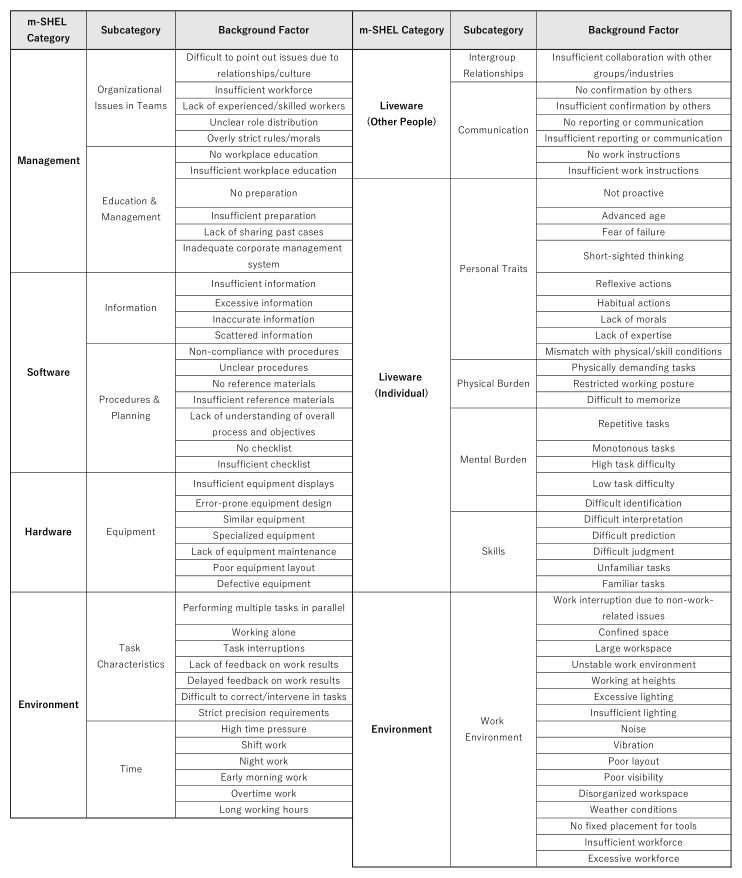
Table 1: Background factor.
Examples of PSF lists include the PSF list from THERP, the PSF list from HEART, the PSF list from CREAM, and the GAP-W type PSF reference list by K¯otai and Nagata. Based on such PSF lists, background factors of human errors were collected, and a selection list for these factors was created. Additionally, 14 subcategories were defined based on the m-SHEL model, and the collected background factors were classified and organized accordingly.
By referring to these past factor frameworks and classification systems, a total of 87 background factors were identified, which are summarized in Table 1. In this study, these background factors were incorporated into an LLM to facilitate factor extraction.
In this study, we decided to use Llama3-ELYZA-JP-8B, which was developed by further training Meta’s Llama 3 model. Here, classification
16 Banno and Okada
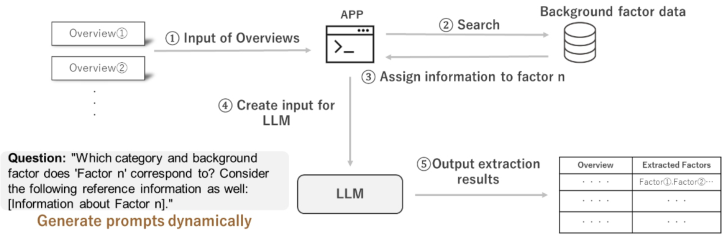
definitions and classification examples were assigned to each of the 87 background factors. The structure of this tool is summarized in Figure 1.
Figure 1: Mechanism of the factor analysis functionality.
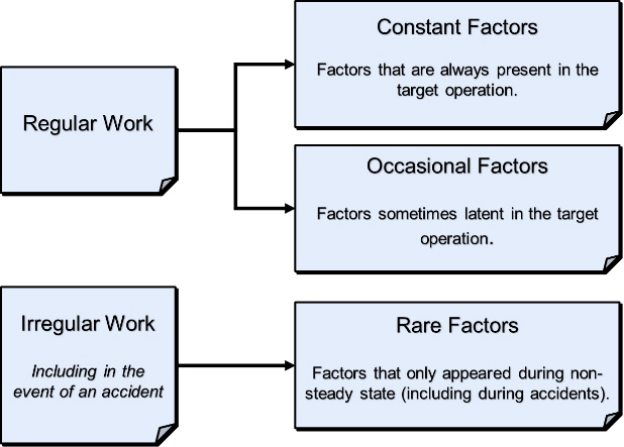
There are regular tasks and non-regular tasks in operations. Here, we describe the extraction status of background factors for direct factors that are always present in task execution and environmental conditions during countermeasure operations (Figure 2).
Figure 2: Classification according to the routine nature of the work.
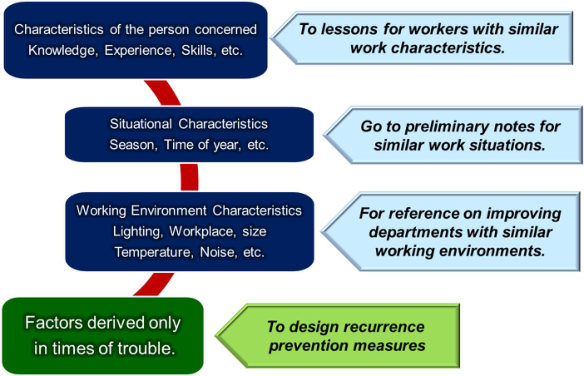
Therefore, documents should collect not only accident-specific information but also factors that affect routine operations. By analysing these factors, they can be utilized for safety measures and recurrence prevention (Figure 3).
Development of an Analysis Support Tool for Near-Miss Events 17
Figure 3: Efforts in information collection.
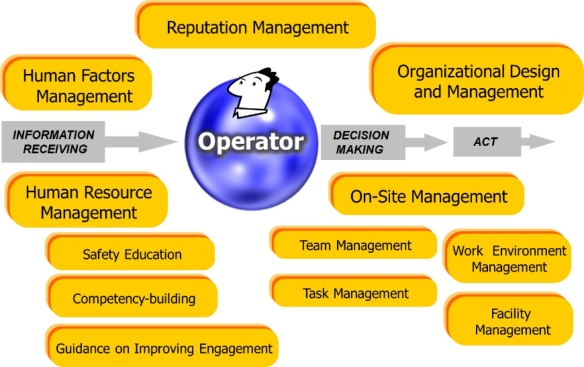
Furthermore, since an operator’s decision-making is influenced by multiple management factors, utilizing the analysis results of near-miss incidents enables more efficient safety management (Figure 4).
Figure 4: Use of factor analysis for near-miss events for various types of management.
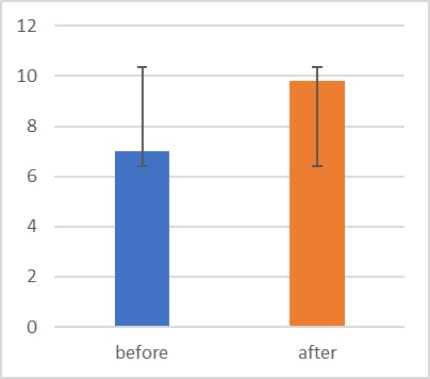
Here, the factor analysis support application developed in this study was applied to the actual analysis work. Factor analysis was conducted for each individual report, and the average number of extracted factors was calculated and compared, as shown in Figure 5. The method used before implementing the factor analysis support application involved extracting background factors through text mining of commonly used report documents.
18 Banno and Okada
Figure 5: Comparison before and after support.
From Figure 5, it can be observed that when the factor analysis support application developed in this study was applied to actual analysis tasks, the number of extracted factors increased. This indicates that potential factors were identified, and the diversification of extracted factors was confirmed.
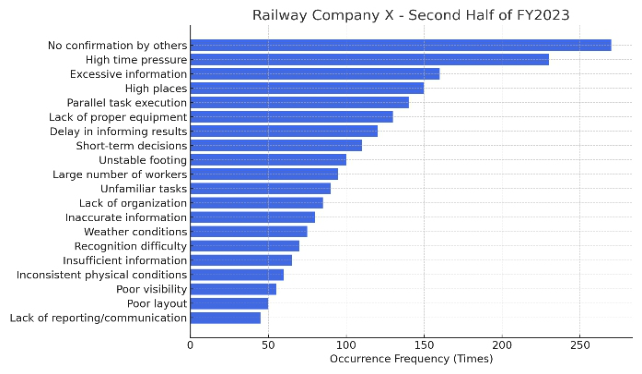
As a potential application of this system, aggregating the extracted factors, including latent factors, from documents can further support the factor extraction process. In practice, the extracted factors were aggregated using the hazard prediction factor analysis support application at Railway Company X (Figure 6). Here, the extracted background factors were ranked in descending order of frequency of occurrence, and the top 20 were compiled into a graph. This visualization allows for the interpretation of changes over different periods.
Development of an Analysis Support Tool for Near-Miss Events 19
Figure 6: Top 20 occurrences of background factors in company X (FY2023, FY2022).
20 Banno and Okada
DISCUSSION
Based on the analysis results from Company X, factors such as “No confirmation by others” and “High time pressure” consistently rank among the top risk factors. This indicates that human error is the primary risk factor, with a strong tendency for workers to proceed with tasks based on individual judgment. Additionally, the persistent presence of risks such as “Lack of confirmation,” “Delay in reporting,” and “Lack of organization” highlights the need for reinforcing safety awareness as a key challenge.
By conducting such an analysis, the findings contribute to real-world safety activities, including the prioritization of countermeasures for high- risk factors and the development of training programs based on frequently occurring risk factors. Furthermore, for future utilization, sharing accident information with other companies and analyzing risk trends can facilitate the establishment of industry-standard safety guidelines.
The ultimate goal is to develop a factor analysis support system capable of automatically conducting assessments based on guidelines similar to those presented in Table 2. Therefore, Figure 6 has also been evaluated using this table, demonstrating the feasibility of extracting and evaluating risk factors through a structured factor analysis system.
Table 2: Reference guidelines on factor deepening.
Table available in the original PDF paper.
Visualization played a critical role in supporting decision-making and trend analysis. By ranking the frequency of extracted background factors and presenting them in graphical form, stakeholders could quickly grasp which factors were most prevalent and how their frequency changed over time. This enabled more informed prioritization of countermeasures and resource
Development of an Analysis Support Tool for Near-Miss Events 21
allocation, particularly in identifying persistent risks or emerging patterns that might otherwise remain unnoticed in raw text data.
CONCLUSION
This study explored the use of Large Language Models (LLMs) to enhance the factor analysis of near-miss events. By leveraging LLMs, the analysis process was improved, allowing for the extraction of not only direct causes but also broader background factors that consistently exist in work environments and operations.
The key findings of this research are as follows:
1. Increased Factor Extraction: The application of the factor analysis support system resulted in a higher number of extracted factors compared to conventional text mining methods, confirming the identification of potential and latent factors. 2. Diversification of Extracted Factors: The system facilitated the discovery of a wider range of background factors beyond commonly reported direct causes, contributing to a more comprehensive understanding of human errors. 3. Improved Factor Aggregation and Visualization: The aggregation of extracted factors and their ranking by frequency enabled a clearer interpretation of trends and changes over different time periods.
By integrating LLM-based analysis, even individuals with limited expertise in human factors can effectively identify underlying causes of near-miss events. This approach enhances analysts’ awareness and supports the development of more effective preventive measures, ultimately improving workplace safety.
The objective of human error countermeasures is not the elimination of human error, but ‘to do a good job (for each person on site)’. Meaningful human error countermeasures can only be said to be effective if the products and services produced by each individual’s work are evaluated as valuable by users and society. This must be a common understanding throughout the company, and the extraction and analysis of factors in near-miss events must not be the sole activity of the safety management department. Human error countermeasures are support measures for on-site work. Good countermeasures can only be developed if they are liked and relied upon by the frontline.
We intend to implement a function that can provide specific suggestions on what kind of guidance should be given in the target department regarding the writing of reports, as well as a function that can provide suggestions for modifications to safety guidance in the field, including OJT, so that we can contribute to the development of human error prevention activities.
“Seven Failure Points When Engineering a Retrieval Augmented Generation System.” arXiv preprint, arXiv:2401.05856.
22 Banno and Okada
Chandler, F. T., Chang, Y. H. J., Mosleh, A., Marble, J. L., Boring, R. L., and Gertman, D. I. (2006). Human reliability analysis methods: selection guidance for NASA, NASA/OSMA Technical Report, July 2006. Chew, T. S. (2011). “The checklist manifesto: how to get things right.” Clin Med
(Lond), 11(3): 296–297. Dhillon, B. S. (2019). Safety, reliability, human factors, and human error in nuclear power plants. CRC Press. Embrey, D. E., Humphreys, P. C., Rosa, E. A., Kirwan, B., Rea, K. (1984). SLIM-
MAUD: An Approach to Assessing Human Error Probabilities Using Structured Expert Judgment, Volume 1, p. 13, U. S. Nuclear Regulatory Commission, Washington DC. ELYZA. “Llama3-ELYZA-JP-8B,” Hugging Face, https://huggingface.co/elyza/ ELYZA-japanese-Llama-2-7b. Gyomachi, Takeo, Nagata, Manabu. (2004). “A Reference List and Case Study Using the GAP-W Type PSF.” Human Factors, Vol. 9, No. 1, pp. 46–62. Hawkins, F. H. (1987). Human Factors in Flight. Gower Technical Press. Hollnagel, E. (1998). Cognitive Reliability and Error Analysis Method (CREAM).
Elsevier. Hollnagel, E. (2017). Safety-II in Practice: Developing the Resilience Potentials (1st ed.). Routledge. Japan Aerospace Exploration Agency (JAXA). (2017). Human Factors Analysis
Handbook. Kawamura, R., Inoue, M. (2008). “Development and Application of J-HPES.”
Human Factors and Ergonomics Journal, 50(5): 491–498. Konishi, Tadawo, Okada, Yusaku. (2002). “A Study on Human Error Factor Analysis Support.” Journal of the Japan Society for Plant Human Factors, Vol. 7, No. 1. Llama3. https://www.llama.com/ Miyaji, Yumeko. (2017). “Proposal for the Collection and Utilization of Risk-Related
Information such as Near-Misses in Railways.” REAJ Journal, Vol. 39, No. 6 (Issue 238). Nakanishi, Miwa, Okada, Yusaku. (2005). “Proposal for an Unsafe Event Collection System Including Near-Misses in Open Mechanisms—Targeting University Chemistry Laboratories.” Human Factors, Vol. 9, No. 2. Okada, Yusaku. (2004). “Development of a Human Error Prevention Approach—
Analysis of Human Error Seeds and Evaluation of Human Error Probability.” Safety Engineering, Vol. 43, No. 3. Read, Gemma J. M. (2017). Integrating human factors methods and systems thinking for transport analysis and design. CRC Press. Reason, J. (2000). “Human error: models and management.” BMJ, 320(7237):
768–770. Salmon, Paul M. (2011). Human factors methods and accident analysis: practical guidance and case study applications. Ashgate. Stanton, Neville, Salmon, Paul M., Rafferty, Laura A., Walker, Guy H., Baber,
Chris, Jenkins, Daniel P. (2013). Human factors methods: A practical guide for engineering and design. Ashgate. Suzuki, Daisuke, Okada, Yusaku. (2008). “A Study on Education and Training Based on Human Behavior Models—A Proposal for Improving Safety in Train Operations.” Safety Engineering, Vol. 47, No. 3.
Development of an Analysis Support Tool for Near-Miss Events 23
Swain, A. D., Guttmann, H. G. (1983). Handbook of Human Reliability Analysis with Emphasis on Nuclear Power Plant Applications - Final Report, NUREG/CR- 1278, U. S. Nuclear Regulatory Commission. Vesely, W. E., Goldberg, F. F., Roberts, N. H., Haasl, D. F. (1981). Fault Tree
Handbook. U. S. Nuclear Regulatory Commission.
LISTED IN THE AHFE DIGITAL BOOKSTORE CATALOGUE
Explore the complete digital volume
Safety Management and Human Factors
Read this individual research paper free through the original publisher, or explore the full digital proceedings book.
ISBN 978-1-964867-65-6
Explore this ISBN in the AHFE Bookstore ↗Listed in the July 2026 bookstore catalogue; search by ISBN to confirm current availability · Digital book purchase optional