Weixuan Li, Glyn Lawson, Setia Hermawati, Kyle Harrington (2025). Human factors in emergency rescue: Can real-time spatial video enhance communication and command capabilities?. In: Safety Management and Human Factors. AHFE Open Access, vol. 189, pp. 111–120. https://doi.org/10.54941/ahfe1006576
The purpose of this study was to investigate whether real-time spatial video feedback could enhance navigation and command capabilities of emergency rescue teams. Participants engaged in search and rescue missions using a simulated virtual disaster scenario in Unity, with two methods of communication available: traditional voice communication and real-time video feedback. Forty individuals were separated into 20 groups, and each group carried out four experiments using a within-subject design. Post-experimental evaluations included the NASA Task Load Index (NASA-TLX), task completion time, and walking distance and a short interview. A repeated measures analysis of variance found that, as compared to traditional communication, real-time video feedback considerably reduced perceived workload, task completion time, and walking distance. These findings imply that using real-time spatial video can improve the efficiency of rescue teams and ease human factors issues in emergencies.
Previous studies identified navigation and rescue operations in confined spaces as significant challenges frequently encountered by emergency rescue teams. In order to provide more efficient rescue tools to the emergency rescue team, Researchers hope to verify the possibility of real-time video feed from the rescuer to the commander being applied in emergency rescue, and to verify whether the new technology has significant advantages compared to traditional (voice only) rescue modes.
Effective communication and navigation are critical components of emergency rescue missions (Chehade et al., 2020). Traditional communication systems rely heavily on voice communication, which frequently results in misunderstandings, delayed information delivery, and higher cognitive effort for team members (Fischer et al., 2013). As technology advances, real-time spatial video feedback has emerged as a promising solution to improve situational awareness and simplify command and control for rescue crews.
Human factors, including workload, stress, and cognitive load, have a substantial impact on rescue personnel’s performance and decision-making skills (Owen, 2014). Addressing these issues can improve the efficiency and effectiveness of rescue operations, thereby saving lives and resources. The purpose of this study is to determine whether real-time spatial video feedback can reduce human error by increasing navigational assistance and communication clarity within emergency rescue teams.
To replicate a high-risk disaster scenario environment without actual risks, Unity was used to create a virtual disaster environment. The participants had to use traditional voice communication or real-time visual feedback technologies to find and rescue survivors in the virtual ruins.
METHODOLOGY
Research Questions: Can real-time spatial video feed from the rescuer to commander improve emergency rescue team performance?
Participants This experiment enrolled 40 participants, divided into 20 pairs. Each pair contains one Team Member and one Commander. Participants were randomly assigned to different roles and communication situations in order to reduce bias and provide balanced exposure under various conditions.
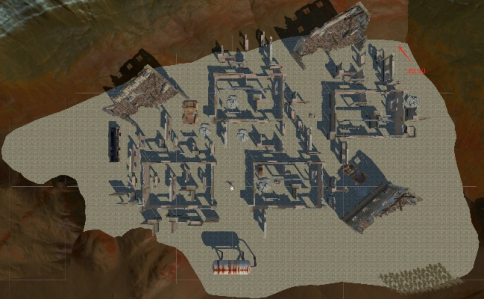
Materials and Equipment Virtual Environment: Developed by using Unity, the environment simulated a collapsed building with multiple rooms and pathways (Figure 1).
Figure 1: Building ruins in unity 3D.
Communication Systems:
Traditional Communication: Voice-based communication system.
Real-Time Video Feedback: Live spatial video feeds to the Commander.
Human Factors in Emergency Rescue: Can Real-Time Spatial Video Enhance Communication113
NASA-TLX Questionnaire: To assess perceived workload post- experiment.
Timing and Route Tracking Tool: Report every second time and location to server for analysis.
Interview: To understand the participants’ subjective feelings about the experiment.
Design This study employed a within-subjects design with two independent variables:
Communication Type:
Traditional Voice Communication
Real-Time Video Feedback Role:
Team Member
Commander Each team participated in four experimental conditions:
Experiment 1: Traditional Communication (A: Commander, B: Team Member)
Experiment 2: Real-Time Video Feedback (A: Commander, B: Team Member)
Experiment 3: Traditional Communication (A: Team Member, B: Commander)
Experiment 4: Real-Time Video Feedback (A: Team Member, B: Commander) The order of experiments was counterbalanced across teams to control for order effects.
Procedure Upon arrival, participants were educated on the study’s aims and given instruction on how to use the communication tools in the virtual world. For their early trials, each team was allocated at random to one of two communication paradigms. Following each trial, participants filled out the NASA-TLX questionnaire. Roles were then reversed, and teams completed the remaining trials in the counterbalanced order. After all 4 experiments participants were asked to join a short interview.
Data Cleaning and Preparation Data were cleaned and Z-scores were calculated using Python to remove outliers (|Z| ≥3). Consequently, data from Group 1 across all experiments were excluded from subsequent analysis, leaving 76 observations from 19 groups.
RESULTS
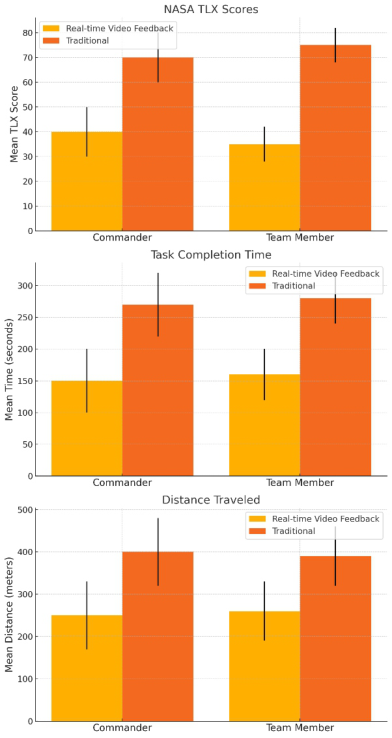
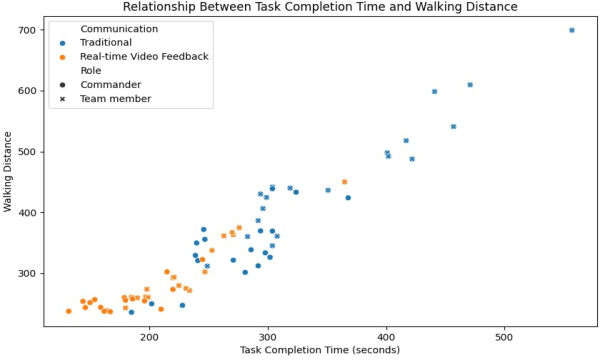
Data Analysis The analysis of NASA-TLX scores and task performance (Figure 2) reveals that real-time video feedback significantly reduces participants’ perceived workload, task completion time, and walking distance. When real-time video feedback is used, NASA-TLX scores drop, indicating a reduction in workload. Compared to traditional communication methods, real-time video feedback resulted in significantly lower perceived workload (p < .001, ηp2 = .99), faster task completion (p < .001, ηp2 = .66), and shorter distances (p < .001, ηp2 = .60). Scatter plots (Figure 3) show a positive correlation between task completion time and walking distance, with the video feedback condition consistently producing lower values. Role-specific analysis reveals that both rescue team members and commanders had lower NASA-TLX scores under the real-time video feedback condition, emphasising the effectiveness of this communication modality in reducing workload.
Figure 2: Descriptive statistics results.
Human Factors in Emergency Rescue: Can Real-Time Spatial Video Enhance Communication115
Figure 3: Relationship between task completion time and walking distance.
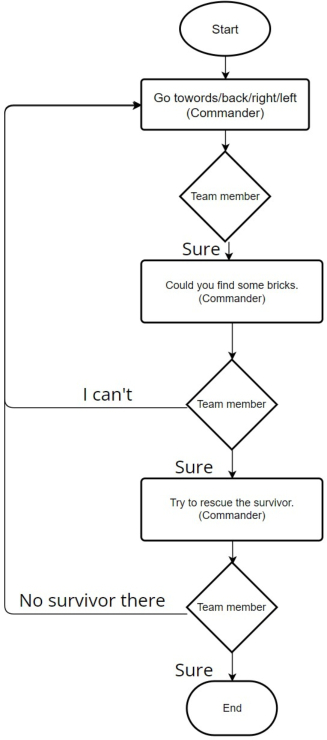
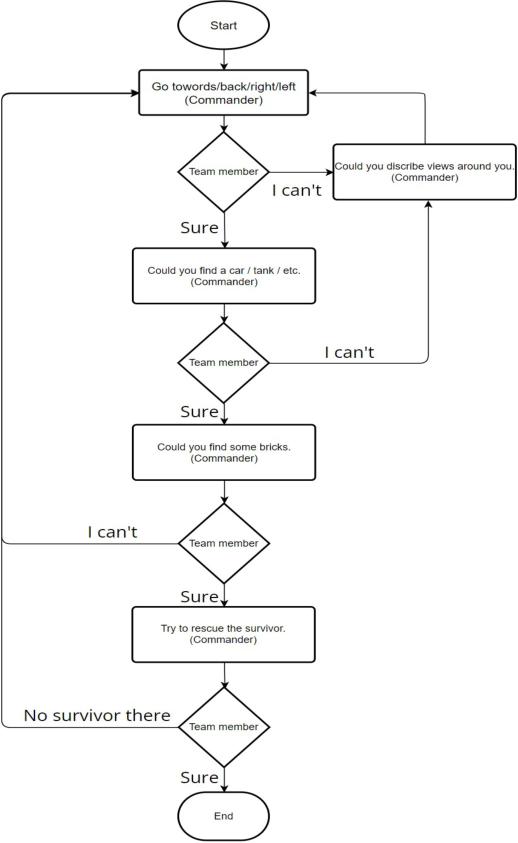
Communication Analysis During the experiment, the researchers recorded conversations between participants in each experiment. Through conversation analysis, researchers found that there were fixed patterns of communication among experimental participants. In the traditional rescue command mode, the dialogue mode is often as shown in the Figures 4 and 5 below.
Analysing the differences in dialogue modes between the two command modes, we can find that in the traditional command mode, the commander needs to confirm the environment around the team member multiple times to confirm the location of the team member. In the real-time video feedback mode, the commander can confirm the surrounding environment of the team member through the real-time video feedback perspective and determine the location and direction of the team member based on the map. In this command mode, the communication between the commander and the team member is more concise, thus saving a lot of communication time and time of trial and error of paths. In the interviews after the experiment, each group of participants said that in real-time video feedback-based rescue, the commander can understand the situation faced by the team member through audio and video at the same time. Therefore, command and communication can be more efficient, and misjudgements reduced.
Summary of Findings This study confirms the efficacy of a rescue command model that uses real- time spatial video feedback in emergency rescue operations. The results show that using real-time video improves rescue efficiency significantly by lowering communication costs and reducing time lost due to ineffective communication. Participants reported a significant decrease in perceived workload, as measured by NASA-TLX scores, indicating that real-time video feedback reduces both cognitive and physical stress compared to traditional voice communication methods. Furthermore, the use of real-time video
feedback resulted in faster task completion and optimised navigation. Both rescue team members and commanders benefited consistently from the real- time video feedback, demonstrating its broad applicability across rescue operations. Overall, the use of real-time spatial video feedback improves team performance, coordination, and the effectiveness of emergency rescue operations.
Figure 4: Real-time video feedback.
DISCUSSION
This study confirms the viability of a rescue command model based on real- time spatial video feedback. According to the study’s findings, the command model based on real-time spatial video feedback can not only assist rescue teams in lowering communication costs and time wasted due to ineffective communication, thereby significantly improving rescue efficiency, but it can also optimise navigation and command processes via real-time video feedback.
Human Factors in Emergency Rescue: Can Real-Time Spatial Video Enhance Communication117
Figure 5: Traditional method.
Participants’ perceived workload (NASA-TLX total score) fell considerably when they received real-time video feedback. The repeated measures ANOVA results showed that communication modality had a significant impact on perceived workload (ηp2 = 0.99), indicating that real-time video feedback nearly totally reduced the cognitive and physical stress caused by traditional voice communication methods. This finding is congruent with Jones, Tang, and Neustaedter (2022) study, which discovered that real-time visual information might increase team confidence, hence enhancing task execution efficiency. Furthermore, both rescue team members (ηp2 = 0.91) and commanders (ηp2 = 0.90) shown consistency in the reduction of perceived workload, demonstrating that video feedback has broad applicability potential in different roles.
Real-time video feedback considerably reduces task completion time, with a moderate to large effect size (ηp2 = 0.66). This finding suggests that real- time visual information can help people make faster decisions and complete tasks more efficiently. Consistent with Kienbacher et al. (2024) findings, they discovered that real-time video aided systems can greatly increase the quality of assisted cardiopulmonary resuscitation for nonprofessionals. Both rescue team members and commanders performed tasks faster while using video feedback, demonstrating that it has a considerable impact on simplifying rescue operations.
The analysis of variance results showed that the walking distance was greatly reduced under real-time video feedback settings (η2
p = 0.60). This suggests that video feedback not only increases navigation efficiency, but it also assists rescue team members in better planning routes, reducing unnecessary movements, and saving time and energy. Real-time location and visual aid technology can successfully optimise staff mobility paths while improving overall job productivity. The video feedback technology improves the team’s strategic and targeted response skills by tracking team members’ and survivors’ whereabouts in real time.
Analysing data from rescue team members and commanders independently, reveals the precise influence of real-time video feedback on various responsibilities. The large reduction in workload, task completion time, and walking distance between the two suggests that video feedback has a general positive influence on team performance. Commanders in charge of strategic decision-making benefit the most from video feedback since it allows them to have a better awareness of the environment, allowing for more effective coordination and task allocation. This is consistent with Thomaschewski, Weyers, and Kluge (2021) finding that shared situational awareness considerably improved spatially dispersed team cooperation.
Why Real-Time Video Feedback Improves Overall Outcomes Real-time video feedback enhances situational awareness and decision- making abilities by providing instant and accurate visual information, which enhances the overall effectiveness of emergency rescue operations. These visual data allow the rescue commander to gain a better understanding of the disaster environment, resulting in more effective coordination and team cooperation. Video feedback improves navigation and task allocation through tracking team members and survivors in real time, reducing unnecessary movement and saving time and energy. Furthermore, visual communication reduces common misunderstandings and information delays in traditional voice communication, simplifying interactions and increasing collaboration efficiency among team members. The reduction in perceived workload allows team members to focus more effectively on their tasks, increasing overall efficiency and performance. As a result, incorporating real-time video feedback not only accelerates the rescue operation, but also ensures that resources are used more effectively, making the rescue mission more successful and timelier.
Human Factors in Emergency Rescue: Can Real-Time Spatial Video Enhance Communication119
Contribution to Knowledge This study demonstrates the comprehensive benefits of incorporating real-time spatial video feedback into emergency rescue operations using experimental research, thereby enriching the existing knowledge system. Although previous studies, such as Jones, Tang, and Neustaedter (2022) and Kienbacher et al. (2024), have shown that real-time visual information can improve team confidence, this study expands the scope of research by systematically evaluating its impact on overall rescue efficiency. It quantifies the reduction in perceived workload, task completion time, and walking distance in order to better understand how real-time video feedback can improve all aspects of rescue operations. This study builds on and expands previous research, providing empirical evidence of the benefits of video feedback in a variety of ways, thereby filling a gap in the literature regarding its comprehensive role in improving the emergency rescue process.
Implications for Emergency Rescue Operations Integrating real-time spatial video input into emergency rescue operations can dramatically improve team performance by using the following strategies.
Reducing Workload: Lowering perceived workload reduces fatigue, improves focus, and efficiency in important operations.
Improving Efficiency: By completing tasks faster and optimized travel paths, rescue operations become more efficient and effective.
Enhancing Coordination: Real-time visual information improves team communication and collaboration, minimising misunderstandings and information delays.
These enhancements can lead to more effective and timely rescues, ultimately saving more lives and resources during critical missions.
Limitations Although this work demonstrated the efficacy of a rescue command paradigm based on real-time spatial video feedback in a simulated environment, the virtual environment may not adequately reflect the complexity and intensity of real-world crisis events. Environmental unpredictability, physical exhaustion, and emotional stress are all challenging to replicate in virtual research. Furthermore, the participants in this study were ordinary people who had not had professional rescue training, and the experimental design was rather straightforward, focussing solely on navigation issues. As a result, the research findings’ universality and practical application implications require further verification.
Future Research Future study should include studies with professional rescue professionals to see if real-time spatial video feedback can minimise communication costs and increase rescue efficiency in simulated real-life rescue scenarios. Furthermore, research can look at mixing other advanced technologies, such as real- time data analysis in augmented reality or machine learning-driven decision support systems, with real-time video feedback to improve the performance
of rescue teams. Long-term study should also look into the impact of real- time video input on team dynamics and decision-making processes to fully assess its potential use in actual rescue operations.
CONCLUSION
This study demonstrates the significant benefits of integrating real-time spatial video feedback in emergency rescue operations. Results confirmed reduced perceived workload, task completion time, and walking distance, enhancing overall rescue efficiency. These findings underscore the potential of modern communication technologies to address critical human factors challenges in emergency scenarios. However, given the study’s simulation- based limitations and participant demographics, future research should explore validation with professional rescue teams in real-world situations.
REFERENCES
Chehade, Samer et al. (2020). “Handling effective communication to support awareness in rescue operations.” en. In: Journal of Contingencies and Crisis Management 28.3. eprint: https://onlinelibrary.wiley.com/doi/pdf/10.1111/1468- 5973.12317, pp. 307–323. ISSN: 1468–5973. doi: 10.1111/1468-5973.12317. URL: https://onlinelibrary.wiley.com/doi/abs/10.1111/1468-5973.12317 (visited on 01/05/2025). Cohen, Jacob (1988). Statistical Power Analysis for the Behavioral Sciences. en. 2nd
ed. Hoboken: Taylor and Francis. ISBN: 978-0-8058-0283-2. Fischer, Ute et al. (Sept. 2013). “Exploring Communication in Remote Teams: Issues and Methods.” en. In: Proceedings of the Human Factors and Ergonomics Society Annual Meeting 57.1. Publisher: SAGE Publications Inc, pp. 309–313. ISSN: 1071–1813. doi: 10.1177/1541931213571068. URL: https://doi.org/10.1177/ 1541931213571068 (visited on 01/05/2025). Jones, Brennan, Anthony Tang, and Carman Neustaedter (Apr. 2022). “RescueCASTR: Exploring Photos and Live Streaming to Support Contextual Awareness in the Wilderness Search and Rescue Command Post.” In: Proc. ACM Hum.-Comput. Interact. 6. CSCW1, 113:1–113:32. doi: 10.1145/3512960. URL: https://doi.org/10.1145/ 3512960 (visited on 01/02/2025). Kienbacher, Calvin Lukas et al. (May 2024). “Drone-Facilitated Real-Time Video-Guided Feedback Helps to Improve the Quality of Lay Bystander Basic Life Support. A Randomized Controlled Simulation Trial.” In: Prehospital Emergency Care 29.1. Publisher: Taylor & Francis eprint: https:// doi.org/10.1080/10903127.2024.2351970, pp. 46–52. ISSN: 1090–3127. doi: 10.1080/10903127.2024.2351970. URL: https://doi.org/10. 1080/ 10903127.2024.2351970 (visited on 01/02/2025). Owen, Christine (2014). Human factors challenges in emergency management:
Enhancing individual and team performance in fire and emergency services. Ashgate Publishing, Ltd. Thomaschewski, Lisa, Benjamin Weyers, and Annette Kluge (Aug. 2021). “A two-part evaluation approach for measuring the usability and user experience of an Augmented Reality-based assistance system to support the temporal coordination of spatially dispersed teams.” In: Cognitive Systems Research 68, pp. 1–17. ISSN: 1389–0417. doi:10.1016/j.cogsys.2020.12.001. URL: https:// www.sciencedirect.com/science/ article/pii/S1389041720301078 (visited on 01/ 02/2025).
LISTED IN THE AHFE DIGITAL BOOKSTORE CATALOGUE
Explore the complete digital volume
Safety Management and Human Factors
Read this individual research paper free through the original publisher, or explore the full digital proceedings book.
ISBN 978-1-964867-65-6
Explore this ISBN in the AHFE Bookstore ↗Listed in the July 2026 bookstore catalogue; search by ISBN to confirm current availability · Digital book purchase optional