Lucas Farah, Mariana Martins, Eliel Oliveira, Francisco José De Castro Moura Duarte, Adson Eduardo Resende (2025). Impacts of Safety Culture in an Oil and Gas Research Laboratory in Brazil. In: Safety Management and Human Factors. AHFE Open Access, vol. 189, pp. 145–152. https://doi.org/10.54941/ahfe1006580
The oil and gas industry plays a prominent role in Brazilian and global industrial landscape. Due to the high-risk nature of this sector, companies consistently invest in research on industrial safety. Operational incidents and accidents do not stem solely from human errors, technical failures, or environmental factors but result from a combination of these and other elements. In this context, studies highlight the potential for progress through the evaluation of safety culture in high-risk industries to understand how safety-related practices and values are shared among different homogeneous groups of an organization. This includes aspects such as preventive thinking, collective responsibility, effective communication, and proactive risk management. There is no standardized formula for identifying the level of safety culture in an organization. Moreover, discrepancies in the approaches used for this evaluation are not uncommon, leading to variations in interpretations and applied methods. Against this backdrop, the objective of this research was to assess the maturity level of safety culture in the research center of a Brazilian oil and gas company and propose actions to develop safety practices within this unit. To achieve this objective, the methodology developed in the Human and Organizational Factors of Industrial Safety Project was used. This methodology is based on the principles of ergonomics and human factors, employing a mixed approach that includes quantitative, qualitative, and ethnographic phases. As a result, a quantitative and qualitative diagnosis of the safety culture maturity level was developed for each homogeneous group analyzed. The diagnosis is based on the classification proposed by the International Association of Oil & Gas Producers (IOGP), which defines five levels of safety culture: resilient, proactive, managerial, reactive, and pathological, with resilient being the highest level of maturity and pathological the lowest. The research identified characteristics of reactive or pathological cultures in the unit. Key findings pointing to these levels of safety culture maturity include: (1) Blame Culture, reported by different groups and stemming from the belief that human errors are the main causes of accidents, along with investigative methods focused on assigning blame; (2) Perceived disconnect between the Health, Safety, and Environment (HSE) team and other teams, leading to a lack of trust and mutual support; (3) Underreporting, attributed to the excessive bureaucratic burden of incident/accident reporting processes or the absence of follow-up actions and feedback. Based on these observations, interventions were suggested, such as creating a local HSE team to promote engagement with other groups, rebuild trust, encourage reporting of anomalies, and foster improvement proposals without seeking to assign blame. Mechanisms for reporting and feedback were also proposed, including stages for discussion, resolution, and follow-up. One strategic intervention to restore trust between HSE and operational teams was the development of a new accident analysis methodology that integrates subjective, material, and organizational aspects. This research contributes to understanding and improving safety culture in oil and gas organizations, emphasizing the importance of proactive and integrated practices to prevent accidents and promote a safer work environment with active worker participation.
In recent years, the oil and gas sector has implemented various programs aimed at industrial safety. Although a reduction in accident frequency rates has been observed, the most commonly adopted methods are not considered effective in preventing more severe incidents. The persistence of serious accidents has led the sector to reassess its safety strategies, increasing interest in Safety Culture (SC) and the Human and Organizational Factors of Industrial Safety (Mercado, 2021).
The concept of Safety Culture (SC) is traditionally centered on the sharing of safety-related practices and values among different members of the same organization (Hopkins, 2005). Antonsen (2009) adds that every organization is composed of subgroups, each with multiple sets of individuals, values, perceptions, and behavioral patterns. In this regard, Rocha et al. (2023)
highlights the difficulty of establishing a homogeneous safety culture across an entire organization. According to Xuecai et al. (2024), there is still no unified definition or construction method for safety culture on a global scale, as each industry possesses unique characteristics. Therefore, proposing industry-specific operational elements is beneficial for the development of safety culture.
The classification of Safety Culture often follows the categorization originally proposed by Westrum (1998) for organizational cultures, later adapted to the safety field by Hudson (1999; 2003). This classification, adopted by the International Association of Oil & Gas Producers (IOGP), considers five maturity levels: pathological, reactive, managerial, proactive, and resilient. The level of trust among organization members and the flow of information increase as the maturity level develops, ranging from pathological (least developed) to resilient (most developed).
In recent years, safety culture has garnered significant attention across various industrial sectors (Fleming et al., 2018). It is important to consider the nature of this type of unit, as it defines unique situations, differentiating them from others in the oil and gas universe. Raoni (2023) reinforces the need to adapt and adjust your analysis to the language and context of the unit’s workers. In this context, this study aims to assess the maturity level of the safety culture in a research center of a Brazilian oil and gas company and propose situated actions to enhance safety practices in collaboration with the unit.
METHOD
This study adopted a mixed-methods approach, based on the collection of both quantitative and qualitative data, following the methodology proposed by Rocha et al. (2023). The quantitative phase of the diagnosis involved defining homogeneous groups, designing, and administering a questionnaire.
The homogeneous groups were established based on three criteria: organizational hierarchy, type of employment relationship (contracted or permanent), and similarity of performed activities. As a result, the unit was segmented into eight groups: support assistants, representatives, supervisors, leadership, contracted laboratory technicians, in-house laboratory technicians, pilot plant technicians, and Health, Safety, and Environment (HSE) technicians.
The construction of the safety culture questionnaire occurred in two main stages: (1) an initial phase based on literature references and (2) an adaptation to align the questions with the unit’s specific context. The questionnaire was administered between October 2023 and January 2024, with the participation of 138 respondents out of a possible 140 (CI = 95% and ME = 2%). To ensure the accuracy of responses, the questionnaire was completed anonymously and individually.
After data collection, the information was organized and analyzed, allowing the identification of both convergences and divergences in perceptions among the groups. The evaluation of results was structured around five safety-related themes: blame culture, relevance of the rules,
Impacts of Safety Culture in an Oil and Gas Research Laboratory in Brazil 147
safety priority, safety bureaucracy, and feedback and lessons learned (Rocha et al., 2023). Through this approach, it was possible to determine the maturity level of the safety culture for each homogeneous group within these themes.
The graphs generated from the responses were analyzed individually, and the most representative ones were selected for the qualitative phase. For this stage, the research team conducted on-site visits in 2024 on April 29, April 30, and May 2. In total, ten discussion meetings were held, each lasting approximately two hours, with the participation of seventy individuals.
During the meetings, the most representative graphs for each homogeneous group were presented, and participants were asked whether they agreed with the results and proposed interpretations. Based on these interactions, several concrete examples were discussed to justify workers’ perceptions of safety. It is essential to highlight that the discussions took place in an environment of trust established between researchers and workers. The situations presented and the debates conducted during the qualitative phase served to validate or, when necessary, refine the quantitative findings.
RESULTS AND DISCUSSION
The intervention consisted of two stages: a quantitative phase and a qualitative phase. The quantitative phase initially included a preliminary study aimed at understanding operational practices to facilitate the subsequent steps. During this stage, homogeneous groups were defined, and the questionnaire was designed and administered. The teams were stratified into eight homogeneous groups: leadership, support assistants, foremen, supervisors, leadership, contracted laboratory technicians, in-house laboratory technicians, pilot plant technicians, and Health, Safety, and Environment (HSE) technicians. The industrial safety questionnaire, customized for the unit, was administered by the research team to each homogeneous group, with 138 out of 140 possible participants responding (CI = 95% and ME = 2%).
During the questionnaire administration and the subsequent qualitative phase, a parallel ethnographic study was also conducted. This study focused on understanding the work dynamics of the homogeneous groups within the unit and remained ongoing throughout the entire project intervention. After processing the quantitative data, a table and a graph were generated for each questionnaire statement, assigning a score for each homogeneous group based on their responses. These insights were crucial for the unit’s preliminary diagnosis and served as input for the qualitative phase. Subsequently, the graphs related to the most divergent responses were selected for discussion during the qualitative phase meetings. The selection was primarily based on which topics were expected to generate the most meaningful debate during the qualitative discussions.
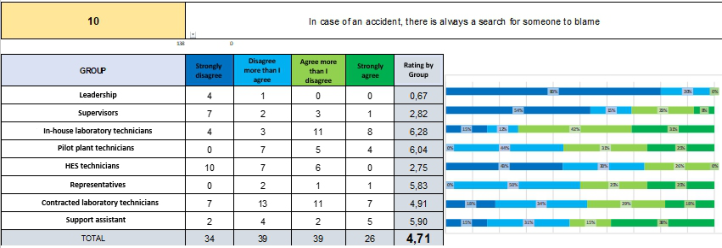
When analyzing the information presented in Figure 1, a significant divergence among the different groups within the unit is observed. While technicians, leadership, and supervisors believe that there is no tendency to
assign blame, the other groups hold differing opinions, indicating a lack of consensus.
Figure 1: Analysis chart for question 10 from the quantitative phase, presented during the qualitative phase meetings (the author, 2024).
For the presentation of the quantitative phase results, three questions from each thematic category that exhibited discrepancies and had the potential to stimulate discussions in the qualitative phase were selected, as illustrated in Figure 1.
The qualitative phase consisted of meetings with each homogeneous group, lasting approximately two hours, held on April 29, April 30, and May 2. During these meetings, the quantitative results were discussed, and participants’ perceptions of the study’s themes were further explored to obtain verbal statements and real-life cases that substantiated these perceptions. In addition to verbal contributions, the case reports provided by the groups were fundamental for the final diagnosis and the formulation of intervention proposals, playing a key role in validating or adjusting the levels identified in the previous phase.
After compiling the verbal statements and case reports from the qualitative meetings, a new analytical process was conducted to compare the questionnaire results with the actual perceptions of the homogeneous groups within the unit.
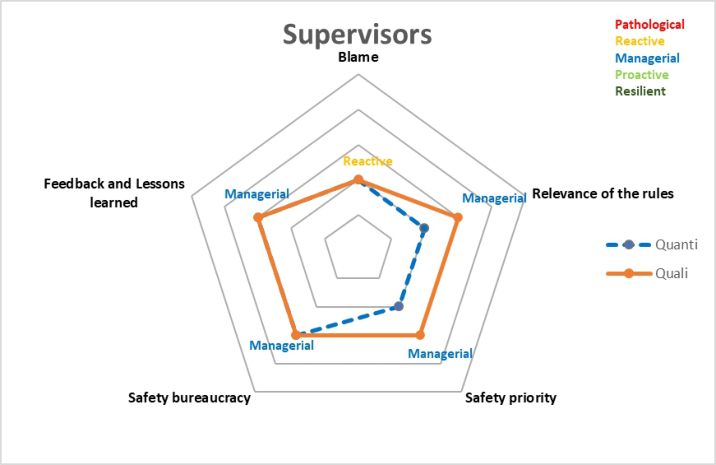
Below, the quantitative-qualitative safety culture diagnostic graph for the supervision group is presented. In this graph, the maturity level ranges from pathological (least developed) to resilient (most developed), covering the five themes analyzed in the study. The results from the quantitative phase (preliminary diagnosis) are represented in Figure 2 by blue dashed lines, while those from the qualitative phase are indicated by solid orange lines.
In the case of Figure 2, it was observed that some of the quantitative maturity levels did not fully align with the qualitative phase reports. As a result, an increase in maturity level from Reactive to Managerial was suggested for two themes (rule relevance and safety prioritization), while the others remained unchanged. These adjustments may arise from verbal statements and case reports provided both by the group itself and by others regarding the group, highlighting the need to examine
Impacts of Safety Culture in an Oil and Gas Research Laboratory in Brazil 149
various interrelations at the conclusion of the quantitative-qualitative analysis.
Figure 2: Quantitative-qualitative radar chart of the Petrobras supervision homogeneous group (the author, 2024).
Regarding the results presented in Figure 2 for the supervision group, it was noted that the group expressed diverse opinions on the theme of blame culture during the qualitative phase. However, overall, they adopted a critical stance toward this practice. Supervisors indicated that the blame culture might be linked to the disconnect between HSE (Health, Safety, and Environment) and other teams, noting that they perceive HSE more as consultants than as proactive safety agents. One specific case—an accident during a valve replacement—illustrates this issue: although systemic factors were recognized as the root cause of the incident, the worker was still held responsible for recklessness. Based on these findings, the study suggests that the Safety Culture remains at the Reactive level, though with indications of maturity toward the Managerial level.
Additionally, concerning the theme of experience feedback, the group identified challenges in safety culture training due to high worker turnover resulting from precarious contracts. Unlike offshore units, the research center lacks continuity in knowledge transfer, which impacts safety. Despite this, there was notable satisfaction regarding the acceptance and implementation of improvement suggestions by leadership, with active worker participation in developing procedures. Consequently, the analysis suggested maintaining the Safety Culture at the Managerial level.
The unit’s quantitative-qualitative diagnosis revealed weaknesses in achieving a resilient safety culture, including a lack of engagement and trust
between HSE and other teams, deficiencies in the workforce experience feedback system, and investigative methods focused on assigning blame.
To address these issues, a workshop was conducted with unit leadership to present the diagnosis and collaboratively develop an action plan. Following the meeting, it was decided to propose a new accident analysis method incorporating Human Factors principles. As part of this initiative, an accident that occurred in 2023 was reanalyzed using the Activity-Based Accident Analysis technique.
The selected accident took place during the cutting of a tubing for valve installation. In this incident, a contracted instrumentation technician had the fifth digit of his right hand crushed by the tube, resulting in an injury.
One key contribution of the activity-based analysis method was that the worker’s reconstruction of the task provided a deeper understanding of the specificities involved, enabling an analysis of the actual work context. Additionally, constraints that reduced the planned execution time for activities were identified, highlighting operational challenges encountered daily. The relationships between the worker, supervisors, and safety technicians were also examined, along with the interaction between the maintenance team and the laboratory team receiving the maintenance. It was observed that unforeseen issues, such as the unavailability of the laboratory supervisor or delays in Permit-to-Work (PT) approval, directly impacted the technician’s daily planning, requiring flexibility and adaptability to meet the weekly schedule.
On a broader scale, the strategy adopted for replacing obsolete Detroit- type valves was found to rely on replacement only upon failure. This approach can lead to disruptions, as there is not always sufficient time for replacement, potentially increasing the risk of leaks or interruptions in laboratory activities. Furthermore, the production measurement system established in the contract necessitates a delicate management of human resources, creating situations where workforce availability does not fully meet the expectations of either the contracting company or the subcontractor. As a result, workload distribution fluctuates, leading to periods of high demand followed by idle time.
The analysis revealed the absence of an appropriate tool for performing the task. Contrary to the official conclusion, which suggested reintroducing the tool cart as a solution, it was determined that this measure would be insufficient, as the required tool was not included in the scope of available materials and would need to be procured. Given the tools available at the time of the task, the operator selected the one he deemed most suitable, underscoring the need for better planning in the provision of essential equipment.
It is important to highlight that results obtained in this analysis are specific and only pertain to this type of activity in the oil and gas sector. The intervention was carried out considering a unique, dynamic nature related to the development of new methods, which are not easily found even within the sector.
During the intervention period, with a view to long-term impact, training was developed for a team that will work alongside the analysis of accidents.
Impacts of Safety Culture in an Oil and Gas Research Laboratory in Brazil 151
The project’s intention is that as new analyses are conducted, this prepared group will pass on the information, creating a more receptive scenario for the proposed ideas, also distributing knowledge and acting on the Work as Done.
CONCLUSION
The research enabled the identification of barriers to developing a resilient and just safety culture, including the belief that human errors are the primary cause of accidents, investigative methods focused on assigning blame, a lack of engagement and trust between HSE and other teams, and the absence of collective spaces for discussing anomalies.
In response, several actions were proposed, such as establishing a local HSE team to strengthen trust and engagement, implementing new reporting and feedback mechanisms, and developing an accident analysis methodology that integrates subjective, material, and organizational aspects. These initiatives aim to enhance the safety culture through interventions aligned with the realities of the work environment.
Thus, this study contributes to the understanding and development of safety culture in a research laboratory within the oil and gas sector, highlighting the importance of proactive and integrated practices for accident prevention and the promotion of a safer work environment, with active worker participation.
ACKNOWLEDGMENT
This study received financial support from the Human Resources Training Program for the Oil, Natural Gas, and Biofuels Sector (PRH-ANP 15.1), funded through Research, Development, and Innovation resources in accordance with ANP Resolution No. 50/2015. The authors express their gratitude to ANP and the oil and gas company where the research was conducted.
REFERENCES
Antonsen, S. (2009). Safety culture and the issue of power. Safety Science, 47(2), 183–191. Fleming, M., Harvey, K., & Cregan, B. (2018). Safety culture research and practice:
A review of 30 years of research collaboration. Journal of Applied Biobehavioral Research, 23(4), e12155. Hopkins, A. (2005). Safety, culture and risk: The organizational causes of disasters.
CCH Australia. Hopkins, A. (2016). Quiet outrage: The way of a sociologist. Wolters Kluwer CCH. ICSI (2018). Safety Culture: From Understanding to Action. Institut pour une Culture de Sécurité Industrielle (ICSI). Le Coze, J.-C. (2019). How safety culture can make us think. Safety Science, 118,
221–229. Mercado, M. P., Rocha, R., Duarte, F., Lima, F., Araújo, A., Garotti, L., & Campos, M. (2021). A cultura de segurança: Uma revisão sistemática para a indústria de óleo e gás. Revista Ação Ergonômica, 13(2), 1–11.
Rocha, R., Duarte, F., Lima, F., Mercado, M., Araújo, A., Garotti, L., & Campos, M. (2023). Framework for the assessment of the safety culture in the oil and gas industry. International Journal of Occupational Safety and Ergonomics, 30(1), 224–237. Xiecai, X., Zhang, Y., Li, J., Wang, H., & Chen, Z. (2024). Development
and application of safety culture analysis program: First online safety culture quantitative analysis and assessment system in China. Journal of Loss Prevention in the Process Industries, 89, 105312. Westrum, R. (1988). Organizational and inter-organizational thought: World Bank workshop on safety control and risk management. Washington, DC.
LISTED IN THE AHFE DIGITAL BOOKSTORE CATALOGUE
Explore the complete digital volume
Safety Management and Human Factors
Read this individual research paper free through the original publisher, or explore the full digital proceedings book.
ISBN 978-1-964867-65-6
Explore this ISBN in the AHFE Bookstore ↗Listed in the July 2026 bookstore catalogue; search by ISBN to confirm current availability · Digital book purchase optional