Ana Cláudia Antunes, Alexandre Anibal Campos Bonilla, Milton Cinelli, Raphael Alberto Sachetti Castro (2025). Kinematic comparison of biomechanical gait of elderly women with different indoors footwear. In: Human Factors in Aging and Special Needs. AHFE Open Access, vol. 174, pp. 1–10. https://doi.org/10.54941/ahfe1006289
The increase in life expectancy and, consequently, population aging is a phenomenon observed worldwide. One of the main problems that aging brings is the difficulty in mobility due to the muscle weakening that is natural to aging, resulting in a slower and more unstable biomechanical gait. Footwear plays an important role in gait patterns and risk of falls among older adults. The research´s aim is to investigate how much a senescent woman's kinematic gait can be altered due to the type of footwear used, focusing on the use of footwear worn indoors, since most falls occur in this environment. The study compares gait when using footwear and also in relation to walking barefoot as a basis for comparisons. The aim is to contribute and guide future research related to human factors in footwear, aiming to provide comfort and safety to elderly women while using the shoe. Slow gait speed in elderly people indicates a trustworthy risk of falls, as well as increased step length and variability in swing time, which are the main predictors of falls. Therefore, for the experiment, the main kinematic measures of quantitative gait analysis were determined, describing the kinematics of barefoot gait, using flip-flops, open sandals and knitting shoe upper, comparing the results and listing the similarities and differences between the four gaits obtained. A convenience sample of ten elderly women over 70 years of age were invited to walk on a walkway marked on the floor, barefoot and while wearing the three different models of footwear. The experiment consisted of capturing video of a ten-step walk for each shoe and also barefoot. The gaits were filmed and analyzed in the Tracker 6.2.0 software for Windows, which it was possible to extract numerical data of position and angle of the predetermined points from the videos captured for the kinematic analyses. Spatial gait parameters used in this study were: stride length and heel-to-heel support base. Temporal parameters used were: speed, step time, swing time, double support time and cadence. The results of stride length variability, stride time variability and swing time variability were computed and statistically analyzed by repeated measures analysis of variance based on the barefoot gait pattern. The results, when analyzed according to the main gait factors predictive of falls in the elderly, indicate that walking barefoot or with flip-flops and open heels shoe model indicate a higher risk of falls when compared to walking with high collar shoe model or shoes that at least cover the instep. The research revealed that the gait of elderly women changes according to the footwear used, so footwear may be a factor that increases the risk of falls or contributes to preventing them.
The increase in life expectancy and, consequently, population aging is a phenomenon observed worldwide. In order to have a good quality of life in old age, it is necessary to preserve the autonomy and independence of the elderly for as long as possible, so that they can carry out their daily activities and continue to actively participate in the community.
One of the main problems that advancing age brings is the difficulty in mobility due to muscle weakening, which is natural to aging, resulting in a slower and more unstable biomechanical gait. Mehrlatifan et al. (2023) claim that there is a kinetics in the walking of elderly people that causes a set of biomechanical changes, putting their health at risk while walking. Cammen et al. (2016) identified that most falls among elderly people occur inside and around the home.
Footwear plays an important role in gait patterns and risk of falls among older adults. Inadequate shoes can negatively impact gait parameters, associated with an increased risk of falls (Cammen et al., 2016).
For Ikpeze et al. (2015), problems with footwear use are endemic among the elderly, with a prevalence rate of almost 80%, with women being more susceptible to this problem due to differences in footwear design for the sexes. Elderly women often choose for shoes that are less complex to put on, such as open sandals or models that do not have foot closure and adjustment systems, options considered more unstable and can lead to imbalance and falls (Antunes, 2019).
In this context, the problem of this study is how much the type of footwear interferes with an elderly person’s gait, focusing on the use of shoes used indoors. The shoes used for the experiment are flip-flops, open sandals and knitting shoe upper. The research aims to investigate how much a senescent woman’s kinematic gait can be altered due to the type of footwear she uses. The experiment compares gait when using these shoes and also in relation to walking barefoot as a basis for comparisons.
Kinematic analysis considers the characteristics of the movement and examines it from a spatial and temporal perspective, involving the description of the movement to determine how fast it moves, how high it reaches or how far it moves (Hamill, 2015). To answer the research problem, the main kinematic measures of quantitative gait analysis were determined, the kinematics of walking barefoot, using flip-flops, open sandals and sneakers were described, the results were compared and the similarities and differences between the four gaits were listed.
The aim is to contribute to and guide future research related to human factors in footwear, aiming to provide comfort and safety to elderly women while using the device.
This paper is organized as follows: first, it provides background information for this research, including a review of the state of the art. Next, the methodology used is introduced, followed by the presentation of results obtained from field tests. Finally, a discussion and conclusions are presented.
BACKGROUND
With the natural aging of the human body, Pinho (2016) states that the decrease in muscle volume, common in the elderly population, has as a direct consequence the decrease in strength, speed, power and muscular endurance, which leads to difficulty in performing weight-bearing tasks, such as walking, increasing fatigue and the risk of falls and bone fractures. The author warns that these structural and functional losses are more noticeable in women, as they commonly have less muscle mass when compared to men.
Mehrlatifan et al. (2023) ensure that changes in gait occur in both the kinetics and kinematics of walking in old age, due to the lack of neuromuscular and skeletal capacity, weakness and aspects of balance, coordination and postural control. As a consequence, the elderly tend to execute compensatory strategies and altered movement patterns in gait, leading to changes in kinematic and kinetic characteristics.
Gait disorders are common among the elderly, increasing with advancing aging. Age-related gait changes are recognized in the literature and include reduced speed, shorter stride length, and increased stride time and double
Kinematic Comparison of Biomechanical Gait of Elderly Women 3
support time. These changes can increase the risk of falling (Cammen et al., 2016; Pinho, 2016). Verghese et al. (2009) point to gait speed as a reliable indicator of fall risk. They report that individuals with low gait speed (≤0.70 m/s) had a 50% increased risk of falling and that a 0.10 m/s reduction in speed corresponds to a 7% increase in fall risk.
Auvinet et al. (2003) found that the group of elderly individuals with a history of falls, when compared to the control group, had lower gait speed (0.73 m/s versus 1.24 m/s) and shorter stride length (0.86 m versus 1.28 m). Callisaya et al. (2009) explains that decreased muscle strength reduces the stability needed to maintain a vigorous gait cadence, which leads to decreased step length and speed.
The majority of falls in older adults occur in and around the home (Cammen et al., 2016). In addition to risk factors associated with aging or pathological conditions, gait can be further affected by an essential extrinsic risk factor, which is footwear (Mettelinge et al., 2015).
A pilot study at the Geriatric Outpatient Clinic at Erasmus University Medical Center found that open heel shoe model were common and preferred among older adults for use in and around the home. In 2003, the Easington primary care trust found that “sloppy slippers” were responsible for a considerable number of falls. In 2004, a study in residential care homes in New Zealand reported that wearing slippers was associated with injurious falls (Cammen et al., 2016) Footwear assessment is an important component to minimize the risk of falling and promote better gait patterns. Broad recommendations are made, such as that older adults wear well-fitting shoes with low, wide heels, a large contact area, covering the instep, and having adjustments such as laces, firm heels, and moderately hard soles (Mettelinge et al., 2015; Ikpeze et al., 2015, Vass, 2015).
Mettelinge et al. (2015) state that walking barefoot or with inadequate footwear results in slower gait patterns, decreased cadence, and greater stride variability compared to the use of well-fitting standard footwear, which the author describes in his research as a shoe similar to a simple running shoe with laces. For Cammel et al. (2016), walking barefoot or wearing socks can increase the risk of falling for older adults. However, Ren et al. (2022) claim that walking barefoot is more stable for the elderly, as footwear interferes with balance, affecting the somatosensory response of the foot and ankle, and, as a result, increasing the risk of slipping, tripping and falling.
Cammen et al. (2016) states that when putting on and taking off shoes, ease plays an important role for the elderly user, therefore, shoes with laces are not usually used in domestic environments; ease of fastening and adjustments to fit the shoe to the foot are other important requirements for this audience. For Antunes (2019), older people may have greater difficulty putting on certain models of shoes, elderly women who have greater difficulty putting on shoes may tend to opt for shoes that are less complex to put on, such as open-back shoes or other models that do not require ties or even other fastening systems that secure the shoe to the foot. The problem lies in the fact that these options can also be considered more unstable, since they are not fully attached to the
foot. These types of shoes can therefore cause greater imbalance and possible falls.
According to Antunes (2019), although elderly women in older age groups show concern about the safety offered by footwear, when asked to assess the level of importance of factors when purchasing the product, they may not understand which footwear models are actually safer and more stable, thus prioritizing shoes that are unsuitable for their needs due to the practicality of putting them on.
METHODOLOGY
Participants A convenience sample of eleven active community-dwelling older women was selected. Individuals aged 65 years or older who walked without the use of assistive technology and lived independently were included in the study. Individuals with severe foot deformities or who required assistive technology for mobility were excluded from the study.
Participants were asked to walk on a marked walkway on the floor, barefoot and while wearing three different footwear styles, selected for the study because they are frequently worn indoors. Participants were instructed to “walk at their normal speed” for two trials for each of the situations, barefoot and with each of the footwear styles.
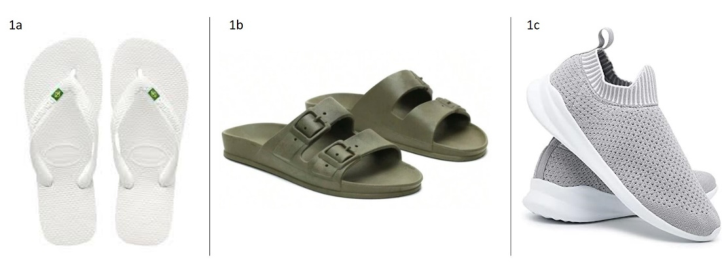
Footwear Models Three types of footwear commonly used indoors by elderly women were selected for the experiment: flip-flops, open sandals and knitting shoe upper, as shown in Figure 1.
Figure 1: Footwear used in the research.
The flip-flop (Figure 1a) is the traditional model, widely used in Brazil for indoor use, with a soft and flexible 100% rubber sole and textured PVC straps. The open sandal (Figure 1b) is a model known as a papete, with straps that cover the instep and are adjusted with a buckle. The knitting shoe upper (Figure 1c) has a sole similar to that of a running shoe, but the upper is made
Kinematic Comparison of Biomechanical Gait of Elderly Women 5
of mesh with enough elasticity to fit the foot without the need for laces or adjustments.
Procedures To analyze kinematic gait, barefoot and using three types of footwear, the experiment consisted of capturing video of a walk with three steps for each shoe. Both bare feet and those with shoes were marked with red dots on the feet that served as centers of mass analyzed during the capture of the videos.
The rear camera of an iPhone 10 cell phone was used to capture the videos. The iPhone X has a dual 12-megapixel rear camera, capable of recording videos in different resolutions and frame rates per second (FPS). The recording options used were: 1920×1080p HD, 30 fps. The videos were captured for the walk with each shoe separately, but the camera remained fixed during the changes of shoes to minimize differences in the image capture process.
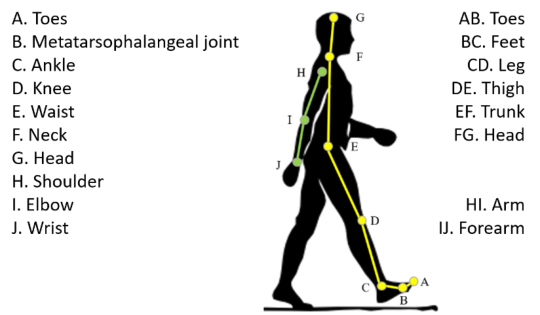
The gaits were filmed and analyzed using Tracker 6.2.0 software for Windows. The software, created in partnership with Open Source Physics (OSP), is a free video modeling and analysis program developed for use in physics teaching. With Tracker, it was possible to extract numerical data on the position and angle of the predetermined points from the videos captured for the kinematic analyses (Tracker, 2024). The capture of the particle positions was performed by means of white circles with a diameter of 20 mm glued to the feet and shoes. These circles were placed on the tips of the toes, the metatarsophalangeal joint, the ankle, the knee, the waist, the neck, the head, the shoulder, the elbow and the wrist, as shown in Figure 2.
Figure 2: Points and angles analyzed in the Tracker.
The Tracker software allowed for the calibration and measurement of distances and angles captured in the videos, as well as the manual and automated tracking of predetermined points, speed and acceleration. Through Tracker, it was also possible to plot data and graphs and export them to perform numerical analyses and develop graphs in other spreadsheet software.
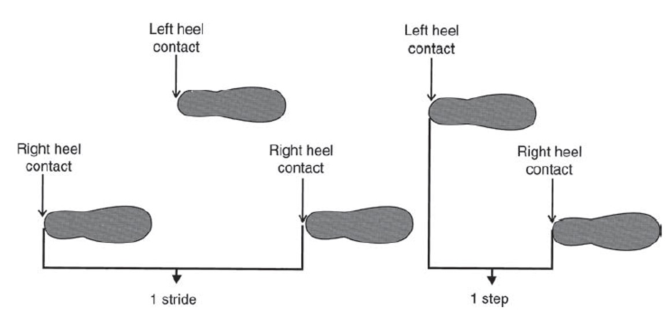
Gait Parameters The temporal parameters used were: speed (m/s) and cadence (steps/minute). The spatial gait parameters used were stride length (m) and step (m). The stride is defined by Hamill (2015) as the interval between an event on one leg and the same event on the same leg, in the following contact, the first instant of foot contact defines the beginning of a stride, that is, the stride can be defined by the contact of the heel of the right foot until the subsequent contact of the heel of the right limb.
Figure 3: Stride parameters during gait (Hamill, 2015).
RESULTS
Eleven elderly women were recruited for the experiment, however the data collected from one participant had to be discarded because the gait was not performed according to the established protocol. Therefore, the study presents the results of the research carried out with ten women aged between 65 and 87 years old (average age of 71.8 years). Based on the data collected, tables were created to compare the results obtained for walking barefoot and with each of the three types of footwear. The average for obtaining the data for each type of situation was obtained by adding the data from all participants and dividing by the number of participants.
In Table 1 is shown the speeds that each participant reach for barefoot and different footwears. The average walking speed with sneakers was higher when compared to the other footwear, being 0.9692 m/s, while walking barefoot had a speed of 0.9244 m/s, followed by walking with flip-flops being 0.9020 m/s and with open sandals it was 0.8594 m/s. This shows that the performance of sneakers in terms of walking speed was more efficient than the other footwear.
Kinematic Comparison of Biomechanical Gait of Elderly Women 7
The average stride length was greater when using sneakers, at 1.2805 m, followed by sandals at 1.2109 m, barefoot at 1.2027 m and flip-flops at 1.2025 m, as shown in the figure below, separated by each type of situation, as shown in Table 2 below.
Table 2: Stride length with each type of footwear.
Regarding cadence, the highest average found was in the barefoot situation with 91.8261 steps/min, followed by sneakers with 90.5339 steps/min, flip-flops with 89.8758 steps/min and open sandals with 84.6830 steps/min.
The objective of this study was to investigate how much a senescent woman’s gait kinematics may be altered due to the type of footwear she uses, comparing the gait when wearing these shoes and also in relation to walking barefoot as a basis for comparisons.
In the experiment, the footwear with which the lowest walking speed was perceived was open sandals, followed by flip-flops. According to Verghese et al. (2009), individuals with low walking speed (≤0.70 m/s) presented a 50% increased risk of falling, thus suggesting that the use of open sandals and flip-flops may present greater insecurity for elderly women. According to the authors, a reduction of 0.10 m/s in speed corresponds to a 7% increase in the risk of falling.
Verghese et al. (2009), Auvinet et al. (2003) and Callisaya et al. (2009) indicate the reduction in stride length as a predictive factor for falls. In the comparative analysis, it was found that flip-flops have the shortest stride length; however, it was observed that walking barefoot and with open sandals obtained similar averages; only knitting shoe upper, which presented the longest stride length, stood out with a large difference.
Flip-flops and open sandals, widely used for indoor use by elderly women, offer fewer restrictions on physical movements because they are more practical to put on, but require greater attention when taking steps by the elderly person, resulting in the comparative analysis in lower speed, shorter stride length and lower cadence, and can therefore be indicated as less safe footwear with regard to preventing falls. Due to the fact that open sandals provide a firmer fit to the foot compared to flip-flops, it could be assumed that they offer greater safety; however, the data obtained were not sufficient to determine which of the two types of footwear has a higher level of safety.
Knitting shoe upper had the highest average speed among the footwear, as well as the highest average step length. Regarding cadence, they had the
Kinematic Comparison of Biomechanical Gait of Elderly Women 9
second highest average, behind only barefoot walking. It can therefore be inferred that knitting shoe upper are the safest footwear for elderly women in terms of preventing falls.
Finally, the results, when analyzed according to the main gait factors predictive of falls for the elderly, indicate that walking barefoot or with looser shoes and open heels indicate a greater risk of falls when compared to walking with completely closed shoes.
Comfort in a shoe requires that it be as less noticeable and as instinctive as possible, which is why it requires very flexible materials, reduced thicknesses and anatomical shapes that consider the shape of the feet. As a recommendation for the footwear industry, it is suggested that more models of closed shoes that are easy to put on be developed, to encourage elderly women to use them.
The research revealed that the gait of elderly women changes according to the footwear used, and footwear may be a factor that increases the risk of falls or contributes to preventing them. Therefore, it is suggested that future work should address new discussions on the problem of this research with different data capture methods and with different types of footwear, both for indoor and outdoor use.
ACKNOWLEDGMENT
This study was financed in part by the Coordenação de Aperfeiçoamento de Pessoal de Nível Superior - Brasil (CAPES) - Finance Code 001.
REFERENCES
Auvinet, B. Berrut, G, Touzard, C. Moutel, L. Collet, N. Chaleil, D. Barrey, E.
(Novenber 13, 2024) Gait abnormalities in elderly fallers. Journal of Aging and Physical Activity, Volume 11: Issue 1: https://journals.humankinetics.com/ configurable/content/journals$002fjapa$002f11$002f1$002farticle-p40.xml?t: ac=journals%24002fjapa%24002f11%24002f1%24002farticle-p40.xml Callisaya, M. L. Blizzard, L. McGinley, J. L. Schmidt, M. D. Srikanth, V. K.
(Novenber 13, 2024) Sensorimotor factors affecting gait variability in older peoplea--populationbased study. The Journals of Gerontology: Series A, Volume 65A, Issue 4: https://pubmed.ncbi.nlm.nih.gov/19939910/ Cammel, T. Sterke, C. S. Halilovic, A. Molenbroek, J. (Novenber 13, 2024) Influence of Footwear on Gait Characteristics that are Associated With Increased Fall Risk in Older Persons. The Ergonomics Open Journal: https://pure.tudelft.nl/ws/ portalfiles/portal/33589153/TOERGJ_9_43.pd.pdf Hamill, J. Knutzen, K. M. Derrick, T. R. (2016) Bases biomecânicas do movimento
humano. 4. ed. Barueri: Manole. Ikpeze, T. C. Omar, A. Elfar, J. H. (June 03, 2018) Evaluating Problems With Footwear in the Geriatric Population. Geriatric Orthopaedic Surgery & Rehabilitation, Volume 6, Issue 4: https://pmc.ncbi.nlm.nih.gov/articles/ PMC4647201/ Mehrlatifan, S. Fatahi, A. Khezri, D. (November 13, 2024) Biomechanics of Gait in the Elderly: A Literature Review. Asian J Sports Med, Volume 14, Issue 2: https://www.researchgate.net/publication/372409177_Biomechanics_of_ Gait_in_the_Elderly_A_Literature_Review
Mettelinge, R. T. Calders, P. Danneels, E. Geeroms, S. Du Four, C. Cambier, D. (November 13, 2024) Does Footwear Matter When Performing Spatiotemporal Gait Analysis among Older Women? Geriatric Physical Therapy, Volume 38, Issue 4: https://journals.lww.com/jgpt/abstract/2015/10000/ does_footwear_matter_when_performing.1.aspx Pinho, J. P. S. F. M. (2016) Estrutura e função osteomuscular, capacidade funcional e qualidade de vida de idosas em resposta a um modelo de treinamento fundamentado no princípio de ação do ciclo alongamento-encurtamento. (Tese Doutorado). Universidade de São Paulo, http://www.teses.usp.br/teses/ disponiveis/39/39132/tde-25082016-092631/ Reimann, H. Ramadan, R. Fettrow, T. Hafer, J. F. Geyer, H. Jeka, J. J. (November 13, 2024) Interactions Between Different Age-Related Factors Affecting Balance Control in Walking. Frontier in Sports Act Living, Volume 2: https://pubmed.ncbi.nlm.nih.gov/33345085/ Vass, C. Edwards, C. Smith, A. Sahota, O. Drummond, A. (June 03, 2018) What
do patients wear on their feet? A service evaluation of footwear in elderly patients. International Journal of Therapy and Rehabilitation, Volume 22, Issue 5: https://www.magonlinelibrary.com/doi/10.12968/ijtr.2015.22.5.225 Verghese, J. Holtzer R. Lipton R. B. Wang, C. (November 13, 2024) Quantitative gait markers and incident fall risk in older adults. J Gerontol a Biol Sci Med Sci, Volume 64A, Issue 8: https://pmc.ncbi.nlm.nih.gov/articles/PMC2709543/ Ren, X.; Kebbach, M.; Bruhn, S.; Yang, Q.; Lin, H.; Bader, R.; Tischer,
T.; Lutter, C. (November 13, 2024) Barefoot walking is more stable in the gait of balance recovery in older adults. BMC Geriatrics, Volume 22: https://pubmed.ncbi.nlm.nih.gov/36434546/ Tracker. Tracker: Video Analyses and Modeling Tool. (November 13, 2024) https://physlets.org/tracker/
LISTED IN THE AHFE DIGITAL BOOKSTORE CATALOGUE
Explore the complete digital volume
Human Factors in Aging and Special Needs
Read this individual research paper free through the original publisher, or explore the full digital proceedings book.
ISBN 978-1-964867-50-2
Explore this ISBN in the AHFE Bookstore ↗Listed in the July 2026 bookstore catalogue; search by ISBN to confirm current availability · Digital book purchase optional