Xin Chen, Xuan Li (2025). Innovative design of intelligent commuting vehicles for elderly users. In: Human Factors in Aging and Special Needs. AHFE Open Access, vol. 174, pp. 59–69. https://doi.org/10.54941/ahfe1006294
Nowadays, the proportion of elderly people in the population structure is gradually increasing, and their travel is a problem that society needs to pay attention to and urgently solve. With the decline of physical functions, it is difficult for elderly people to have a comfortable and stable ride experience that can reassure themselves and their families. This not only affects their quality of life, but also limits their enthusiasm for participating in social activities. Based on the above background, this study is an innovative design research of intelligent commuting vehicles for elderly users. This product is designed for elderly users or patients who are sick, weak, and have limited mobility. Through the research content of the project, it helps the elderly or patients to travel more conveniently in their daily lives, improving their quality of life and convenience. Intelligent commuting vehicles combine advanced medical technology and intelligent vehicle technology, aiming to provide essential medical assistance and comfortable driving experience for the elderly, helping them better manage their health, respond to emergency situations, and maintain contact and social activities with the outside world. This study first adopts the literature research method to thoroughly sort out and summarize the development history, current development status, and future development trends of existing intelligent commuting vehicles, providing comprehensive research background knowledge. Secondly, by collecting questionnaires and other methods, we aim to extensively gather data from the elderly, in order to gain a deeper understanding of their attitudes, needs, and expectations towards smart commuting vehicles, and provide empirical basis for product design. Finally, using case analysis method, by analyzing various excellent cases of commuting vehicles at home and abroad, successful elements and innovative points are extracted, and specific design practice content is formed. Through the analysis of the elderly population and intelligent commuting vehicles using the above methods, it is found that in complex urban transportation environments, some physically weak elderly people lack the ability to ensure their own physical health and handle emergency situations while driving. And the market for elderly vehicle does not have relevant emergency plans due to the limitations of the consumer group. In response to factors such as inconvenient hands and feet, decreased vision and hearing, and diseases among the elderly, this intelligent commuting vehicle is designed with an easy-to-use intelligent operation interface, as well as front style doors and movable seats that are convenient for the elderly to get on and off the vehicle. In terms of medical assistance, corresponding health monitoring equipment has been equipped, including emergency rescue functions, medical monitoring devices, remote medical services, and other equipment and functions. In addition, to ensure the psychological security and trust of family members, a remote control system is set up to allow family members to have real-time access to the travel situation of the elderly. Intelligent commuting vehicles that integrate advanced medical technology and intelligent vehicle technology are expected to provide safer, more convenient, and comfortable travel solutions for the elderly population, thereby having a profound impact on improving their quality of life, promoting social inclusiveness, and harmonious development.
The aging of the global population has become a social phenomenon that cannot be ignored. The increasing proportion of the elderly population has had profound impacts on health services, labor markets, housing conditions, and transportation systems (Cui et al., 2017). As the proportion of the elderly continues to grow, the pressures and conflicts in an aging society will intensify, making elderly care an increasingly troublesome challenging issue for governments around the world (Reynaud and Miccoli, 2019). Consequently, there is a growing societal focus on the physical and mental health and quality of life of the elderly. Mobility is not only a basic need for the elderly to maintain their daily lives but also a key factor in ensuring their quality of life and enjoyment of their later years (Zeng et al., 2023).
Existing research shows that regardless of the country, the travel patterns of the elderly are generally characterized by relatively short and low frequency (Liu and Zong, 2013). With increasing age, declines in skills and physical abilities, as well as changes in lifestyle, often lead the elderly to reduce or cease driving alone (Edwards et al., 2010). Moreover, due to the lack of suitable transportation, the elderly become more reliant on friends
and family to meet their mobility needs (Graham et al., 2018). It is worth noting that the development of the global economy, science and technology, and medical advancements is changing the lifestyle and travel characteristics of the elderly. The travel needs of the elderly are on the rise, and they are more likely to rely on automobiles than in the past (Liu et al., 2017). This dependence brings new challenges. Studies have shown that there is a negative correlation between social distancing and mental health (Marroquín et al., 2020). Reduced travel frequency leads to a loss of independence, which negatively impacts physical and mental health. In contrast, increasing travel frequency can enhance the social participation of the elderly, promote mental health, and improve their sense of control and autonomy (Stanley et al., 2011). To address these challenges, it is necessary to combine intelligent technologies with innovative design to develop mobility scooters and other assistive tools that better meet the needs of the elderly.
With the advancement of technology, autonomous driving technology has provided new mobility solutions for the elderly and people with disabilities who are unable to drive (Williams et al., 2020). Advanced intelligent interaction technologies and medical devices can ensure the safety and convenience of independent travel for the elderly. These technologies offer new solutions for the mobility of the elderly. Against this backdrop, this paper will explore how the elderly travel and the various safety concerns related to travel, and combine intelligent technologies to innovate the design of mobility scooters for the elderly. The goal is to design a mobility scooter that can be used with confidence by the elderly and their guardians. Through this independent mode of travel, the elderly can have a greater sense of control and confidence in their lives, thereby improving their quality of life and mental health status.
RESEARCH METHODS
Literature Review
Studies indicate that the main purpose of travel for the elderly is for leisure and entertainment, with most relying on public transportation or walking. Due to the limitations of available transportation options, the travel distances for the elderly are generally short, primarily focused on open public spaces such as parks, squares, street sides, and community fitness areas (Jianzhong and Meng, 2015).
The decline in physical functions among the elderly, such as reduced respiratory function, weakened mobility, poor stability, and osteoporosis (Fan and Zou, 2020), leads to multiple inconveniences and risks that gradually cause an aversion to travel. Additionally, although public transportation systems are undergoing intelligent upgrades, these improvements have not sufficiently addressed the needs of the elderly and other individuals with mobility challenges. The elderly are increasingly dependent on mobility aids, but public transportation and electric vehicles still face many restrictions (Cao et al., 2020), which further reduces their willingness to travel.
Innovative Design of Intelligent Commuting Vehicles for Elderly Users 61
The primary causes of mortality among the elderly include malignant tumors, cerebrovascular diseases, respiratory diseases, heart diseases, and other physical illnesses. Given this, it is crucial to enhance the monitoring of physiological parameters of the elderly in daily life (Cao et al., 2020).
Medical assistive devices play an essential role in improving the quality of life for the elderly and people with disabilities. In recent years, with technological advancements, these devices have been evolving towards intelligence and multifunctionality. With the application of Internet of Things (IoT), Artificial Intelligence (AI) and machine learning technologies, medical assistance equipment is rapidly becoming intelligent. By incorporating advanced sensor technologies and intelligent algorithms, these devices can achieve automated control and remote monitoring. The intelligence of medical assistive devices can better monitor and manage the health status of the elderly, thereby increasing the trust of family members and caregivers in these products.
Intelligent vehicles, equipped with advanced sensors, artificial intelligence algorithms, and highly automated systems, are poised to bring significant social, environmental, and economic benefits, emerging as a vital component of future transportation. These vehicles aim to assist drivers by facilitating driving activities, reducing the workload, and lowering the risk of accidents or collisions. For elderly drivers, intelligent vehicles can mitigate the impact of age-related functional decline and prevent potential hazardous behaviors, thereby enhancing road safety (Rhiu et al., 2015).
Moreover, intelligent vehicles may feature a range of specialized driving assistance devices, in-vehicle information support systems, vehicle operation and maintenance devices, emergency assistance networks, and safety enhancement features (Shaheen and Niemeier, 2001). The research and development of these technologies and functions offer numerous possibilities for the future independent mobility of the elderly.
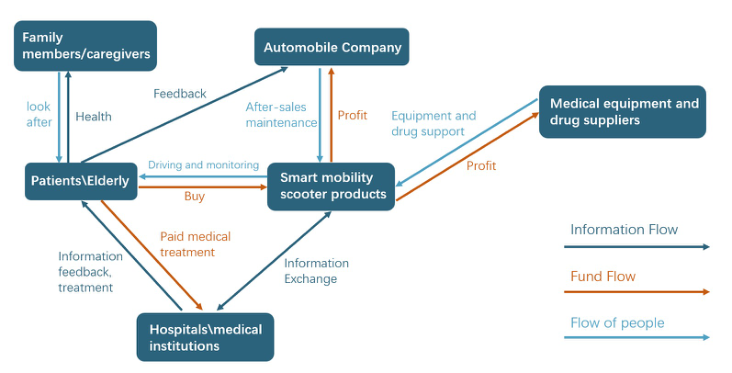
Service Blueprint and User Journey Map Analysis The service blueprint in Figure 1 shows the ecosystem, multiple key roles and their interactive relationships of smart mobility scooter products in medical and health services. The service blueprint elucidates the interactions among these stakeholders through three main flows: information, finance, and human. This comprehensive approach allows for a holistic understanding of the roles involved, identification of overlooked relationships, and the discovery of new needs, thereby enhancing the functionality of the product.
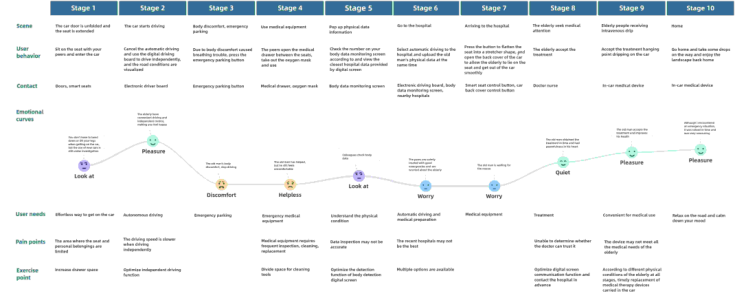
To refine the functionality of the intelligent mobility scooter, we conducted research on the process of elderly individuals driving automobiles and integrated this with the use of intelligent mobility scooters. We hypothesized scenarios where users might encounter accidents while using the intelligent mobility scooter, analyzed the users’ emotions, usage processes, potential issues, and opportunities at different stages, and proposed corresponding solutions to address these issues.
62 Chen and Li
Figure 1: Service blueprint.
Figure 2 is a user journey map that documents the entire process from boarding to returning home, divided into 10 stages. For each stage, we explored the pain points and opportunities based on user behavior, touchpoints, emotional changes, and needs.
Figure 2: User journey map.
RESEARCH RESULTS Appearance Design of the Intelligent Mobility Scooter
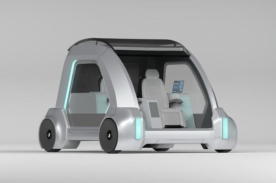
The intelligent mobility scooter adopts a simple appearance (as shown in Figure 3), and the overall shape of the body mainly adopts a streamlined design, with large transparent glass windows on both sides and the front of the vehicle. These windows provide passengers with an excellent and expansive view, reducing blind spots while driving. This design not only enhances the pleasure of enjoying the scenery during the journey but also ensures safety. The vehicle is designed with a low center of gravity, which
Innovative Design of Intelligent Commuting Vehicles for Elderly Users 63
facilitates easy boarding and alighting for the elderly and improves stability during travel, offering a smooth and comfortable riding experience. High- brightness LED lights are used around the body of the vehicle, which helps to enhance the vehicle’s recognition and improve safety when driving at night.
Figure 3: Overall appearance of the mobility scooter with the front cover slide open.
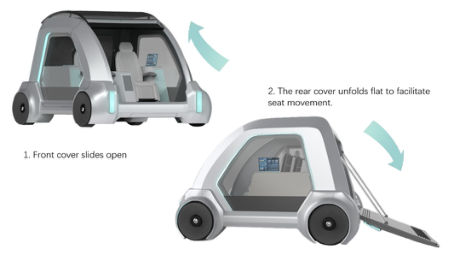
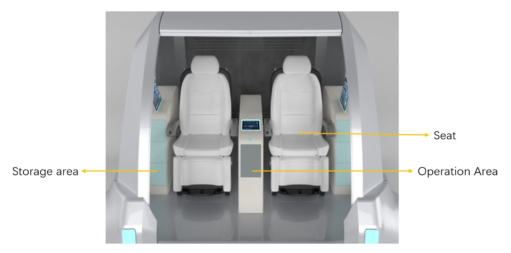
Space Planning and Functional Layout of the Intelligent Mobility Scooter The interior space of the intelligent mobility scooter is primarily divided into four key areas: the driver’s seat area, the operation area, the storage area (as shown in Figure 4), and the boarding/alighting area (as shown in Figure 5). The seating arrangement is designed to accommodate two passengers, with the operation panel positioned centrally between the seats to facilitate easy access for intelligent operations. Electronic displays are placed on either side, primarily showing passengers’ health information and other relevant content, making it convenient for passengers to monitor their status. Storage compartments are located on both sides of the vehicle, providing space for medications and personal items needed by the elderly. The boarding and alighting area features a sliding and lifting mechanism for the front cover slide and rear hatch, which simplifies the process of getting in and out of the vehicle, thereby reducing physical exertion for the elderly.
Figure 4: Driving seat area, operation area, and storage area.
64 Chen and Li
Figure 5: Boarding and alighting area.
Functional Design of the Intelligent Mobility Scooter Based on four key aspects—convenience, interaction, medical support, and emergency response—we have designed four main functions for the intelligent mobility scooter: transformable mobile seating and boarding methods (as shown in Figure 5), intelligent interaction interface, vital signs monitoring system and emergency medical device design, and an emergency rescue system. These functions aim to provide the elderly with a comfortable riding experience from all aspects.
Most vehicles have limited space and lack sufficient handrails or other assistive features to provide additional support, which significantly increases the risk of falls for the elderly.
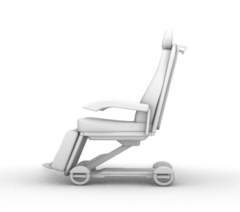
Therefore, the seating of the intelligent mobility scooter is designed to transform according to user needs. For example, changing the structure of fixed car seats and designing foldable seats (as shown in Figures 6 and 7). The vehicle’s threshold is lowered, the front cover slide is enlarged and extended to a transparent glass window, and the conventional vehicle’s dashboard operation section is removed. This allows the front glass window to slide open (as shown in Figure 6), and the seat can move forward to the front end. This design reduces the difficulty for the elderly to board from the side, changes the way they get into the vehicle, and decreases the balance and core strength required for boarding. The seat is combined with a stretcher, and the seat is equipped with wheels and a foldable, flat design. In case of sudden physical emergencies for the elderly, this design allows for rapid evacuation from the vehicle and reduces the difficulty of transferring the patient, saving time in rescue efforts.
Figure 6: Seat in normal use position.
Innovative Design of Intelligent Commuting Vehicles for Elderly Users 65
Figure 7: Seat in flat position.
Modern automobiles have integrated a variety of emerging technologies. However, these technologies are primarily designed for middle-aged and younger users who are familiar with interacting with smart devices. The elderly often find it challenging to adapt to these systems. Therefore, the input and output modes of the interaction design should be based on the physical conditions and habits of the elderly (Detjen et al., 2021), creating a more natural and convenient user-friendly interaction method.
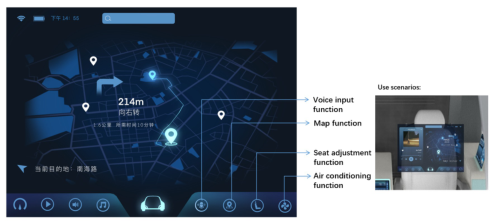
Firstly, the interface should be simplified and intuitive, using large icons with concise text instructions. Secondly, a voice assistant should be included to combine visual and auditory interactions, reducing manual input and allowing the elderly to operate the system more directly. This minimizes the discomfort and confusion that the elderly may experience when faced with complex user interfaces. As shown in Figure 8, the main interface displays the driving map, location, and various in-car equipment adjustment functions, consolidating operations to reduce the learning required for different devices. Finally, a guided tutorial should be provided, offering step- by-step instructions for use. Considering the memory decline in the elderly, the tutorial can be repeated to assist them in using the system.
Figure 8: Main interface and usage scenarios of the intelligent mobility scooter.
With the decline of physical functions, the elderly face complex and diverse health challenges. Many are limited in their mobility or fear accidents (Faber and van Lierop, 2020). To address these concerns, we have designed a vital signs monitoring system and equipped the vehicle with emergency medical devices to provide a sense of security for elderly travelers.
66 Chen and Li
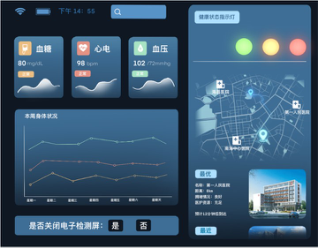
The vital signs monitoring system primarily tracks the elderly person’s heart rate, blood pressure, body temperature, respiratory rate, and blood glucose levels (as shown on the left side of Figure 9). The display interface for vital signs monitoring should be located next to the armrest of the seat, allowing the elderly to conveniently check their health status while driving. In case of any abnormal readings in heart rate, blood pressure, body temperature, or respiratory rate, the system will issue a warning and send alerts to the remote control terminal of family members or caregivers. Additionally, the vehicle is equipped with emotion recognition cameras and microphones. These devices analyze the elderly person’s emotional state through facial expressions and vocal tones. If anxiety or other negative emotions are detected, the system will provide prompts and feedback.
Figure 9: Vital signs monitoring interface.
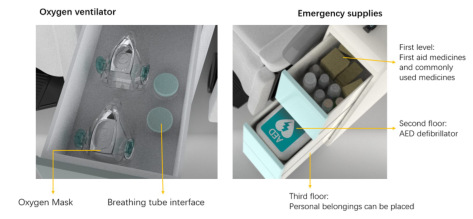
To better safeguard the health and safety of the elderly, the vehicle is equipped with a range of emergency medical devices. Firstly, an in-car medical kit is placed in accessible storage compartments (as shown in Figure 10), containing basic first-aid supplies (such as bandages and antiseptics) as well as medications commonly used by the elderly. Secondly, emergency medical devices such as an AED (Automated External Defibrillator) and an oxygen respirator are installed in easily reachable locations near the seat, providing immediate assistance in case of cardiac emergencies. Through a series of emergency equipment, the safety and travel experience of the elderly can be comprehensively improved.
Figure 10: Schematic diagram of first aid supplies and medication placement in the vehicle.
Innovative Design of Intelligent Commuting Vehicles for Elderly Users 67
The emergency rescue system is one of the crucial components of the intelligent mobility scooter for the elderly and also an important measure to ensure their physical safety.
Firstly, it can be activated either manually by the elderly pressing the emergency call button or issuing a voice command, or automatically triggered when the vital signs monitoring device detects abnormal data. Secondly, the system allows for an assessment of the elderly person’s specific health condition through the vital signs monitoring interface, and appropriate first aid supplies and equipment within the vehicle can be used accordingly. For example, an oxygen mask can be used to maintain the elderly person’s breathing until they reach the hospital, ensuring their safety. Then, the vehicle’s GPS system determines the location and sends the coordinates to the rescue center and pre-set contacts. The system informs the emergency center, family members, and other contacts of the location and situation through multiple channels such as text messages and phone calls. Finally, the system selectively transmits data to the nearest hospital (as shown on the right side of Figure 8), allowing the hospital to prepare the necessary equipment and medical staff in advance. The intelligent mobility scooter will guide the driver automatically to the nearest hospital through the shortest route planning, shortening the rescue process for the elderly and increasing their chances of survival.
LIMITATIONS OF THE RESEARCH AND FUTURE WORK This research has limitations in terms of sample size, technology and regulations during the research and design process. In terms of sample size, although market research and competitive analysis were conducted, the selected information does not fully represent the needs and preferences of all elderly individuals. Regarding technology, some functions and structures are still in the development stage, and their feasibility has not been verified, which introduces uncertainty into the design. In terms of regulations, the lack of specific regulations and standards for elderly mobility scooters means that some functions in the design may be constrained.
Currently, this intelligent mobility scooter is still in the conceptual design stage, and there are many issues to be resolved in the actual implementation process. For example: (1) Although the mobility scooter has a minimalist interface design, it still poses a certain technological barrier for some elderly people. Moreover, advanced technologies inevitably come with high costs. (2) Through the analysis of the service system diagram, it is known that a large amount of information exchange is needed to improve the efficiency of emergency rescue. Therefore, fast information exchange inevitably brings the challenge of how to protect data security, and ensuring user privacy is a key issue. The remote control system also needs strict security measures to prevent the possibility of being hacked and exploited. (3) The design and use of intelligent mobility scooters need to comply with local traffic regulations and medical device certification requirements. However, the standards for elderly-specific transportation are not yet well-developed, and there is a lack of unified technical specifications and quality evaluation systems.
68 Chen and Li
To further improve the design, we will continue to research the following areas in the future: In terms of interaction, we will simplify the interaction design and provide more intuitive operating instructions to ensure that all elderly users can operate easily. Regarding data security and privacy protection, we will establish a strict user authorization mechanism to ensure that only verified users can access and control the vehicle and ensure the security of information transmission. In terms of cost-effectiveness, we will conduct detailed material and technical research to explore more cost-effective material and technical solutions and control manufacturing costs.
In summary, although the design concept of the intelligent mobility scooter is forward-looking, there are still many challenges in the implementation process. Future research will further optimize the design, reduce costs, and ensure the feasibility and safety of the product.
CONCLUSION
This study conducted an in-depth study on the design of smart mobility scooters for the elderly, combining mobility scooters with intelligent technology and optimizing the vehicle structure and functions. The functions of smart mobility scooters are mainly considered from four aspects: convenience, interaction, medical treatment and emergency situations: designing movable and transformable seats, special ways of getting on and off the vehicle; simple and easy-to-operate intelligent operation interface; equipped with vital sign monitoring system and emergency medical device; in emergency situations, through emergency rescue system and automatic driving system, it can more effectively protect the life safety of the elderly during driving.
The intelligent mobility scooter discussed in this research represents an optimized upgrade of existing transportation options and is a proactive response to the mobility challenges faced by the elderly in an aging society. By further improving the travel methods of the elderly, the elderly group will have a more harmonious and happier life in their later years.
ACKNOWLEDGMENT
This study was supported by National College Student Innovation Training Program Projects for 2024 (Grant number 202410590059) and the Ministry of Education of the People’s Republic of China Humanities and Social Sciences Youth Foundation (Grant number 24YJC760014).
REFERENCES
Cui, J., Loo, B. P., & Lin, D. (2017). Travel behaviour and mobility needs of older adults in an ageing and car-dependent society. International Journal of Urban Sciences, 21(2), 109–128.
Innovative Design of Intelligent Commuting Vehicles for Elderly Users 69
Cao, M., Zhong, X., & Han, T. (2020). Optimized design of accompanying smart car for the elderly based on humanization design methods. In Advances in Human Factors and Ergonomics in Healthcare and Medical Devices: Proceedings of the AHFE 2019 International Conference on Human Factors and Ergonomics in Healthcare and Medical Devices, July 24–28, 2019, Washington DC, USA 10 (pp. 302–313). Springer International Publishing. Detjen, H., Faltaous, S., Pfleging, B., Geisler, S., & Schneegass, S. (2021). How to
increase automated vehicles’ acceptance through in-vehicle interaction design: A review. International Journal of Human–Computer Interaction, 37(4), 308–330. Edwards, J. D., Bart, E., O’Connor, M. L., & Cissell, G. (2010). Ten years down the road: Predictors of driving cessation. The Gerontologist, 50(3), 393–399. Fan, L., Zou, X. (2020). The importance of the management and preventive health
care of chronic diseases in the elderly in my country. Chin. J. Clin. Healthc. 23(02), 145–147 (in Chinese). Faber, K., & van Lierop, D. (2020). How will older adults use automated vehicles? Assessing the role of AVs in overcoming perceived mobility barriers. Transportation research part A: policy and practice, 133, 353–363. Graham, H., De Bell, S., Flemming, K., Sowden, A., White, P., & Wright, K. (2018).
The experiences of everyday travel for older people in rural areas: A systematic review of UK qualitative studies. Journal of Transport & Health, 11, 141–152. Jianzhong, H., Meng, W. U. (2015). An investigation and analysis of travel characteristics and related factors of the elderly population in megacities—the case of the central area in Shanghai. Urban Planning Forum. Liu, W., Zong, G., & Zhang, C. (2013). An integrated model of urban transportation
and land use. J. Inn. Mong. Univ. (Nat. Sci. Ed.), 44, 212–218. Liu, W., Lu, H., Sun, Z., & Liu, J. (2017). Elderly’s travel patterns and trends: The empirical analysis of Beijing. Sustainability, 9(6), 981. Marroquín, B., Vine, V., & Morgan, R. (2020). Mental health during the COVID-19
pandemic: Effects of stay-at-home policies, social distancing behavior, and social resources. Psychiatry research, 293, 113419. Reynaud, C., & Miccoli, S. (2019). Population ageing in Italy after the 2008 economic crisis: A demographic approach. Futures, 105, 17–26. Rhiu, I., Kwon, S., Bahn, S., Yun, M. H., & Yu, W. (2015). Research issues in smart
vehicles and elderly drivers: A literature review. International Journal of Human- Computer Interaction, 31(10), 635–666. Stanley, J. K., Hensher, D. A., Stanley, J. R., & Vella-Brodrick, D. (2011). Mobility, social exclusion and well-being: Exploring the links. Transportation research part A: policy and practice, 45(8), 789–801. Shaheen, S. A., & Niemeier, D. A. (2001). Integrating vehicle design and human
factors: minimizing elderly driving constraints. Transportation Research Part C: Emerging Technologies, 9(3), 155–174. Williams, E., Das, V., & Fisher, A. (2020). Assessing the sustainability implications of autonomous vehicles: Recommendations for research community practice. Sustainability, 12(5), 1902. Zeng, F., Wang, M., Li, L., & Cai, S. (2023). Survey on the acceptance of smart cars
amongst middle-aged and elderly in China. Technology in Society, 73, 102234.
LISTED IN THE AHFE DIGITAL BOOKSTORE CATALOGUE
Explore the complete digital volume
Human Factors in Aging and Special Needs
Read this individual research paper free through the original publisher, or explore the full digital proceedings book.
ISBN 978-1-964867-50-2
Explore this ISBN in the AHFE Bookstore ↗Listed in the July 2026 bookstore catalogue; search by ISBN to confirm current availability · Digital book purchase optional