Xin Chen, Wutian Chen (2025). Innovative Design of Detached Community Mobile Healthcare Emergency Vehicle System. In: Advances in Human Factors of Transportation. AHFE Open Access, vol. 186, pp. 219–230. https://doi.org/10.54941/ahfe1006511
In the urbanization process, the traditional emergency vehicle is exposed to insufficient response speed and efficiency in dealing with complex communities' environments, public health emergencies, and traffic congestion. Therefore, it is necessary to focus on the innovative design of the detached community mobile medical emergency vehicle system. Based on literature review, data collection and user requirements research, the existing community medical service and emergency vehicle systems are analyzed in depth, and a prototype model is developed based on the modularization concept. In cooperation with community health service centers, hospitals, and many other parties, the detached mobile medical emergency vehicle for communities integrates medical resources to form a multifaceted service system. It can deliver medical services to residents, flexibly adjust services, and carry out health education. the detached design expands the scope of first aid, and with the UAV form, it can cope with congestion. The system significantly shortens medical response time, improves service coverage and resource utilization, provides a good user experience, offers high potential for improving the quality and efficiency of emergency medical services in the community, and provides a new way of thinking for the development of medical emergency systems in the future.
As the population of urban communities continues to grow, people are paying more attention to the protection of community healthcare services, and China is vigorously promoting the development of community healthcare services in various regions (Hu et al., 2010). After the COVID-19 pandemic, the community-based joint prevention and control mechanism has become one of the highlights of the “Chinese experience” in preventing and controlling COVID-19 (Cheng et al., 2020; Zhao and Wu, 2020), and the community plays a key role as an important carrier to protect people’s health. Community emergency care, as an important part of the community health care system, plays a crucial role in the emergency treatment of patients and the protection of people’s lives. However, the current urban community healthcare services still need to be optimized and improved in terms of medical resource
allocation, medical management, and staffing (He and Wang, 2023). The traditional one-piece medical emergency vehicle has gradually exposed many limitations when coping with the complex and changing environment and diversified medical needs in the community. Its bulky body is difficult to pass through the narrow roads in some communities; after receiving the patient, the process of going to the hospital can not quickly complete the patient’s information and the hospital’s docking work; when encountering traffic congestion, it is also difficult to quickly make effective response. Aiming at the above shortcomings of the traditional emergency vehicle, this thesis proposes a system design scheme of detached community mobile medical emergency vehicle. The detached emergency vehicle is able to respond quickly to emergency situations as it moves around the community on a daily basis. The detached emergency vehicle can be more flexible to cope with the complex environment within the community, and quickly arrive at the patient to carry out rescue work. When receiving a patient, the emergency vehicle is able to quickly synchronize patient information with the hospital, improving the efficiency of emergency treatment when the patient is admitted to the hospital. In addition, the emergency vehicle is equipped with a UAV-type flight mode that can effectively deal with traffic congestion, dramatically improve the response speed of community emergency care, shorten the pre- hospital emergency care time, and provide a new direction and strategy for improving community medical services.
RELATED RESEARCH Community Medical Services
Studies have shown that community health service centers play a pivotal role in providing affordable health services to patients with chronic diseases and patients with poor health conditions in the community. However, there is still room for improvement in the current community-oriented services, and to improve the patient experience, incentive policies should be developed to guide patients to make community health service centers their primary choice for daily health care (Zhang et al., 2020).
The needs of community residents for medical services are characterized by diversity. They not only need basic disease diagnosis and treatment services, but also have a strong demand for preventive health care, rehabilitation and nursing care, etc. He et al. (2023) found that residents were highly concerned about the medical conditions in the community and had an active interest in exercise and fitness, health maintenance and health care by analyzing the main feedback from 87 residents about community health management. Since the new crown epidemic, in order to achieve active health management in the community, most of the residents expressed their willingness to try to participate if the community is equipped with relevant facilities, provides supporting services and manages them effectively (He and Wang, 2023). Meanwhile, scholars have continued to explore innovative community healthcare service models. He et al. (2023) developed a conceptual model of community-based active health management, aiming to provide a reference
Innovative Design of Detached Community Mobile Healthcare Emergency Vehicle System 221
for community health management work in China and the international community, and to provide strategic support for improving community health management (He and Wang, 2023). In the study by Rasku (2019) and others, community-assisted healthcare programs were seen as a model with a promising future. However, there is a lack of research data in this area and further research is needed to clarify whether this new healthcare model can actually reduce costs, improve the health status of the population as well as enhance people’s healthcare experience (Rasku et al., 2019). With the rapid development of information technology, the application of informatization in the field of community medical services has received widespread attention. Wang and Zhu (2023) launched a study around the community public health informatization construction based on the grassroots management system of community health records, and discussed in depth the construction of a health information platform centered on community residents’ health records. They introduced Internet technology and decision tree modeling algorithm into the construction of public health information system of community health record system, and constructed a brand new public health information system, which has been verified by practice, and the system can increase the satisfaction of residents by 23% (Wang and Zhu, 2023).
Ensuring the quality of community medical services is the key to protecting residents’ health. Yang et al., (2023) constructed a set of online health community service quality evaluation system, which covers four primary indicators and 16 secondary indicators. The index system is tested to be reasonable and effective, and the evaluation method used is highly applicable and operable. The results of this research can provide theoretical guidelines for community platform operators and relevant departments to design an effective online health community service quality evaluation mechanism, and at the same time, it can also provide important references for decision makers and policy makers (Yang et al., 2023), and through the construction of such a quality evaluation system, the quality of community healthcare services can be effectively guaranteed.
In terms of quality improvement of community healthcare services, Bigham et al. (2013) proposed in their study that the model of utilizing caregivers to manage urgent, low-risk illnesses and injuries is called “community- assisted healthcare”. They conducted a systematic review and evaluation of the international literature with the aim of describing existing community paramedic programs. One of the randomized controlled trials (RCT) demonstrated that caregiver practice in a wider context is not only safe and feasible, but also effective in improving system operational performance and enhancing patient prognosis (Bigham et al., 2013). Shao (2018) and others concluded from their study that the government should design appropriate training content based on the knowledge and skill needs of different designs, and at the same time establish a unified, rigorous, and utility-focused training and evaluation system as a way to promote the development and improvement of the community health service system in mainland China (Shao et al., 2018).
222 Chen and Chen
Community Emergency Vehicle The emergency vehicle is an important part of community first aid. Any delays in emergency situations such as problems with emergency vehicle dispatch, offloading, and clinical handover communications during community healthcare emergencies can greatly reduce the chances of patient survival. Current research on emergency vehicles shows that there is regional inequality in the distribution of emergency vehicles, which has a significant impact on the prehospital transfer time and in-hospital mortality of patients. Therefore, it is particularly important to do a good job of rational allocation of emergency vehicles, because the speed and time of emergency vehicle response to emergencies are directly related to the response time of patients receiving emergency medical services in the community. Furthermore, system- level and patient-level factors that can be referenced during emergency vehicle dispatch are valid predictors of response time performance, and utilizing these metrics can help improve the timeliness of emergency medical services response (Nehme et al., 2017). Dispatch data from emergency medical call centers, as well as emergency vehicle data, are prime examples of routinely and efficiently collected syndromic data that may be useful for infectious disease surveillance efforts (Duijster et al., 2020). Efficient operation and management of community emergency vehicle is essential to improve the quality of emergency services. Wang and Hu (2024) proposed a dynamic ambulance deployment model aimed at improving the fit between ambulance deployment plans and emergency call demand. The results of simulation experiments show that dynamic ambulance redeployment can effectively reduce response time (Wang and Hu, 2024). This shows that emergency vehicle plays a key role in improving community healthcare services.
RESEARCH METHODOLOGY In this study, in order to ensure that the research results are both scientific and comprehensive, we have comprehensively used a variety of research methods to carry out an in-depth exploration of detached community mobile medical emergency vehicle from different dimensions. These research methods are complementary and synergistic, aiming at comprehensively organizing the current research situation, accurately grasping user needs, and laying a solid foundation for the development of a detached emergency vehicle system that can effectively meet the actual needs of community emergency care.
To gain a deeper understanding of community healthcare operations and residents’ evaluations of community healthcare and emergency vehicles, we conducted a questionnaire survey and collected 105 valid responses. By analyzing the questionnaire data regarding residents’ perspectives on current community medical services, emergency vehicle status, and modular design concepts, we identified critical directions for improving community emergency services. These include enhancing emergency response efficiency, introducing detachable designs and flight modules to expand emergency vehicle functionality, strengthening first-aid knowledge dissemination, and improving information coordination between hospitals.
Innovative Design of Detached Community Mobile Healthcare Emergency Vehicle System 223
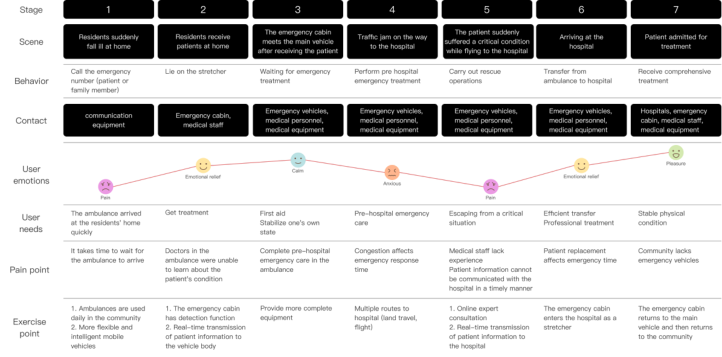
We further analyzed community residents’ user needs, emotional responses, and pain points to identify the potential value of opportunity points. Accordingly, we developed a user journey map (see Figure 1) that systematically visualizes these insights, serving as a crucial foundation for subsequent system design. The user journey map is mainly divided into seven stages: Stage 1: Residents call the emergency number to contact the ambulance during a sudden illness at home. They want the ambulance to arrive quickly. In response to this demand, we identified the opportunity for emergency vehicles to function as mobile rescue stations operating daily within the community. These could be complemented by more flexible and intelligent mobile vehicles.
Stage 2: After the patient is received at home, they want to receive treatment as soon as possible. However, doctors cannot immediately assess the patient’s condition. The opportunity identified here is to equip emergency cabins with detection functions and real-time patient information transmission capabilities.
Stage 3: During the rapid transfer of the patient to the hospital, they may worry about not receiving adequate pre-hospital treatment. They hope to receive comprehensive emergency care on the ambulance to stabilize their condition. The opportunity here is to equip emergency vehicles with more advanced medical equipment.
Stage 4: The ambulance encounters congestion en route to the hospital, delaying arrival. We identified the opportunity to navigate efficiently through multiple routes, including utilizing air flight capabilities.
Stage 5: During transit, a patient may experience a sudden crisis requiring immediate intervention, but the medical staff may lack sufficient experience, and the hospital may not receive timely updates about the patient’s condition. The opportunity here is to provide online expert consultation and real-time patient information transmission to the hospital.
Stage 6: Upon arrival at the hospital, the patient needs to be transferred from the ambulance to the hospital. However, changing stretchers can consume valuable time. The opportunity identified is for the emergency cabin to function as a stretcher that can seamlessly enter the hospital.
Stage 7: After the patient is hospitalized and stabilized, the community still lacks a permanent rescue station for ambulances. The opportunity here is to integrate the main body of the emergency vehicle with a spare emergency cabin, enabling it to return to the community for daily operations.
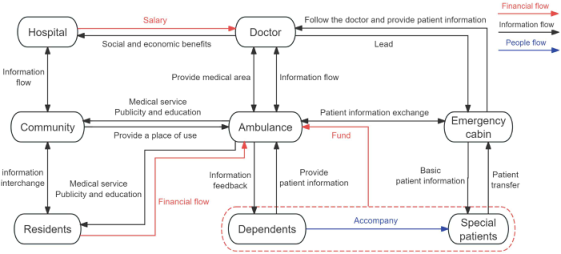
In order to gain a deeper understanding of the current development of community healthcare and emergency vehicle, this study adopts the literature research method, extensively consults related literature, conducts an in-depth analysis of the existing community healthcare system and emergency vehicle system, and systematically organizes the information obtained from the study. By organically combining the emergency vehicle with the community medical system, the workflow of the detached community mobile medical emergency vehicle is clarified and visualized in the form of a service system diagram (see Figure 2).
224 Chen and Chen
Figure 1: User journey map.
In the service system diagram, the system operation process of detached community mobile medical emergency vehicle between the community and the hospital is clearly and intuitively shown. In the daily work, the emergency vehicle needs to be operated and managed by doctors, while the community provides space support for the daily work of the emergency vehicle. The emergency vehicle not only provides daily medical services and health education for the community residents, but also provides patient information to the hospital, which facilitates the hospital to complete the patient information in a timely manner. When the detached emergency cabin is activated in case of emergency, the detached emergency cabin will automatically follow the doctor to the resident’s home and transfer the patient’s information to the hospital at the same time to ensure that the hospital can prepare for the treatment in advance.
Figure 2: Service system map.
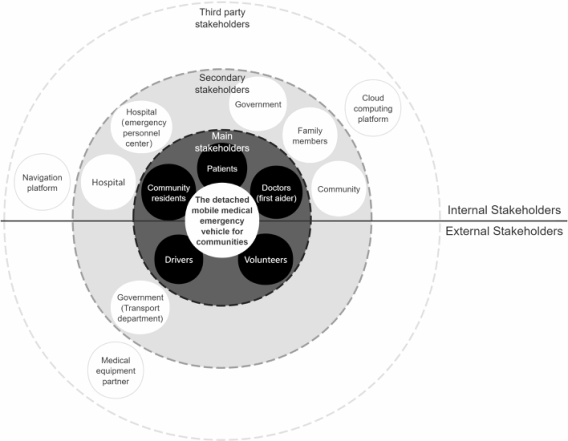
The creation of a stakeholder map (see Figure 3) helps us to comprehensively identify all parties related to the detached community mobile medical emergency vehicle, clearly define their interests, and then provide strong support for decision-making and communication and coordination.
Innovative Design of Detached Community Mobile Healthcare Emergency Vehicle System 225
Figure 3: Stakeholder map.
DESIGN PRACTICE After completing the multidimensional study of the detached community mobile medical emergency vehicle, based on the results obtained in the previous period by using various research methods such as the literature review method, theoretical analysis method, user needs research, and community field research, we have an in-depth understanding and comprehensive knowledge of the design of the detached community mobile medical emergency vehicle. These research results not only give us a clear grasp of the current research situation and insight into the real needs of users, but also a deeper understanding of the characteristics and challenges of the actual operating environment, which lays a solid theoretical and data foundation for the subsequent design practice. Based on this foundation, we carried out the design practice of detached community mobile medical emergency vehicle. The purpose of this design practice is to transform the previous research results into actual product design, in order to solve the many problems existing in the traditional emergency vehicle in the community medical emergency services, to create a highly efficient, intelligent, adapted to the needs of the community detached emergency vehicle system, to effectively improve the quality and efficiency of community medical services, and to provide more powerful medical services for the life and health of the community residents.
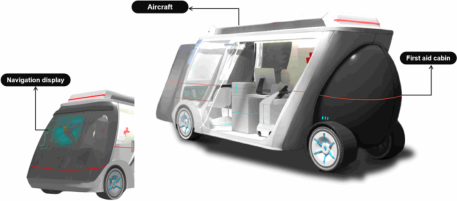
Overall Functional Orientation and Module Division The detached community mobile medical emergency vehicle is mainly composed of three parts: the main body, the emergency cabin and the aircraft (Figure 4). As the core carrier of the community medical emergency service, it has the comprehensive service capability of integrating daily preventive
226 Chen and Chen
health care, emergency rescue, transfer of the sick and wounded, medical information collection and transmission, etc., and is able to adapt to the complex environment and diversified needs of the community.
Based on its functional positioning, the mobile medical emergency vehicle for communities can be divided into driving module, power and transportation module, intelligent system module, medical function core module, auxiliary service module and other major parts. The driving module covers traditional driving, automatic driving and flight mode; the power and transportation module is responsible for the driving and basic control of the vehicle; the intelligent system module has the following functions: in the daily state, it can synchronize the patient’s information with the hospital in real time; in the case of emergencies, it can be connected with the hospital experts in real time through the high-speed network to share the patient’s vital signs, condition images and other data, so that the experts can give timely professional guidance during the transit; in the case of emergency, it can share the patient’s vital signs, condition images and other data with the hospital experts. The core module of medical function carries the main medical equipments and emergency operation space; the auxiliary service module provides supporting functions such as storage of drugs and consumables, stretcher storage, and rest for medical personnel (Figure 5).
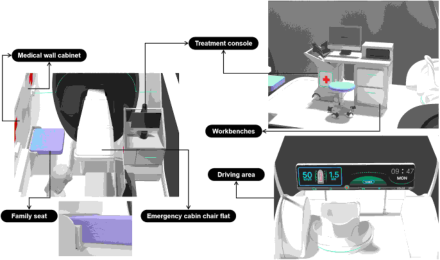
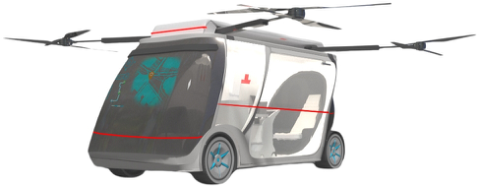
Figure 4: Mobile medical emergency vehicle for communities overall layout.Figure 5: Mobile medical emergency vehicle for communities internal layout.
Emergency Cabin Module Design The emergency cabin module is connected to the main body of the vehicle through a mechanical structure. The emergency cabin is equipped with an
Innovative Design of Detached Community Mobile Healthcare Emergency Vehicle System 227
intelligent medical aid system, which is able to synchronize the patient’s information to the hospital through preliminary detection after receiving the patient, thus shortening the time required for the hospital to dock the patient’s information. The seats in the emergency cabin can be flattened to facilitate basic examination of patients on a daily basis. When an emergency occurs in the community, the emergency cabin can detach from the main body of the vehicle, quickly arrive at the residents’ homes, and then quickly join the main body of the vehicle after receiving the patient, and then go to the hospital together.
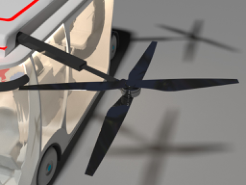
Flight Function Module Design The flight function of the mobile medical emergency vehicle for communities is analyzed and designed based on actual cases. The flight function adopts a four-axis rotor layout. In the daily state, the rotor is stored in the roof of the mobile medical emergency vehicle for communities. When the flight function is needed, the rotor will automatically extend out from the roof of the vehicle, and the front wing and the rear wing are placed in a staggered manner, so as to realize the reasonable utilization and storage of space. The mobile medical emergency vehicle for communities adopts the vertical take-off and landing method, which is relatively safe, without the need for an additional take-off runway, and does not have any special requirements for the site. In case of traffic congestion, mobile medical emergency vehicle for communities can take off on the spot and quickly drive to the hospital. The rotor has a high degree of safety and reliability, with a total of four axes, each equipped with two sets of rotors, for a total of eight rotors. This design not only ensures the safety and stability of flight, but also ensures the smoothness and stability of the vehicle (Figure 6, Figure 7).
Figure 6: Mobile medical emergency vehicle for communities flight demonstration.Figure 7: Wing part of the vehicle.
228 Chen and Chen
Space Layout Inside the Vehicle The interior of the mobile medical emergency vehicle for communities is divided into a driving area, a doctor’s working area and a patient’s treatment area. The driving area is equipped with a single seat, with a touch screen in front of the seat, and the front glass of the vehicle also serves as a navigation display. The driver’s area is equipped with an intelligent driving system, which is able to quickly plan an efficient and effective driving route, helping the mobile medical emergency vehicle for communities to quickly drive to its destination. The doctor’s workspace is equipped with a desk, computer, and a movable treatment table, making it easy for the doctor to perform treatment on the patient, and there is also a movable seat to facilitate the doctor’s freedom of movement. The patient treatment area consists of an emergency cabin, and a seat for the family. There are medical cabinets on the inner wall of the vehicle for storing medicines and all kinds of medical sundries.
CONCLUSION
In conclusion, this thesis aims to analyze the community medical service, combine the emergency vehicle with the community medical service system, use the daily emergency vehicle as the community mobile medical station, and form a system innovation of “detached community mobile medical emergency vehicle” as the main body. “As the main body of the system innovation design, for the future smart healthcare scenarios, to solve the community healthcare emergencies. The vehicle presents modular detached, with several functional forms as follows: (1) as a mobile aid station in the community to deal with simple medical problems; (2) in case of emergency, it can become a rescue cabin after splitting, and the emergency cabin can be used to transport patients in an emergency back to the aid station for emergency treatment; (3) the emergency vehicle travels to the hospital quickly and efficiently, and it has several driving modes, which are normal vehicle driving, unmanned driving, and UAV type flight mode.
The detached community mobile medical emergency vehicle system design integrates unmanned technology, intelligent operation technology, and UAV- style vehicle research technology to link the community with medical services, promote the development of the community healthcare system, and facilitate the sinking of medical services into the community, so that more people can enjoy timely and high-quality medical services. Through the innovative design of detached community mobile medical emergency vehicle system, we can improve the efficiency and quality of medical emergency services, and make positive contributions to the development of community medical care.
RESEARCH LIMITATIONS AND FUTURE RESEARCH DIRECTIONS The study has several limitations that need to be addressed. First, the selection of sampling sites during the field interview research phase was limited by the location of the researchers, which may have resulted in selection bias. In order to increase the generalizability of the study, future research could explore
Innovative Design of Detached Community Mobile Healthcare Emergency Vehicle System 229
the sampling locations more comprehensively to ensure broader geographic representation.
Second, the design solutions presented in this study are still in the conceptual stage; therefore, the understanding of the solutions is entirely dependent on the researchers’ descriptions and lacks practical experience. To mitigate this limitation, it is important to move beyond the conceptual stage. Researchers can create prototypes that allow users to interact with the solution and gather feedback based on their real-world experiences. Improvements based on user feedback through iterative testing and refinement can significantly improve the product.
In addition, while the use of first aid pods takes into account the inconvenience of buildings in Chinese communities, where their small size allows them to travel directly to residents’ homes via elevators, it fails to take into account this situation in communities without elevators, and future research should delve deeper into how to better cope with this situation. Although the overall tendency is reasonable, there are still some detailed problems. For example, the storage space for emergency medicines and consumables is not planned carefully enough, which leads to time-consuming searching for specific medicines or consumables. In addition, the activity space of the personnel in the vehicle is slightly confined during emergency treatment, especially when multiple people operate at the same time, which is easy to interfere with each other.
In conclusion, addressing these limitations through integrated sampling, prototyping, real user interaction and incorporating different first aid skills will strengthen the validity, reliability and utility of the findings and contribute to the advancement of healthcare services in the community.
ACKNOWLEDGMENT
This study was supported by National College Student Innovation Training Program Projects for 2024 (Grant number 202410590058) and the Ministry of Education of the People’s Republic of China Humanities and Social Sciences Youth Foundation (Grant number 24YJC760014).
REFERENCES
Bigham, B. L., Kennedy, S. M., Drennan, I., & Morrison, L. J. (2013). Expanding paramedic scope of practice in the community: A systematic review of the literature. Prehospital Emergency Care, 17(3), 361–372. Cheng, Y., Yu, J., Shen, Y. and Huang, B. (2020), Coproducing Responses
to COVID-19 with Community-Based Organizations: Lessons from Zhejiang Province, China. Public Admin Rev, 80: 866–873. Duijster, J. W., Doreleijers, S. D., Pilot, E., van der Hoek, W., Kommer, G. J., van der Sande, M. A.,... & van Asten, L. C. (2020). Utility of emergency call centre, dispatch and ambulance data for syndromic surveillance of infectious diseases: A scoping review. European journal of public health, 30(4), 639–647. He, J., & Wang, T. (2023). The community proactive health management model
based on the grounded theory: The case of Beijing, China. Heliyon, 9(4).
230 Chen and Chen
Hu, H., Liang, W., Liu, M., Li, L., Li, Z., & Li, T., et al. (2010). Establishment and evaluation of a model of a community health service in an underdeveloped area of china. Public Health, 124(4), 206–217. Nehme, Z., Andrew, E., & Smith, K. (2017). Factors influencing the timeliness of
emergency medical service response to time critical emergencies: An observational study. Australasian Journal of Paramedicine, 14(1), 24. Rasku, T., Kaunonen, M., Thyer, E., Paavilainen, E., & Joronen, K. (2019). The core components of community paramedicine–integrated care in primary care setting: A scoping review. Scandinavian journal of caring sciences, 33(3), 508–521. Shao, S., Wu, T., Guo, A., Jin, G., Chen, R., Zhao, Y.,... & Lu, X. (2018). The
training contents, problems and needs of doctors in urban community health service institutions in China. BMC Family Practice, 19, 1–9. Wang, Y., Zhu, C. (2023) Thoughts on the construction of public health informatization for community health archives grass roots management system. Front. Public Health. 11:1160478. Wang, Z., & Hu, Z. (2024). A discrete-event simulation study for pre-hospital emergency systems. Journal of Simulation, 1–21. Yang, H., Wang, S., & Wang, F. (2023). Online health community—An empirical
analysis based on grounded theory and entropy weight TOPSIS method to evaluate the service quality. Digital Health, 9. Zhang, L., Li, J., Ma, T., Zhang, R., & Zhang, Q. (2020). Usual source of care and experiences with primary care among community health service centre patients in Changchun, China: A cross-sectional survey. Health & Social Care in the Community, 28(6), 1979–1988. Zhao, T., & Wu, Z.. (2020). Citizen–state collaboration in combating COVID-19
in China: Experiences and lessons from the perspective of co-production. The American Review of Public Administration, 50(3).
LISTED IN THE AHFE DIGITAL BOOKSTORE CATALOGUE
Explore the complete digital volume
Advances in Human Factors of Transportation
Read this individual research paper free through the original publisher, or explore the full digital proceedings book.
ISBN 978-1-964867-62-5
Explore this ISBN in the AHFE Bookstore ↗Listed in the July 2026 bookstore catalogue; search by ISBN to confirm current availability · Digital book purchase optional