Haoyue Lei, Shuxiao Zhong, Duan Wu (2025). Integrated Medical and Elderly Care in Shanghai: A Case Analysis of Resource Distribution and the Five-Bed Linkage Model in Jing'an District. In: Human Factors in Aging and Special Needs. AHFE Open Access, vol. 174, pp. 70–79. https://doi.org/10.54941/ahfe1006295
China’s rapidly ageing population has made the integration of medical and elderly care resources a pressing challenge. In 2022, Jing’an District in Shanghai introduced the Five-bed Linkage (FBL) model, integrating home-based care beds, institutional care beds, home medical beds, hospital beds, and palliative care beds into an efficient and accessible system. The FBL model is examined by an initial analysis of the spatial distribution and accessibility of medical and care resources using Geographic Information System (GIS). Meanwhile, the way the FBL model integrates facilities and other resources through a flexible system is further explored to identify challenges through three real-life cases. Targeted strategies are proposed to enhance the efficiency and accessibility of the FBL model and offer practical guidance for integrated medical and elderly care services.
China is experiencing one of the fastest ageing processes globally. It is forecast that by 2035, over 20% of the population will be aged 65 and above, marking a shift to a deeply aged society (National Bureau of Statistics of China, 2021). Aging is accompanied by rising chronic diseases and disability rates, with 75% of elderly individuals affected by chronic illnesses and 18%-20% experiencing disabilities (China National Working Commission on Aging, 2020). This means significant demands on healthcare and long-term care services.
Therefore, in the 14th Five-Year Plan (2021–2025), the Chinese government elevated ageing to a national strategy, focusing on integrating medical and elderly care services for seamless transitions across home, community, and institutions. Under this policy, many innovative policies and actions have been introduced, e.g. leveraging health monitoring (State Council, 2021). In sum, China is now in the social transition process from a home-based senior health system to an integrated one, which guides municipal actions in Shanghai.
Integrated Medical and Elderly Care in Shanghai 71
Shanghai is a typical metropolis, according to the Shanghai Municipal Bureau of Civil Affairs (2024), 60 years and older individuals accounted for 37.4% of the total registered population in Shanghai by the end of 2023, far exceeding the national average. In response to the social transition, Shanghai is now updating the senior living paradigm as the 15-minute medical and elderly caring circle. With this new paradigm, senior citizens in Shanghai are promised accessible medical and caring facilities within a 15-minute walk in 2030. However, the central urban areas are now facing an intense built- up urban environment, making simply building up abundant nearer facilities impossible. Therefore, it is of vital importance to integrate medical and care facilities and provide accessible senior health services.
Jing’an is one of seven downtown districts in Shanghai and also the earliest urban area that enter into deep aging. As of the end of 2023, among the district’s total household population of 903,900, 42.1% are aged 60 years and above (Shanghai Municipal Bureau of Civil Affairs, 2024). In 2022, Jing’an district pioneer introduced the Five Bed Link (FBL) model. This ambitious service model aims to meet different ageing needs by building a more efficient and accessible flow system between various types of resources available. As the name indicates, the five ‘beds’ are metaphors that cover distinct modes of service in FBL.
1. Home-based care beds: Professionalized care service at home. 2. Institutional care beds: Long-term care service for unsupported elderly. 3. Home-based medical beds: On-site medical care service at home. 4. Hospital beds: Acute and inpatient care service. 5. Palliative care beds: End-of-life support and psychological care service.
From the implementation perspective, FBL is an organic combination of the facilities where the ‘beds’ are and the seamless urban elderly services links in between. With joint efforts from the public and private sectors, FBL intends to bridge elderly care, medical services, and palliative care into an efficient and accessible closed-loop network, ensuring personalized care across life stages. Although still in the pilot stage, it has made significant contributions. As of 2022, Jing’an had established 779 ‘home-based care beds’ for more than 14,833 people (Pan, 2022). Therefore, the FBL model is discussed as a case study in this paper to explore how integrated healthcare services can contribute to the upcoming ageing future.
METHODS AND DATA This paper is divided into three sections. The first section adopts a geographical perspective and employs Geographic Information System (GIS) tools to analyze the spatial distribution and accessibility of medical and care resources. GIS, as a research tool which enables the visualization and analysis of spatial data, provides insights into the relationships between geographic features and service accessibility. The analysis draws on the latest national census data in 2020 (National Bureau of Statistics of China, 2021), spatial data from open map platforms Gaode and Baidu in 2024, and official reports and documents disclosed by the Shanghai and Jing’an District governments.
The second section focuses on how the FBL model integrates existing spatial facilities and human resources through a flexible system. Based on three real-life cases, it identifies major challenges such as uneven resource distribution and mismatched supply and demand. The data used in this section are secondary sources derived from case studies reported by the Shanghai and Jing’an District governments. Subsequently, expert consultations were conducted to verify the authenticity and applicability of the data.
The third section synthesizes the findings from the previous sections to propose targeted strategies for improving the efficiency and accessibility of the FBL model. The suggestions aim to provide practical guidance for enhancing integrated medical and elderly care services.
GIS ANALYSIS OF RESOURCE DISTRIBUTION Categories and Locations of Resources
To begin with, it is essential to define the categories of these medical and elderly care facilities. The spatial resources can be divided into 3 types according to different supervision and association. The first type includes sub-district offices and affiliated communities, under municipal government oversight. Jing’an District comprises 14 sub-districts, each with a grassroots office collaborating with its communities (shè q¯u, typically fenced and well-defined residential areas). With the community as the basic unit, sub- district offices manage and allocate resources for ‘home-based care beds’ and ‘home-based medical beds’ for seniors.
The second type consists of elderly care institutions. As of 2024, Jing’an District houses 47 such institutions in either private or public funding (Jing’an District Government, 2024). These are categorized into large and embedded facilities, by the different management modes. Large-scale institutions, including district nursing homes and senior apartments, operate under the supervision of the civil affairs department. It provides ‘institutional care beds’ through centralized, long-term services. Meanwhile, embedded facilities, especially community care centres, are often co-managed by communities and nearby medical institutions. These facilities provide ‘institutional care beds’ for senior residents, with short-term, centralized caring services to meet specific needs.
The third type encompasses medical institutions, overseen by the Jing’an District Health Commission. In 2024, Jing’an District has 36 hospitals classified as public or private and by scale (primary or secondary). Primary hospitals, including 14 community health service centres, deliver basic medical services and conduct chronic disease follow-ups. Secondary hospitals provide advanced and specialized care, contributing ‘hospital beds’ to the system.
Notably, Jing’an District lacks dedicated facilities for ‘palliative care bed’. Palliative services, particularly pain management, are overseen by the Urban Health and Wellness Committee and require licensed professionals. These services are typically offered in hospital speciality zones, elderly care facilities, or, in rare cases, within residential areas. The absence of dedicated
Integrated Medical and Elderly Care in Shanghai 73
facilities limits accessibility creates unclear responsibilities and complicates institutional coordination. In summary, the spatial resources supporting medical and elderly care in Jing’an District include residential communities, large-scale and embedded elderly care institutions, and two-tier hospitals. However, gaps remain, particularly in the provision of specialized palliative care facilities.
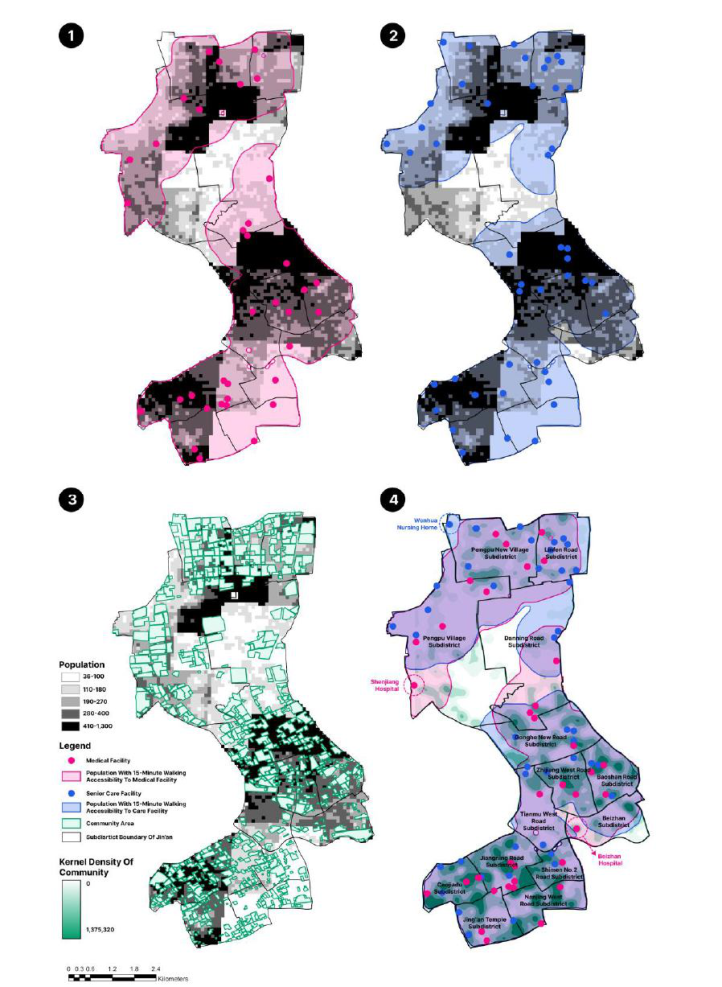
Figure 1: Analysis of spatial resource distribution (drawn by the authors).
Analysis of Spatial Resource Distribution With the help of GIS tools, the spatial distribution of healthcare and elderly care facilities is analyzed in details. In Figure 1, Maps 1, 2, and 3 identify the locations of 36 hospitals, 47 elderly care institutions, and 865 residential communities as of 2024. Noticeably, Maps 1 and 2 highlight the household population within a 1-kilometer radius (a 15-minute walking distance) of each facility. Coverage rates for medical and elderly care services, respectively at 83% and 82%, indicate high accessibility from the community to medical/caring facilities but falling short of full coverage. Moreover, Map 4 overlays the above facility coverage with the community density map. It reveals that in densely populated sub-districts, especially the four southern ones, senior residents in communities generally achieve dual accessibility to hospitals and elderly care facilities. However, in central areas of Jing’an, especially Pengpu Road, Daning Road, and Gonghe New Road sub-district, significant gaps in facility distribution make integrated health services still inaccessible for senior residents.
Map 4 also depicts accessibility between hospitals and elderly care facilities. The results show that 2 hospitals and 1 elderly care facility are isolated from other services, which may lead to difficulties in transferring senior citizens between these hospitals and care facilities. In summary, this figure depicts the spatial distribution and accessibility of healthcare and elderly care facilities in Jing’an District and highlights a generally high but incomplete coverage, which might challenge the implementation of FBL.
SYSTEM INTEGRATION AND CASES OF FBL Integration of Human Resources and New Financial Mechanisms
As previously noted, the dense population and limited space in Shanghai restrict the large expansion of spatial resources. The FBL model addresses these challenges by seamlessly linking services, particularly for ageing populations in sub-districts with limited facility access. Two key approaches of FBL stand out with significant outcomes. Firstly, FBL allows healthcare professionals to break away from the institution-centred system and become more efficient through dedicated assigned tasks. Concerning the large population in Jing’an District, the number of 1,500 licensed physicians and 3,200 registered nurses is still relatively inadequate. Moreover, these professionals used to affiliate with the above-discussed institutions and this exacerbates the inaccessibility of services in certain areas. The FBL model improves service efficiency by breaking down tasks into 5 service modes and assigning them to specialized personnel. For example, a full-time family doctor is stationed in the communities to be responsible for the health assessment of the contracted seniors and make the service more accessible.
Secondly, the creation of the FBL has led to a new mechanism for the flow of public funds. Currently, financial resources for the FBL model come from government funding, long-term care insurance, and private sector participation. The Jing’an District government allocates approximately ¥120 million budget annually for constructing elderly care facilities, subsidizing
Integrated Medical and Elderly Care in Shanghai 75
home-based care services and supporting family medical bed services. Long-term care insurance reimburses eligible disabled senior residents for care services, achieving high coverage rates. Additionally, some elderly care institutions and nursing services are funded through public-private partnership models, supplementing gaps in government funding.
Generally, by integrating human resources and establishing new financial mechanisms, FBL promotes service accessibility and links the spatial resource gaps. The below 3 cases reflect three typical service scenarios of FBL. Through these cases, the strengths and challenges of FBL is further explored with an aim to bridge the gap between spatial resources and integrate human resources.
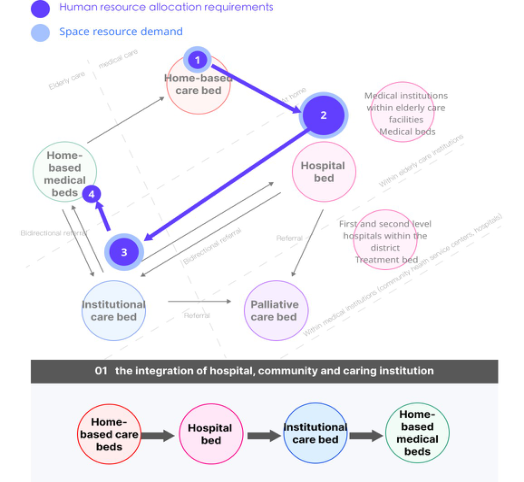
Case 1: The Integration of Hospital, Community and Caring Institution This case suggests how FBL connect the resources among hospitals, communities and caring institutions. Senior citizen, Y lives in Shimen No. 2 Road Sub-district (located in southern Jing’an) and receives daytime care at home supported by the associate community, which is a typical part of the ‘home-based care bed’ service. After a serious fall, Y suffered a fracture and was transitioned to a secondary hospital for surgery. Afterwards, Y was moved back to the community care centre (embedded institution) for a ‘home-based medical bed’ service. After fully recovering, Y returned home and continuously received the routine daycare as before.
Figure 2: Service scenario in the first case (drawn by the authors).
This case demonstrates the integration across communities, and medical and senior caring institutions by FBL. The success of this case proves the strength of FBL in coordinating service and sharing information. Senior
patients can benefit from this fully covered service system. Plus, this system contributes to the reallocation of resources, especially Jing’an is now in shortage of medical professionals. FBS allows patients who wish for a home- based setting to receive equivalent services while relinquishing ‘hospital bed’ resources to those in need.
However, scaling up FBL across the district still faces challenges in both the spatial and human resources of communities. Firstly, this integration relies on the availability and accessibility of all kinds of institutions. As noted in previous GIS analysis, sub-districts with weaker communities, such as central Jing’an, may not be able to carry out such home-based services. Also, due to the insufficient community-stationed professionals, service frequency cannot be further increased to meet the increasing demand from seniors. In summary, these challenges add to the current limitation of equal access to services and resources for all seniors across Jing’an and future service optimization.
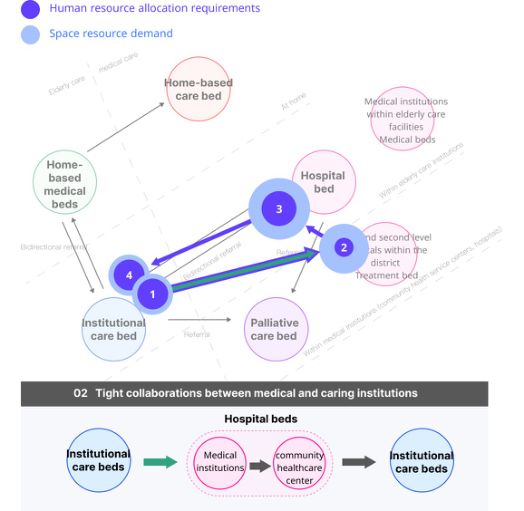
Case 2: Tight Collaborations Between Medical and Caring Institutions Senior citizen S lives in a nursing home and has experienced a sudden urinary tract infection which requires emergency treatment. Noticed by the caregiver, S was transferred to a secondary hospital in the first instance through the Green Channel of FBL. After discharge, S was first transitioned to a community health service centre (primary hospital) for specialised rehabilitation and then was ultimately returned to the original nursing home after fully recovering.
Figure 3: Service scenario in the second case (drawn by the authors).
Integrated Medical and Elderly Care in Shanghai 77
This case demonstrates the effectiveness of transitions between caring institutions and different tiers of hospitals. Plus, in these emergency scenarios, Green Channel of FBL exhibits great potential in rapid service coordination.
However, two challenges might affect the progress of FBL. Firstly, as noted in the GIS analysis, the uneven distribution of spatial facilities might interfere with the implementation of FBL. The two hospitals and one nursing home in this case are rather isolated from others. Senior patients in those institutions might not receive equally rapid service as in this case. Secondly, from a human resources perspective, the prompt notification by caregivers in the nursing home underscores the importance of rapid responsiveness. Yet, as noted, currently, both the caregiver and physicians are inadequate. Therefore, it poses challenges for comprehensive prompt service for all senior patients across the district.
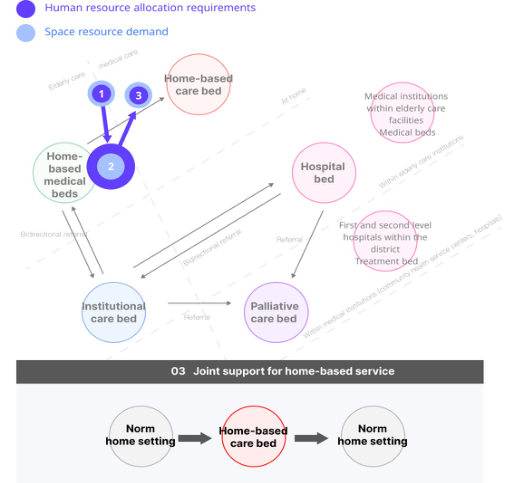
Case 3: Joint Support for Home-Based Service This case of senior citizen F demonstrates the capacity of joint support of various resources to home-based by FBL. F, 78-year-old, live alone at home and suffered a spinal compression fracture after slipping on the stairs. Due to chronic diseases, F received conservative treatment, including strict long-term medication and rehabilitation exercises. Regarding the wish for home-setting caring, a ‘home-based medical bed’ was equipped for F. The solitary living conditions and the continuous treatment highly require support from both the community caring centre (caring institution) and health service centre (medical institution). After the recovery, the home setting of F was restored to its original state.
Figure 4: Service scenario in the third case (drawn by the authors).
In this case, FBL provides multiple resource support for the home-based service. For human resources, a joint team of the community caregiver and medical professionals collaborated in the treatment with on-site service 3 times a week. The success in such a case mainly relies on the capacity of the community and its surroundings. Therefore, once again, certain amount of communities are limited by the accessibility and availability of other resources. Besides, not all households have the condition to accommodate ‘home-based medical bed’ services, for example, the sufficient space for long- time medical equipment. In conclusion, it remains challenging to extend the FBL system to each private household for solo-living senior residents in Jing’an.
Summary of Case Analysis Through the above cases, three key service scenarios within the FBL system are illustrated: (1) the integration of diverse ‘beds’ across institutions, (2) the rapid connection between hospitals and caring institutions, and (3) the joint support for home-based services. These cases may provide three insights for enhancing FBL strategies in the future.
Firstly, the optimization of service streamlines should be highlighted. The complexity of service transitions—such as those in Case 1 and Case 2— places significant pressure on resource coordination in different institutions. Efficient service pathways require streamlined collaboration among the three types of institutions. However, the current human resource shortages, particularly among caregivers and community healthcare staff, challenge the capability of FBL to deliver comprehensive and timely care for all seniors.
Secondly, cross-institutional and cross-departmental collaboration is a key strength of FBL, as shown in all three cases. However, hidden gaps in information sharing and resource integration can result in delays, inefficiencies, and increased burdens on caregivers and families. Enhancing digital platforms for shared data might be a potential approach.
Thirdly, these cases demonstrate that the effectiveness of FBL heavily relies on the spatial distribution of medical and caring facilities. For instance, Cases 2 and 3 highlight how uneven facility distribution in sub-districts, as noted in the GIS analysis, lead to unequal access and delays in service provision. However, regarding the intense built-up cityscape of Shanghai, the system must explore innovative approaches to address the distribution gaps.
CONCLUSION AND DISCUSSION It is noteworthy that the above 3 cases are only benchmark situations in FBL and cannot demonstrate the overall performance of FBL. However, this paper intends to show the potential of FBL through three scenarios and the possible solutions.
In conclusion, there are two obstacle of the future optimization of FBL. Firstly, based on the GIS analysis and case analysis, uneven distribution of spatial and human resources is still the biggest obstacle in the implementation of FBL. In response, new attempts can be witnessed in recent government documents. For example, the public announcement demonstrates that
Integrated Medical and Elderly Care in Shanghai 79
Jing’an District is currently working on the problem of resource distribution by reallocating and increasing the non-public-funded medical institutions (Jing’an District Government, 2023).
Another obstacle is that there is relatively less publicly available data on ‘palliative care beds’. It is partly because palliative service is still in its beginning of progression and complex issues such as the mindset of the palliative have made this service data less disclosed. This paper looks forward to more future research and progress regarding this field. In summary, this case study is an attempt to draw attention on addressing resource disparities and the long-term success of FBL requires a sustained commitment to equitable resource allocation, cross-institutional collaboration, and ongoing innovation in service delivery in the future.
ACKNOWLEDGMENT
The authors wish to thank the experts who provided comments for this research. We also acknowledge the financial support from Tongji University that made this work possible. Finally, the authors deeply appreciate the mutual assistance and encouragement from one another during this research.
REFERENCES
China Research Center on Aging. (2020). Analysis of Disability Status Among China’s Elderly Population. Jing’an District Government. (2023, February 7). Public announcement on resource distribution and non-public-funded medical institutions. Retrieved from https://www.jingan.gov.cn/zmhd/007008/007008001/20230207/e7ed0bb0-ac0e -4c3d-8205-6b0c6c1b5066.html. Jing’an District Government. (2024, April 8). Public information on Jing’an District
healthcare resource distribution. Retrieved from https://www.jingan.gov.cn/xxgk /002013/002013016/002013016010/002013016010003/20240408/340545ff- a4b0-4a59-9032-272d92069cc0.html. National Bureau of Statistics. (2021). The Seventh National Population Census Data.
Website: https://www.stats.gov.cn/sj/pcsj/rkpc/d7c/. Pan, G. (November 17, 2022). Shanghai Jing’an’s home care bed pilot has covered all streets and towns, with a satisfaction rate of over 95% among signed elderly. Xinmin Web. https://www.jingan.gov.cn/rmtzx/003008/003008005/20221117/ 42827dde-18f5-4067-ae83-0d331d3b537b.html. Shanghai Municipal Bureau of Civil Affairs. (2023). Annual Report on Aging and
Elderly Services in Shanghai. Shanghai Municipal Bureau of Civil Affairs. (2024, July 6). 2023 Comprehensive Statistical Information on Shanghai’s Elderly Population, Aging Affairs, and Elderly Care Services Released! Website: https://mzj.sh.gov.cn/2024bsmz/ 20240706/73924c349f4d475a9d46b6019f1a396b.html. Tan, R. (2023). Analysis of Disability Status and Changes in China’s Elderly
Population: Based on the Sixth and Seventh National Population Censuses. Health Economics Research, 40(03), 6–11. The State Council of the People’s Republic of China. (2022). Notice on the Publication of the ‘14th Five-Year Plan’ for National Aging Development and Elderly Care Service System. State Council Gazette of the People’s Republic of China, (07), 13–29.
LISTED IN THE AHFE DIGITAL BOOKSTORE CATALOGUE
Explore the complete digital volume
Human Factors in Aging and Special Needs
Read this individual research paper free through the original publisher, or explore the full digital proceedings book.
ISBN 978-1-964867-50-2
Explore this ISBN in the AHFE Bookstore ↗Listed in the July 2026 bookstore catalogue; search by ISBN to confirm current availability · Digital book purchase optional