Mingyue Wang, Zhang Zhang (2023). Design of Shanghai Style Dressing Furniture from the Perspective of Eye-mind Assumption. In: Affective and Pleasurable Design. AHFE Open Access, vol. 71, pp. 196–205. https://doi.org/10.54941/ahfe1003259
At present, people's demand for furniture products not only stays at the function and structure level, but also gives more and more attention to the cultural connotation. Therefore, infusing more cultural semantics into the product shape is helpful to the creative transformation of furniture products and promotes the expansion of the furniture market and cultural exchange. Most researches in related fields stay on the direct extraction and application of traditional cultural elements, and few research on the aesthetic preference of modeling in a certain style system. At the same time, the past research is more subjective, and lack objective data support and experimental research. Therefore, this study introduced eye movement experiment and scale, combined subjective and objective, and took Shanghai style furniture as the research object to provide more scientific and specific guidance for the research and design of furniture.Firstly, 10 nautical folding three-mirror dressers were collected and selected as the experimental samples; the 10 samples were generalized using Adobe Photoshop to obtain the stimulus materials required for the experiment; secondly, under the theoretical support of the eye-brain hypothesis, 30 subjects were tested and scored according to their subjective preferences using eye-tracking technology; the resulting experimental data were After careful processing, the contrast, purity, and proportion of the 10 dresser samples were calculated using aesthetic formulas; finally, the above three values and the subjective scores of the subjects' preferences were imported into SPSS software and Pearson correlation analysis was used to investigate the correlation between contrast, purity and proportion and preference respectively. It was found that there was no correlation between contrast and preference and between purity, and preference in the experimental samples; the correlation between proportion and preference in the experimental samples was significant and showed a positive trend. The results of this study show that the aesthetic preferences of the public are better served by the excellent proportions of the furniture of the Shanghai-Style. Take the excellent model 7 in the experimental results as the overall framework, and refer to its mirror, countertop, and cabinet proportions for innovation in the design of a freestanding Shanghai style dressing table as the bearer of refinement and tolerance, highlighting the historical heritage of Shanghai.In this study, based on the eye-brain hypothesis, the combination of an eye-movement experiment and subjective scoring questionnaire can screen out the Haber-comb furniture with aesthetic value and in line with the aesthetic preference of the public, which is conducive to cultural inheritance and in turn proves the reliability of the eye-brain hypothesis.
INTRODUCTION OF SHANGHAI-STYLE FURNITURE Shanghai-Style furniture, also known as old Shanghai furniture, is born in Shanghai in modern China. It is an old furniture school with unique charm that integrates Chinese and western art forms. On the one hand, it reflects a high tolerance for the structure, shape and function of western furniture; on the other hand, it continues the traditional decorative patterns, materials, craft technology and cultural connotation of our country (Liu, 2017). Its production is called the turning point from traditional Chinese furniture to modern furniture (Li et al. 2021).
Research on the Design of Shanghai-Style Dressing Furniture 197
Shanghai-Style dressing furniture mainly refers to dressing table and dres- sing, writing dual-purpose table, evolved from the ancient dressing box, dressing mirror frame. Dressers can be divided into freestanding and modular types according to their relationship with other furniture in the room. The combination type refers to the combination of other furniture in order to reduce the space occupation, which is suitable for the small space bedroom; The independent style is more favored by the female group who advocates freedom and shows individuality, and the integrity is strong.
Common dresser modeling generally has two categories, one is the whole mirror in the middle. Another is three mirror, temporarily called it a main mirror and left and right two auxiliary mirror. The three links with hinges, can be adjusted opening Angle. The secondary mirror has a smaller area than the middle mirror and can usually be folded inw- ard to present a closed state. The main mirror can adjust the elevation Angle and depression Angle vertically to achieve the most appropriate Angle (Liu, 2017).
METHOD OF AETHETIC MEASUREMENT The aesthetic attributes of an object mainly include beauty and attractive- ness (Khalighy et al. 2014). Beauty is the inner reality, and relatively stable; Attraction is more derived from the subjective perception of the object, which will change with time, space, and the physiological and psychological differe- nces of the object. By quantifying the aesthetic perception index of the dresser through the eye movement experiment, taking the score of the subjects as its degree of attractiveness and conducting Pearson correlation test, the correla- tion between subjective perception and objective existence can be obtained, so as to guide the design of the Shanghai-Style dressing furniture which not only conforms to the aesthetic tendency of the masses but also has aesthetic value.
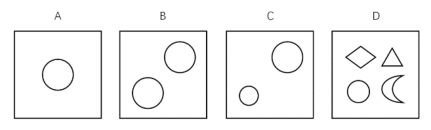
Beauty in design can be explained as the composition of design aesthetic laws, which can be summarized as three interacting concepts: contrast, purity and proportion. The specific explanation of data and aesthetic perception index is as follows: (1) Contrast: It defines the degree of difference between objects and visual elements. Contrast is divided into two categories: the number of ele- ments and the differences between the shapes of several elements, including area, contour direction, detail treatment, etc., which can be measured by purity and proportion respectively. In Figure 1, B has a higher contrast than A, because there are more elements in B than in A; The contrast of D is the highest, because the number of elements in D is not only large but also different, and the complexity is high. (2) Purity: It defines the degree of simplicity to complexity of an object, which is related to the number of elements and can be used as a quan- titative indicator of contrast. In Figure 1, A has higher purity than B, because the number of elements in A is less than that in B. D has the lowest purity.
198 Wang and Zhang
Figure 1: Conceptual diagram of contrast, purity and proportion.
(3) Proportion: It defines the proportion of visual inertia in the total vision and shows the similarity between elements, usually represented by the relationship between the areas occupied by two elements. In Figure 1, B, C and D all have proportions and are different. A is not proportional because there is only one element. (4) The relationship between the three: purity and proportion are varia- bles that describe contrast. Contrast decreases with increasing purity and proportion, so beauty is a specific relationship between contrast, purity and proportion. When the contrast reaches a certain value, the best aesthetic effect can be obtained (Liu et al. 2020).
APPLICATION OF EYE TRACKING TECHNOLOGY IN THE EYE-BRAIN HYPOTHESIS The eye-brain hypothesis was proposed by Just and Carpenter in 1980 (Just and Carpenter, 1980), which holds that the length of human brain’s thinking about an object is equal to the length of its gaze (Zhang and Yang, 2016).
The credibility of this hypothesis has been confirmed in the fields of rea- ding and spatial perception, while the advantage of this hypothesis in the aspect of image observation is that it can avoid controversy. During the rea- ding process, the subject was able to perceive and process the information about BCD in the peripheral points of A through limbic vision at fixation point A, that is, the understanding of BCD began before the formal fixation on the BCD itself. The objection is more to interpret ABCD as words. The reading of words requires the brain processing and understanding of the sub- jects, because the composition of the words themselves follows strict rules. When a paragraph is put in front of the eyes, it will not attract the attention because the words are loose, the words are empty, or the words are suddenly twisted into flowers. However, the existence of these beauty indicators in pro- duct modeling is straightforward and does not need to be explained. When subjects observe product modeling, they do not process and interpret certain words like reading. Therefore, the eye-brain hypothesis is feasible in the eye movement experiment of modeling evaluation.With the support of the eye- brain hypothesis, eye-movement tracking technology can help to achieve the detection of subjects’ preference for experimental samples.
Human mental state can be expressed through physiological behavior, including eye movement behavior. Eye tracking technology can visualize these physiological indicators that are difficult to observe by the naked eye in the form of data, which has the advantage of being objective and accurate. This technology has an early application in psychology and is also widely used
Research on the Design of Shanghai-Style Dressing Furniture 199
in the study of reading, visual search and pattern recognition (Yan, 2003). Excluding the special cases such as daze and wandering, when people face the visual stimulus with certain characteristics, the gaze time of the visual target will be significantly extended. Using the eye-tracking technology to collect the objective visual data of the public on the Shanghai dressing table, combi- ned with the subjective rating to make the judgment of their liking degree is more convincing.
EXPERIMENTAL DESIGN In the experiment, SMI ETG 2W was used to record eye movements, and Begaze 3.7 software was combined to divide areas of interest and col- lect eye movement data. SPSS 26 was used for data analysis (Liu and Yang, 2021). Experiment was conducted in the eye movement lab, uses the stability of artificial lighting, ensure that the interference factors to a minimum.
The experimental subjects were 30 young and middle-aged students and teachers aged from 22 to 30 years old in colleges and universities, among whom 14 were male and 16 were female. The visual acuity of naked eye or corrected was above 1.0, and the eyes and other physiological health were in good condition. Among the subjects, 19 people have experience in selecting and purchasing dressers, 5 people have dressers in their homes, and 10 people have hardly observed dressing furniture.
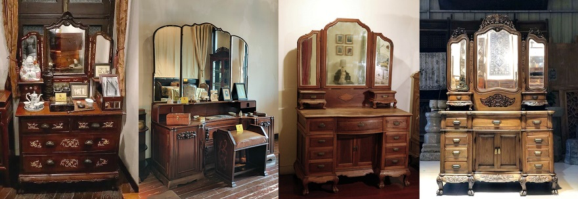
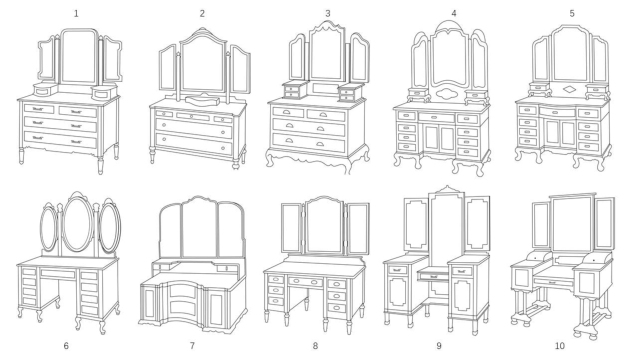
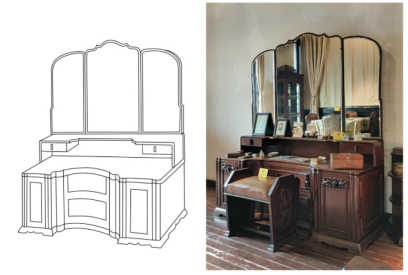
Through reading related books, under the condition of permission to observe museum of Shanghai-Style furniture dresser physical, Shanghai-Style furniture online sales platform for samples. Ten independent dresser samples with three mirrors and overall axissymmetry in line with Figure 2 were scree- ned out and processed with Photoshop. The rough shape lines were extracted to eliminate the factors that may affect the observation of the overall shape, such as the material and carving details. The axonometer diagram was drawn and the proportion was adjusted to be consistent with the physical object to ensure that the independent variable was unique. The sample pictures are numbered, among which No. 1, 2, 6, 8, 9 and 10 are from the Shanghai Fur- niture Development Classic (Liu, 2017), No. 4 and 5 are from Shanghai Yigu Furniture Factory, and No. 3 and 7 are from Shikumen House Museum, as shown in Figure 3.
Figure 2: Axially symmetrical dressing table with three mirrors.
200 Wang and Zhang
Figure 3: Sample images of dressing tables 1 to 10.
The experiment process consists of the following steps: (1) Subjects were given a general training on the knowledge related to Shanghai-Style furniture to help the smooth running of the experiment and to avoid confusion during the observation process that could affect the actual oculomotor physiological data. (2) Subjects were led into the oculomotor laboratory and informed of the operating instructions to ensure they had a clear understanding of the experimental procedure. (3) Prior to the experiment, the seat-to-screen distance and screen height were adjusted and assisted with a head support if necessary to keep the subject’s viewing distance at around 60cm for a five-point calibration. (4) After calibration, a slideshow of the experimental samples was automa- tically played, with each sample picture remaining for 7s and a 5s blank screen set between samples to allow the subject to take a short break to reduce the impact on the next sample. (5) In order to avoid the impressions left during the experiment having a large correlational effect on the subsequent scale scores, subjects rated the 10 samples on a scale of 1 to 10 according to their subjective preference and aesthetic preference one week after the eye movement experiment.
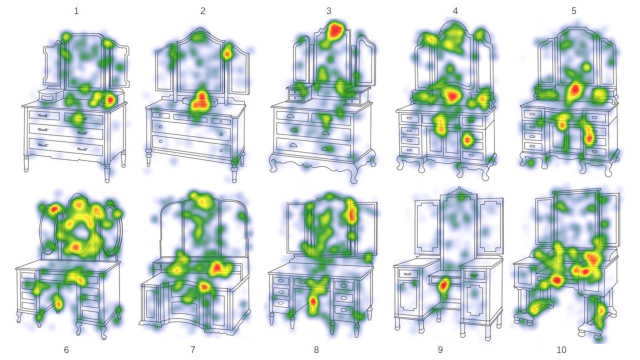
AETHETIC VALUES AND SUBJECTIVE PREFERENCES CORRELATION TEST Subjects’ subjective preferences for each sample image were scored and ave- raged. The experimental data were imported into Begaze 3.7 to obtain the total number of fixations in the area of interest of each sample image, the total time of each sample image, the average fixation per fixation per sample image, the visual intake per fixation. Get heat map, as shown in Figure 4.
Research on the Design of Shanghai-Style Dressing Furniture 201
Figure 4: Sample images of dressing tables 1 to 10.
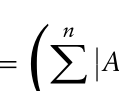
According to the definition of contrast, T=total time, A=average fixation, V=visual intake and n=number of subjects, the contrast index (C) can be calculated with the following formula:
!
Equation reproduced from the original PDF.
Based on the definition of purity, N = number of fixations, the purity index (Pu) can be calculated as follows: Pu = 1 ÷ N (2)
Based on the definition of proportionality and the relationship between the three, then the proportionality index (Pr) can be calculated with the following formula: Pr = (N ÷ C) × 0.01 (3)
After the relevant data obtained from the experiment were substituted into the formula, the fixation point, total fixation duration, contrast, purity and proportion of 10 experimental samples were obtained, as well as the average score of subjects’ preference degree obtained from each sample picture, as shown in Table 1.
Import the experimental data into SPSS software, and conduct Pearson cor- relation test for contrast and preference degree, purity and preference degree, proportion and preference degree of experimental samples respectively. The results are shown in Table 2.
The data in Table 2 shows that there is no correlation between contrast and preference and between purity and preference for the experimental sam- ple; the correlation between proportion and preference for the experimental sample is significant.
202 Wang and Zhang
Table 1. Point of gaze, total gaze duration, contrast, purity, scale and preference data for all experimental samples.
**. At the 0.01 level (two-tailed), the correlation is significant. *. At the 0.05 level (two-tailed), the correlation is significant.
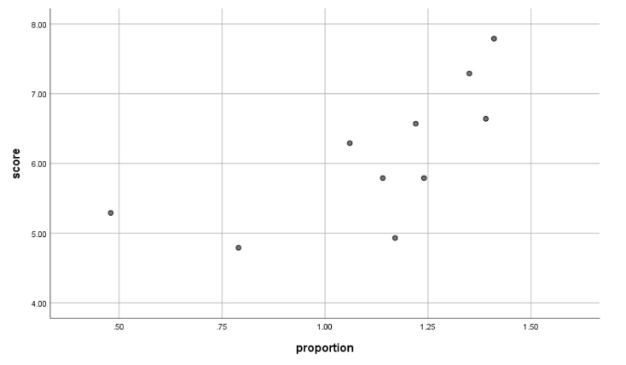
Figure 5: Scatter plot of the correlation between the proportion of the experimental sample and the preference data.
Combined with the scattered layout in Figure 5, it can be seen that propor- tion and preference are positively correlated, so the nautical dresser look in the experimental sample image numbered 7 is the most popular in this group.
Research on the Design of Shanghai-Style Dressing Furniture 203
DESIGN OF SHANGHAI-STYLE DERSSING TABLE BASED ON THE EXPERIMENTAL RESULTS Since the ratio values obtained in this experiment did not exceed 1.50, the conclusions were only discussed in the range of 0∼1.50. According to the experimental results, there is a strong correlation between the proportion index of Shanghai-Style dressing table and people’s subjective preference for its shape, and when the proportion index changes within the range of 0∼1.50, the greater the value, the higher the preference. This shows that in order to design Shanghai-Style dressing furniture in line with the public aesthetic pre- ference, we should focus on the overall shape proportion and control it in a good numerical interval, that is, limPr→1.50. At the same time, No. 7 dres- ser (see Figure 6) among the 10 samples can be regarded as a model for the innovative design of Shanghai-Style dresser.
Taking the excellent model 7 from the experimental results as the overall framework, the design of the freestanding dressing table of the Sea School was innovated with reference to its mirror, countertop and cabinet propor- tions, and on this basis the decorative details were refined and simplified, reflecting the traditional spirit of the fusion of East and West in the Sea Sch- ool culture, while conforming to the modern furniture style where simplicity is paramount. The lower half of the cabinet is hollowed out in the middle to allow space for the legs to be placed, and the original cabinet is designed with removable drawer shelves for easy cleaning; the handles are simple geometric forms, contrasting with the traditional sea school culture and adding interest.
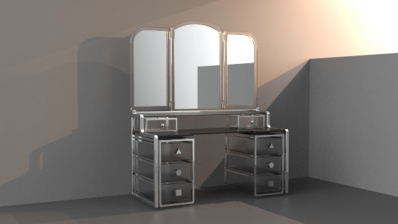
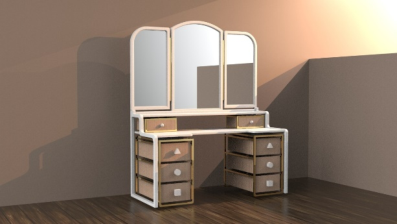
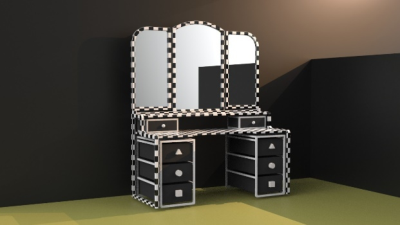
Figures 7–9 show the final dressing table form, which is compatible with a variety of CMF matching options, responding to a diverse market demand (Xu, 2021) for a modern design attempt. Figure 7 shows the dressing table with a silver metal frame and frosted glass, which is avant-garde and modern, with a strong sense of technology; Figure 8 shows the dressing table with a large area of wood (Chen et al. 2022) and golden metal, giving a warm and simple feeling; Figure 9 shows the dressing table with drawers made of toned PVC, while all other parts are painted, allowing for individual colour matching according to consumer needs.
Figure 6: Excellent design template.
204 Wang and Zhang
Figure 7: Metal & frosted glass.Figure 8: Metal & wood.Figure 9: Panel & PVC.
CONCLUSION
On the basis of the eye-brain hypothesis, a combination of eye-movement experiments and subjective rating questionnaires allowed for the selection of furniture with aesthetic value and in line with the aesthetic preferences of the masses, and also proved the reliability of the eye-brain hypothesis in reverse. The conclusions drawn from the experiment are as follows: (1) Dressing-type furniture with good proportions is more aesthetically valuable and more desirable. (2) Other aesthetic values, such as purity and contrast, also affect the overall aesthetic value of dressing-type furniture, but there is no correlation between them and the subjective perceptions of the subjects.
Research on the Design of Shanghai-Style Dressing Furniture 205
(3) Proportionality can be a primary consideration in the design of morph- ological refinement, and appropriate adjustments can be made in con- junction with eye-movement experiments to bring the proportionality index as close to 1.50 as possible.
Modern design is often prone to a lack of cultural connotation. As a bearer of refinement and tolerance, and a manifestation of Shanghai’s histori- cal heritage, Haipai furniture should receive more widespread attention and importance. The final design creates modern dressing furniture with a nau- tical connotation, helping to open up the market for nautical furniture. The inheritance and innovation of Haipai culture will help people to understand more deeply the natural and human elements of Shanghai’s characteristics and the all-encompassing cultural spirit of the city, and to re-examine the meaning of modern or post-modern design under its guidance (Dai and Qiu, 2016). The research of this experiment focuses on the overall shape of Shanghai- Style dressing furniture. In addition, wood types, carved patterns, decorative parts, the application of mortise and tenon structure, space placement and other aspects are worthy of further study.
REFERENCES
Chen Ningfeng, Zhang Zhang, Dai Yuxuan. Design of Aging Care Bed Based on INPD and Entropy Weight Method [J/OL]. Packaging Engineering: 1-14[2022- 04-05]. http://kns.cnki.net/kcms/detail/50.1094.TB.20210716.1906.014.html Dai Yunting, Qiu Weili. The Art Deco Gene in Shanghai Style Furniture: Localiza-
tion of Western Furniture & Westernize of Chinese Furniture [J]. Art&Design, 2016(4): 37–39. Just MA, Carpenter PA. A theory of reading: from eye fixations to comprehension.
Psychol Rev. 1980 Jul;87(4): 329–54. PMID: 7413885. Khalighy S, Green G, Scheepers C, et al. Measuring aesthetic indesign[C]//DESIGN 2014 13th International Design Conference. 2014. Li Ruoyao, Zou Weihua, Yu Wenxuan. A study on the Development of Shanghai-
Style Furniture Artistic Style [J]. Furniture & Interior Design, 2021(3): 12–15. DOI:10.16771/j.cn43-1247/ts.2021.03.003. Liu Feng. Shanghai style furniture development classics [M]. Shanghai: Shanghai Science and Technology Press, 2017. Liu M, Yang S. The Influence of Icons on the Visual Search Performance of APP List
Menu[M]. 2021. Liu P, Wang K, Yang K, et al. An Aesthetic Measurement Approach for Evaluating Product Appearance Design[J]. Mathematical Problems in Engineering, 2020, 2020. Xu Boming. Forty Years of Contemporary Chinese Furniture Evolution and Future
Trends [J]. Furniture & Interior Design, 2021(1): 1–3. DOI:10.16771/j.cn43- 1247/ts.2021.01.001. Yan Guoli. A magic science to explore the mystery of the window on mind [M].
Beijing: Science Press, 2012. Zhang Qi, Yang Lingyu. Learning Measurement Progress and Trends in e-Learning— —Based on Eye Movement Application Perspective [J]. Electrifying Education, 2016(11):6.
LISTED IN THE AHFE DIGITAL BOOKSTORE CATALOGUE
Explore the complete digital volume
Affective and Pleasurable Design
Read this individual research paper free through the original publisher, or explore the full digital proceedings book.
ISBN 978-1-958651-47-6
Explore this ISBN in the AHFE Bookstore ↗Listed in the July 2026 bookstore catalogue; search by ISBN to confirm current availability · Digital book purchase optional