Yoshifusa Matsuura (2023). Skill training method aiming at empathy for body movements in the manufacturing industry. In: Affective and Pleasurable Design. AHFE Open Access, vol. 71, pp. 120–128. https://doi.org/10.54941/ahfe1003251
This study explores a new approach to effectively learn manufacturing skills that involve physical movements. While automated welding machines and welding robots have been introduced in the welding field, manual welding is still widely used in many manufacturing processes. However, due to the intense arc light, it is difficult to directly observe the operator's posture and the operation of the electrode holder, which are critical for training purposes. In general, novices learn by observing expert welders and imitating their physical movements. However, novice welders struggle to control their bodies to assume the posture to be imitated, making it challenging to acquire the necessary skills. In welding, the primary training is the behavior of the covered electrode, which can be observed, but understanding how to control the body is difficult. As a result, the acquisition of welding skills does not improve, and motivation for training decreases.To address this problem, the researchers developed a method for structuring skill information by applying the factor analysis of quality engineering methods. In this method, the objective of welding skill acquisition is defined as "improvement of welding quality," and welding skills are structured as follows:(a) Direct factors: Information on the molten pool and arc that directly affect the weld quality(b) Indirect factors: Information on the operation of the welding electrode related to the direct factors(c) Somatic factors: Body part information that controls the manipulation of the welding electrode(d) Somatosensory factors: Somatosensory information that controls the body factors.Previous teaching methods focused on explaining the molten pool and arc conditions during welding, as well as the position and angle of the welding electrode, but provided little explanation of body part control for proper manipulation of the welding electrode. Consequently, novice welders were unable to predict the operation of the welding electrode and their body movements during the operation. This method of structuring skill information enables instructors to understand the necessary structure of skill information for training and provide adequate explanations to novice welders. The novice trainee can visualize, in advance, the state of the body parts required for the proper control of the welding rod and can train while being aware of those body parts. Consequently, the instructor and novice trainee can discuss based on the structured information and train while understanding each other's imagined information. This approach is expected to create a training environment that is satisfactory to the novice trainees and increase their motivation.
This paper proposes a novel educational support method that effectively improves shielded arc welding skills. Welding can be employed to firmly join metals such as steel and stainless steel, and is used in several products and buildings. In recent years, there has been an increase in the number of cases in which welding processes in factories have been automated using automa- tic welding machines and welding robots. However, the demand for welding technicians remains high. In welding, the condition of the molten metal dire- ctly affects the quality; therefore, the stabilization of the molten pool (melted
A Skill Training Method Aiming at Empathy for Body Movements 121
part) is extremely important. Therefore, to prevent quality deterioration due to oxidation of the molten metal, inert gas is constantly blown around the molten pool, and attention is paid to the welding posture and movement of the welding rod to continuously stabilize the shape of the molten pool. There- fore, automation of the welding process is limited to manufacturing processes in which the molten pool can be stabilized relatively easily, and the burden of equipment investment is also significant. In fact, manual welding is employed in a considerable number of manufacturing processes, in addition to welding, which requires a high level of quality, such as high-pressure piping in plant factories, welding of thin metal plates, and welding that is highly versatile at construction sites.
Therefore, it is necessary to train several welding technicians; however, they cannot directly observe the welding work owing to the intense arc light during welding. Generally, in welding skill training, a training method is implemented in which the state of the arc light and molten pool during wel- ding is observed via a light-shielding mask, and the quality is evaluated from the state of the weld bead after welding. Recently, a method employing videos taken with a special camera capable of capturing the arc light and molten pool as learning materials and a VR welding training system has been developed. However, the information during training is limited to visual information, and the technician’s posture and upper-body movements during holder ope- ration, which significantly affect the welding quality, are rarely used. Skill training involving general body movements is performed by observing the actual skills of experts and then imitating the body movements. Therefore, the similarity of body postures and movement of body parts is important, and is used to evaluate the degree of skill acquisition. However, it is very difficult for beginners to control their bodies to maintain the posture of the imitation target. In the case of welding, training is mainly based on observable behavi- ours of the welding rod; however, it is difficult to understand how to control the body. Accordingly, the learning of welding skills does not improve, and the motivation for training decreases.
Therefore, in this study, we first examine the challenges of welding skill analysis using the conventional method and clarify the skill information necessary for both the learner and instructor from the analysis of the skill lear- ning process. Based on these results, the skill information structuring method developed by the author will be explained by applying a factor analysis of the quality engineering method. Furthermore, using this method, we will pro- pose a new training method for shielded arc welding and implement it for beginners. Ultimately, from the mutual understanding of sensory informa- tion related to skills, the teacher and learner will realize “empathy” as a state of feeling the information outside the body in the same way and will be able to recall very similar images. In addition, the process of satisfaction with skill improvement will also be described.
WELDING SKILL ANALYSIS BY CONVENTIONAL METHOD AND ITS PLOBREMS The author has been developing skills training support methods focusing on the physical knowledge of welding skills and targeting shielded arc welding,
122 Matsuura
which is manual welding. The author’s early welding skill research was called the “expert novice research”, and like several skill researches, first, the lear- ner’s movements were compared with those of an expert, and the degree of proficiency was determined (Matsuura, 2010), (Matsuura, 2012). We develo- ped a system in which the motion position information of the upper body and welding holder during welding was acquired by a 3D motion capture system, and the learner’s motion was compared with the expert’s motion to deter- mine the proficiency level. Simultaneously, the positions of body parts and muscle activity were measured, and the MT system (Taguchi, 2001), which is a pattern recognition method in the field of quality engineering, was emplo- yed to determine the degree of proficiency. This made it possible to judge body movements and muscle activity based on proficiency; however, a serious challenge emerged when a skill-education support system was subsequently developed.
First, there is a challenge, in that the standard changes when the expert compares changes. Particularly for skills related to body movements, there is a significant difference in the position of body parts, muscle activity, and the evaluation criteria, depending on the difference in physique and the teaching method of experts; the standard is averaging, and the variance range becomes large, making it impossible to make an accurate judgment.
Second, even if a motion judged to have not reached the goal is presented as learning information, the learner cannot control the position and move- ment of his or her body part like an expert. Conventional skill research does not deal with learning information on how to properly control the body. The- refore, learners will have to adopt a trial-and-error method, and because they cannot acquire skills effectively, the goal is to simply “imitate the movements of experts.”
Finally, even if the experts’ physical and guide information are presen- ted during welding, they cannot be recognized or understood. According to the author’s survey, most of the existing research on skill learning support is aimed at analysing the level of proficiency, and there is approximately no rese- arch that directly presents information on body movements for the purpose of improving the level of proficiency. In the body movement learning experiment conducted by the author, an experiment was conducted in which the learner’s upper body image and expert’s image were presented simultaneously on a see- through HMD in real time. This was impossible; therefore, it is necessary to support skill learning by selecting factors for real-time monitoring based on learners’ proficiency.
METHOD FOR STRUCTURING SKILL INFORMATION In general, the initial learning of physical skills imitates expert movements. The hypothesis was made that in addition, it is important to select appro- priate monitoring items at the time of acquisition, because only one or two elements can be monitored in real time by a person during physical exercise. The purpose of welding skill learning is to improve the welding quality of the target, and from the author’s hypothesis, it is necessary for the learner to monitor the factors that directly affect the quality of the welding process
A Skill Training Method Aiming at Empathy for Body Movements 123
in real time. Furthermore, to accurately control this factor, we believe that physical control is necessary to control the indirectly related factors.
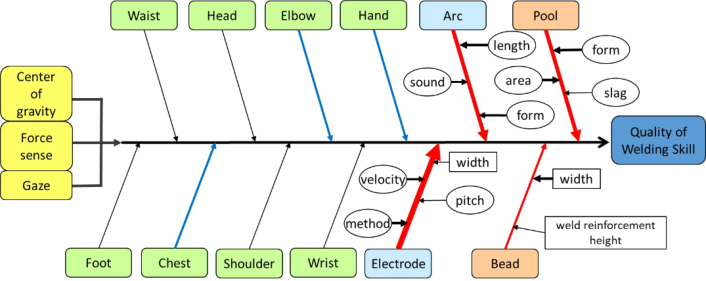
Based on the above hypotheses, the author proposed a method for stru- cturing skill information, considering three factors: evaluation, real-time monitoring, and control (Matsuura, 2015). Structuring defines the following five factors (see Figure 1).
(1) Direct factors: factors that directly affect the quality of skill deliverables. This is generally regarded as an evaluation item in skill education. (2) Indirect factor: defined as a factor that affects the direct factor. These indirect factors comprise N-th order indirect factors, depending on the skill. The indirect factors represent the conditions of the machi- nes, instruments, and tools to be operated. This method is subject to real-time monitoring. (3) Physical factors: defined as physical factors. This physical factor is defi- ned such that the body part that operates the machine/instrument, which is an indirect factor, is the upper physical factor, and the degree increases as it approaches the trunk. (4) Somatosensory factor: defined as a factor related to body-manipulation control. It is a sense of the position of the centre of gravity and activation site of muscle activity, i.e., what kind of balance should be achieved, which site should be consciously stressed, and which should be relaxed. This somatosensory factor has rarely been addressed in conventional skill education. (5) Visual factors: defined as factors related to gaze points. It is important to pay attention to the location and vibrations during movement. There is little information on this visual factor in conventional education.
In the field of shielded arc welding skills, the information necessary for skill training has been investigated in the literature, multimedia teaching materi- als, and actual skill training sites. In addition, we apply the fishbone diagram, which is a quality engineering technique, to visualize the relationship between each factor of skill information. Characteristics are defined as skill quality, and items that affect quality are specified as the main factors. The evaluation
Figure 1: Fishbone diagram for welding skill information.
124 Matsuura
items are described as sub-factors of the factors and are visually expressed by drawing squares for quantitative evaluation and circles for qualitative evaluation.
PROPOSAL OF A NEW SKILL TRAINING METHOD AIMING AT EMPATHY In the skill information structuring method explained above, comprehensive information is collected on factors related to skill quality. In conventional skill learning, the obtained information is evaluated based on the informa- tion of an expert, but there is approximately no discussion on how to use the evaluation for learning. Because it depends on the imitation learning of the learner at the time of learning, it ends up imitating the “shape” from beginning to end. In particular, it is necessary to handle multiple temporally and spatially dynamic pieces of information, and it is extremely important to teach which information should be used for learning at what time. In addi- tion, there are approximately no examples of somatic sensations being taught by professors, and it is necessary for technicians who actually work to notice and recognize it as a sensation.
Therefore, when considering the cognitive process of skill movements, we set the following three attributes: (a) consciousness, (b) attention, and (c) evaluation.
(a) Consciousness attribute: defined as the information that the subject is conscious of before performing the skill, to increase the sensitivity of the sensory organs that receive the specific information necessary for skill acquisition. For physical skills, the body parts that affect skill quality and sensory information during control are applicable. (b) Attentive attribute: defines the information that the subject concentra- tes on during practice. This is based on the same technology as system monitoring in machine control systems, compares the attention attri- bute information with the reference image that the learner remembers in advance during practice, and determines the parameters for controlling body movements. (c) Evaluation attributes: are to be evaluated when performing the action by comparing the attention attribute with the reference in real time during skill implementation, quality of the deliverable after completion, and overall body movement, which is defined as the information for evaluating quality according to the purpose of skill acquisition.
We propose a design method that selects the necessary structured skill information by considering the above attributes.
(1) Clarification of skill proficiency targets and related factors. The relationship between the indirect factors that affect the quality of the target proficiency level and physical factors related to indirect factors is cla- rified. In addition, it should be considered that the evaluation is only for welding quality and that imitation of body movements is not the purpose of learning.
A Skill Training Method Aiming at Empathy for Body Movements 125
(2) Recall the skill-action image. The purpose is to stimulate “awareness” by recalling the skill movement and physical sensation at that time. In particular, by presenting muscle acti- vity, force information of parts, and physical sensation information at that time, we believe that it will be easier for learners to understand the relati- onship between physical sensations and movements by being aware of the sensory information of multiple body parts.
(3) Proficiency and attention attributes Determine the items to be carefully monitored during the operation. Because one or two items can be monitored while a person is moving, the monitoring items are set according to the target proficiency level.
(4) Comparison with images of monitoring items. Practice by comparing the monitoring items and images before learning while moving. Record information that differs from the image.
(5) The relationship between product evaluation and monitoring items. First, we evaluate the target quality of deliverables. Furthermore, we exa- mine the monitoring items as an evaluation factor. In addition, we examine whether the discrepancy information recorded in (4) affects the evaluation of deliverables.
The information necessary for all processes is selected from the structured skill information, designed to be presented to learners, and evaluated. It is important to note that the items to be monitored during the learning of the information and skills create awareness and allow the items to evaluate the deliverables. In addition, (2) is similar to image training; however, the teacher presents as much physical sensory information as possible to the learners. This aims to stimulate the sensory organs and create awareness during the image-training stage of the learner. If the sensory organs are not excited, we will not notice it even if we perform several movements. Failure to do so leads to a loss of motivation.
In (3), by paying attention to the items that lead to the evaluation necessary for the target skill proficiency during skill learning and comparing them with their own image as a standard, it is possible to clarify the cause of the evalu- ation of deliverables. By designing and developing a skill education support system based on the above educational process and information, learners will be excited in advance to a state that is easy to notice from a lot of informa- tion related to skills, and will be able to have a comparison standard. This difference is expected to be recognized. However, if the teacher is in a similar state, it will be easier for the teacher to understand the physical sensations of the learner, and it will be possible to gain empathy from the learner.
LEARNING EFFECT OF SKILL TRAINING PROGRAM BY SKILL STRUCTURING METHOD We conducted an experiment using a novel teaching method based on skill information structuring that considers the proficiency level proposed in this study, targeting the acquisition of welding skills in university factory trai- ning (Matsuura, 2019). The purpose of the conventional training method was to have students experience manual welding, and practical training was
126 Matsuura
performed after explaining the shape of the molten pool, arc length, and angle between the welding rod and metal plate to be welded. Most of the skill information dealt with here are attentional factors, and there is no con- sciousness factor. Therefore, even after repeated learning, it was not possible to understand how the hand holding the welding holder should be conscious of the upper arm, how the line of sight should be conscious, and what should be paid attention to regarding the molten pool and arc state to achieve good and stable welding. However, it was not possible to be improved within the training time.
Therefore, a new learning program was created and implemented by stru- cturing skill information, considering beginner-level technicians’ proficiency. Controlling the welding rod is important for the stability of the molten pool and arc state, and we determined how this control should be performed by the upper arm and hand supporting the welding holder. From this structu- ring, in the image training before the practical skill, the following can be observed (a) the upper arm movement to lower the welding holder vertically downward at a constant speed considering the shortening of the welding rod and movement of that movement. (b) If the upper arm is moved vertically downward while the molten pool advances, the molten pool will draw an arc; therefore, the straight line of the weld line should be controlled. Two consciousness factors were selected, namely, the control of turning the wrist slightly to maintain the During practical training, it is necessary to monitor whether the state of the molten pool and arc is stable, and these factors were considered. Bead quality was clarified as an evaluation factor, and these were used as new learning contents.
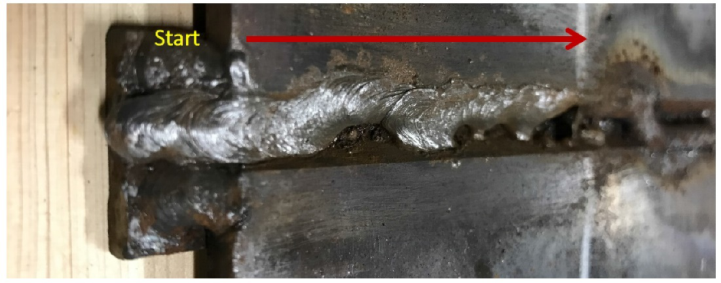
The subjects performed butt welding for the first time. In the results of the tenth trial using the conventional teaching method, a slight bead was formed at the start of welding. However, because of the strong intention to move the welding rod in the direction of the weld line, even though the welding rod had melted because the height of the holder was approximately constant, the arc length became longer, resulting in insufficient bead formation (see Figure 2).
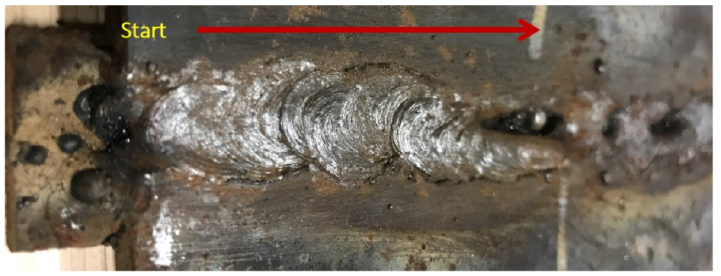
However, the result of the new teaching method is that the bead shape is insufficient, even though the state of penetration into the base metal is con- siderably improved. In an interview with the subject, he said that he was
Figure 2: Example of bead appearance result by the traditional teaching method.
A Skill Training Method Aiming at Empathy for Body Movements 127
conscious of maintaining a constant arc length and melting the welding rod into the molten pool. However, because the angle of the hand holding the hol- der was not conscious, it became constant, and accordingly, the upper arm from the hand to the elbow moved in an arc. Therefore, as the welding pro- gressed, the welding rod came into contact with the groove surface, and the angle was altered hastily, resulting in an imperfect bead shape (see Figure 3).
In the new teaching method, the learners became aware of the relationship between the attentional and evaluation factors, and they set up tasks and tried them out regarding the causal relationship with the quality of the evaluation. In addition, in the interview after the experiment, I tried to explain the feeling of body movement, operation of the welding rod, and state of the molten pool and arc at that time. In addition, not only did the awareness of the arc state and holding hand, wrist, and upper arm increase, but also the amount of speaking increased. This is because the learner’s motivation is improved and it is considered that it is possible to realize independent learning. In addition, the fact that the number of utterances related to skill movements increased means that awareness of the state of body movements and somatosensory sensations was created, and it can be said that the awareness of verbalizing and communicating with third parties improved. It is considered that the same effect can be obtained for experts, and it can be said that it is possible to support the learning of physical skills by “empathy.”
Figure 3: Example of bead appearance result by the new teaching method.
CONCLUSION
In this paper, we introduced the development of a skill information structu- ring method by applying the concept of body knowledge to skill movements in welding skill education and proposed a novel welding learning support method using structured skill information.
Welding skills, which are the subject of this study, also require the develo- pment of effective training support methods. In particular, because the work is performed under a strong arc light, it is not possible to directly observe and imitate the movement of the rod and body during welding. Therefore, in this study, we developed a skill information-structuring method and further
128 Matsuura
considered the process of skill acquisition. We proposed a new skill educa- tion support method that explicitly attached meaning. It was introduced that this method stimulates learners’ awareness, makes them simulate skills, and realizes effective learning.
In the future, we will develop a system that visually presents the relation- ship between the somatosensory factors at the time of learning and evaluation results to the instructor and learner so that both learners notice the skill information necessary for proficiency and recall the same image. We aim to develop a new skill learning support method that can realize “empathy.” Furthermore, we expect that this method will become the basis for creating an environment that leads to skill inheritance and development via discussi- ons among technicians by noticing the tacit knowledge that technicians have acquired.
ACKNOWLEDGMENT
This work was supported by JSPS KAKENHI Grant Numbers JP18K1156, JP21K02740.
REFERENCES
Matsuura, Y. and Takada, H. (2012). Development of the evaluation proficiency method on welding skill. In: The 26th Annual Conference of the Japanese Society for Artificial Intelligence. Matsuura, Y. and Takada, H. (2019). Development of welding skill education sup-
port system (proposal of skill information structuring method corresponding to required skill level). In: The Proceedings of the Technology and Society Conference 2019. Matsuura, Y. and Takada, H. (2010). Study on evaluation method of welding skill motion. In: The 24th Annual Conference of the Japanese Society for Artificial Intelligence. Taguchi, G., Chowdhury, S. and Wu, Y. (2001). The Mahalanobis Taguchi system.
New York: McGraw-Hill.
LISTED IN THE AHFE DIGITAL BOOKSTORE CATALOGUE
Explore the complete digital volume
Affective and Pleasurable Design
Read this individual research paper free through the original publisher, or explore the full digital proceedings book.
ISBN 978-1-958651-47-6
Explore this ISBN in the AHFE Bookstore ↗Listed in the July 2026 bookstore catalogue; search by ISBN to confirm current availability · Digital book purchase optional