Shinya Nagasawa, Yusuke Irisawa (2023). Brand Design based on Kansei Product Development: Integration among Customer Experience, Kansei Value, and Emotional Design. In: Affective and Pleasurable Design. AHFE Open Access, vol. 71, pp. 129–139. https://doi.org/10.54941/ahfe1003252
In this study, we have summarized the theories about the customer experience and have discussed the central position of the theories and the relationship between the theories. In addition, we attempted an analysis of two cases one involving a movie and the other a car. On the basis of this discussion and case analysis, the products and services in which the concept of emotional design is applied can be positioned as customer stimuli (i.e. stimuli of consumption behavior), by which the customer experience is created through Kansei information processing. We have also verified the fact that this process is experienced by the customer.In terms of customer experience, which is difficult to manipulate and control, first, the customer’s experience can be targeted by asking the question, “What kind of experience do you want customers to have?”, and the products and services can be designed by a process in a direction opposite to that discussed in this study. This can be seen as a new product design methodology, which we define as “Customer Experiential Design” and which makes this study unique.In conclusion, we have considered and analyzed the process of design of products and services by focusing on the customer experience. The experience of customers, which is difficult to manipulate and control, has been clarified, and it is possible to implement product design in such a way as to realize the experience of the assumed customer. In addition, in this study, we have made suggestions about product design and the design process, focusing on the customer experience itself, as well as the related research and business.
In today’s harsh corporate environment, product development that attracts customers and social groups is an essential requirement in order to differen- tiate from other companies and create a competitive advantage. In particular, emotional product design that appeals to customers’ Kansei and actions is still considered as an important theme.
In particular, research on experiential marketing that focuses on custo- mer experience (CX), research on user interfaces in cognitive psychology that focuses on customer psychology, and sensibility that focuses on customer sen- sations, feelings, and ease of use. Many studies are being conducted from the business side, including research on marketing.
In this research, we will focus on the customer experience (CX) theory advocated by Bernd H. Schmitt, the Kansei information processing process advocated in Kansei science and Kansei engineering, and the emotional design
theory advocated by Donald A. Norman. We theoretically consider what kind of position the theoretical position of design elements is, and what kind of relationship there is between theories. Through case analysis, we try to consider how the process can affect the experience of difficult-to-manipulate customers.
PREVIOUS RESEARCH ON CUSTOMER EXPERIENCE AND KANSEI Outline of Customer Experience (CX)
Customer Experience refers to the act of seeing customers as “creatures of reason and senses,” and as their own experiences associated with the consum- ption of products and services. As shown in Table 1, it can be classified into five experiences: SENSE (Sensory), FEEL (Emotional), THINK (Cognitive), ACT (Behavioural) and RELATE (Relational) (Schmitt 1999). This study addresses the customer’s global experience that derives from consumption. Instead of simply considering products and services themselves, emphasis is given to the customer experience (CX) created from the consumption of pro- ducts and services. This concept is rooted in the way customers are perceived; Morris B. Holbrook was the first to see customers as ‘creatures of reason and senses’ and stated that ‘consumption is often influenced by emotional responses’ (Holbrook, 1982).
Previous theoretical studies that have focused on customer experience (CX) include an analysis of the strategic executing conditions required to realize customer experience (CX) (Nagasawa and Yamamoto, 2005), a study into customer experience (CX) derived from design (Nagasawa and Yamamoto, 2007) and a study into experience and hospitality values (Nagasawa and Fuji- wara, 2007). There have also been many case studies on customer experience (CX) that have examined long-established Japanese companies and foreign brands, such as Hermès.
However, although customer experience (CX) has been examined from theoretical aspects and case studies, it may be possible to further explore this topic from the perspective of the practical values of businesses.
Outline of Kansei The term ‘Kansei’ has been given philosophical, epistemological and psych- ological definitions, but it can be seen as a sensuous and irrational element that opposes reason and intelligence. There have been a wide range of Kan- sei-related studies, such as Kansei marketing, Kansei science and engineering
Brand Design Based on Kansei Product Development 131
and Kansei design. However, these studies have all been carried out in the field of cognitive psychology as information processing theory research, and were all designed for human psychology, to process events that occur in the mind (Lindsey 1977).
From this perspective, Kansei can be seen as a series of information flows generated by external stimuli such as products and services, after being transmitted to human sensory receptors: ‘Sense →Perception →Cogni- tion →Emotion →Expression (representativeness)’ (Figure 1). Methodo- logical research for product and service development has made full use of this concept of Kansei (Nagasawa, 2002).
As shown above, research into Kansei has generally been centred on studies from the aspect of human psychology. This research, however, is primarily based on other Kansei-related studies and businesses.
Outline of Emotional Design There have been a wide range of studies into product design in recent years, including user-centred design and Kansei design, which focus on people; eco- design, which focuses on the environment and sustainability and universal design, which has broad consumer appeal.
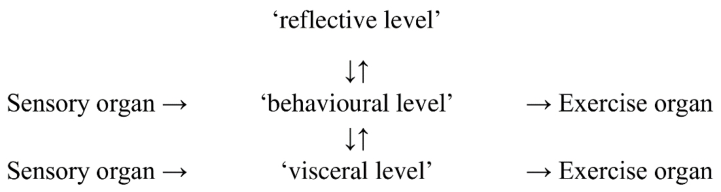
One of the most relevant studies into emotional design was conducted by the cognitive psychologist Donald A. Norman. In this study, he stated that human characteristics can be divided into three processing levels from the perspective of brain function, and that human emotions can be classified as the ‘visceral level’, an automatic and innate level; the ‘behavioural level’, a level that includes the part that controls daily activities and the ‘reflective level’, in which the brain carefully and consciously considers things (Ortony, Norman & Revelle 2004). These three levels mutually interact and influence one another. The visceral and behavioural levels are driven by the perceptions of the sensory organs, whereas the reflective level is driven by conscious thou- ghts. The reflective level also constantly monitors and controls the visceral and behavioural levels (Figure 2).
Figure 1: Information flow in Kansei (adapted from Nagasawa, 2002).
Figure available in the original PDF paper.
Figure 2: Three levels of brain processing (adapted from Norman, 2004).
132 Nagasawar and Irisawa
Still, according to Norman, each level of human emotion requires a design, and it is important to take a design approach of products and services for each level (Norman 2004).
This approach focuses on trying to scientifically understand human cogni- tion and emotion, and to analyse how they affect product design, without mentioning much about customer experience (CX) and how they use the products. However, examining product and service design based on three customer’s levels indicates that product design plays an important role in customer behaviour.
Summary The previous research described above has been based on customers’ psych- ological and emotional aspects, but there has been no analysis centred on customer experience (CX), which is also necessary from the aspect of ensu- ring that product design appeals to the customer experience (CX). Therefore, the next chapters are dedicated to theoretical discussions and analyses centred on customer experience (CX).
THEORETICAL CONSIDERATION THROUGH COMPARATIVE STUDY Position Assumed in Each Theory
As we focus on the customer’s experience, we consider the essential aspects of the experience. The customer’s “experience”means that the customer receives a physical stimulus from the product or service through the use, utilization, or consumption behavior of the product or service that exists outside the customer, and based on that stimulus, the customer’s internal experience. You can think of it as a customer’s response after going through a psychological process. In other words, it can be said that it is a series of processes in which there is a cause that stimulates the product or service, and based on that, some processing is carried out inside the customer, and the result of “customer’s reaction = experience” is obtained.
From this point of view, the theories described in previous studies can be organized as shown in Table 2.
Table 2. The expected position for each theory (adapted from Irisawa & Nagasawa, 2010).
Table available in the original PDF paper.
IPO process Theory Scope Position Objective INPUT (cause) Emotional design Broad design for products/ Services
Eclectic
PROCESS Kansei Information process-based on the psychological side of the brain Subjective Comprehensive experience centered people OUTPUT (result) Customer experi-ential marketing
Brand Design Based on Kansei Product Development 133
The point of experiential marketing is that it classifies and organizes the customer’s experience through the consumption of goods and services, and develops it as a marketing strategy goal to create that experience. In other words, it can be considered a theory that focuses on the resulting experience and takes into account the subjective standpoint.
When the customer’s experience is captured as a result, it is thought that it goes through some kind of processing, and the information processing model described in the definition of Kansei seems to be appropriate. The point of contention in the definition of Kansei is to classify and organize human internal processing from the physical and psychological aspects from the viewpoint of information processing, and to categorize and organize it into a series of processes of “sense →perception →cognition →emo- tion →expression (representativeness)”. This is because it is at the expanded point.
In order to carry out the processing, it is thought that some kind of stimulus (cause) is also necessary, and a design that creates stimulus from products and services seems appropriate. The point of emotional design is that the consumer’s emotions are involved in the consumption behavior of products and services. This is because it has been developed into service design, and it can be considered a theory that considers an objective standpoint.
From the above, it can be explained that the scope of consideration becomes clear when each theory is organized around the customer’s expe- rience from the viewpoint of customer’s “experience”. Based on this, we will proceed with consideration of the relationship between each theory.
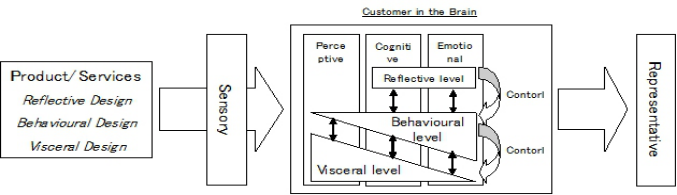
Consideration of Relationships Based on Theoretical Positions First, we will consider the relationship between emotional design and the information processing process of Kansei. As mentioned above, there are three types of design in the broad sense of design for products and services, and Norman states that each design affects three levels of processing in the customer’s brain. In other words, when designing products and services, it is necessary to design according to the brain processing level of the customer. On the other hand, in the Kansei information processing process, the first “sense” is the customer’s five senses (sensory receptors), the last “expression (representativeness)” is the customer’s body (effector), and the intermediate “perception, cognition, and emotion” are It refers to the activity that takes place in the customer’s brain.
From the point of view of the brain function of these customers, it can be organized as shown in Figure 3.
Kansei information processing is a sequential activity in the customer’s brain, and it is thought that Norman’s processing level is associated with each activity. According to Norman, “The instinctive and behavioral levels are driven by perception, the reflective level by thought.” Therefore, it seems that there is no introspective level in ‘perception’ and it exists from ‘cognition.’
In other words, from the perspective of perception, it can be considered that there are two types of perception: “instinctive perception and behavio- ral perception.” From the side of cognition, there are three types: instinctive
134 Nagasawar and Irisawa
Figure 3: The relation between Norman’s emotional design and the information process of Kansei (adapted from Irisawa & Nagasawa, 2010).
cognition, behavioral cognition, and introspective cognition. It seems that there are three types of In particular, it is thought that the instinctive level accounts for a large proportion of the perception, and it is thought that the instinctive perception mainly has a large influence. In addition, emotions are thought to occupy a large portion of the behavioral level, and are thought to work under the influence of the introspective level. And in cognition, the instinctive level and the behavioral level are considered to be at about the same rate, and the introspective level seems to be the main influence.
From the above, instinctive design, behavioral design, and introspective design in emotional design correspond to the activities of “perception, cogni- tion, and emotion” through “senses” from products and services. It is considered that there is a relationship that it is processed by and appeals to the customer’s Kansei.
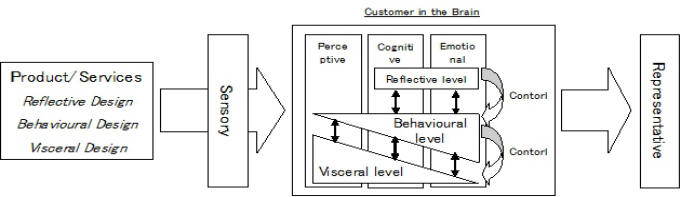
Next, let us consider the relationship between the information processing process of kansei and the value of experience. The experiential value mentio- ned above is classified into five strategic experiential value modules: SENSE is an experience based on the customer’s five senses, FEEL is an experience based on the customer’s emotions, THINK is an experience based on the customer’s perception and interpretation, and ACT is the customer’s expe- rience, and RELATE is an experience based on society and relationships, including customers. These can be considered as the results of each acti- vity that appears in the Kansei information processing process, and can be organized as shown in Figure 4.
Figure 4: The relation between Norman’s emotional design and the information process of Kansei (adapted from Irisawa & Nagasawa, 2010).
Brand Design Based on Kansei Product Development 135
Considering Norman’s level of processing mentioned above, instinctive perception and behavioral perception together stimulate the customer’s perception and create a sensory customer experience (CX) called SENSE. After that, instinctive cognition, behavioral cognition, and introspective cognition are combined to recognize the customer, and the cognitive customer experience (CX) of THINK is created. Then, instinctive emotion, behavioral emotion, and introspective emotion are brought together to evoke the custo- mer’s emotion, and the emotional customer experience (CX) called FEEL is created. As a result, it is thought that customers will be encouraged to act through the “expression (representativeness)” process.
ACT and RELATE of experiential value are related to the “expression (representativeness)” process in information processing process of Kansei. This means that the customer himself is acting (behavioral change) through the information processing of expressions (representativeness). Since custo- mers themselves change their behavior or behavior style, they create behavio- ral customer experience (CX) called ACT. In addition, since there are multiple customers who receive similar products and services, we consciously create a sense of connection in order for other customers to go through similar pro- cesses and take similar actions. Become. Such a sense of connection creates a relational customer experience (CX) called RELATE, and it is thought that customers will act with a sense of social connection.
From the above, it was understood that customer experience (CX) is cre- ated through the information processing process of Kansei. In addition, by products and services that practice emotional design, instinctive design, beh- avioral design, and introspective design work on the information processing process of Kansei, and in the process, customer experience (CX) is createde. We understand that there is a series of flows. Next, in order to specifically verify this trend, the next section will attempt a case study.
CASE ANALYSES In order to obtain an objective view of the previous discussion, in this chapter, we analyse it based on three cases. As examples, we chose the movie ‘Finding Nemo’, the car ‘New Beetle’ and the mobile devices ‘iPhone/iPod Touch’, based on the following reasons:
Movie ‘Finding Nemo’: An example that can be analysed with Sch- mitt’s customer experience (CX), based on the case dealt with in Norman’s emotional design.
Car ‘New Beetle’: An example that can be analysed with Norman’s emo- tional design, based on the case dealt with in Schmitt’s customer experience (CX).
Mobile devices ‘iPhone/iPod Touch’: An original case analysis with a hit product that everybody understands.
Due to the limited number of the volume of the paper, the mobile devices ‘iPhone/iPod Touch’ will be introduced below.
Mobile Devices ‘iPhone/iPod Touch’ The modern world of mobile devices is extremely broad, with a huge line-up of products including laptops, notebooks, handheld computers and cell
136 Nagasawar and Irisawa
phones. Two products that have stood out in the mobile device field in recent years are the iPhone and the iPod Touch. Both products were developed by Apple Inc., which is famous for its iMac computers, and both have under- gone explosive growth both in the US and Japan since they were released, meaning that they can be considered successful products in the mobile device field. The difference between an iPhone and an iPod Touch is basically that the former has a telephone function and a camera.
These mobile devices can be seen as products that are carried around, and could have become commodities, but the fact that they succeeded despite this image created around them suggests that they were conceived with a product design that appealed to the customers’ Kansei and experience. For this reason, it was considered that it would be useful to make a case analysis of the iPhone and iPod Touch.
The iPhone and iPod Touch both have a rounded aerodynamic shape, and a metallic gloss and Apple’s trademarked apple-shaped logo on the back. The neatly organized user interfaces of their screens, which feature icons with various designs laid out, stimulate the user’s visceral level. They are also easily distinguishable as Apple products, because of their unique form and logo, which provides the user with a sense of luxury, in that they are more than simple mobile devices.
In addition to their unique appearance, the possibility of selecting the necessary icons, inputting text and making all controls with a finger, combi- ned with an intuitive user interface and a system processing mechanism that provides a stress-free experience, all stimulate the user’s behavioural level. These elements urge the user to carry their iPhone and/or iPod around, and give them the perception that these products are not only stylish, but also have been built with the newest information technology. Moreover, by installing applications according to their needs, the user can have their own exclu- sive mobile devices. This possibility of customization gives them a sense of satisfaction, as well as affection for always having their device with them.
Moreover, the hardware technology (which provides user-friendly inter- face and processing speed), the software technology (which enables the use of various applications) and the network technology (which allows the devi- ces to be used anywhere) all give the user a new perception that the newest information technology has been implemented. It also makes the user wonder as to what kind of technology is being used, and as to how it is put together inside such small cases. This sparks the user’s intellectual curiosity and evo- kes admiration (‘Wonderful, amazing!’) and intellectual joy (‘I know how cutting-edge technology works!’).
Based on the previous discussion, the customer experience (CX) created from the iPhone/iPod Touch for the user can be broken down as follows: ‘Sense’ appeals to the five senses of the audience through the distinguisha- ble rounded forms of the devices and the apple-shaped logo, as well as the impulse to carry them around. The visually distinguishable apple-shaped logo and their aesthetic form, in particular, create a distinguished experience. ‘Feel’ creates the sense of luxury for owning these products, and generates affection for them. as the user also gains satisfaction from being able to customize these products according to their liking, and experiences of joy and admiration
Brand Design Based on Kansei Product Development 137
for being in contact with the most advanced technology. ‘Think’ provides a sense that their mobile devices are completely different from those of other companies because of their unique design, and creates an experience of intel- lectual curiosity about the way that they are built, using the most advanced information technology.
Then, along with the desire of best using a fully customized device, ‘Act’ causes behavioural changes deriving from the urge to carry the devices around. Furthermore, the fact that these devices can be used to obtain infor- mation for both professional and personal purposes is thought to affect the user’s daily actions, creating the experience of changing their routine beha- viour. Lastly, ‘Relate’ refers to the connections created among users through online tools such as iTunes, music, videos and applications, as well as blogs that review and comment on the available contents. Then, through those con- nections, users can exchange advanced tips and innovative ideas about their devices, and can also discuss similar problems and issues, creating a shared experience among themselves.
As described above, this study presents a case analysis of the iPhone and iPod Touch, which both belong to the category of mobile devices that have somewhat become commodities, making differentiation difficult. As a result, it was possible to verify that even Apple’s hit products, which have helped the company to recover, follow the process of creating customer experience (CX) through emotional design in products and services, using the information processing of Kansei. The customer experience (CX) is created as a result of this process.
Summary of Case Studies Through case analysis, it was shown that the customer’s experience is crea- ted by the stimulus from the product or service, and that the stimulus is the emotional design embedded as the design of the product or service. It’s just a story from the perspective of “customer experience (CX)”, and it can be said that whether the experience has value for the customer is another issue. In the cases cited in this research, customers basically choose cases in which they find value in their experiences.
In addition, although this case analysis was mainly focused on an American product, we believe that it can basically be applied to Japanese products and services as well. We plan to take this as an issue.
CONSIDERATION OF THE DESIGN PROCESS IN PRODUCT DESIGN What is important in designing products and services is to envision the “usage scenes” of how actual customers will consume and use them. When assuming this usage scene, it is necessary to image and design the customer’s experience as a marketing strategy goal, and to design and develop products and services to realize and embody the usage scene. As a guideline for that purpose, a product design process that utilizes emotional design can be applied.
In addition, there is a quality function deployment (QFD) as a method of developing the required quality based on customer information obtained from questionnaires, etc., and the scene deployment method is described in
138 Nagasawar and Irisawa
it. This is used to design and develop products and services while considering the customer’s needs, assuming usage situations such as how the customer will use it from the 5W1H perspective. The viewpoint of scene assumption is considered to be functional and convenient, focusing on “how it is used”, and does not include the viewpoint of what kind of experience the customer will have. For this reason, it is possible to think of a method called “qua- lity experience development” that expands from the function benefit to the customer’s experience from the viewpoint of scene assumption, and we plan to dig deeper into this point as a future research topic.
CONCLUDING REMARKS In this research, we organized the theories about the customer’s experience, considered the central position and relationship of each theory, and tried to analyze it through the case of mobile terminals. Based on the above discussion and case analysis, products and services that apply the concept and method of emotional design are positioned as the cause of customer stimulation (con- sumption behavior), and as a result, through the information processing process of customer’s Kansei, the customer’s experience is created, and the process of customer’s “experience” could be verified.
In this research, we set the customer’s experience as a goal, “What kind of experience do you want the customer to have with this product / service?” There is a method of designing products and services by the reverse process of the above process (setting the customer’s experience as a goal →conside- ring the information processing of Kansei →considering the design to realize it). Such a design process makes it possible to implement product designs that are intended for the customer’s experience. This can be considered as a new methodology of product design, and the author defines it as “Customer Experience Design”, which is also the originality of this research.
As described above, in this research, we considered and analyzed the design process of products and services based on the customer’s experience. As a result, the customer’s experience, which is said to be difficult to control and operate, will be actualized (designing the customer’s experience itself), and it will be possible to implement product design to realize the experience for the expected customer. become. In addition, this research provides new sug- gestions for product design and design processes that focus on the customer experience (CX) itself, as well as related research and business.
ACKNOWLEDGMENT
This paper is financially supported by Grant-in-Aid (B) No. 18H00908 of Japan Society for the Promotion of Science (JSPS).
REFERENCES
Holbrook, M. B. Hirschman, E. C. (1982) The Experiential Aspects of Consumption: Consumer Fantasies, Feelings, and Fun. Journal of Consumer Research, Vol. 9, No. 2, pp. 132–140.
Brand Design Based on Kansei Product Development 139
Irisawa, Y. Nagasawa, S. (2010) Managerial Characteristic and Customer Experience at the Long-Standing Company of Kyoto Inn ‘Tawaraya’. ICIC Express Letters: An International Journal of Research and Surveys, Vol. 4, No. 2, pp. 511–516. Irisawa, Y. Yamamoto, N. Nagasawa, S. (2018) Study on Product Design and Affe-
ctive Value for Product Development: Relation among Customer Experience, Kansei and Emotional Design –, Journal of Japan Society of Kansei Engineering, Vol. 16, No. 3, pp. 133–139. Japan Industrial Designers’ Association (ed.) (2009) Guidebook for Product Design: For those who are involved in product development. Tokyo: Works Coporation. Lindsey, P. H. Norman, D. A. (1977) Human Information Processing: An Introdu-
ction to Psychology 2nd ed. New York, NY: Academic Press. Lindstrom, M. (2005) Brand Sense. Boston, MA: Free Press. Nagasawa, S. (ed.) (2021) Kansei Products in Daily Life: Product Development and Strategy to Enhance Kansei/Fetish Value in Near Future, Kyoto: Koyo Shobo Corporation. Norman, D. A. (2004) Emotional Design: Why we love (or hate) everyday things.
New York, NY: Basics Books. Pine II, B. J. Gilmore, J. H. (1999) The Experience Economy. Boston, MA: Harvard Business School Press. Pinker, S. (1997) How the Mind Works. New York, NY: New York Norton. Schmitt, B. H. (1999) Experiential Marketing: How to Get Customers to Sense, Feel,
Think, Act, and Relate to Your Company and Brands. Boston, MA: Free Press.
LISTED IN THE AHFE DIGITAL BOOKSTORE CATALOGUE
Explore the complete digital volume
Affective and Pleasurable Design
Read this individual research paper free through the original publisher, or explore the full digital proceedings book.
ISBN 978-1-958651-47-6
Explore this ISBN in the AHFE Bookstore ↗Listed in the July 2026 bookstore catalogue; search by ISBN to confirm current availability · Digital book purchase optional