Bhargavi Badve, Khushi Gandhi, Ganesh Jadhav (2024). Enhancing Organizational Efficiency and Security in Supermarkets: A Case Study of DMart. In: Human Factors, Business Management and Society. AHFE Open Access, vol. 135, pp. 53–64. https://doi.org/10.54941/ahfe1004930
In India, retail chains are rapidly expanding, with both domestic and international players competing. Among all its competitors, DMart stands out as one of the most prominent retailers. DMart Supermarket chain is a one-stop shop for all your home utility needs, with groceries being its main market. It currently operates 341 stores across India and is still growing. It’s revenue as of 2023 is ₹42,968 crore (US$5.4 billion). It faces challenges in maintaining organization in the store and security due to high foot traffic. This study investigates the underlying reasons behind lack of organizational efficiencies in the store and security vulnerabilities using a mixed-methods approach. Qualitative methods, including observation, ethnography, and case studies, are employed to explore customer experiences and security concerns. Additionally, quantitative surveys gather data to quantify the extent of these issues. Findings indicate that these factors contribute to customer dissatisfaction and increase the risk of theft incidents. A redesign of the store's rack layout and improved security systems are proposed to address these challenges and improve organizational efficiency. Through careful analysis, it is evident that even minor adjustments, such as reconfiguring rack layouts, can significantly improve customer satisfaction by saving time and enhancing accessibility. Further, minor security enhancements can boost the organization's efficiency and gain both customers and stakeholders' trust. The research provides valuable insights for the retail industry, DMart , by providing practical solutions to improve customer service and mitigate security risks.
The Retail Industry in India The retail industry serves as a vital intermediary between businesses and con- sumers, facilitating the direct provision of goods and services to end-users across various domains such as groceries, electronics, apparel, and more (Sujana et al., 2023). In India, this sector has witnessed significant growth, contributing substantially to the nation’s GDP and ranking prominently on the global stage (Retail Industry in India, n.d.). With a current valuation of
approximately INR 91,891 billion, the Indian retail industry is poised for sus- tained expansion, driven by factors including urbanisation and technological advancements, with a projected Compound Annual Growth Rate (CAGR) exceeding 13% by 2027 (Sharma, n.d.).
Three primary sectors dominate India’s retail landscape: Food and Gro- ceries, Footwear and Apparel, and Consumer Electronics, comprising 63%, 9%, and 7% of the market, respectively (Retail Industry in India, n.d.). Amongst various retailer formats, including department stores, specialty stores, supermarkets, and online retailers, supermarkets have experienced intense competition (Kumbar et al., 2020).
The term “supermarket”denotes a large self-service retail store specializing in groceries, dairy products, and household items (Selvam and Senthilkumar, 2023). These establishments are owned and operated by a diverse range of entities, from affluent local individuals to large multinational corporations with global operations (Selvam and Senthilkumar, 2023). While the emer- gence of supermarkets in developing nations is relatively recent, their growth has been swift, establishing them as dominant players in retail across many regions. A supermarket functions as a service-oriented business entity rather than a traditional producer of physical goods (Selvam and Senthilkumar, 2023). Its primary role involves adding value by sourcing existing prod- ucts from suppliers located at a distance, consolidating them in regional warehouses, distributing them to local stores, and ultimately selling these products to local customers (Selvam and Senthilkumar, 2023). Supermarkets offer several advantages: Firstly, they save time by providing customers with everything they need in one convenient location, with self-service options. Secondly, they provide all the necessary information for making informed decisions when comparing similar products from different manufacturers (Selvam and Senthilkumar, 2023). Additionally, customers may benefit from discounts, as multi-brand stores often engage in bulk purchases and pass on the savings to consumers (Selvam and Senthilkumar, 2023).
In India, the major players in this sector are DMart, Star Bazaar, Reliance Fresh, and Big Bazaar vying for market share. Indians still buy their supplies from supermarkets because they have everything they need under one roof at a lower price.
DMart - The Supermarket Chain Among all the major players, DMart differentiates itself by offering a wide range of home utility products, catering to diverse consumer needs. DMart was founded by Radhakishan Damani in 2002 and operated by Avenue Supermarts Limited, has emerged as a standout player in the supermarket sector (Kumar et al., 2022). Starting with its flagship store in Powai, Mum- bai, DMart has expanded its presence across multiple states in India, boasting a network of 341 stores nationwide (Wikipedia contributors, n.d.). Its success can be attributed to its EDLP (Everyday Low Price) strategy, backed by EDLC (Everyday Low Cost) principles (Pawar and Sangvikar, 2019). Maintaining strong relationships with customers, vendors, and employees is central to DMart’s ethos. By offering consistently lower prices (around 6-7% lower
Enhancing Organisational Efficiency and Security in Supermarkets 55
than competitors), prompt vendor payments, and a supportive work envi- ronment, DMart has earned customer loyalty and a reputation for reliability (Pawar and Sangvikar, 2019).
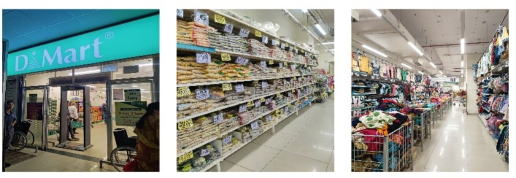
Figure 1: Represents one of the DMart store outlet in Pune.
DMart, despite its remarkable success, grapples with typical challenges encountered by large retail enterprises. Figure 1 indicates the field visit which was conducted in Pune city, India. During the field visit, it was observed that the frequency of organisational inefficiencies within the store, such as product misplacements and discrepancies between displayed tags and actual products, increases as the rush increases throughout the day. Furthermore, security concerns have been identified, encompassing barcode-related issues such as barcode tearing, products lacking individual barcodes for multiple parts, and compartments of bags left unsealed at entry gates, posing a risk of theft. Despite the presence of 24/7 CCTV surveillance, expecting employees to continuously monitor screens is unrealistic, considering human limitations. It is imperative for DMart to address these challenges to sustain its growth trajectory and uphold its position as a leader in the Indian retail market.
METHODOLOGY
In this study, the methodologies adopted are outlined as follows:
1. Field Visit and Observation-The initial stage involved visiting various branches of DMart in Pune, India, to gain an overview of the current situ- ation. During this phase, prominent methods utilised were shadowing and content analysis. These methods were instrumental in understanding the operational dynamics and challenges within DMart stores.
Ethical Approval and Informed Consent Before the interview/questionnaire session, participants are requested to sig- nature the consent form which compress the following subsection: about the current study, confidentiality, Statement of Consent, and Right to Withdraw and Questions. Institutional ethical board approval was obtained from MIT Pune prior to the study (Approval Number MITWPU/DoD 2024-1).
2. Design Thinking Process-Following the observation phase, the study followed the design thinking process, comprising observation, ideation, pro- totyping, user feedback, and implementation. This structured approach facilitated the systematic identification of challenges, ideation of solutions, and iterative refinement of proposed interventions. Figure 2 (Drysdale, 2024) represents the Design Thinking Process.
Figure 2: Represents design thinking process.
Figure available in the original PDF paper.
3. Survey and Data Collection-A comprehensive survey was conducted in- person with customers and employees in the field. Direct observations, along with photographs and interviews, supplemented the survey data, providing rich insights of challenges within DMart stores and perspectives of employees and customers.
4. Analysis and Conceptualization-The collected data underwent rigor- ous analysis to identify key challenges and loopholes within DMart stores. Based on these findings, different design interventions and concepts were conceptualized to address the observed challenges effectively.
5. Proposal of Design Interventions-The conceptualized interventions were tailored to address the specific challenges identified during the field visit. These proposed interventions aimed to provide actionable solutions and enhance organisational efficiency and security within DMart stores.
By employing a combination of observational, analytical, and partici- patory methods, this methodology facilitated the development of practical and effective design interventions to address the identified challenges within DMart stores.
RESULTS
Findings The field survey conducted at DMart stores aimed to comprehend the pre- vailing challenges concerning organisation and security systems. Utilizing the shadowing method provided deeper insights into the current scenario and verified the relevance of identified problems.
Direct informal interviews were conducted with stakeholders directly impacted, namely customers and employees. However, obtaining compre- hensive information from employees was hindered by confidentiality norms. Therefore, primary insights were derived from customer interviews, reveal- ing significant organisational issues affecting both customers and employees. Insights were taken from approximately 100–200 individuals, and an average mean was calculated. Figure 3 (A) depicts the frequency of visits to the DMart store, providing insights into its popularity and customer preference. Like- wise, Figure 3 (B) suggests that customers favor DMart due to substantial discounts and competitive pricing. Finally, Figure 3 (C) presents customers’ overall opinions about the store.
Enhancing Organisational Efficiency and Security in Supermarkets 57
Figure 3: Represents the public’s perception of DMart outlets and customer traffic.
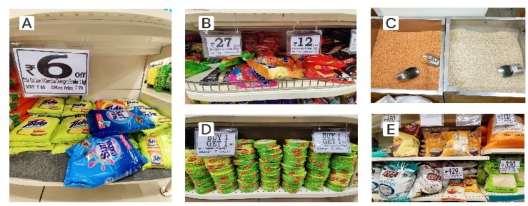
The observations highlighted that employees diligently arrange and organ- ise the store every morning, yet as customer traffic increases throughout the day, maintaining this order becomes challenging, resulting in a less organised appearance for the store. Discrepancies between displayed tags and prod- uct placement, especially in the groceries section, contributed to customer confusion and inefficiencies in product retrieval as seen in Figure 4 (A) and Figure 4 (B). Similarly, In the footwear and apparel sector, a notable lack of organisation resulted in mixed-up items, hindering customers’ ability to find desired sizes and types efficiently. Additionally, the loose cereals and grains stored in open containers are prone to mixing together easily, as depicted in Figure 4 (C). Figure 4 (D) reveals two distinct price tags displayed for varying quantities, yet the products on the rack are uniform in quantity, causing con- fusion among customers. In Figure 4 (E), the displayed products are visibly intermingled, with some plastic bags intended for holding display paper tags found empty or with the plain side of the paper tag facing forward.
Figure 4: Represents the organisational problems mentioned in the study.
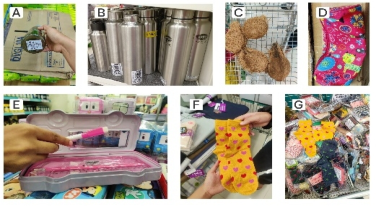
Furthermore, security concerns were evident, particularly regarding barcode-related issues such as barcode tearing and products lacking individ- ual barcodes for multiple parts, as depicted in Figure 5 (A) and Figure 5 (B), which adds the potential risk of theft. Additionally, incomplete or absent barcodes on products are noticeable in Figure 5 (C) and Figure 5 (D). Moreover, Figure 5 (E) highlights how easily items inside poorly sealed products can be accessed without barcodes, worsening security vulnerabil- ities. Another significant security issue observed in the clothing section is illustrated in Figure 5 (F) and Figure 5 (G), where socks were left unsealed without barcodes, potentially increasing the risk of theft.
Figure 5: Represents the security problems mentioned in the study.
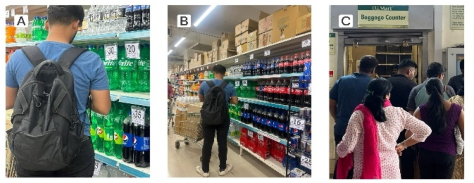
During peak hours, the rush of customers made thorough bag checks impractical, allowing thieves to exploit unsealed compartments. Figure 6 (A) and Figure 6 (B) depicts the same.Similarly, lax exit inspections due to high foot traffic posed risks, as untagged or improperly tagged items could go undetected by anti-theft measures, facilitating potential theft. Figure 6 (C) shows baggage counter at DMart store.
Figure 6: Represents the security problems related to baggage mentioned in the study.
Overall, the findings underscore the critical need for organisational improvements and enhanced security protocols within DMart stores to mitigate organisational inefficiencies and minimize theft incidents.
Concepts and Implementation Based on the findings and observations, various design interventions were developed and categorized into the following:
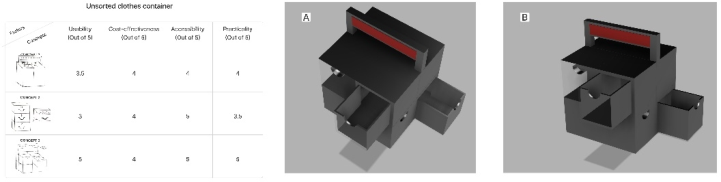
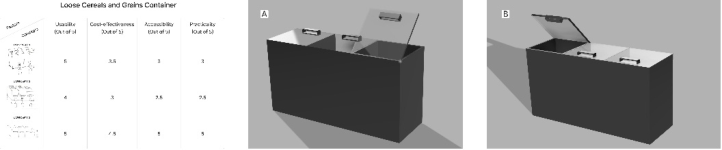
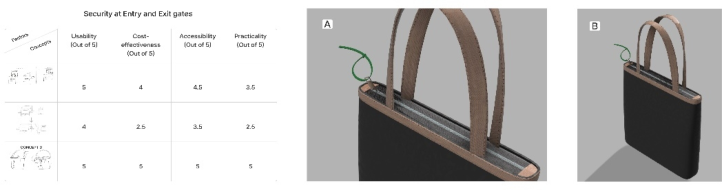
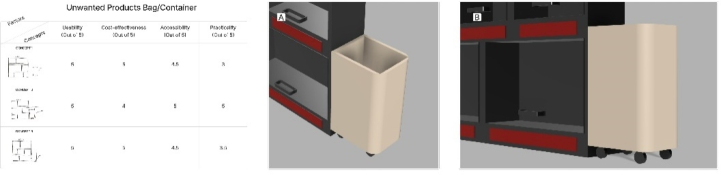
1. Unsorted clothes container 2. Loose cereals and grains container 3. Security at entry and exit gates 4. Unwanted products bag/container 5. Food rack Within each category, 3–4 concepts were generated. Using a Pugh chart, one final concept was selected based on its positive outcomes compared to the others.
Enhancing Organisational Efficiency and Security in Supermarkets 59
Concept 1.1 proposes a four-compartment container for unsorted clothes. It features a transparent lid with a handle on top to prevent mixing of different-sized clothes and includes a digital display.
Concept 1.2 involves three levels of drawers stacked on top of each other, all accessible from the same side, with each drawer designated for different clothes sizes.
Concept 1.3 comprises four compartments and eight drawers divided into two levels. The first level of drawers opens from the front, while the second level opens from the side, facilitating simultaneous viewing for multiple cus- tomers interested in clothes of different sizes. It also includes a digital display (Red colour box in the 3d model denotes the same) showcasing offers and discounts in two languages.
After evaluating all three concepts, Concept 1.3 demonstrated positive results in terms of feasibility, practicality, and usability, thus it has been chosen for implementation. Figure 7 (A) and Figure 7 (B) shows visual representation of the finalised concept via 3D model.
Figure 7: Represents pugh chart and design intervention for unsorted clothes container.
Pugh chart 2 (Figure 8): Loose cereals and grains container Concept 2.1 proposes a semi-automatic system where users can press a button until they attain the desired amount of grains and cereals. Addition- ally, the container is fully enclosed, with a sample of the product placed on top.
Concept 2.2 involves an automatic system where individuals select the required amount from provided options. Users can select multiples if the desired amount exceeds the given options. The container is fully enclosed, with a sample of the product placed on top.
Concept 2.3 introduces a simple yet impactful modification to existing grains and cereals container. It features a transparent lid with a handle that can be opened to test and retrieve the desired amount of product.
After evaluating all three concepts, Concept 2.3 was chosen for implemen- tation due to its minimal limitations. The simple addition of a transparent lid prevents mixing of cereals and grains, whereas the other two concepts presented ergonomic constraints and potential issues with grain flow when nearing the container’s bottom. Figure 8 (A) and Figure 8 (B) shows visual representation of the finalised concept via 3D model.
Figure 8: Represents pugh chart and design intervention for loose cereals and grains container.
Pugh chart 3 (Figure 9): Security at entry and exit gates. Concept 3.1 introduces a weighing machine at the entry gate and near the billing counter. Customers weigh their bags before entering the store and receive a sticker displaying the weight, which is affixed to their bag. Upon exiting or at the billing counter, the bag is weighed again and cross-checked with the sticker from the entry gate.
Concept 3.2 proposes a fully automated machine at the entry gate that scans and counts the items in each bag, generating a receipt. This receipt is then checked at the exit gate, with a similar machine available for recounting items.
Concept 3.3 suggests providing customers with a simple cloth bag at the entry gate for essential items, while their personal bags are kept at a baggage counter. These bags are sealed with unbreakable zip ties, to be opened by store employees at the billing counter or exit gates.
After evaluation, Concept 3.3 was selected for implementation due to its cost-effectiveness and user-friendliness. The other two concepts were deemed less practical compared to the chosen concept. Figure 9 (A) and Figure 9 (B) shows visual representation of the finalised concept via 3D model.
Figure 9: Represents pugh chart and design intervention for security bags at entry and exit gates.
Pugh chart 4 (Figure 10): Unwanted products bag/container. Concept 4.1 proposes a solution akin to a laundry bag placed at the start or end of each aisle beside the food rack. Customers can use this bag to deposit products they no longer wish to purchase from their cart.
Concept 4.2 introduces a container with wheels that magnetically attaches to the start or end of the food rack in every aisle. This container serves the
Enhancing Organisational Efficiency and Security in Supermarkets 61
same purpose as Concept 4.1, allowing customers to place unwanted items from their cart into it.
Concept 4.3 suggests using a bag attached to the start or end of food racks in every aisle through hooks. Similar to the previous concepts, customers can deposit unwanted items from their cart into this bag.
After evaluation, Concept 4.2 was chosen for implementation due to its ease of transportation compared to the other concepts. Additionally, its mag- netic attachment ensures stability and durability, making it a more reliable option than the cloth bags proposed in the other concepts. Figure 10 (A) and Figure 10 (B) shows visual representation of the finalised concept via 3D model.
Figure 10: Represents pugh chart and design intervention for unwanted products bag/container.
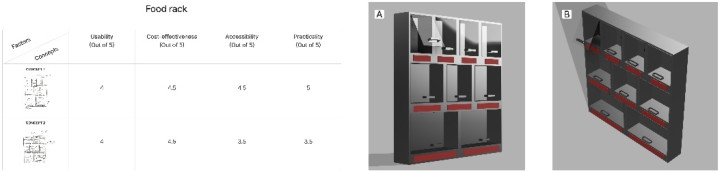
Pugh chart 5 (Figure 11): Food rack. Concept 5.1 proposes a solution featuring adjustable slabs at each com- partment in the rack, accompanied by a digital display for showcasing product prices.
Concept 5.2 introduces fixed sizes of compartments, such as small, medium, and large, on every level of the rack. All compartments are closed with transparent lids equipped with handles for easy opening, and each com- partment includes a digital display (Red colour box in the 3d model denotes the same) for displaying product prices.
After evaluation, Concept 5.2 was selected for implementation. In Con- cept 5.1, the presence of adjustable slabs may cause issues with the digital display and potentially confuse customers with product pricing. Addition- ally, as Concept 5.2 has closed compartments the likelihood of the rack becoming unorganised is low. Figure 11 (A) and Figure 11 (B) shows visual representation of the finalised concept via 3D model.
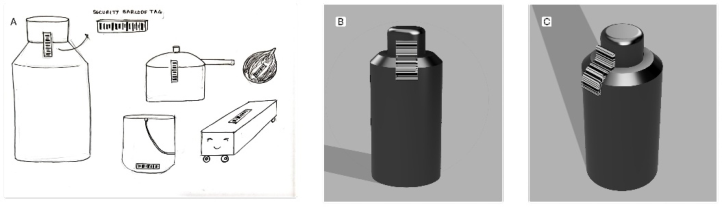
Lastly, a new concept has been suggested to address barcode-related con- cerns, particularly for products with multiple components. The current barcodes utilized at DMart Stores are prone to tearing and do not endure over time. The proposed design intervention entails utilizing a sturdier mate- rial for the barcode that is resilient and long-lasting. It will be positioned at the intersection of two parts for better sealing and to prevent possible thefts. Figure 12 (A), Figure 12 (B) and Figure 12 (C) shows visual representation of the finalised concept via Sketch and 3D Model.
Figure 11: Represents pugh chart and design intervention for food rack.Figure 12: Represents sketch and design intervention barcode related issues.
The aforementioned design interventions effectively address the previously identified issues highlighted in the study, notably the lack of organisation within the store, particularly in sections such as grocery and clothing, and security-related concerns. These interventions mitigate potential thefts by addressing issues such as inadequate sealing of products and bags at entry and exit gates, as well as barcode-related challenges.
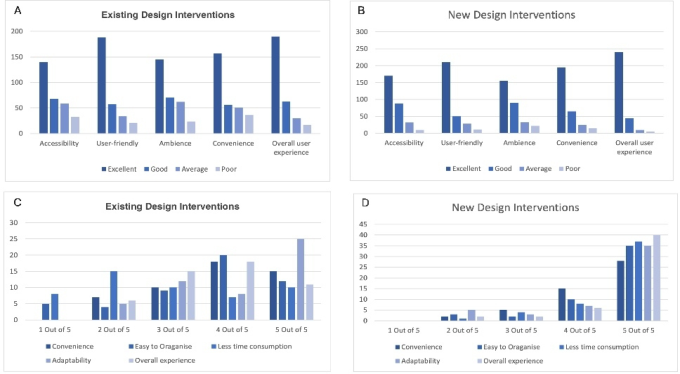
Analyzing the Impact To assess the effects of the suggested design interventions, a content anal- ysis approach was employed. A survey questionnaire was devised targeting two primary stakeholders: customers and employees of the store. Feedback was gathered from approximately 300 customers and about 50 employees. Results indicated that both groups provided positive responses towards the proposed interventions. They expressed appreciation for the efforts of the design team, particularly the employees, who found that the interventions facilitated their daily tasks in the store, making operations more efficient and organised. Figure 13 (A) and Figure 13 (B) depict the comparison between the existing and proposed design interventions from the customers’ perspec- tive, while Figure 13 (C) and Figure 13 (D) illustrate the same from the employees’ standpoint.
Enhancing Organisational Efficiency and Security in Supermarkets 63
Figure 13: Represents feedback from customers and employees for the proposed design interventions in comparison with existing design interventions.
CONCLUSION
In conclusion, the research conducted at DMart stores has revealed sig- nificant challenges pertaining to organisational inefficiencies and security vulnerabilities. Through a comprehensive methodology encompassing field visits, design thinking processes, surveys, and data analysis, key insights have been garnered regarding the prevalent issues impacting both customers and employees.
Observations highlighted the dynamic nature of organisational challenges, particularly during peak hours, where maintaining order becomes increas- ingly difficult, leading to product misplacements and confusion among cus- tomers. Furthermore, security concerns, especially regarding barcode-related issues and inadequate sealing of products, have been identified as potential avenues for theft.
The findings underscore the urgent necessity for organisational enhance- ments and the implementation of robust security protocols within DMart stores. Proposed design interventions, formulated through a structured approach, aim to address these challenges effectively. By employing a com- bination of observational, analytical, and participatory methods, practical solutions have been conceptualized to enhance organisational efficiency and bolster security measures.
Moving forward, the successful implementation of these proposed inter- ventions holds the promise of fostering a more streamlined and secure shopping experience for both customers and employees at DMart stores. Additionally, this research contributes to the broader discourse on retail man- agement, providing valuable insights into addressing operational challenges within the retail industry. Lastly, market value of the concepts proposed and technical aspects remains as the further scope of the study.
ACKNOWLEDGMENT
The authors wish to extend their heartfelt gratitude to all those who provided invaluable assistance during the data collection process.
CONFLICT OF INTEREST In regard to the publication of this work, the authors declare no conflicts of interest.
REFERENCES
Drysdale, Jarrod. “ Design Process - Design Guides - Proximity School of Design.”
Proximity School of Design, https://proximityschool.com/learn/design-process/. Accessed 26 March 2024. Gourav. “An Overview on Chains of Supermarket in India.” In Journal of Advances and Scholarly Researches in Allied Education 16.2 (2019). Guruprasad, M. “Study on the Consumer Preference and Perception of Supermarket
Chain-Case of Dmart.” International Journal of Innovative Science and Research Technology (2018). Hunt, Irma, Allison Watts, and Sarah K. Bryant. “Walmart’s international expansion: Successes and miscalculations.” Journal of Business Strategy 39.2 (2018): 22–29. Kowsalya, S., and S. Gandhimathi. “Impact of Advertisement and sales promo-
tion strategies adopted by DMart.” EPRA International Journal of Research and Development (IJRD) 8.7 (2023): 239–244. Kumar, Atul, Vinaydeep Brar, and A. B. Dadas. “DMart: Stellar Growth.” KIM Journal of Management Cases 1.1 (2022): 89–94. Kumbar, Santosh, and S. Jayadatta. “A study on marketing activities and consumer
response for D-mart.” The Way Ahead (2020). Latha, G. “Indian Retail Chain Industry: Influencing factors of DMart Customers.” RES MILITARIS 13.3 (2023): 2587–2599. Pawar, Avinash, and B. V. Sangvikar. “Strategy and Success of DMart: The Case
of Retail Chain in India.” NIDA International Conference for Case Studies on Development Administration. (2019). Rani, DR A. Sandhya. “Consumer Preference and Satisfaction of customers towards D-Mart.” “Retail Industry in India - Indian Retail Sector, Market Size.” Invest India,
www.investindia.gov.in/sector/retail-E-commerce. Accessed 22 March 2024. Selvam, B., and MK Senthilkumar. “A study on evolutions of supermarket in India: An overview.” In Dogo Rangsang Research Journal 13.2 (2023): 116–123. Sharma, Sandeep. “Retail Industry in India: Overview of Retail Sector, Market
Size, Growth.” Indian Retailer, https://www.indianretailer.com/article/retail- business/retail/retail-industry-india-overview-retail-sector-market-size-growth, Accessed 22 March 2024. Sharma, Sneha, and Suresh K. Chadha. “Customer Perceptions about Retail Store Attributes: A Comparative Analysis between Supermarkets, Department Store and Specialty Stores in India.”IIMS Journal of Management Science 11.1 (2020): 1–15. Sujana, Ms SV Mohana, and CP Senthil Kumar. “An empirical study on consumer
preference towards supermarkets.”The Online Journal of Distance Education and e-Learning 11.2 (2023). Wikipedia contributors. “DMart.” Wikipedia, https://en.wikipedia.org/wiki/ DMart#:˜:text=Avenue%20Supermarts%20Limited%2C%20d%2Fb, and%20union%20territories%20in%20India, Accessed 20 March 2024.
LISTED IN THE AHFE DIGITAL BOOKSTORE CATALOGUE
Explore the complete digital volume
Human Factors, Business Management and Society
Read this individual research paper free through the original publisher, or explore the full digital proceedings book.
ISBN 978-1-964867-11-3
Explore this ISBN in the AHFE Bookstore ↗Listed in the July 2026 bookstore catalogue; search by ISBN to confirm current availability · Digital book purchase optional