Anna-kristin Behnert, Julia Arlinghaus, Melanie Kessler, Maria Freese (2024). Approaching Cognitive Biases in the Circular Economy through Serious Gaming. In: Human Factors, Business Management and Society. AHFE Open Access, vol. 135, pp. 11–21. https://doi.org/10.54941/ahfe1004926
The current linear economy model extracts resources at a rate that far exceeds the ability of the planet to regenerate them. Climate change, global warming, and the destruction of natural habits are just a few consequences. They highlight the urgent need for a shift towards a more sustainable economic model, such as the circular economy. Such a paradigm shift would offer novel approaches that aim to uncouple economic development from environmental degradation, however, the adoption of circular economy principles by consumers is often hindered by the human behavior which is influenced by so-called cognitive biases. These effects influence human decision-making leading to a systematic deviation from a rational optimum. Exemplarily the status quo bias shows this connection. Thereby, individuals favor existing conditions over potential changes. Research on circular economy as well as on cognitive biases increases, however, the interplay between these areas remains unexplored. Serious games, defined as games with a primary purpose other than pure entertainment, could be a promising approach to mitigate cognitive biases in the context of the circular economy. Serious games are being increasingly recognized as a valuable tool for education, especially in the context of complex systems (such as circular economy) and behavioral change, as they engage players in an interactive, and immersive environment. This paper explores in an exploratory approach possible ways, prerequisites, and obstacles of the use of serious games enabling circular value creation. Utilizing a structured literature review, the authors examine existing work in this area and identify gaps in the literature, underscoring the need for further research in this emerging field. This study, thus, serves as a starting point for future studies on the role of serious games in shaping sustainable practices.
The prevailing linear economic structure and our complex global supply chains are reaching their tangible limits, as evidenced by the impact of crises such as climate change, COVID-19, and energy scarcity (Zheng et al., 2021). Rapid industrial development has a significant negative impact on our envi- ronment and society, generating large amounts of solid waste and harmful air, water, and soil pollution (Govindan and Hasanagic, 2018). With the Agenda
2030, the United Nations has outlined 17 Sustainable Development Goals (SDGs) emphasizing the need for sustainable development across economic, social, and ecological dimensions (22-Jan-24). The circular economy (CE) concept has emerged as a promising alternative to the current linear model as it emphasizes sustainability, resource conservation, and waste reduction (Ghisellini et al., 2016). In general, CE aims to transform sourcing, pro- duction, distribution, and consumption processes to enhance environmental quality, economic prosperity, and social equity (Kirchherr et al., 2017). As a result, companies are rethinking their business models, product lifecycles, and underlying mindsets to enable a systematic transition (Govindan et al., 2022). This transition, however, also heavily relies on the acceptance and cooperation of consumers. Consumer have a negative connotation with the various circular business practices due to their cognitive biases (Singh and Giacosa, 2019). Biased human behavior plays also an important role in pro- duction systems because these biases can significantly influence the successful implementation of CE principles (Bendul, 2019). The so-called Lead Time Syndrome describes the situation in production that planners tend to over- react and to deviate systematically from rationality in their decision-making whenever schedule adherence declines. In response, planners modify sched- uled lead times too frequently, thus actually worsening schedule adherence (Bendul and Knollman, 2016; Selçuk et al., 2006). Also, the Bullwhip Effect can be traced back to biased human decision-making. This describes how order variability increases as it progresses though the supply chain (see for instance Udenio et al., 2017; Croson et al., 2014). These examples show the negative influence cognitive biases have on the logistic performance in the area of production and supply chain management.
THEORETICAL BACKGROUND The definitions of CE encompass a wide range of societal activities. There is no consensus among researchers on the scope or the definition of the CE (Kirchherr et al., 2017). The defining characteristic of the CE is its holistic approach to reduce waste, energy, and raw material use. It aims to cre- ate closed loops for material, energy, and waste flows, covering all societal activities (Grafström and Aasma, 2021). Several authors have explored the relationships, dependencies, and significance of barriers within the context of a CE (Grafström and Aasma, 2021). Besides technological barriers, mar- ket barriers, and regulatory barriers, social and cultural barriers play an important role in the CE (Grafström and Aasma, 2021; Kirchherr et al., 2018). In this context, the significance of a multi-level approach to addressing challenges in the CE is worth mentioning. This approach is essential for sim- plifying the complexity of these challenges and considering its various aspects at different levels - ranging from micro to macro. To understand the entire ecosystem (macro-level) it is crucial to also look at the meso-level (cooper- ation between businesses) and the micro-level (organizations, businesses & customers). In addition to, key barriers at the organizational level include lack of awareness, limited attention to the end-of-life phase in product design and
Approaching Cognitive Biases in the Circular Economy Through Serious Gaming 13
higher costs. These challenges, which are primarily associated with the micro- level, can be effectively categorized under the broader umbrella of social and cultural barriers. The multi-level approach tackles these issues from vari- ous angles and perspectives, offering a comprehensive understanding of the matters at hand. It highlights the deep interconnection between micro-level problems and broader social and cultural factors, underscoring the need for a holistic problem-solving approach. This includes costumers’ reluctance to adopt refurbished product and recycled materials as noted by Kirchherr et al. (2017). Moreover, social and cultural barriers are present not only among customers (individual level) but also within organizations. For instance, Mah- pour (2018) discuss the reluctance to restructure the supply chain. In addition Masi et al. (2018) highlight in their results that the CE-approach is mainly driven by economic considerations and not by ecological ones. Overcoming these barriers is a crucial step in the realization of a sustainable future (Graf- ström and Aasma, 2021; Kirchherr et al., 2018). Singh and Giacosa (2019) investigated the barriers of the CE taking into account cognitive biases that prevail among consumers for circular products. So, especially human-biased behavior can either facilitate or hinder the transition to the CE (e.g., Millette et al., 2020).
Cognitive biases can be defined as effects which arise as a result of mental short cuts which are used by the human brain to process information and which lead to distorted human behaviour. Kahneman and Tversky (1974) were two of the first researchers who investigated how cognitive biases influ- ence human decisions and described a plenty of effects. The occurrence of cognitive biases can be traced back to different areas in the human brain. Tversky and Kahnemann (1974) classified them as ‘intuition’ and ‘reasoning’. Depending on the decision situation and the decisional environment, such as number of involved parties, familiarity with decision situation, or also the time horizon, the dominant system is determined. These biased human deci- sions represent an obstacle in the adoption of CE principles. Exemplarily, the status quo bias describes this connection. Thereby, people perceive change as a threat and prefer their known common things.
To analyze the role of cognitive biases, serious games seem to be a promis- ing tool (Dunbar et al., 2014). Generally spoken, serious games are games with a serious purpose (Abt, 1970) that can be used to analyze and design complex systems. Complex systems themselves consist of individual ele- ments that interact with each other, taking into account uncertainty. This also applies to the field of the CE. Due to the fact that serious games are understood as complex and dynamic in themselves, they make it possible to represent situations characterized by VUCA attributes. In this VUCA world, the CE is also becoming increasingly important (Jinil Persis et al., 2021). Scholars like Martey et al. (2017) have already highlighted the added value serious games have for overcoming above-mentioned barriers in the imple- mentation of CE. There are also studies (Martey et al., 2017) that have already dealt with the interface between serious games and cognitive biases.
Research on the CE and serious gaming as well as cognitive biases and serious gaming increases, however, the interplay between these areas remains unexplored. Serious games seem to be a promising tool to impart knowledge
about cognitive biases, taking into account the previously identified barriers in the field of the CE. A structured literature review will be used to derive a research agenda to motivate research in this subject area.
METHODOLOGY
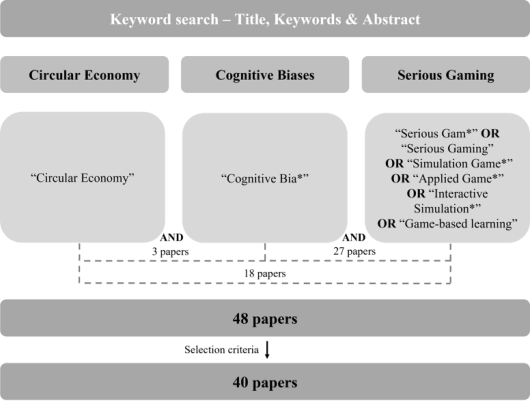
This structured literature review has been undertaken to develop a com- prehensive understanding of the relationship between CE barriers, cognitive biases, and serious gaming as a solution-oriented approach. The review pro- cess was conducted in a systematic and transparent manner, following a well-established three-stage process (Tranfield et al., 2003). First, the authors have scoured multiple databases to gather a wide range of academic arti- cles, studies, and reports that provide valuable insights into the barriers to the adoption of a CE. The two central databases were “Web of Science” and “Scopus” as they are globally recognized citation indices and form the basis for most bibliometric tools (Groote and Raszewski, 2012). The follow- ing keywords were used to find the publications relevant to this paper (see “…” in Fig. 1). English-written publications in the period from 2014 (earli- est publications on these topics) to 2023 were considered. Publications that dealt exclusively with simulations and duplicates were removed from the fur- ther analysis. Second, with the help of the data analysis tool “MAXQDA”, the authors coded the articles and analyzed in a third step the emerging themes following the grounded theory methodologies approach by Strauss and Corbin (1998).
Figure 1: Overview of structured literature review.
RESULTS & DISCUSSION Circular Economy and Cognitive Biases
Based on the results of the structured literature review, there are no publica- tions that address the role of cognitive biases in the CE using a serious gaming
Approaching Cognitive Biases in the Circular Economy Through Serious Gaming 15
approach. Publications dealing with cognitive biases in the CE have not yet analyzed specific cognitive biases. However, an analysis of the research poten- tial shows that this is precisely what is needed. Understanding and addressing cognitive biases can significantly assist policymakers in creating impactful interventions that help spread circular business models (Singh and Giacosa, 2019). The perspectives of consumers can be particularly valuable as a driving force to fast-track the acceptance of these models. Therefore, it emphasizes the importance of comprehending and tackling cognitive biases for the effec- tive promotion and implementation of the principles of the CE (Singh and Giacosa, 2019). In addition, the perspective of the organization needs to be considered as also decisions made on an organizational level might be influenced by human-biased behavior.
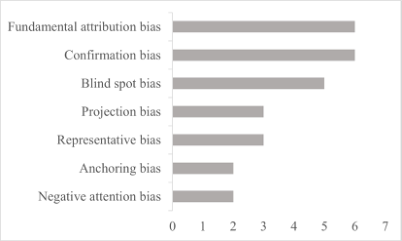
Serious Gaming and Cognitive Biases Serious games have already been used to address specific cognitive biases. An overview is shown in Fig. 2. In the publications analyzed, the focus has primarily been on the fundamental attribution and conformation bias.
Figure 2: Overview of specific cognitive biases analyzed in serious gaming literature. Only those biases are shown that have been analyzed in more than one publication.
As mentioned at the beginning, there are barriers in the CE that need to be overcome. Interventions with the aim of change might be helpful to achieve this. According to Ghosh et al., (2023: 13) using “[…] serious games based on the CBM [Cognitive Bias Modification] paradigms will help in improving the effectiveness and engagement of digital interventions.” Also, Arnold 2018 stated that the analysis of trainings (such as serious games) might enhance interventions aimed at overcoming CE barriers, as they can support the anal- ysis of human biases. They consider the potential of these tools to manage biases through training, data visualization, and simulations of future key performance indicators, while also addressing rebound effects and newly emerging biases. Further Legaki et al., (2021: 14) suggested that applications considering gamified strategies might be a promising topic for future research, particularly in the context “[…] of both learner outcomes and forecasting accuracy”. This premise is further supported by Dunbar et al., (2018: 80), who found that game-based learning environments notably enhance “[…] intrinsic motivation, cognitive absorption, positive cognitive appraisals, and greater content knowledge gained regarding deception detection cues”. In a similar vein, Martey et al., (2017: 19) propose that educational games
have great potential in “[…] providing persistent training in avoiding cog- nitive biases, a fairly pervasive aspect of human information processing and decision making”. This proposition aligns with the findings of Symborski et al. (2017), who found that training can significantly mitigate cognitive biases. This indicates that serious game interventions can train players to recognize and mitigate their cognitive biases. In summary, these studies col- lectively highlight the potential of gamified applications and serious games in improving learning outcomes, enhancing cognitive processes, and mitigating cognitive biases.
Circular Economy and Serious Gaming
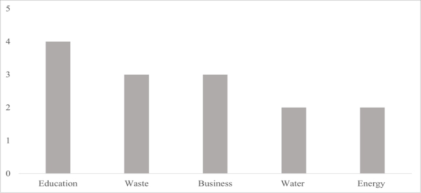
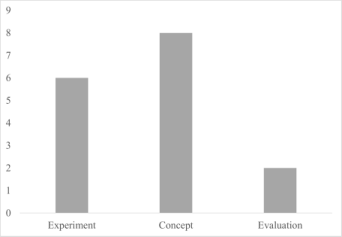
Figure 3 illustrates that serious games have already been addressed in stud- ies focusing on different CE sub-categories, such as water, waste, or energy. However, serious games were often used as an educational tool (e.g., for learning, training, etc.). In addition to the fact that efficient management and sustainable practices in all four sub-categories of CE shown in Fig. 3 are necessary to ensure environmental responsibility and long-term viability, they also represent characteristics of complex systems. Serious games can poten- tially enable complex systems’ characteristics, such as efficient management and sustainable practices. The inclusion of serious games in policy-making could help overcome barriers and propose strategies to tackle challenges “[…] set by the circular economy, the European Green Deal, and SDGs” (Papamichael et al., 2022: 3). A study by Salim et al., (2021: 17) suggested that “[…] game development in End-of-Life management of PV panels should […] evaluate cognitive and relational learning outcomes”. This highlights the role of serious games in enhancing stakeholders’ understanding and their ability to make decisions. Furthermore, they suggested that games should incorporate spatial scales for more accurate decision experimentation, taking into account different characteristics ranging from socio-economic to polit- ical ones. This approach could be particularly useful in the context of the CE, where efficient management and sustainable practices are crucial. How- ever, this area remains largely unexplored, particularly within production systems, indicating a clear potential for future research. Further, our analyses show that in the context of the CE serious games were primarily used at a conceptual level rather than an experimental one (see Fig. 4). This suggests that while we have a theoretical understanding of the role serious games can play in promoting sustainable practices, we lack empirical validation of these theories.
Figure 3: Overview of various sub-categories within the CE in which serious games were used.
Approaching Cognitive Biases in the Circular Economy Through Serious Gaming 17
As Sader et al. (2021: 537) suggest, it’s crucial to undertake thorough quan- titative research to validate and showcase how serious games can influence cognitive biases and decision-making processes. Indeed, the unique nature of serious games may […] bridge the gap between evidence-based training paradigm and an attractive, motivating training environment”. However, as La Torre et al., (2021: 17) point out, there’s potential for future experien- tial development research that helps us understand […] the keys to achieving holistic learning”. Aligning with this, Manshoven and Gillabel (2021: 19) propose that “[…] focus [should] shift from ‘introducing concepts’ towards the translation of game learning outcomes into implementable ideas, relevant business experiments, and practical roadmaps with concrete milestones”. This emphasizes the necessity to move from theoretical understanding to practical application when using serious games within the framework of the CE. It is also evident that studies in which serious games were addressed within the CE also described the actual evaluation of the serious games them- selves, i.e., the achievement of the previously defined learning objectives. All in all, this may indicate the existence of theoretical evidence, but it also shows us that there is a lack of empirical validation. Even if conceptual frameworks are needed, empirical validation must be on the future research agenda in order to enable valid and reliable conclusions for practitioners.
Figure 4: Overview of how serious games were used within CE.
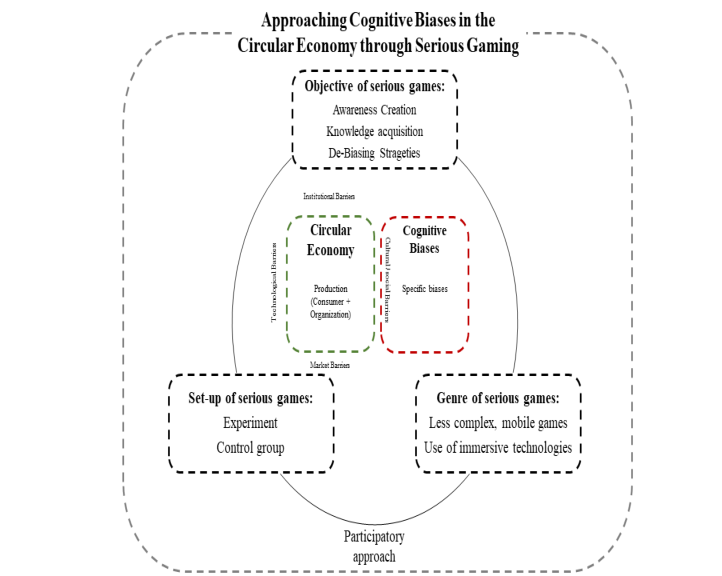
CONCLUSION & FUTURE RESEARCH This paper aims to explore in an exploratory research approach possible ways, prerequisites, and obstacles of the use of serious games enabling cir- cular value creation due to the consideration of cognitive biases. Utilizing a structured literature review, the authors examined existing work in this area and identified gaps in the literature. Generally spoken, the results show that more research is needed with regard to the analysis of cognitive biases in the circular economy by using serious gaming. Our analyses have shown that production has a central position within CE due to the effects mentioned at the beginning that can be caused by human-biased behaviour. Within produc- tion systems, two perspectives must be considered: the consumers perspective, but also the organisational one. At both levels, decisions can be influenced by specific cognitive biases. Serious games seem to be an adequate tool to cre- ate awareness of and acquire knowledge about cognitive biases, but also to
actively experience de-biasing strategies. When focussing on this, it is impor- tant both to proceed experimentally to guarantee valid results and to be aware of the form of the serious game to be used. The results are summarized in Fig. 5.
Besides this, participation plays a crucial role in the context of the CE, serious gaming, and cognitive biases. It is essential to involve learners in the development of learning objectives and the design of activities to ensure align- ment with their perspectives on sustainability and performance assessment in selected competencies (Kioupi et al., 2022). Moreover, serious gaming, which is increasingly recognized as a valuable tool to mitigate cognitive biases, could benefit from incorporating […] breakthrough innovations […] in a partici- patory manner (Della Rossa et al., 2022: 13). Future research on the CE should consider strategies to address “[…] barriers from the consumer per- spective”. If the “[…] CE model is implemented in a top down approach, it might be perceived as a violation of consumer rights […]”(Singh and Giacosa, 2019: 930). This may lead to a negative consumer experience and potential instability of the model. This point connects back to previous points made about the importance of social and cultural norms, and the role of cognitive biases in consumer decision-making. Emphasizing participation could be a key strategy to facilitate the transition to the CE, ensuring consumers feel involved and respected in the process.
Figure 5: Key findings of structured literature review.
Approaching Cognitive Biases in the Circular Economy Through Serious Gaming 19
The potential application of serious gaming extends into various research domains. As indicated by Seo at al. (2020), conducting additional replications of game-based assessment methods in other research areas could considerably establish their generalizability. This implies that through the application of this assessment method in diverse conditions and contexts, researchers could gain valuable insights that enrich their understanding. Moreover, there’s an opportunity to broaden the audience reach of such serious games. For instance, creating “[…] a catalogue of serious games tailored to specific audiences, problems, and situations […]”, as suggested by Khoury et al., (2023: 11), could be a proactive step towards this direction. In the context of modern production systems, which are increasingly adopting advanced technologies and concepts like automation, digital twins, and Industry 4.0, cognitive biases can lead to sub-optimal decisions. The complexity of these systems often poses a significant challenge for operators, managers, and decision-makers whose cognitive biases can cloud judgment. In such sce- narios, serious games can act as a valuable tool for training and education, helping individuals to understand and manage these complex systems more effectively while addressing their cognitive biases.
To conclude, the analysis of cognitive biases under consideration of seri- ous gaming must always be understood as a holistic approach (Singh and Giacosa, 2019), also in the context of the CE. This also means that the actual playing must be supplemented by a debriefing in order to enable learning (Whalen et al., 2018).
REFERENCES
Abt, C. C., 1970. Serious Games. New York: Viking, 1970, 176 pp., L. C. 79-83234.
American Behavioral Scientist, 14 (1), 129. Arnold, M. G., 2018. Combining conscious and unconscious knowledge within human-machine-interfaces to foster sustainability with decision-making concern- ing production processes. Journal of Cleaner Production, 179, 581–592. Bendul, J., 2019. Understanding the meaning of human perception and cogni-
tive biases for production planning and control. IFAC-PapersOnLine, 52 (13), 2201–2206. Bendul, J.C., and Knollman, M., 2016. The human factor in production planning and control: Considering human needs in computer aided decision-support systems. International Journal of Manufacturing Technology and Management, 30 (5), 346. Croson, R., et al., 2014. Order Stability in Supply Chains: Coordination Risk and
the Role of Coordination Stock. Production and Operations Management, 23 (2), 176–196. Della Rossa, P., et al., 2022. A new method to co-design agricultural systems at the territorial scale - Application to reduce herbicide pollution in Martinique. Agricultural Systems, 196. Dunbar, N. E., et al., 2014. Implicit and explicit training in the mitigation of cogni-
tive bias through the use of a serious game. Computers in Human Behavior, 37, 307–318. Dunbar, N. E., et al., 2018. Reliable deception cues training in an interactive video game. Computers in Human Behavior, 85, 74–85.
Ghisellini, P., Cialani, C., and Ulgiati, S., 2016. A review on circular economy: the expected transition to a balanced interplay of environmental and economic systems. Journal of Cleaner Production, 114, 11–32. Ghosh, A., et al., 2023. Serious Games Based on Cognitive Bias Modification and
Learned Helplessness Paradigms for the Treatment of Depression: Design and Acceptability Study. JMIR Serious Games, 11. Govindan, K., et al., 2022. Circular economy adoption barriers: An extended fuzzy best–worst method using fuzzy Dematel and Supermatrix structure. Business Strategy and the Environment, 31 (4), 1566–1586. Govindan, K., and Hasanagic, M., 2018. A systematic review on drivers, barriers,
and practices towards circular economy: A supply chain perspective. International Journal of Production Research, 56 (1–2), 278–311. Grafström, J., and Aasma, S., 2021. Breaking circular economy barriers. Journal of Cleaner Production, 292, 126002. Groote, S. L. de, and Raszewski, R., 2012. Coverage of Google Scholar, Scopus, and
Web of Science: a case study of the h-index in nursing. Nursing outlook, 60 (6), 391–400. Jinil Persis, D., et al., 2021. Modelling and analysing the impact of Circular Economy; Internet of Things and ethical business practices in the VUCA world: Evidence from the food processing industry. Journal of Cleaner Production, 301, 126871. Khoury, M., et al., 2023. NEXTGEN: A serious game showcasing circular economy
in the urban water cycle. Journal of Cleaner Production, 391. Kioupi, V., Vakhitova, T. V., and Whalen, K. A., 2022. Active learning as enabler of sustainability learning outcomes: Capturing the perceptions of learners during a materials education workshop. MRS Energy & Sustainability, 9 (1), 64–78. Kirchherr, J., et al., 2018. Barriers to the Circular Economy: Evidence From the
European Union (EU). Ecological Economics, 150, 264–272. Kirchherr, J., Reike, D., and Hekkert, M., 2017. Conceptualizing the circular economy: An analysis of 114 definitions. Resources, Conservation and Recycling, 127, 221–232. La Torre, R. de, et al., 2021. The Role of Simulation and Serious Games in Teaching
Concepts on Circular Economy and Sustainable Energy. Energies, 14 (4). Legaki, N.-Z., et al., 2021. Gamification to avoid cognitive biases: An experiment of gamifying a forecasting course. Technological Forecasting and Social Change, 167. Mahpour, A., 2018. Prioritizing barriers to adopt circular economy in construction
and demolition waste management. Resources, Conservation and Recycling, 134, 216–227. Manshoven, S., and Gillabel, J., 2021. Learning through Play: A Serious Game as a Tool to Support Circular Economy Education and Business Model Innovation. Sustainability, 13 (23). Martey, R. M., et al., 2017. Testing the Power of Game Lessons: The Effects of Art
Style and Narrative Complexity on Reducing Cognitive Bias. International Journal of Communication, 11, 1635–1660. Masi, D., et al., 2018. Towards a more circular economy: exploring the awareness, practices, and barriers from a focal firm perspective. Production Planning & Control, 29 (6), 539–550. Millette, S., Hull, C. E., and Williams, E., 2020. Business incubators as effective tools
for driving circular economy. Journal of Cleaner Production, 266. Papamichael, I., et al., 2022. Unified waste metrics: A gamified tool in nextgeneration strategic planning. Science of the Total Environment, 833.
Approaching Cognitive Biases in the Circular Economy Through Serious Gaming 21
Sader, J., et al., 2021. Serious game training in medical education: potential to mitigate cognitive biases of healthcare professionals. Diagnosis, 8 (4), 536–537. Salim, H., et al., 2021. R3SOLVE: A Serious Game to Support End-of-Life Rooftop
Solar Panel Waste Management. Sustainability, 13 (22). Selçuk, B., Fransoo, J. C., and Kok, A. G. de, 2006. The effect of updating lead times on the performance of hierarchical planning systems. International Journal of Production Economics, 104 (2), 427–440. Seo, K., Ryu, H., and Kim, J., 2020. Can Serious Games Assess Decision-Making
Biases? Comparing Gaming Performance, Questionnaires, and Interviews. Euro- pean Journal of Psychological Assessment, 36 (1), 44–55. Singh, P., and Giacosa, E., 2019. Cognitive biases of consumers as barriers in transition towards circular economy. Management Decision, 57 (4), 921–936. Strauss, A., and Corbin, J., 1998. Basics of qualitative research techniques. Symborski, C., et al., 2017. The Design and Development of Serious Games Using
Iterative Evaluation. Games and Culture, 12 (3), 252–268. THE 17 GOALS | Sustainable Development, 22-Jan-24 [online]. Available from: ht tps://sdgs.un.org/goals [Accessed 22-Jan-24]. Tranfield, D., Denyer, D., and Smart, P., 2003. Towards a Methodology for Develop-
ing Evidence-Informed Management Knowledge by Means of Systematic Review. British Journal of Management, 14 (3), 207–222. Udenio, M., et al., 2017. Behavioral causes of the bullwhip effect: An analysis using linear control theory. IISE Transactions, 49 (10), 980–1000. Whalen, K. A., et al., 2018. ‘All they do is win’: Lessons learned from use of a serious
game for Circular Economy education. Resources, Conservation and Recycling, 135, 335–345. Zheng, R., Shou, B., and Yang, J., 2021. Supply disruption management under consumer panic buying and social learning effects. Omega, 101, 102238.
LISTED IN THE AHFE DIGITAL BOOKSTORE CATALOGUE
Explore the complete digital volume
Human Factors, Business Management and Society
Read this individual research paper free through the original publisher, or explore the full digital proceedings book.
ISBN 978-1-964867-11-3
Explore this ISBN in the AHFE Bookstore ↗Listed in the July 2026 bookstore catalogue; search by ISBN to confirm current availability · Digital book purchase optional