Madalena Pereira, Marta Bicho Fernandes, Sandra Ferreira, Joaquim Trindade, Rui Miguel, Teresa Raquel Barata (2026). The Future of Sustainability and Circular Fashion in Contributing to the Improvement of Better Life Conditions in Communities. An Approach with Artificial Intelligence. In: Human Systems Engineering and Design (IHSED2026): Future Trends and Applications. AHFE Open Access, vol. 237, pp. 545–554. https://doi.org/10.54941/ahfe1008194
Publisher statistics will load when you open Metrics.
AHFE OPEN ACCESS OPEN ACCESS CONFERENCE PROCEEDINGS PAPER
The Future of Sustainability and Circular Fashion in Contributing to the Improvement of Better Life Conditions in Communities. An Approach with Artificial Intelligence
1 University of Beira Interior, Department of Textile Science and Technology, Covilhã Portugal; FibEnTech - Fiber Materials and Environmental Technologies, University of Beira Interior Covilhã, Portugal; UNIDCOM/IADE-UE, University Europeia, Lisbon, Portugal ↗
2 University of Beira Interior, Department of Textile Science and Technology, Covilhã Portugal; FibEnTech - Fiber Materials and Environmental Technologies, University of Beira Interior Covilhã, Portugal ↗
3 University of Beira Interior, Department of Textile Science and Technology, Covilhã, Portugal ↗
4 University of Beira Interior, Department of Textile Science and Technology, Covilhã Portugal; FibEnTech - Fiber Materials and Environmental Technologies, University of Beira Interior Covilhã, Portugal; CIAUD, University Lisboa, Lisbon, Portugal ↗
Currently, the evolution of design has shifted its focus from solely the user to the human being and, more recently, to communities, to address societal problems, to which design itself has contributed (Papanek, 1971; Manzini, 2015; Norman, 2023). This evolution stems from the emergence of new challenges, such as climate and environmental change, social inequalities, high consumption, and the loss of a sense of community. Similarly, fashion design should evolve towards sustainable, regenerative, and circular models, where social innovation, creative communities, co-design, and community circularity are present in design practice with the aid of AI (Fletcher & Tham, 2019; Manzini, 2022; Wiegand & Wynn, 2025; Cianfanelli, 2025). The objective of this research is to analyze the contribution of AI to a sustainable and circular fashion design that serves the living conditions of communities. As a methodology, a literature review was combined with an embedded case study of the integrated project be@t, with as primary sources the Sustainability Reports of T&C (2024 and 2025) and the European statistics on AI adoption in companies. It is concluded that the twin transition of the Portuguese T&C is asymmetrical, Ecodesign accelerates (11% to 19% between 2019 and 2024) while digitalization stagnates (21%), and that AI is primarily a contribution to efficiency, productivity, and resource management, with its energy and water costs remaining to be measured: a trade-off between the use of new technologies and the improvement of living conditions in communities conceptualizes and proposes to operationalize through double accounting.
Received July 12, 2026 Revised August 4, 2026 Accepted August 18, 2026 Available online September 25, 2026
LITERATURE REVIEW
From User-Centred Design to Community-and Planet-Centred Design The recent evolution of design thinking can be understood as a progressive expansion of its focus: from the individual user to human beings in their collective condition and, more recently, to communities and ecosystems. This evolution has its roots in Papanek’s (1971) seminal critique but gained renewed significance when the founder of the user-centred design paradigm critically reassessed his own concepts. Norman (2023) proposes a humanity-centred design approach, oriented towards sustainability and collective behaviour, recognising that user-centred design has itself contributed to the systemic problems that now require urgent solutions. Similarly, Manzini (2015) shifts the design focus towards creative communities and proposes the scenario of livable proximity, in which digital platforms should facilitate relationships rather than merely transactions (Manzini, 2022). This perspective also provides an important normative criterion for evaluating the role of Artificial Intelligence. Escobar defend one solution with autonomy of territories for not create asymmetries in improvement of quality of life.
Sustainable, Circular and Regenerative Fashion: Competing Perspetives Today different reports quantified the environmental impacts of the fashion ecosystem (Niinimäki et al., 2020). But the different process used by research and institutions is in order of discussions. Europe for example support the circularity base in technology and industrial. This view, sustainability can be achieved through digitalisation, product traceability, and material circularity while maintaining the current architecture of production systems. Nafz et al. (2022) emphasise the digital transformation of textile supply chains, whereas Wiegand and Wynn (2024, 2025) identify digitalisation as a key enabler of sustainability and circularity. Similar conclusions are reported in Portugal by Pereira et al. (2025), while systematic reviews confirm the growing convergence between digital and circular strategies within the textile sector (Orisadare et al., 2025). Market analyses also highlight Artificial Intelligence and digital product development as important drivers of competitiveness (McKinsey & Company, 2025). This perspective is reflected in the Ecodesign for Sustainable Products Regulation (ESPR) (Regulation (EU) 2024/1781), whose working plan identifies textiles as a priority product group and establishes the Digital Product Passport (DPP) as a central policy instrument (European Commission, 2025). A second perspective, associated with post- growth and localist approaches, argues that efficiency gains become ineffective if production volumes continue to increase because of rebound effects. Fletcher and Tham (2019) propose placing planetary wellbeing before profit and advocate the rescaling of fashion towards territorial systems. Likewise, Fletcher and Fitzpatrick (2024) subject the concept of product durability itself to a critical decolonial and decarbonisation perspective.
The Future of Sustainability and Circular Fashion in Contributing to the Improvement 547 A third perspective adopts a relational and territorial approach, seeking to reconcile these opposing views by proposing a model of prosperity based on relationships among actors and territories (Cianfanelli, 2025). This study positions communities as the decisive criterion for assessing these different perspectives, arguing that it is at the community level that improvements in quality of life can ultimately be verified.
These practices require enabling infrastructures, co-design and organisational capabilities (Manzini, 2015, 2022; Elf, Werner and Black, 2022). They also require environmental and digital skills, addressed by GreenComp and DigComp 2.2 (Bianchi et al., 2022; Vuorikari et al., 2022). A methodological gap nevertheless remains industrial studies usually quantify resources but overlook communities, whereas social-innovation research describes community effects without comparable indicators. AI intensifies this tension. Its applications include predictive maintenance, process control, textile sorting, generative design, digital twins and traceability. The literature reports potential improvements of up to 25% in resource efficiency and waste reductions of up to 30%, although implementation barriers remain substantial for small and medium-sized enterprises (de Lucas López, Luengo Vera and Álvarez Miguel, 2026). Computer vision may also classify textiles by composition, condition and recyclability, supporting reuse and recovery decisions (Nisa et al., 2025). These benefits represent only one side of the balance. Data-centre electricity demand may reach approximately 945 TWh by 2030, while digital infrastructures also consume water, land and materials (IEA, 2025; Aczel et al., 2026). Benefits may arise in textile-producing regions while environmental burdens affect the communities hosting computing and energy infrastructures (Roberts et al., 2024). This distribution is defined here as a community trade-off.
Eco-design addresses materials, durability, disassembly and recyclability; eco-engineering concerns energy, water, maintenance, industrial symbiosis and Life Cycle Assessment. Since design decisions may influence up to 80% of product life-cycle impacts, AI can connect product, process and recovery data from the design stage (Regulation (EU) 2024/1781). The research therefore asks how AI can support circular fashion without separating textile benefits from digital costs and community effects. Its central contribution is a dual-accounting framework based on the distinction between “AI for sustainability” and the “sustainability of AI” (van Wynsberghe, 2021).
Eco-Design and Eco-Engineering: The Operational Interface Between AI and Sustainability These different viewpoints agree about the results of impact in environment are in the design phase. According to the European regulatory framework, design decisions influence up to 80% of a product’s environmental impacts throughout its life cycle (Regulation (EU) 2024/1781). Eco-design operates primarily at the product level through material selection, mono-material design, design for disassembly, and recyclability. Eco-engineering, in contrast, addresses processes and systems by focusing on energy and water efficiency, industrial symbiosis, and Life Cycle Assessment (LCA) in accordance with ISO 14040 and ISO 14044. This interface between products and processes
represents the area in which Artificial Intelligence can make its most significant contribution. AI supports generative design and real-time LCA through Internet of Things (IoT) technologies within eco-design (de Lucas López et al., 2026), while enabling intelligent sorting systems and predictive maintenance in eco-engineering (Nisa et al., 2025). The Digital Product Passport provides the data infrastructure required to close this circular information loop (European Commission, 2025). A coherent eco-design approach in the era of AI therefore requires dual accounting: one accounting system for the textile product itself and another for the digital infrastructure supporting it. This requirement remains largely absent from current research and constitutes one of the central analytical contributions of this study. Recent work by Fernandes et al. (2026) begins to address this gap, reinforcing the imbalance previously identified by van Wynsberghe between “AI for sustainability” and the “sustainability of AI.” In summary, three major research gaps justify the present study: the lack of consensus regarding the most appropriate pathway for the sustainability transition, the limited integration of AI’s material costs into fashion research, and the insufficient consideration of communities as the primary scale for evaluating sustainability outcomes.
METHODOLOGY
This study adopted a two-component research design. The first component consisted of a literature review covering the last five years, focusing on primary sources and indexed scientific publications. The second component comprised an embedded case study of the integrated project be@t – Bioeconomy in the Textile Industry (Portuguese Recovery and Resilience Plan—PRR, Component C12, TC-C12-i01), coordinated by CITEVE and involving a consortium of 58 organisations, including the University of Beira Interior, with an investment of approximately €138 million. The documentary analysis was based on the 2024 Sustainability Report (second edition, reporting 2023 data) and the 2025 Sustainability Report (third edition, reporting 2024 data) of the Portuguese Textile and Clothing Sector (STV), produced by CITEVE within the framework of the be@t project through voluntary corporate reporting (CITEVE, 2024, 2025). These sources were complemented by publicly available project results and by official Eurostat statistics on AI adoption derived from the ICT Survey, dataset isoc_eb_ain2, covering enterprises classified under NACE C13–C15 (Eurostat, 2025, 2026). The data were analysed using an analytical matrix integrating eco-design, eco-engineering, and Artificial Intelligence, while considering a transversal dimension focused on communities’ quality of life, including employment, skills development, and territorial cohesion. The concept of dual accounting was adopted as the main analytical criterion throughout the study.
ANALYSIS AND RESULTS The participation in report of be@t was from 77 companies in 2023 to 105 companies in 2025, representing a growth of 36%, these companies employ 16,000 workers within the Portuguese textile and clothing industry, nearly
The Future of Sustainability and Circular Fashion in Contributing to the Improvement 549 half of whom are women (CITEVE, 2025). The be@t project has established a culture of measurement that previously did not exist, regarding sustainability and circularity practices.
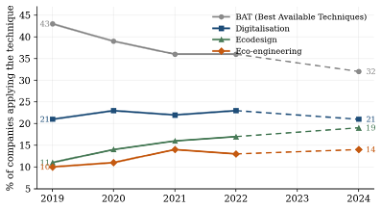
In 2024, 89% of reporting companies used at least one sustainability technique: Best Available Techniques represented 32%, digitalisation 21%, eco-design 19% and eco-engineering 14%. Eco-design increased from 11% in 2019 to 19% in 2024, whereas digitalisation remained near 21–23%. Eco-design reached 50% among vertically integrated companies. Digitalisation was more frequent in knitting and weaving, at 44%, and finishing, at 40%. Product-level environmental practices therefore progressed more rapidly than the digital infrastructure required for traceability and circular information flows.
Figure 1: Sustainability techniques applied by companies in the Portuguese T&C sector, 2019–2024 (% of reporting companies). Dashed segment: 2023 value not shown [to be confirmed against the original report, p. 36]. Source: authors’ elaboration based on CITEVE (2025) data.
Sustainability techniques applied by reporting companies in the Portuguese Textile and Clothing Sector, 2019–2024. Disaggregated values for 2023 were unavailable; dashed segments represent missing, not estimated, observations. Source: authors’ elaboration based on CITEVE (2025).
AI and Community Indicators The sectoral reports present AI both as a possible accelerator of fast- fashion production and as an instrument for efficiency, flexibility and resource management. This ambivalence confirms that its environmental effect depends on the purpose of the application. AI is not independently measured. Digitalisation appears as a single category without separating software, automation, machine learning or generative AI. Electricity, water and computational requirements are also absent, preventing calculation of a net environmental balance. The reports indicate progress in chemical substitution, renewable and recycled materials and Scope 1 and Scope 2 emissions. Waste recovery, water use and wastewater management remain less developed. AI may contribute through monitoring and optimisation, but the documents do not establish whether reported improvements resulted from AI.
Between 2019 and 2024, companies reporting no community support decreased from 40% to 10%. Support for local events reached 50%, product donations 57% and financial donations 43%. Be@t implemented 296
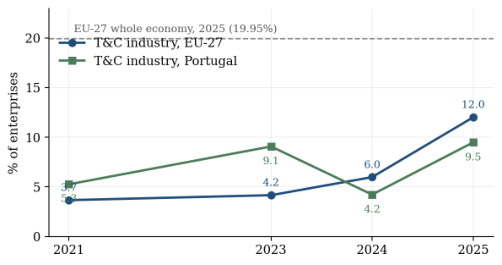
initiatives involving training, awareness and knowledge dissemination; its capacity-building programme involved 89 companies, and 99.7% of trainees recorded increased knowledge. These figures demonstrate activity and competence development, but not causal improvement in quality of life. In 2025, 19.95% of EU enterprises with at least ten employees used AI. Within NACE C13–C15, adoption reached 12.01%, compared with 5.98% in 2024. Portugal reached 9.48%, while 88.6% of Portuguese textile and clothing enterprises reported no AI use, compared with 85.3% in the EU.
Figure 2: Enterprises using at least one AI technology in the T&C industry (NACE C13–C15), Portugal and EU-27, 2021–2025 (% of enterprises); reference: EU-27 whole economy, 2025. Source: authors’ elaboration based on Eurostat (2025, 2026).
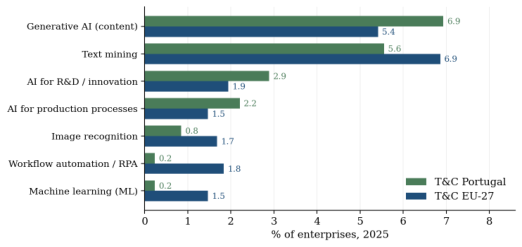
Figure 3 shows that Portuguese adoption is concentrated in general- purpose tools. Generative AI reached 6.9%, above the European sectoral value of 5.4%, while machine learning, robotic process automation and image recognition remained below European values. Among adopters, however, use in production and research and development was comparatively higher. The problem is therefore the limited scale and technological depth of adoption, not its industrial orientation. A further 13% of Portuguese companies had considered AI without implementing it. At European level, insufficient expertise was the main barrier, followed by legal uncertainty and data-protection concerns. Skills, rather than absence of interest, constitute the principal constraint.
Figure 3: Adoption of AI technologies and purposes in the T&C industry, Portugal vs. EU-27, 2025 (% of enterprises). Source: authors’ elaboration based on Eurostat (2026).
The Future of Sustainability and Circular Fashion in Contributing to the Improvement 551 DISCUSSION: TOWARDS A DIGITAL ECO-DESIGN FRAMEWORK SERVING COMMUNITIES
The evidence defines a clear pattern: eco-design is advancing, digitalisation remains stable, industrial AI adoption is shallow and digital environmental costs are unmeasured. Be@t nevertheless created an operational basis through more than 80 research and innovation lines, 98 new products or validated solutions, four digital platforms and the Textile Sorting Pilot Unit, with an annual capacity of 50 tonnes across 14 material categories. Table 1 consolidates the empirical evidence, technological applications and assessment criteria. It replaces a longer descriptive discussion and makes the article’s contribution explicit.
Table 1: Eco-design × eco-engineering × AI matrix applied to the be@t/T&C ecosystem, with national and European primary evidence. Source: authors’ elaboration.
Table available in the original PDF paper.
Critical Reading Priority Opportunity
Dimension Primary Evidence (CITEVE 2024/2025; Eurostat 2025/2026) Eco-design (product) 19% of companies in 2024 (11% in 2019); 50% in vertically integrated companies
(iii) Dynamic LCA; (iv) generative design with circularity constraints
Green transition accelerating; concentrated where design and production are integrated
Eco- engineering (process)
14% in 2024 (10% in 2019); 38% in knitting/ weaving
(i) Intelligent sorting (computer vision + NIR)
Least adopted technique; potential in process-intensive segments
Digitalisation / AI
Digitalisation stagnant (~21–23% since 2019); AI: 9.5% (EU T&C: 12.0%); ML 0.2%; automation 0.2%; GenAI 6.9%
“Digital-ready, not AI-enabled”; light adoption without depth; AI unmeasured; ambivalent framing
(ii) Intelligent symbiosis matching; disaggregate the indicator; convert light adoption into deep adoption
Cost of the digital layer
No accounting in the inventories analysed nor in the Eurostat survey
(v) Dual accounting: kWh/l per unit of benefit
Accounting asymmetry confirmed — the community trade-off remains unmeasured
Communities (transversal)
Capacity building as the unlocking mechanism; monitor AI effects on communities via the sectoral observatory
Most consolidated impact: capabilities, employment, relational capital; the dominant barrier to AI in the EU is the lack of skills (70.9%)
Integrated digital eco-design framework linking sectoral evidence, Artificial Intelligence applications and dual accounting. Source: authors’ elaboration based on CITEVE (2024, 2025), Eurostat (2025, 2026) and the be@t project. The framework identifies five connected priorities. Intelligent
sorting can transform end-of-life infrastructure into a source of product data. Industrial-symbiosis systems can match residues with suitable users, if contamination, transport and treatment are included. Dynamic LCA can return environmental information during production, while generative systems can compare designs under circularity constraints. Across all applications, dual accounting must compare verified resource savings with digital electricity, water, hardware and computation. Suitable indicators include electricity per kilogram of waste avoided, digital water use relative to process water saved, digital emissions relative to avoided emissions, computing requirements per defective unit prevented, and effects on employment and competencies. Dual accounting does not demand zero digital impact. It demands evidence that the additional burden is proportionate to the verified benefit and that costs are not transferred invisibly to other communities.
CONCLUSION
For the case study of the Portuguese textile and apparel sector, the transition to eco-design and eco-engineering and digitalization differ. Eco-design practices increased from 11% to 19%, while digitalization remained at 21-23%. National adoption of AI remained below the European sectoral average in advanced industrial applications, although companies already using AI demonstrated values higher than the European average for production and research. AI can support sorting, process control, industrial symbiosis, dynamic LCA, and the development of circular products. It is not inherently sustainable: the same technology can reduce waste or accelerate production and consumption. Current reports measure the benefits within textile production but exclude the resource requirements of the supporting digital infrastructure. The reports address this omission by linking textile performance, digital impacts, and community outcomes. Confirmation from the be@t project and Eurostat indicates that the main obstacle to AI adoption is not technological availability but a shortage of relevant skills in sustainability and digital technology. The proposed framework provides a conceptual basis for future empirical research and offers practical guidance for policymakers, industry stakeholders, and researchers seeking to align Artificial Intelligence with the principles of sustainable and circular fashion for better conditions in communities.
Declaration of Generative AI and AI-Assisted Technologies in the Writing Process Statement: During the preparation of this work, the author(s) used Claude (Anthropic) and chatGPT to assist in translate, structuring and drafting sections of the manuscript, analysing documentary data from the sustainability reports and Eurostat statistics, and formatting the reference list. After using this tool/service, the author(s) reviewed, edited and verified the content against the primary sources as needed and take(s) full responsibility for the content of the published article with Ethical Standarts for Publication.
ACKNOWLEDGEMENT
Os autores agradecem o apoio financeiro do projeto integrado be@t — Bioeconomia Têxtil (TC-C12-i01, Bioeconomia Sustentável N.º 02/C12- i01.01/2022), promovido pelo Plano de Recuperação e Resiliência (PRR), Next Generation EU, para o período 2021–2026, e o apoio da Unidade de Investigação FibEnTech-UBI, através dos projetos UID/00195/2025, UID/PRR/00195/2025 e UID/PRR2/00195/2025, financiados pela FCT — Fundação para a Ciência e a Tecnologia, IP/MECI.
REFERENCES
Bianchi, G., Pisiotis, U. and Cabrera Giraldez, M. (2022) GreenComp: The European sustainability competence framework. Edited by M. Bacigalupo and Y. Punie. EUR 30955 EN. Luxembourg: Publications Office of the European Union. doi: 10.2760/13286. Bicho, M., Pereira, M., Barata, T.R., Santiago, A., Ferreira, S. and Miguel, R. (2024)
‘Development skills in sustainable fashion design projects’, in Global Fashion Conference. Cham: Springer Nature Switzerland, pp. 90–102. Cianfanelli, E. (2025) ‘Towards a new sustainable and relational paradigm for the fashion system’, Fashion Highlight, (SI1 – Prosperity Fashion). (SI1), 18–20. CITEVE (2024) Relatório de sustentabilidade 2024: Setor têxtil e vestuário
(2.º relatório; dados de 2023). Projeto be@t/PRR. Vila Nova de Famalicão: CITEVE. CITEVE (2025) Relatório de sustentabilidade 2025: Setor têxtil e vestuário (3.º relatório; dados de 2024). Projeto be@t/PRR. Vila Nova de Famalicão: CITEVE. de Lucas López, A.J., Luengo Vera, C. and Álvarez Miguel, Á.J. (2026) ‘Artificial
intelligence as a catalyst for the circular economy: A mixed-methods analysis of sustainable production ecosystems (2023–2024)’, International Entrepreneurship and Management Journal, 22(2), 59. doi: 10.1007/s11365-026-01176-y. Elf, P., Werner, A. and Black, S. (2022) ‘Advancing the circular economy through dynamic capabilities and extended customer engagement: The case of small sustainable fashion enterprises’, Business Strategy and the Environment, 31(6), pp. 2682–2699. Escobar, A. (2018) Designs for the pluriverse: Radical interdependence, autonomy,
and the making of worlds. Durham, NC: Duke University Press. European Commission (2025) Ecodesign for Sustainable Products Regulation — working plan 2025–2030. Luxembourg: Publications Office of the European Union. Eurostat (2025) Use of artificial intelligence in enterprises — Statistics Explained.
Available at: https://ec.europa.eu/eurostat/statistics-explained/index.php?title= Use_of_artificial_intelligence_in_enterprises (Accessed: 11 July 2026). Eurostat (2026) Artificial intelligence by NACE Rev. 2 activity [isoc_eb_ain2] [Dataset]. Available at: https://ec.europa.eu/eurostat/databrowser/view/isoc_eb_ ain2/default/table?lang=en (Accessed: 11 July 2026). Fernandes, C. E., Morais, R., & Piñeiro-Naval, V. (2026, May). SustAInability
Much? Mapping the Intersection of AI, Design, and Sustainability in Scopus and WoS-Indexed Journals. In Metrics (Vol. 3, No. 2, p. 9). MDPI. Fletcher, K. and Fitzpatrick, A. (2024) ‘Decentering durability: Decarbonizing and decolonizing ideas and practices of long-lasting clothes’, Fashion Theory, 28(7), pp. 1015–1041. doi: 10.1080/1362704X.2024.2427493. Fletcher, K. and Tham, M. (2019) Earth Logic: Fashion action research plan. London:
The J J Charitable Trust.
IEA (2025) Energy and AI. Paris: International Energy Agency. Available at: https:// www.iea.org/reports/energy-and-ai (Accessed: 11 July 2026). Manzini, E. (2015) Design, when everybody designs: An introduction to design for
social innovation. Cambridge, MA: MIT Press. Manzini, E. (2022) Livable proximity: ideas for the city that cares. Milan: Bocconi University Press/Egea. McKinsey & Company (2025) The state of fashion 2025. Available at: https://www.
mckinsey.com/industries/retail/our-insights/state-of-fashion (Accessed: 11 July 2026). Nafz, R., Schinle, C., Kaiser, C. and Kyosev, Y. (2022) ‘Digital transformation of the textile process chain – state-of-the-art’, Communications in Development and Assembling of Textile Products, 3 (2), 79–89. Niinimäki, K., Peters, G., Dahlbo, H., Perry, P., Rissanen, T. and Gwilt, A. (2020)
‘The environmental price of fast fashion’, Nature Reviews Earth & Environment, 1(4), pp. 189–200. doi: 10.1038/s43017-020-0039-9. Nisa, H., Van Amber, R., English, J., Islam, S., McCorkill, G. and Alavi, A. (2025) ‘A systematic review of reimagining fashion and textiles sustainability with AI: A circular economy approach’, Applied Sciences, 15(10), 5691. doi: 10.3390/ app15105691. Norman, D.A. (2023) Design for a better world: meaningful, sustainable, humanity
centered. Cambridge, MA: MIT Press. Orisadare, E.A., Achukwu, O.E., Ogunyemi, A.A., Adedeji, D.O., Diyaolu, I.J., Ugwu, E.I., et al. (2025) ‘Digitalisation and green strategies: A systematic review of the textile, apparel and fashion industries’, Circular Economy and Sustainability, 5(4), pp. 2775–2827. Papanek, V. (1971) Design for the real world: human ecology and social change.
New York: Pantheon Books. Pereira, M., Barata, T.R., Bicho, M., Mesquita, A., Vilaça, H., Silva, C.J., Belino, N., Santiago, A., Ferreira, S. and Miguel, R. (2025) ‘Portugal’, in Wynn, M. and Wiegand, T. (eds.) Sustainability, the circular economy and digitalisation in the European textile and clothing industry. SDGs and Textiles. Singapore: Springer. doi: 10.1007/978-981-97-9116-3_8. Regulation (EU) 2024/1781 of the European Parliament and of the Council of
13 June 2024 establishing a framework for setting ecodesign requirements for sustainable products (2024) Official Journal of the European Union, L, 28 June. Roberts, H., Zhang, J., Bariach, B., Cowls, J., Gilburt, B., Juneja, P., Tsamados, A., Ziosi, M., Taddeo, M. and Floridi, L. (2024) ‘Artificial intelligence in support of the circular economy: Ethical considerations and a path forward’, AI & Society, 39(3), pp. 1451–1464. van Wynsberghe, A. (2021) ‘Sustainable AI: AI for sustainability and the sustainability
of AI’, AI and Ethics, 1(3), pp. 213–218. Vuorikari, R., Kluzer, S. and Punie, Y. (2022) DigComp 2.2: The digital competence framework for citizens. EUR 31006 EN. Luxembourg: Publications Office of the European Union. doi: 10.2760/115376. Wiegand, T. and Wynn, M. (2024) ‘Circularity and digitalisation in German
textile manufacturing: Towards a blueprint for strategy development and implementation’, Processes, 12(12), 2697. doi: 10.3390/pr12122697. Wiegand, T. and Wynn, M. (2025) ‘Introduction’, in Wynn, M. and Wiegand, T. (eds.)
Sustainability, the circular economy and digitalisation in the European textile and clothing industry. SDGs and Textiles. Singapore: Springer. doi: 10.1007/978-981- 97-9116-3_1.
FIND THE COMPLETE VOLUME IN THE AHFE DIGITAL BOOKSTORE
Explore the complete digital volume
Human Systems Engineering and Design (IHSED2026): Future Trends and Applications
Read this individual research paper free through the original publisher, or explore the full digital proceedings book.