Takako Nonaka, Rei Shiina (2026). Usability Evaluation of Handlebar Geometry for Steering Operability in a Semi-Recumbent Quadricycle. In: Human Systems Engineering and Design (IHSED2026): Future Trends and Applications. AHFE Open Access, vol. 237, pp. 125–130. https://doi.org/10.54941/ahfe1008152
Last-mile mobility is increasingly important in tourist areas, where safe and convenient short-distance transportation is required. The authors are developing a license-free personal mobility vehicle: an electric-assist quadricycle with a semi-recumbent riding posture that allows riders to enjoy the surrounding scenery. This quadricycle employs front-wheel steering and rear-wheel drive, resulting in structural and steering characteristics distinct from conventional bicycles. However, handlebar options are often limited, as components are typically repurposed from standard bicycles. Therefore, it is crucial to evaluate whether such handlebars are ergonomically suitable for quadricycles and how they influence steering operability. This study investigates the influence of handlebar geometry on steering operability in a semi-recumbent quadricycle, focusing on subjective ratings of braking and steering. Experiments were conducted using a prototype vehicle, SQC-03A. Three common bicycle handlebar types—straight, bullhorn, and butterfly—were examined, with two gripping configurations for the butterfly handlebar, resulting in four experimental conditions.Participants included 10 male university students who performed braking and steering operations on a stationary vehicle. Usability was assessed using a five-point subjective rating scale. Results indicate that the straight handlebar achieved the highest usability ratings for both braking and steering, whereas the bullhorn handlebar received lower ratings. This may indicate an ergonomic mismatch; the bullhorn geometry encourages a forward-leaning posture that is incompatible with the semi-recumbent position supported by a backrest. These findings suggest that straight handlebars provide superior usability for semi-recumbent quadricycles. However, long-term fatigue and variations in grip strength should also be considered.
In recent years, the demand for personal mobility vehicles has increased in tourist areas as a means of short-distance transportation, particularly for last-mile mobility to alleviate traffic congestion.
In response to this demand, the authors have been developing a license-free electric-assist quadricycle intended for shared use in tourist areas (Nonaka et al., 2023; Miyazawa and Nonaka, 2025). The developed vehicle adopts a four-wheel structure that enables stable self-support even at low speeds and
126 Nonaka and Shiina when stationary, allowing inexperienced users to operate it safely. This is expected to reduce the psychological barriers for elderly users and beginners who may feel uneasy about conventional two-wheeled bicycles.
To achieve both comfort and fatigue reduction, the vehicle is equipped with an electric assist system and adopts a semi-recumbent riding posture with a back-supported seat. In this posture, the pedals are positioned in front of the seat, allowing the reaction force generated during pedalling to be supported by the backrest, thereby enabling efficient propulsion. Compared with the conventional upright posture, the rider’s line of sight is elevated, allowing better enjoyment of the surrounding scenery during travel.
However, due to differences in riding posture, the range of motion and force generation during handlebar operation differ significantly from those in conventional upright bicycles. In quadricycles, steering relies primarily on the handlebar angle because there is little assistance from body lean during turning. Therefore, the influence of handlebar geometry on usability is expected to be more significant.
It is well known that riding posture and interface design significantly affect usability and physical load from an ergonomic perspective. Hsiao (2015) demonstrated that optimization of riding posture contributes to the reduction of physical load.
In the developed vehicle, commercially available bicycle handlebars are used from the perspectives of cost and component strength. Although the usability of these handlebars is well understood in conventional bicycles, their suitability for semi-recumbent quadricycles has not been sufficiently investigated. When considering rental use by a wide range of users, interface design must accommodate differences in body size and user experience. Such considerations have not been sufficiently addressed.
Therefore, this study aims to evaluate the influence of handlebar geometry on steering operability and to provide fundamental insights into handlebar design for electric-assist quadricycles.
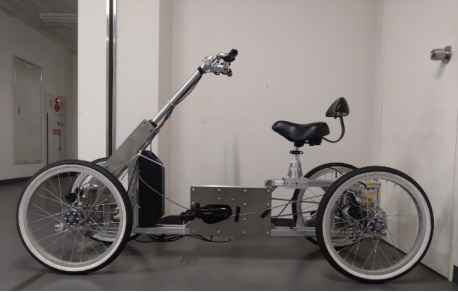
EXPERIMENTAL METHOD A prototype electric-assist quadricycle (SQC-03A) was used in the experiment. Figure 1 shows an overview of SQC-03A.
Figure 1: Overview of the prototype electric-assist quadricycle (SQC-03A).
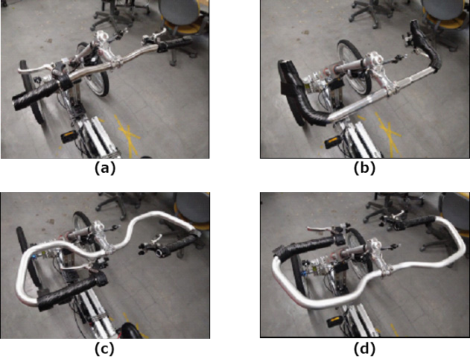
Usability Evaluation of Handlebar Geometry for Steering Operability 127 Three types of handlebars commonly used in bicycles—straight, bullhorn, and butterfly—were selected for evaluation. All handlebars satisfied the requirements for “ordinary bicycles” under the Japanese Road Traffic Act, with a maximum width of 600 mm. For the butterfly handlebar, two gripping configurations were considered depending on the mounting orientation, namely near-grip and far-grip positions, resulting in four experimental conditions. Table 1 summarizes the characteristics of the evaluated handlebars, and Figure 2 shows the installed configurations.
Usability was assessed based on two aspects: ease of braking operation (ease of gripping the brake lever) and ease of steering operation. Subjective evaluations were conducted using a five-point Likert scale.
A total of 10 male university students with experience in bicycle riding participated in the experiment. All participants evaluated all handlebar conditions. The participants were seated on the vehicle with their feet placed on the pedals and performed braking operations and left–right steering operations. They then evaluated the usability of each condition. Participants were instructed to grip the handlebars at positions marked with black grip tape.
For safety and experimental efficiency, all evaluations were conducted under stationary conditions.
Table 1: Characteristics of the evaluated handlebars.
Table available in the original PDF paper.
Handlebar Type Concept / Posture Grip Position Straight Standard / Flat Neutral width
Bullhorn Sporty / Forward Extended forward Butterfly (Near) Relaxed / Upright Close to body
Butterfly (Far) Active / Wide Wide and forward
Figure 2: Handlebar configurations in the experiment. (a) Straight, (b) Bullhorn, (c) Butterfly (Near), (d) Butterfly (Far).
RESULTS AND DISCUSSION
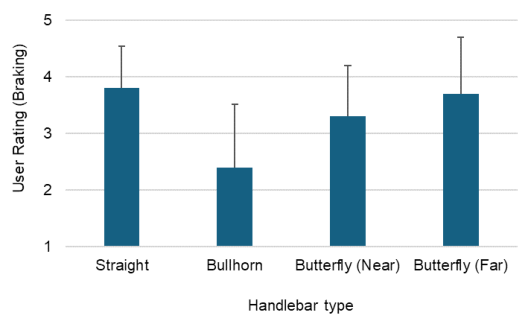
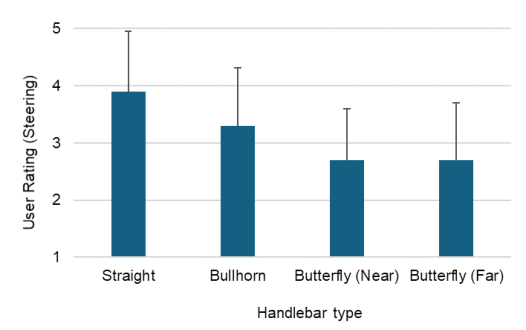
Figure 3 shows the subjective evaluation results for braking operation, and Figure 4 shows those for steering operation, both presented as mean values with standard deviations. In both cases, ratings were based on a five-point scale, where 1 indicates poor usability and 5 indicates high usability.
Figure 3: Comparison of usability ratings for braking operation across different handlebar types (mean ± standard deviation).Figure 4: Comparison of usability ratings for steering operation across different handlebar types (mean ± standard deviation).
The results indicate that the straight handlebar achieved the highest mean usability ratings for both braking and steering operations. The bullhorn handlebar received the lowest mean rating for braking. The butterfly handlebar showed different ratings depending on the gripping position.
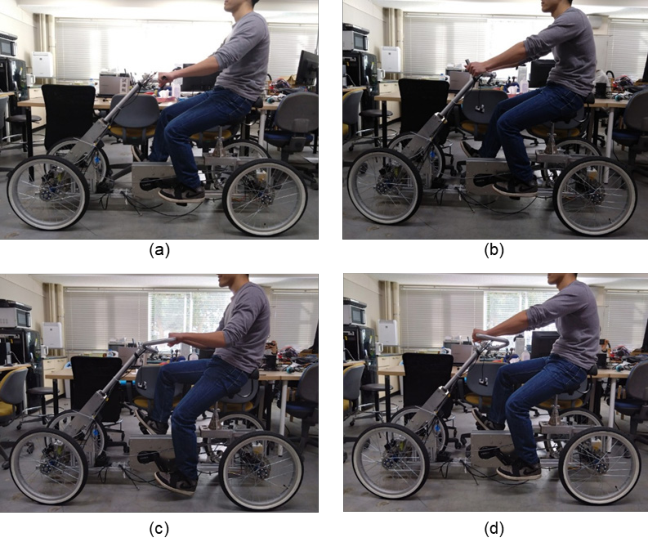
These results suggest that handlebar geometry plays a critical role in determining rider posture in semi-recumbent vehicles. Figure 5 shows the riding postures under each handlebar condition. As shown in the figure, the straight handlebar allows a more natural upper body posture, whereas the bullhorn handlebar induces a forward-leaning posture. In the
Usability Evaluation of Handlebar Geometry for Steering Operability 129 case of the butterfly handlebar, the far-grip condition similarly induces a forward-leaning posture, while the near-grip condition allows the rider to adopt a more upright posture.
In this vehicle, the upper body is supported by a backrest; therefore, handlebar geometries that assume a forward-leaning posture may force the rider into an unnatural position during operation. In particular, the bullhorn handlebar encourages a forward-reaching posture, which may reduce compatibility with the semi-recumbent configuration and reduced usability. In contrast, the straight handlebar allows a natural upper body posture and reduces physical load during operation, leading to higher usability ratings.
These findings highlight the importance of human-centered design in the development of quadricycle mobility systems. In particular, the compatibility between the rider’s posture and the handlebar position appears to significantly influence perceived usability.
Overall, these results suggest that, within the scope of this study, the straight handlebar is more suitable for semi-recumbent quadricycles.
Figure 5: Riding postures under different handlebar conditions. (a) Straight, (b) Bullhorn, (c) Butterfly (Near), (d) Butterfly (Far).
CONCLUSION
This study conducted a subjective evaluation to investigate the influence of handlebar geometry on usability in an electric-assist quadricycle.
130 Nonaka and Shiina The results showed that the straight handlebar achieved the highest mean usability ratings for both braking and steering operations. In contrast, the bullhorn handlebar received the lowest mean rating for braking, while the butterfly handlebar showed different ratings depending on the gripping position. These findings are attributed to differences in riding posture caused by handlebar geometry. In a semi-recumbent configuration, handlebar designs that allow a natural upper body posture are considered to provide better usability.
Within the scope of this study, the straight handlebar was found to be the most suitable for semi-recumbent electric-assist quadricycles.
However, this study is based on subjective evaluations conducted under stationary conditions, and thus does not fully capture dynamic operational characteristics during actual riding.
Future work will include evaluations under real riding conditions, as well as investigations into the effects of body size diversity and long-term fatigue.
ACKNOWLEDGMENT
This work was supported by JSPS KAKENHI Grant Number JP24K15646.
REFERENCES
Hsiao, S.W. (2015). “Applying Riding-posture Optimization on Bicycle Frame Design”, Applied Ergonomics, 51, pp. 69–79. Miyazawa, T. and Nonaka, T. (2025). “Design and Development of an Electric Power-
Assisted Quadricycle as Last-mile Transportation”, Proceedings of the 12th IEEE International Conference on Consumer Electronics Taiwan (ICCE-Taiwan 2025), pp. 205–206. https://doi.org/10.1109/ICCE-Taiwan66881.2025.11207807 Nonaka, T., Inage, T., Takano, S., and Miyata, Y. (2023). “Design and Development of an Electric Power-Assisted Quadricycle for Female Day-Trippers Visiting the Shonan Area”, Applied Human Factors and Ergonomics International, Vol. 112, pp. 91–97. https://doi.org/10.54941/ahfe1004117
FIND THE COMPLETE VOLUME IN THE AHFE DIGITAL BOOKSTORE
Explore the complete digital volume
Human Systems Engineering and Design (IHSED2026): Future Trends and Applications
Read this individual research paper free through the original publisher, or explore the full digital proceedings book.