Masayuki Ihara, Hiroko Tokunaga, Hiroki Murakami, Akihiko Koga, Takashi Yukihira, Ryoichi Maeda, Masashige Motoe, Shinpei Saruwatari (2026). Designing an Online Rehabilitation Exercise Service for Frailty Prevention among Older Adults. In: Human Systems Engineering and Design (IHSED2026): Future Trends and Applications. AHFE Open Access, vol. 237, pp. 1–11. https://doi.org/10.54941/ahfe1008140
Frailty prevention is a critical challenge in aging societies, as frailty represents a reversible state between robustness and the need for long-term care, involving both physical and social dimensions. This study presents the design and evaluation of an online rehabilitation exercise service aimed at preventing frailty among older adults. The service connects participants at home and in a community facility via video conferencing, enabling group exercise sessions and social interaction. A six-month experiment was conducted with 14 older adults, combining structured exercise sessions and informal social gatherings. Data were collected through physical function measurements, questionnaires, interviews, and video recordings. Results showed limited improvement in physical function, likely due to low session frequency and insufficient exercise intensity relative to participants’ baseline fitness. However, some participants reported increased awareness of stretching and greater motivation to engage in physical activity in daily life. In contrast, notable effects were observed in social engagement. Participants actively took on roles such as preparing and organizing the environment, which facilitated interaction and contributed to the prevention of social frailty. At the same time, challenges were identified in fostering interaction between online and in-person participants, as well as in supporting individuals without prior social connections. Video analysis revealed that meaningful insights emerged not only from structured activities but also from informal moments such as breaks and setup. The findings suggest that older adults can engage with digital technologies and contribute to service operation, highlighting the importance of designing sustainable, person-centered services that recognize their capabilities and agency.
Frailty prevention is one of the key challenges to be addressed in an aging society. Frailty is defined as a state in which physical and mental vulnerability emerges due to age-related declines in functions such as motor and cognitive abilities, and it is positioned between a healthy state and a condition requiring long-term care. It is also suggested that appropriate interventions for individuals in a frail state can help maintain and improve their functional abilities. Frailty can be broadly classified into physical frailty, which mainly concerns motor function, and social frailty, which involves the loss of social connections due to factors such as living alone or social withdrawal. We have been working on the development of an online rehabilitation exercise service aimed at preventing these forms of frailty. Following initial basic evaluations with a small number of participants (Yukihira et al., 2023; Ihara et al., 2025), we conducted a service validation experiment targeting community-dwelling older adults. This paper presents the design and results of this experiment.
ISSUES ADDRESSED Frailty Prevention
In an aging society, frailty prevention is essential for extending healthy life expectancy; however, it also involves many practical challenges. While there are institutional issues, key challenges on the part of older adults themselves include awareness and motivation. One of the fundamental issues related to physical frailty is malnutrition, such as insufficient protein intake necessary for muscle formation. As people age, many tend to adopt simpler diets, which can lead to a decline in physical strength. In addition to physical decline, life events such as the loss of a spouse or retirement may lead to loneliness and reduced motivation to go out. Such withdrawal results in the loss of social connections. For issues such as nutrition and social interaction, it is generally not easy for individuals to become aware of the problem and take proactive action to address it. Lack of interest and knowledge is another challenge. Although frailty is reversible and individuals can return to a healthier state through their own efforts, many older adults are not aware of this. Psychological factors such as overconfidence (“I am still fine”) or resignation (“I am already old”) also pose barriers.
Online Rehabilitation As mentioned above, older adults may experience reduced motivation to go out. Other factors that hinder outings include psychological reluctance, physical difficulties such as leg pain while walking, caregiving responsibilities for cohabiting family members, and infection prevention concerns. Enabling older adults to perform rehabilitation exercises such as physical exercise at home is valuable, as it allows them to maintain physical function without needing to go out. Previous studies have examined the effects of remote
Designing an Online Rehabilitation Exercise Service for Frailty Prevention 3 rehabilitation for older adults. Online interventions have been shown to improve physical functions such as walking speed, balance, and lower- limb strength (Dawson et al., 2024), and to be effective in improving health-related quality of life (QOL), activity limitations, and physical function (Wicks et al., 2023). Furthermore, according to Dawson et al., online rehabilitation involves relatively few technical issues, can be safely conducted at home, and can serve as an effective alternative to face-to-face rehabilitation. Lindberg et al. (2021) reported that some older adults show a willingness to use technologies required for online services, perceiving them as stimulating.
Social Isolation Social isolation is an important risk factor that affects mortality and functional decline in older adults (Steptoe et al., 2013; Holt-Lunstad et al., 2015). In a frail state, physical limitations reduce opportunities for social interaction, and social isolation creates a negative cycle that further accelerates functional decline (Hoogendijk et al., 2016; Gale et al., 2018). On the other hand, group-based exercise interventions for frail older adults have been shown to improve not only physical function but also social networks and depressive symptoms (Coll-Planas et al., 2017; Czaja et al., 2018). Yamada et al. (2026) demonstrated that multi-participant online rehabilitation for frail older adults provides both physical benefits through structured exercise and psychosocial benefits through online interaction.
Sustainable Services Based on the above studies, online rehabilitation can be considered effective for preventing both physical and social frailty. However, beyond the framework of experiments, there has been insufficient analysis from a service design perspective regarding whether such systems can be sustainably used in real-world settings, considering factors such as technology use, safety, and the psychology of older adults. Rather than limiting the study to hypothesis testing using predefined evaluation metrics, it is necessary to extract issues for sustainable services through exploratory approaches such as ethnography. In addition, as pointed out by Kitwood, it is important to apply the concept of person-centered care—which recognizes each older adult as an individual with unique characteristics and potential—to service design (Kitwood et al., 1992). Harvey et al. (2023), based on ethnographic research, argue that exercise programs should not be standardized solely by age, but should instead focus on the capabilities of older adults.
In this paper, we present a validation experiment of an online rehabilitation service for multiple participants. We report the results of evaluating its effects on physical and social frailty prevention and discuss the feasibility of the service, focusing on the use of IT technologies as well as the capabilities, potential, and psychological aspects of older adults.
EXPERIMENT Experimental Environment
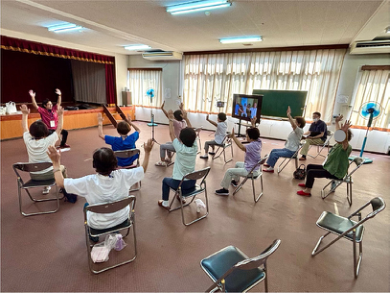
To evaluate the effectiveness of the online rehabilitation service and identify related challenges, we conducted an experiment in which older adults’ homes and a community center were connected online. In this service, older adults were able to perform exercises while viewing other participants and the exercise instructor through a screen. In the experiment, the community center was equipped with a tablet for the instructor, a large display for participants, a tablet for capturing an overhead view of the entire exercise scene, and a laptop computer for hosting the Zoom session. In the homes of participants joining online, tablets prepared by the experimenters were installed. All devices were connected to a Zoom meeting, creating an environment in which participants could engage in both exercise and conversation through the screen (see Figure 1). The arrangement of tablets and displays, as well as the configuration of Zoom windows shown on these devices, were refined through trial and error in the initial stage. Once an optimal design was identified, the experiment was conducted using that configuration. On the instructor’s tablet, windows showing the online participants were displayed, and the instructor spoke toward the tablet when addressing them. Participants at the community center could check the actions and speech of online participants by looking at the large display as needed.
Figure 1: Exercise at the community center.
Session Design and Participants In this experiment, in order to provide effects not only on physical frailty but also on social frailty, time for social gatherings was included in addition to exercise. Each session lasted 90 minutes and consisted of the following components:
First exercise segment (30 minutes)
Break (5 minutes)
Second exercise segment (30 minutes)
Social gathering (25 minutes)
Designing an Online Rehabilitation Exercise Service for Frailty Prevention 5 Sessions were conducted approximately once every two weeks, for a total of 11 sessions over a six-month period. The exercise program was designed by physical therapists and occupational therapists with careful consideration for safety. A total of 14 older adults (in their 70s to 90s; 4 males and 10 females) participated in the experiment. Participants were mainly recruited from those who attended other events at the community center (e.g., smartphone classes).
Participants indicated in advance which sessions they preferred to join online, and the experimenters assigned online participation accordingly. In each session, several participants (approximately two) experienced joining the session online from their homes or from another room in the community center. The reason for allowing participation from another room in the facility was that some participants were reluctant to use their homes as experimental settings. Wi-Fi connections and tablet configurations required for online participation were handled by experimenters who were present.
Data Collection To evaluate the effects, physical function measurements, questionnaires, and interviews were conducted before and after the experimental period. In addition, all sessions were recorded with the cameras of all devices connected to the Zoom meeting, including preparation and cleanup times. The questionnaire items included body movement, fatigue, and motivation, as well as mobility in daily life, exercise, level of independence, roles, social interaction, anxiety, and use of IT. Pre-interviews asked about participants’ exercise habits and social interactions, both in the present and in the past. Post-interviews explored episodes observed during the experiment in more depth. All interviews were conducted in a group format of approximately four to five participants, with each session lasting about 30 to 40 minutes.
RESULTS
Physical Function A comparison of physical function measurements before and after the experiment showed that there was little improvement in participants’ physical functions, except for an improvement in muscle quality. Similarly, comparisons of questionnaire responses before and after the experiment did not yield particularly notable findings. However, approximately half of the participants reported that they became more conscious of the stretching exercises performed during the sessions (see Table 1).
Table 1: Comparison of exercise habits before and after the experiment.
13 2–3 Yoga, dance 4+ Yoga, dance, stretching 14 2–3 Muscle training exercises, walking 4+ Exercise (exercises learned in this study)
On the other hand, post-interviews revealed an increase in motivation for exercise among some participants. Some participants reported performing exercises independently at home using the distributed exercise manual, while others increased the frequency of physical activity in their daily lives (see Table 1). Additionally, many participants pointed out in post-questionnaires and interviews that the exercise intensity was too low. It is possible that the older adults who volunteered to participate in this experiment were relatively confident in their physical strength and therefore had higher expectations for the exercise program.
Social Interaction In each session, after the exercise, participants sat around a table and engaged in conversation while drinking tea. Topics were not fixed, and the experimenters intentionally explored different approaches. For example, when the experimenters invited participants to introduce topics, one participant talked about a gardening event they had attended, and other participants showed interest and took notes about the event. In another session, when the experimenters explained the mechanisms of the devices used for online participation, some participants became interested and asked questions.
It was also frequently observed that participants voluntarily engaged in setting up and cleaning up chairs and tables used in the sessions. Furthermore, when a group chat on social media was created for communication among participants, one participant offered to take on the role of posting reminders before each session. These behaviors represent the proactive assumption of roles, which is an important factor in preventing social frailty.
DISCUSSION
Prevention of Physical Frailty One reason why little improvement in physical function was observed in this experiment may be the low frequency of sessions (once every two weeks) and the relatively high baseline fitness levels of participants. In addition, the exercise program was limited to seated exercises in order to prevent accidents such as falls, which may have resulted in insufficient physical load for participants. As shown in the questionnaire results, participants were already aware of the importance of exercise and had established exercise habits in their daily lives (see Table 1). However, as shown in Table 1, after the experiment, more participants reported being conscious of stretching exercises. Some also reported practicing exercises learned during the sessions. In the program, each session included a themed segment focusing on specific body parts such as the shoulders or lower back, accompanied by professional explanations. This likely contributed to increased awareness of stretching.
Furthermore, comparisons of participants’ past and present exercise habits revealed that while most participants had been actively engaged in exercise when they were younger (12 out of the 14 participants had exercise habits, such as swimming and volleyball), many had stopped exercising as they aged. According to interview results, reasons included physical decline making exercise difficult, dissatisfaction with decreased performance compared to the past, and the loss of companions to exercise with. The second reason may be particularly characteristic of older adults who originally had high confidence in their physical abilities.
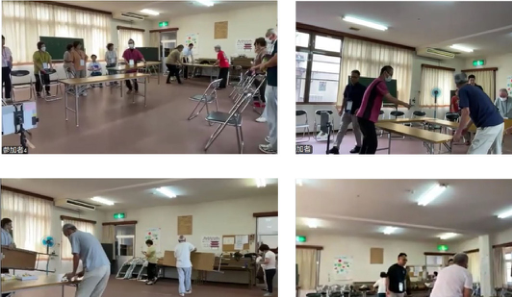
Prevention of Social Frailty As described earlier, participants were frequently observed voluntarily engaging in tasks such as setting up and cleaning up chairs and tables (see Figure 2). These actions were observed from the very first session and among multiple participants. Such cooperative activities not only represent role- taking but also serve as opportunities for interaction among participants, contributing to the prevention of social frailty.
Figure 2: Setting up and cleaning up chairs and tables.
During the social gathering sessions, the large display was moved closer to the table so that online participants could join the conversation. However, conversations between online and in-person participants were limited unless facilitated by the experimenters. It is likely that participants found it easier to talk to those physically present than to communicate through a screen.
Figure 3: Participant (ID4) carrying tables and distributing drinks and snacks.
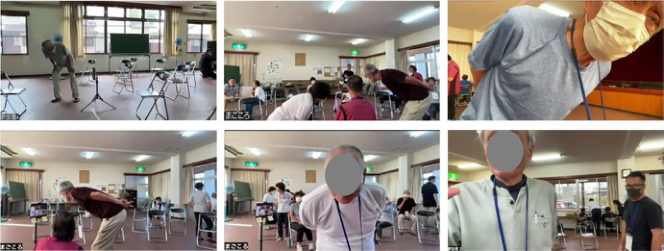
Among the participants, ten were already acquainted with each other, three were acquainted only among themselves, and one participant had no prior connections. This participant (ID4) withdrew from the experiment after the fifth session. Analysis of recorded footage showed that ID4 actively engaged in behaviors such as carrying tables and distributing drinks and snacks during social gatherings (see Figure 3). This suggests that ID4 attempted to connect with others by taking on roles. However, other footage showed that while observing others interacting with online participants (see Figure 4), ID4 observed others’ interaction (Figure 4, left), attempted to initiate interaction but was not noticed (Figure 4, center), and the interaction did not succeed (Figure 4, right). These episodes suggest that despite efforts to engage, ID4 was unable to establish sufficient interaction opportunities, which may have led to withdrawal.
Figure 4: Participant (ID4) trying to communicate with online participants.
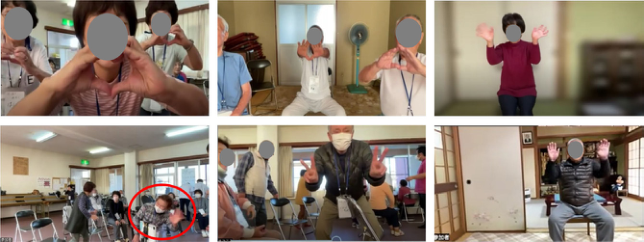
Sustainable Services Analysis of recorded footage revealed that participants showed interest in IT devices and online communication. Some participants repeatedly approached and observed the tablets during breaks (see Figure 5). Others, who initially avoided interacting with unfamiliar devices, gradually began to actively communicate with online participants during breaks (see Figure 6). Participants were observed not only talking but also using gestures such as waving or making heart shapes, enjoying communication through expressive means. The fact that many participants showed interest in IT devices suggests the potential of online services. Moreover, participants may not only engage
Designing an Online Rehabilitation Exercise Service for Frailty Prevention 9 as users but also contribute as part of the service operation by taking on roles. Enabling older adults to take on operational roles not only helps maintain social connections but also contributes to the sustainability of the service itself.
Figure 5: Participants repeatedly approaching and observing the tablets.Figure 6: Participants actively communicating with online participants.
CONCLUSION
This paper presented the results of a validation experiment of an online rehabilitation service and analyzed them from the perspectives of physical frailty prevention, social frailty prevention, and service sustainability. In addition to analyzing physical measurements, questionnaires, and interviews, careful analysis of recorded footage of the experiment allowed us to identify several noteworthy scenes. As a result, we confirmed participants’ exercise habits and attitudes, behavioral changes through participation in the experiment (e.g., increased engagement in stretching), the difficulty of fostering interaction among participants in a hybrid environment, and the potential for participants to take on active roles.
One contribution of this case study is that by capturing and analyzing events occurring outside the main program—such as during breaks, preparation, and cleanup—through video recording, unexpected insights were obtained.
This demonstrates the value of such approaches in experimental design. The experiment included both hypothesis-testing elements (evaluation of frailty prevention effects) and exploratory elements (identification of issues for service implementation). Recording enabled exploration beyond the expectations of the experimenters.
Another contribution is the confirmation of older adults’ acceptance of IT devices, the identification of practical operational challenges, and the recognition of their potential not only as service users but also as active role performers. When designing services for older adults such as IT use or exercise intensity, designers and researchers may unconsciously apply the label of “older adults.” In fact, some participants commented in post- interviews that they felt they were being treated as such. This serves as an important warning for future design improvements.
As a limitation of this study, the insights obtained were derived from an experiment that actively involved trial-and-error, rather than from a finalized service design. In addition, since the participants were older adults with relatively high motivation toward exercise, the findings may be subject to bias stemming from this characteristic. Future work will involve organizing the identified challenges and insights to move toward full-scale service implementation, as well as developing a methodology for service design.
ACKNOWLEDGMENT
We thank the care workers at the outpatient rehabilitation facility “Magokoro” and community members in Omuta city, Japan who cooperated in the experiment.
REFERENCES
Coll-Planas, L., Nyqvist, F., Puig, T., Urrútia, G., Solà, I. and Monteserín, R. (2017).
Social capital interventions targeting older people and their impact on health: A systematic review. Journal of epidemiology and community health, Vol. 71, No. 7, pp. 663–672. https://doi.org/10.1136/jech-2016-208131 Czaja, S. J., Boot, W. R., Charness, N., Rogers, W. A. and Sharit, J. (2018). Improving Social Support for Older Adults Through Technology: Findings From the PRISM Randomized Controlled Trial. The Gerontologist, Vol. 58, No. 3, pp. 467–477. https://doi.org/10.1093/geront/gnw249 Dawson, R., Oliveira, J. S., Kwok, W. S., Bratland, M., Rajendran, I. M., Srinivasan, A.,
Chu, C. Y., Pinheiro, M. B., Hassett, L. and Sherrington, C. (2024). Exercise Interventions Delivered Through Telehealth to Improve Physical Functioning for Older Adults with Frailty, Cognitive, or Mobility Disability: A Systematic Review and Meta-Analysis. Telemedicine journal and e-health: The official journal of the American Telemedicine Association, Vol. 30, No. 4, pp. 940–950. https://doi. org/10.1089/tmj.2023.0177 Gale, C. R., Westbury, L. and Cooper, C. (2018). Social isolation and loneliness as risk factors for the progression of frailty: the English Longitudinal Study of Ageing. Age and ageing, Vol. 47, No. 3, pp. 392–397. https://doi.org/10.1093/ ageing/afx188
Designing an Online Rehabilitation Exercise Service for Frailty Prevention 11 Harvey, K. and Griffin, M. (2023). (In/Ex)clusive fitness cultures: an institutional
ethnography of group exercise for older adults. Ageing and Society, Vol. 43, No. 2, pp. 251–275. https://doi:10.1017/S0144686X21000507 Holt-Lunstad, J., Smith, T. B., Baker, M., Harris, T. and Stephenson, D. (2015).
Loneliness and Social Isolation as Risk Factors for Mortality: A Meta-Analytic Review: A Meta-Analytic Review. Perspectives on Psychological Science, Vol. 10, No. 2, pp. 227–237. https://doi.org/10.1177/1745691614568352 Hoogendijk, E. O., Suanet, B., Dent, E., Deeg, D. J. and Aartsen, M. J. (2016).
Adverse effects of frailty on social functioning in older adults: Results from the Longitudinal Aging Study Amsterdam. Maturitas, Vol. 83, pp. 45–50. https://doi. org/10.1016/j.maturitas.2015.09.002 Ihara, M., Tokunaga, H., Koga, A., Yukihira, T., Motoe, M. (2025). Experimental Design for Participants, Not for Ethics Review. Human-Computer Interaction. HCII 2025. Lecture Notes in Computer Science, Vol. 15771. Springer, Cham. https://doi.org/10.1007/978-3-031-93965-5_3 Kitwood, T., Bredin, K. (1992). Towards a theory of dementia care: Personhood and
well-being, Ageing and Society, 12(3), pp. 269–287. Lindberg T., Sandström B., Andersson E. K., Borg, C., Hjelm, M., Nilsson, L., Olsson, A. and Skär, L. (2021). Older persons’ experience of eHealth services in home health care: A meta-ethnography eHealth services in home health care. Health Informatics Journal. Vol. 27, No. 4. https://doi:10.1177/14604582211059370 Steptoe, A., Shankar, A., Demakakos, P. and Wardle, J. (2013). Social isolation,
loneliness, and all-cause mortality in older men and women. Proceedings of the National Academy of Sciences of the United States of America, Vol. 110, No. 15, pp. 5797–5801. https://doi.org/10.1073/pnas.1219686110 Wicks, M., Dennett, A. M. and Peiris, C. L. (2023). Physiotherapist-led, exercise-based telerehabilitation for older adults improves patient and health service outcomes: A systematic review and meta-analysis. Age and ageing, Vol. 52, No. 11: afad207. https://doi.org/10.1093/ageing/afad207 Yamada, N., Sato, I., Kinoshita, S., Muraji, A., Tokunaga, S., Naka, T. and Okubo, R.
(2026). Multiuser Exercise-Based Telerehabilitation Intervention for Older Adults with Frailty: A Pilot Study. NeuroSci, Vol. 7, No. 1:11. https://doi.org/10.3390/ neurosci7010011 Yukihira, T., Tokunaga, H., Ihara, M., Murakami, H., Koga, A., Maeda, R., Saruwatari, S., Takeshita, K., Hisano, S. and Motoe, M. (2023). Toward an online rehabilitation exercise service based on personal independent living goals and risk management. Human Systems Engineering and Design (IHSED 2023): Future Trends and Applications, Vol. 112, pp. 187–194. http://doi.org/10.54941/ ahfe1004129
FIND THE COMPLETE VOLUME IN THE AHFE DIGITAL BOOKSTORE
Explore the complete digital volume
Human Systems Engineering and Design (IHSED2026): Future Trends and Applications
Read this individual research paper free through the original publisher, or explore the full digital proceedings book.