Masayuki Ihara, Hiroko Tokunaga, Tomomi Nakashima, Shinpei Saruwatari, Hiroki Goto, Yuuki Umezaki, Shinya Hisano, Masashige Motoe (2024). User experience and sustainability of person-centered services - A case study on caregiver workshops and services by a bar type of restaurant. In: Intelligent Human Systems Integration (IHSI 2024): Integrating People and Intelligent Systems. AHFE Open Access, vol. 119, pp. 686–696. https://doi.org/10.54941/ahfe1004533
To develop a care service which satisfies each patient’s demands, we should focus on a trade-off between individual cares and work efficiency. Satisfying demands of elderly people has an impact on social significance of empowering them, but it may not be sustainable as a business due to efficiency issues. This paper introduces an analysis on a balance between individual cares and work efficiency towards development of a person-centered care service.Person-centered care is a principle to deeply understand each patient [1]. There is a practical framework of the person-centered care, called DCM, Dementia Care Mapping [2]. However, it is difficult to operate under the framework at care sites due to there being too many operations in the DCM cycle. A development of new care services to replace the framework is expected, but they should be designed based on a person-centered principle.We focus on a methodology to create services based on the person-centered principle. There is a trade-off between individual cares for better user experience and work efficiency for service sustainability. Each patient has their own unique life backgrounds and values thus care services should be designed with consideration of them so that the services can support independent living of each patient. In particular, it is important to satisfy them by individual cares and social connections because elderly people live a lonely life after they have retired from work or have lost family or friends. In this study, to explore a balance between individual cares and work efficiency, we analyzed those two factors in opinions of on-site care workers and managers of nursing facilities.We held a 3-time workshop with care workers and analyzed questionnaire responses of the participants. The first workshop was to investigate their empathy with the care recipients. The second workshop was a free discussion on the issue of recipient’s loneliness. The third workshop was a lecture on the person-centered care followed by participants reflecting on their own care behaviors. We also held a workshop with managers to discuss a gap between ideal of providing person-centered cares and practical issues of business continuity. This workshop consists of three topics: social contribution through person-centered cares, sustainability as a care service provider and a balance between ideal and realty.The workshop with care workers revealed the need for efficiency to solve the busy work situation, and the importance of providing a good experience to care recipients, including the relationship with family and surroundings. In the workshop with managers, problems about cost bearers, understanding from society, and the long-term care insurance system were pointed out. As a result of case study of discussing utilization of artificial intelligence technologies, we confirmed the importance of considering the cost bearer by both benefits such as risk management on the service provider side and benefits by individual cares on the user side. We also obtained an idea of applying the technologies to parts which cannot be supported by the care insurance system.We also conducted a qualitative analysis on a service in a bar-type restaurant used by many solo customers as a model case of individualized customer service and efficient use of limited resources. We abstracted the analysis results and discussed application to nursing care service development. Future work will include detailed analyses on requirements for a concrete care service and development of a methodology of person-centered design.[1] Kitwood, T. and Bredin, K. (1992) Towards a theory of dementia care: Personhood and well-being, Ageing and Society, Vol.12, No.3, pp.269-287.[2] University of Bradford: Dementia Care Mapping, https://www.bradford.ac.uk/dementia/training-consultancy/
Elderly people who use nursing care services are listed as one of the cate- gories of vulnerable people in the SDGs (Sustainable Development Goals), and one of the goals is to satisfy their demands and empower them (United Nations, 2015). However, it is not easy for nursing care providers to make appropriate investments and operate businesses, and for society to achieve the SDGs. In particular, even if satisfying the demands of individual elderly people has a great social impact by empowering them, such business may not be sustainable due to efficiency issues.
Person-centered care is a principle for deeply understanding each patient (Kitwood et al. 1992). There is a practical framework for person-centered
User Experience and Sustainability of Person-Centered Services 687
care, called DCM, Dementia Care Mapping (University of Bradford). How- ever, it is difficult to operate under the framework at care sites due to there being too many operations in the DCM cycle. The development of new care services to replace the framework is desired by caregivers, and these services should be designed on the basis of the person-centered principle.
This paper analyzes the balance between individual cares and work effi- ciency towards the development of person-centered care services. We also discuss how to improve the user experience on the basis of analyses of both a bar-type restaurant service used by many solo customers and workshops conducted with workers and managers of nursing care facilities.
ISSUES ADDRESSED Service providers have a desire to increase user satisfaction while efficiently investing resources. However, in the nursing care domain, the workload on staff is heavy due to there being labor shortages and a wide variety of tasks. It is not easy for care workers to practice person-centered care at care sites where work efficiency is required due to these shortages. In addition to the DCM mentioned above, there is another framework called VIPS (Røsvik et al. 2013), but it does not address practical issues in service operation such as effi- ciency. Regarding trade-off issues in the healthcare field, the NICE (National Institute for Health and Care Excellence) in the United Kingdom considers principles for social value judgment (National Institute for Health and Care Excellence), and there is also a survey on balance between the demand side and the supply side of the field (Thokala et al. 2018). There are related stud- ies regarding individual patient care such as discrete choice experiments to measure patient preferences (Viney et al. 2002) and analysis of the elements of patients’ values (Lakdawalla et al. 2018). Related studies that pointed out problems on the service provider side include pointing out neglect in the caregiving process through the analysis of a value evaluation framework (Michaels, 2022), analysis of convenience factors in medical care (Higgins et al. 2014), and trade-off analysis regarding risks of caregiving behavior (Sanford et al. 2022). There are many studies from the service provider’s perspective in the marketing field. Cost-effectiveness issues are discussed in the context of customer lifetime value (Esmaeili et al. 2013), and there is an example of using artificial intelligence technology (Yılmaz Benk et al. 2022). Although there are various previous studies on trade-offs and cost- effectiveness, there is no case study that deals with the issue of balancing individualized cares and efficiency in designing person-centered services. In this study, we will analyze the balance between these two factors toward the development of new person-centered care services.
PERSON-CENTERED DESIGN We focus on a methodology for creating services based on the person-centered principle. There is a trade-off between individual care for a better user experi- ence and work efficiency for service sustainability. Each patient has their own unique life background and values; thus, care services should be designed in
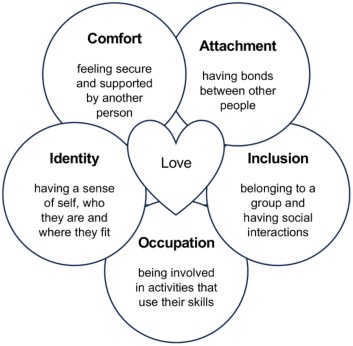
consideration of them so that the services can support each patient in indepen- dent living. Figure 1 shows the five petals of person-centered care: comfort, attachment, inclusion, occupation, and identity. In particular, it is important to satisfy the patients through individual care and social connections because elderly people can live a lonely life after they have retired from work or have lost family or friends. In this study, to explore the balance between individual care and work efficiency, we analyze these two factors through the opinions of on-site care workers and managers of nursing facilities.
Figure 1: Five petals of person-centered care.
WORKSHOPS WITH ON-SITE CARE WORKERS Overview
To investigate the opinions of on-site care workers, we held a 4-time work- shop (WS) with four mid-career workers (all women in their 40s to 50s) at a nursing facility that is represented by the third author of this paper. The WS was conducted four times for 90 minutes each from September to October 2022. The first WS was to investigate their empathy toward care recipients. The second WS was a free discussion on the issue of recipients’ loneliness. The third was a lecture on person-centered care followed by participants reflecting on their own care behaviors. The fourth was about defining spe- cific issues to solve loneliness. For more details on the WSs, see our previous work (Ihara et al. 2023).
Results
After the WS, participants were given a questionnaire survey in which they were asked to freely write their opinions regarding the ideal and reality of nursing care. Table 1 shows the results of organizing their responses into ideal and reality, and it can be seen that although they are conscious of implementing person-centered care, they feel that it is difficult to do so.
User Experience and Sustainability of Person-Centered Services 689
Table 1. Results of organizing care workers’ responses into ideal and reality.
Table available in the original PDF paper.
ID Ideal Reality 1
Care desired by care recipient
No burden on family
Difficulty understanding feelings of care recipient
Being swayed by family demands 2
Focus on family, community, and caregivers
Presence of people who give harsh opinions and are uncooperative
Cases in which worrying about care recipient has opposite effect
Due to progression of dementia, patient’s feelings are ignored and opinions of those around him/her are prioritized. 3
Consider and practice care that suits each care recipient
Due to limited space, time, and number of staff, it is sometimes impossible to provide care tailored to care recipient.
Provide various experiences to care recipients before they lose their ability to understand and make decisions due to dementia
Ask about life history and requests in a casual conversation
4
Set up time to talk with care recipients and ask about their life history and requests
Being busy assisting with excretion and eating
Staff themselves can afford to provide care.
WORKSHOPS WITH MANAGERS AT CARE FACILITIES Overview
We also held a WS with managers at care facilities (3rd, 5th, and 6th authors of this paper) to discuss the gap between the ideal of providing person- centered care and practical issues with business continuity. This WS consisted of four topics: social contribution through person-centered care, sustainabil- ity as a care service provider, the balance between the ideal and reality, and cost effectiveness in an example of utilizing artificial intelligence devices in nursing care. The WS was held a total of six times between January and April 2023, and it took participants 20 minutes to write their thoughts for each topic on sticky notes and 60 minutes to discuss them.
Results
Table 2 shows the results of organizing the opinions written on sticky notes by WS participants regarding the balance between the ideal and reality. In the WS, the managers pointed out problems in terms of the long-term care insurance system, burden on staff, human resources, society’s understanding, risks, and cost bearers. As the result of a case study involving discussion on utilizing artificial intelligence technologies, we confirmed the importance of
considering cost bearer in terms of benefits such as from risk management on the service provider side and benefits of individual care on the user side. We also got an idea to apply these technologies to areas that cannot be supported by the care insurance system. These results show that managers’ focus is not limited to the nursing care facilities but also to society.
In the WS discussion on the long-term care insurance system, it was pointed out that if an assessment of the insurance system determines that the level of care required has decreased, the care service provider’s profit will decrease, which is inconsistent with motivating care workers. Regarding society’s understanding, the WS participants discussed the following. Nursing homes are seen as a convenient place to solve problems. Nursing care facilities and society should work together to solve problems, but attention is not being paid to the division between the facilities and society. To tackle this issue, we need to take a macro perspective that looks at society and a micro one that looks at nursing care sites. In fact, this research aims to obtain insights from case studies from a micro perspective and utilize them for analysis based on a macro one.
Table 2. Results of organizing managers’ responses on a balance between ideal and reality.
Table available in the original PDF paper.
Category Content on sticky note
Person-centered care needs to be socially evaluated.
Long-term care insurance system
Compensating for what patients are unable to do with nursing care and supporting their daily lives are two different things.
The long-term care insurance system does not seem to aim for person-centered care.
Scope of nursing care service providers
Understand original purpose of long-term care insurance.
Improve country’s economic power so that financial resources go toward welfare. Burden on staff
Bridge gap between ideal and reality with patients flexibly and promptly.
Make it easier to bridge gap between ideal and reality through dialogue.
Reduce burden of staff through ideas that make them feel happy.
Make ideal easy to understand so that everyone can imagine it. Human resources
Increase resources to compensate for imbalances
Train successor staff.
Whether care recipient’s desired lifestyle is acceptable to those around him/her and society
Train staff to improve quality of care. Society’s understanding
Disclose information to let people know about efforts of nursing care providers.
Provide information to society that can support lives that care recipients desire Risks
Balance between risk and freedom for care recipients.
Balance between self-actualization and risk responsibility.
Responsibilities of nursing care providers regarding risks Cost bearers
Achieving ideal requires cost, so care recipients should also bear corresponding cost burden.
User Experience and Sustainability of Person-Centered Services 691
ANALYSES ON A BAR-TYPE RESTAURANT As an analysis based on a micro perspective, this paper also analyzes the service in a bar-type restaurant used by solo customers as a model case of individualized customer service and efficient use of limited resources. In gen- eral, bar-type restaurants in Japan are often operated by the owner alone, and customers often come alone. Some bar customers have worries about work, relationships, daily life, etc. They do not necessarily consult anyone, but they are looking for a connection with society by talking to someone. Many elderly people who use nursing care services live with a sense of lone- liness, having retired from long-time jobs or lost loved family or friends. It is important to provide them with a sense of fulfillment through individualized care and connections with society. Therefore, the insights obtained by analyz- ing bar-type restaurants, where many solo customers visit and conversation among the customers is often encouraged, may be useful when considering care services for lonely elderly people.
The first author of this paper visited a bar-type restaurant in Japan about 150 times from 2012 to 2023, experiencing the service as a customer and observing how the service was provided. Table 3 shows the results of the experiences and observations. Note that records of the experiences and obser- vations were not taken at each visit, and the results observed were itemized while reviewing past experiences using a retrospective approach. Since this is a first-person study and the experiencer, observer, and analyst are the same person, subjectivity cannot be completely eliminated. However, the observa- tion results in Table 3 were confirmed by the owner of the bar, and no errors were pointed out.
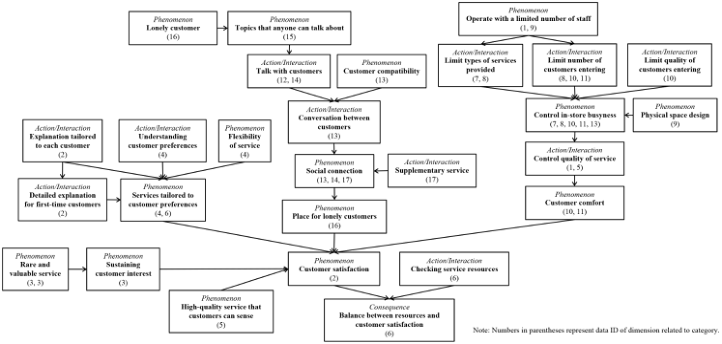
The results in Table 3 were analyzed using the grounded theory approach (GTA), which is a qualitative analysis method. Figure 2 shows a category relationship diagram of the results of axial coding for GTA’s open coding results and classification into phenomenon, action/interaction, and conse- quence. The storyline that can be interpreted from the results in Figure 2 is as follows.
Since it is operated with a limited number of staff, the number and qual- ity of customers as well as the types of services provided are limited, and the space is also designed to prevent overcrowding and control the quality of service. As a result, customer comfort is maintained. The services pro- vided are flexible, the preferences of each customer are understood through explanations tailored to each customer, and services that match the pref- erences are provided. In particular, detailed explanations are provided for first-time customers. Conversations are held on topics that anyone can talk about, and depending on compatibility, customers are guided into conversa- tions with each other, providing social connection and providing a place for lonely customers. Supplementary services are also being used to strengthen social connections. Creating a comfortable place for customers to stay and providing services that match their preferences will lead to customer satisfac- tion. Maintaining customer interest with rare and valuable services and giving them a sense of quality also leads to user satisfaction. Achieving customer satisfaction while checking the resources necessary for the service will lead to a balance between the two.
Table 3. Results of experiences and observations of bar services.
Table available in the original PDF paper.
ID Observation result 1 Since only one owner operates bar, quality of service can be controlled. 2 Adjusts details of explanation of sake provided depending on customer (detailed explanation for first-time customers looking forward to sake). 3 Customers will never get bored at bar as they will be offered once-in-a-lifetime sake that is sold during that season of the year. 4 There is no sake list, so sake chosen by owner on basis of customer preferences is served. 5 High-quality sake cup made of thin glass 6 Owner checks stock of sake and uses it skillfully while responding to customer’s preferences. 7 Does not increase choice of food offered. 8 Limits number of customers in bar to avoid overcrowding and declines food orders during busy times. 9 Counter-based service with 6 counter seats and 1 table for 4 people 10 Annoying customers such as loud groups are not allowed in bar. 11 Even if there are empty seats, customers may not be allowed in, and seats are generally not filled. 12 When not busy, owner speaks with customers. 13 Owner guides customers into conversation with each other depending on owner’s busyness and customer compatibility. 14 Occasionally encourages new customer to speak up so that he/she can engage in conversation. 15 Not only topics about sake, but also general topics 16 Service that takes into consideration lonely solo customers 17 Holds various events such as barbecues, stalls at market, anniversary celebrations, and music concerts.
Figure 2: Category relationship diagram (results of GTA analysis).
As the above storyline shows, most insights are related to the service itself, but it also includes insights about the physical space where the service is pro- vided and the words and actions of the service provider. The insights also
User Experience and Sustainability of Person-Centered Services 693
include ideas for maintaining high-quality service, such as limiting the qual- ity and number of customers, and ideas for maintaining business, such as checking and controlling service resources.
DISCUSSIONS
Table 4 shows the relationship between comments regarding ideal nursing care obtained from the managers and care workers at nursing facilities and ideas and insights in the bar analysis. This table suggests the importance of limiting the services provided, selecting services by understanding prefer- ences, and establishing social connections by understanding the surroundings and guiding people into conversation. Regarding limiting the services pro- vided, it is possible to reduce the burden of on-site work by aligning the level of care required by the users admitted by nursing care facilities. Regard- ing selecting services by understanding preferences, it is possible to respond to preferences by leaving room for selection and customization by users. Regarding guiding conversation, one idea is to increase the number of oppor- tunities for conversation between one staff member and two care recipients to make it easier for the care recipients to talk to each other.
Table 4. Ideal care and insights from bar analyses.
Table available in the original PDF paper.
Mentioner Comments on ideal care Ideas and insights from bar analyses Manager Scope of nursing care service providers Limit the type of services provided. Manager Increase resources to compensate for imbalances.
Limit the type of services provided. Worker Staff themselves can afford to provide care.
Sake chosen by owner on basis of customer preferences is served.
Limit the type of services provided. Manager Make it easier to bridge gap between ideal and reality through dialogue.
Worker Care desired by care recipient Sake chosen by owner on basis of customer preferences is served. Worker Consider and practice care that suits each care recipient.
Guide customers into conversation with each other.
Sake chosen by owner based on customer preferences is served. Manager Whether care recipient’s desired lifestyle is acceptable to those around him/her and society Worker Focus on family, community, and caregivers.
Guide customers into conversation with each other. Manager Bridge gap between ideal and reality flexibly and promptly.
Owner checks stock of sake and uses it skillfully. Manager Achieving ideal requires cost, so care recipients should also bear corresponding cost burden.
Supplementary services
Rare and valuable services and giving customers a sense of quality Worker Provide various experiences to care recipients.
To achieve both individualized care and efficiency, it is necessary to find a balance between the two without causing the business to go bankrupt. To this end, the “selection” mentioned above is important. For example, in the case of meal services, one idea would be to provide the option of eating out at a restaurant in addition to eating inside the facility, allowing care recip- ients to choose according to their will. By allowing care recipients to make their own choices, they can feel that they are “choosing the option they like,” which means they are no longer just using the service passively, so the user experience may be improved. It is important to provide care recipients with an experience that allows them to exercise their independence by designing services with appropriate limitations and flexibility.
Table 5 shows the results of organizing the first author’s bar service expe- rience using the five petals of person-centered care. As shown in Table 5, there are many positive experiences for each petal. This suggests that there is a strong relationship between bar service and person-centered care in the nursing care field and that it is effective to utilize insights from bar services in nursing care service design.
Table 5. Bar service experiences organized by five petals of person-centered care.
Table available in the original PDF paper.
Petal Experience Comfort
Comfortable counter seat
I do not have to order sake or food myself as I can leave it up to the owner.
Owner knows my preferences.
Sake and food are provided depending on my situation that day.
First of all, quality of sake and food is high. Attachment
Conversation with owner at counter
Owner mediates conversation with other customers at counter.
I only need to talk to customers that I enjoy talking to.
Owner refuses entry to strange people. Inclusion
I can participate in conversations among owner and customers.
It becomes easier to talk to regular customers after visiting several times.
Regular customers come to bar on day I visit. Occupation
Playing guitar is common hobby between owner and me, so we played in band together. Identity
There is no need to force conversation against my will.
It is okay to just sit at counter seat.
I can enjoy spending time with my favorite sake and food.
The insights obtained in this study are the results of specific case stud- ies from a micro perspective, but if these can be utilized for analysis from a macro perspective, they may be useful for corporate activities that appeal to the SDGs. In other words, they may have an impact on management perspectives, such as investment behavior and business profits, life-or-death perspectives, such as contributing to a sustainable society and sustainability
User Experience and Sustainability of Person-Centered Services 695
as a business entity, and substantive corporate philosophy, such as human- centeredness and the pursuit of profit. The social contribution of empowering the elderly through the promotion of person-centered care is significant as it contributes to the sustainable society aimed at by the SDGs. The opinions of nursing facility managers shown in Table 2 include many aspects of the nurs- ing care field from a broader perspective, including not only cost but also the long-term care insurance system, social understanding, and cost bearers. It is interesting that many managers view the current problems with elderly care at nursing facilities as a social problem, not just a management problem for one company. Nursing care providers, who are facing the reality of labor shortages, are hoping for social system reform, and this may be reflected in the results of these analyses. We believe that this research, which analyzes person-centered care that requires consideration of the balance between indi- vidualized care and efficiency, is valuable as a micro case study for achieving the SDGs through a social system.
CONCLUSION
In this paper, we analyzed the balance between individualized care and effi- ciency toward the development of new person-centered care services. We believe that the contributions of this research are as follows. First, we applied the insights obtained from a bar service analysis to the analysis of nurs- ing care service design requirements beyond the boundary between the two different fields. Second, we demonstrated the possibility of applying the results obtained from a case analysis from a micro perspective to the anal- ysis of SDGs from a macro perspective. In the future, we would like to create examples of specific services that achieve a good balance between individual care and efficiency and also organize specific issues in developing micro-perspective insights into macro-perspectives.
ACKNOWLEDGMENT
We would like to thank the employees of the nursing facility “Living Aeru” for participating in the workshop. We would also like to thank the bar owner for kindly agreeing to letting us use the bar as the subject of analysis in this study. This work was supported by JST Grant Number JPMJPF2101.
REFERENCES
Esmaeili, G. M. and Tarokh, M. J. (2013) Customer Lifetime Value Models: A Literature Survey, International Journal of Industrial Engineering & Production Research, Vol. 24, No. 4, pp. 317–336. Higgins, A., Barnett, J., Meads, C., Singh, J., and Longworth, L. (2014) Does conve-
nience matter in health care delivery? A systematic review of convenience-based aspects of process utility, Value Health, Vol. 17, No. 8, pp. 877–887. Ihara, M., Tokunaga, H., Nakashima, T., Saruwatari, S., Goto, H., Umezaki, Y., and Motoe, M. (2023) Facilitating Empathy for Care Recipients -Analyzing Care Behaviors Towards Person-Centered Care-. Design, User Experience, and Usabil- ity. HCII 2023. Lecture Notes in Computer Science. Vol. 14034. Springer, Cham. https://doi.org/10.1007/978-3-031-35705-3_26.
Kitwood, T. and Bredin, K. (1992). Towards a theory of dementia care: Personhood and well-being, Ageing and Society, Vol. 12, No. 3, pp. 269–287. Lakdawalla, D. N., Doshi, J. A., Garrison Jr, L. P., Phelps, C. E., Basu, A., and Danzon,
P. M. (2018) Defining Elements of Value in Health Care-A Health Economics Approach: An ISPOR Special Task Force Report [3], Value Health, Vol. 21, No. 2, pp. 131–139. Michaels, J. A. (2022) Value assessment frameworks: who is valuing the care in healthcare? Journal of Medical Ethics. Vol. 48, pp. 419–426. National Institute for Health and Care Excellence. Value Based Assessment of
Health Technologies. https://www.nice.org.uk/Media/Default/About/what-we-do /NICE-guidance/NICE-technology-appraisals/VBA-TA-Methods-Guide-for-Con sultation.pdf. Røsvik, J., Brooker, D., Mjorud, M., and Kirkevold, Ø. (2013) What is personcentred care in dementia? Clinical reviews into practice: The development of the VIPS practice model, Reviews in Clinical Gerontology, Vol. 23, No. 2, pp. 155–163. Sanford, N., Lavelle, M., Markiewicz, O., Reedy, G., Rafferty, A. M., Darzi,
A., and Anderson, J. E. (2022) Capturing challenges and trade-offs in health- care work using the pressures diagram: An ethnographic study, Appl. Ergon. Vol. 101:103688. Thokala, P., Ochalek, J., Leech, A. A., and Tong, T. (2018) Cost-Effectiveness Thresholds: the Past, the Present and the Future, Pharmacoeconomics, Vol. 36, No. 5, pp. 509–522. United Nations. (2015). Sustainable Development Goals. https://sdgs.un.org/goals. University of Bradford. Dementia Care Mapping. https://www.bradford.ac.uk/dem
entia/training-consultancy/. Viney, R., Lancsar, E., and Louviere, J. (2002) Discrete choice experiments to measure consumer preferences for health and healthcare, Expert Rev. Pharmacoecon Outcomes Res. Vol. 2, No. 4, pp. 319–26. Yılmaz Benk, G., Badur, B., and Mardikyan, S. (2022) A New 360
Framework
to Predict Customer Lifetime Value for Multi-Category E-Commerce Compa- nies Using a Multi-Output Deep Neural Network and Explainable Artificial Intelligence, Information, Vol. 13, No. 8: 373.
LISTED IN THE AHFE DIGITAL BOOKSTORE CATALOGUE
Explore the complete digital volume
Intelligent Human Systems Integration (IHSI 2024): Integrating People and Intelligent Systems
Read this individual research paper free through the original publisher, or explore the full digital proceedings book.
ISBN 978-1-958651-95-7
Explore this ISBN in the AHFE Bookstore ↗Listed in the July 2026 bookstore catalogue; search by ISBN to confirm current availability · Digital book purchase optional