Tomokazu Furuya, Takeshi Kawashima (2024). Automotive human‒machine interface to use like a peripersonal space through the elbow using vibrotactile stimulation. In: Intelligent Human Systems Integration (IHSI 2024): Integrating People and Intelligent Systems. AHFE Open Access, vol. 119, pp. 1–8. https://doi.org/10.54941/ahfe1004464
Driving a car is a visually demanding task.The ability to convey information intuitively using other senses, rather than relying solely on vision, will significantly reduce the driver's workload. Therefore, we have been focusing on tactile stimuli and the peripersonal space, and the idea of transmitting the relative position and distance of objects around the vehicle to the driver via vibration stimuli applied to the upper limbs. The peripersonal space is the space around the body in which direct interaction between external objects and the body takes place. While driving, the driver monitors the surrounding situation from the front, and there is essentially a fixed relationship between the visual field and the position of the driver's arms. We conceived the idea of transmitting the relative position and distance of objects around the vehicle to the driver via vibration stimulation to the upper limbs by mapping this relationship like a peripersonal space. In a previous study, we investigated the correspondence between visual information presented on a driving simulator and vibration stimuli applied to the hand and elbow. Under such limited conditions, we found that stimuli to the hand tended to correspond to the range of the effective visual field, whereas stimuli to the elbow tended to correspond to the range outside the effective visual field. In the present basic investigation using a driving simulator, we applied tactile stimuli to the elbows to inform the driver about a possible collision with a vehicle pulling in front of them from a blind spot and confirmed the driver's reaction. In the experimental driving scenario, the driver follows behind a vehicle while driving on the left side of a two-lane road. A vehicle in the right lane suddenly cuts in front of the driver when the distance between the two vehicles is 0.5 m. Prior to cutting in front of the driver, the vehicle in the right lane is in the blind spot on the screen of the driving simulator and is completely invisible to the driver because there is no side mirror. The driver operates the vehicle to avoid colliding with the other vehicle. Three conditions were used: condition 1, no vibration stimulation; condition 2, elbow stimulation at a distance of 0.5 m between the vehicle in the right-hand lane and the driver's own vehicle; and condition 3, elbow stimulation at a distance of 0 m between the vehicle in the right-hand lane and the driver's own vehicle. Vibrotactile stimulation was applied twice, separated by an interval of 500 ms, with a tactile apparent motion. The subjects were informed that the tactile apparent motion indicated the interruption by a vehicle from the right-hand lane. The results showed that in condition 3, the timing of braking was earlier than in the other conditions and the distance between vehicles when interrupted by the vehicle from the right lane was large. Future experiments will be conducted to obtain further detailed mapping of the upper limb and visual space and compare the differences with other sensory human‒machine interfaces.
Driving a car is visually demanding. Moreover, in recent years, the amount of information presented to drivers has increased owing to the increasing sophistication of driver assistance systems. In particular, the visual load on the driver increases because the information is primarily presented graphically. A significant reduction in the load on drivers can be expected if information is conveyed intuitively using other senses rather than relying solely on vision. Auditory displays are a non-visual method for alerting drivers; however, they are mainly electronic sounds. Despite the use of various electronic sounds in vehicles, drivers might struggle to identify them accurately. Electronic sounds can also be heard by other occupants and may cause anxiety. Therefore, we focused on the sense of touch as a sensory organ in addition to vision. We considered that the sense of touch could provide information to the driver without confusion in identifying information. Tactile stimuli are capable of various representations that make use of illusions and aren’t currently utilized in the presentation of information to the driver very much. As an approach to
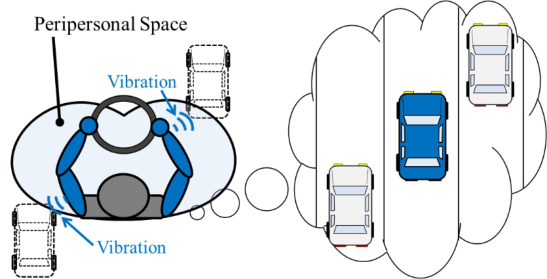
transmitting visual information through tactile sensation, we referred to the peripersonal space. Peripersonal space is the space around the body where direct interactions between external objects and the body occur. It has spa- tial perceptual characteristics that differ from those of other areas, because sensory information from multiple modalities is integrated. It has dynamic and functional plasticity, adapting based on the body parts, tool functions, and usage experience (Enomoto and Yamagami, 2011). While driving, the driver monitors the surrounding situation from the front, and there is a fixed relationship between the field of vision and the position of the driver’s arms. We conceived the idea of transmitting the relative positions and distances of objects around the vehicle to the driver via vibration stimulation of the upper limbs by mapping this relationship (Figure 1). Vibratory stimuli were applied to an area close to the peripersonal space. Understanding the posi- tions of nearby objects helps drivers identify potential dangers and reduces the risk of traffic accidents. This HMI can also contribute to the development of future technologies, such as making it easier for the driver to respond when driving because the status of surrounding objects can be understood even in the eyes-off state during autonomous driving (level 3).
Figure 1: Concept image of automotive HMI to use like a peripersonal space.
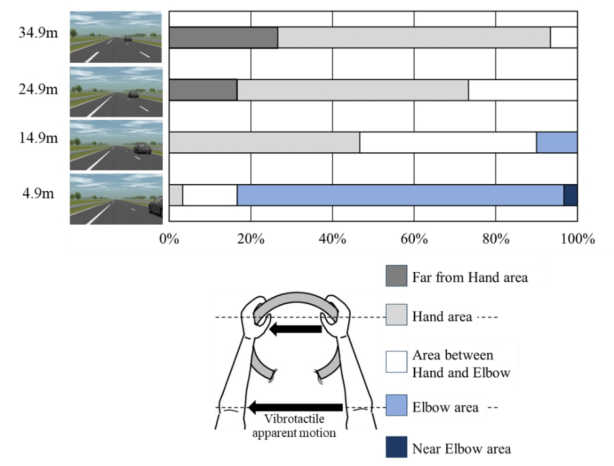
Information presentation to car drivers using tactile stimulation has been studied using vibration stimuli on the abdomen and back (Ho et al., 2005), arms, legs, and back/abdomen (Murata et al., 2011), and directional pre- sentation on the thighs (Okuwa et al., 2008) and transmit warnings and navigation information from the steering wheel to the palms using vibration stimuli (Murata et al., 2009), (Hwang and Ryu, 2010). However, despite the high compatibility between the upper limbs and spatial cognition, none of these studies have mapped the upper limbs and spatial information. In a previous study, we investigated the correspondence between visual infor- mation presented on a driving simulator and vibration stimuli applied to the hand and elbow (Furuya and Kawashima, 2022). Figure 2 presents the exper- imental results from a previous study, showing the percentage of responses in relation to the distance between the vehicle and the vehicle in the right-hand lane. It was confirmed that hand stimulation was suitable at 24.9–34.9 m and
Automotive Human-Machine Interface to Use Like a Peripersonal Space 3
elbow stimulation at 4.9 m. The picture from the driving simulator at 4.9 m showed that half of the vehicle was not visible from the field of view, and the visual angle was approximately 28.4
, which was outside the effective field of view (range of approximately 15
); while at 24.9 m the visual angle was approximately 10.8
, and the vehicle was within the effective field of view. Under such limited conditions, we found that stimuli to the hand tended to correspond to the range of the effective visual field, whereas stimuli to the elbow tended to correspond to a range outside of the effective visual field.
In this study, we confirmed the driver’s reaction to a driving simulator by informing the driver of the vehicle situation using tactile stimulation to the elbows when a vehicle was interrupted from a complete blind spot. To assess the effects and challenges of creating an automotive human-machine inter- face (HCI) for peripersonal space, we compared results from elbow vibration stimulation with those without such stimulation.
Figure 2: Mapping visual information on driving simulator to upper limbs stimuli (Furuya and Kawashima, 2022).
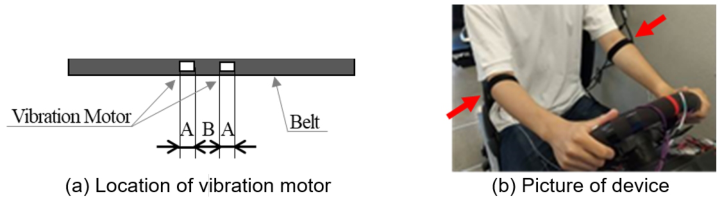
EXPERIMENTAL APPARATUS The experimental setup is illustrated in Figure 3. The arm vibration motor was a small, time-responsive linear vibration motor (LD14-002, reso- nance frequency 150 Hz, Nidec Copal Electronics) controlled by a haptic motor controller (DRV2605, Adafruit) and microcomputer (Arduino Mega 2560). The vibration motor was assembled into a sports stocking belt (width: 25 mm; length: 370 mm) and wrapped around the elbow. For prac- tical use, it is assumed that the device is transmitted from an armrest such as a seat. The armrests were in contact with the olecranon of the ulna; there- fore, two motors with a value of 14 mm for A in Figure 3 were placed in contact across the olecranon of the ulna. The value of B in Figure 3 is set to
4 Furuya and Kawashima
approximately 20 mm. SCANeR Studio by AVSIMULATION was used as the driving simulator. The screen was a single 49-inch screen approximately 1480 mm away from the driver’s eye point. Communication between the driving simulator and microcontroller was achieved via Ethernet using an Arduino Ethernet Shield2.
Figure 3: Experimental apparatus for tactile stimulation.Figure 4: Experimental scenario.
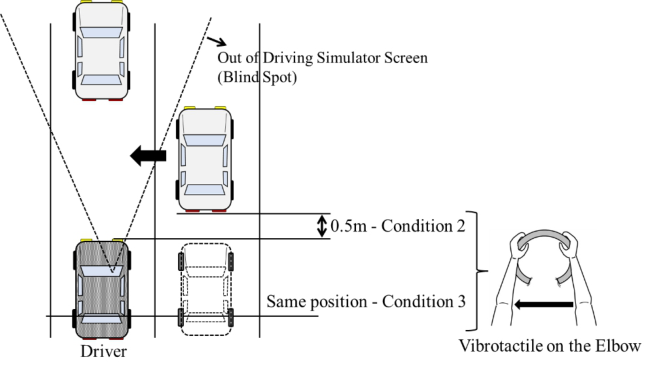
EXPERIMENTAL DESIGN In the driving scene shown in Figure 4, the driver follows the vehicle ahead while driving on the left side of a two-lane road. A vehicle in the right lane interrupts the driver when the distance between the two vehicles is 0.5 m. The vehicle in the right lane was in a blind spot on the driving simulator screen and was completely invisible to the driver because there was no side mirror. The driver operates the vehicle to avoid contact with other vehicles. The vehicle started at a speed of 0 km/h and was controlled at a maximum speed of 100 km/h. Three conditions were used: condition 1, no vibration stimulation; condition 2, elbow stimulation at a distance of 0.5 m between the vehicle in the right lane and the driver’s vehicle (the same time as when the driver was interrupted); and condition 3, elbow stimulation at same position
Automotive Human-Machine Interface to Use Like a Peripersonal Space 5
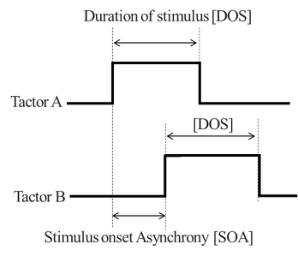
(two vehicles in a row = the centres of the rear axles coinciding). Vibro- tactile stimulation was applied twice, separated by an interval of 500 ms, with a tactile apparent motion characteristic duration of stimulus [DOS] of 400 ms and stimulus onset asynchrony [SOA] of 300 ms, as described in our previous research (Furuya and Kawashima, 2022). The DOS and SOA are illustrated in Figure 5. The subjects were informed that the apparent tactile motion indicated an interruption by the vehicle from the right-hand lane. The participants were ten healthy male and female students aged 18–22 years with driving licences.
Figure 5: Duration of stimulus and stimulus onset asynchrony.
To eliminate the influence of order effects, half of the subjects performed two trials for condition 1, four trials for condition 2, and four trials for con- dition 3, followed by two trials for condition 1. The other half of the subjects conducted the trials under the conditions described above, interchanging con- ditions 2 and 3. In the vibration stimulus condition, the subjects listened to white noise through headphones to remove any influence of the vibra- tion sound. The experiments were reviewed and approved by the Research Ethics Committee of the Arakawa Campus of the Tokyo Metropolitan Col- lege of Industrial Technology and informed consent was obtained from all participants.
RESULTS
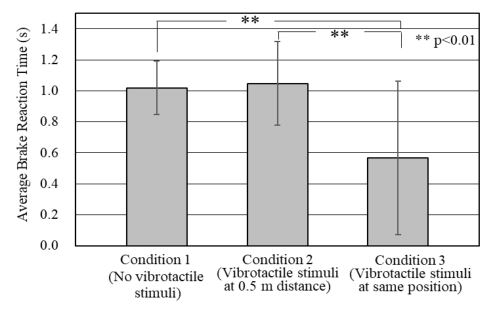
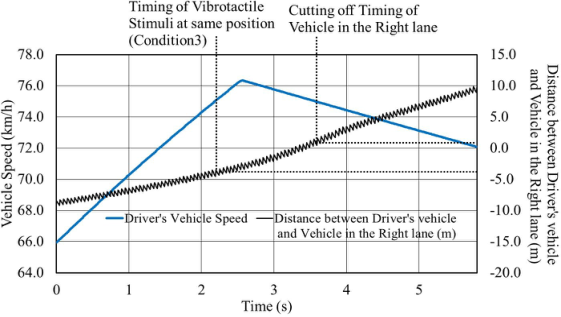
The first step was to determine the time from when the vehicle in the right lane was interrupted (distance:0.5 m) to when the driver stepped on the brake. However, in conditions 1 and 2, all the subjects stepped on the brake; however, in condition 3, 30% of the subjects avoided a collision without braking. The results for the seven subjects who avoided collisions by braking are shown in Figure 6. Analysis of variance (ANOVA) shows a significant difference, F (2, 81) = 17.60, p <.01. The braking reaction time was faster in condition 3, and the multiple comparison (Bonferroni) results showed a significant difference compared to conditions 1 and 2. A representative exam- ple of the time-series data of the speed adjustment of a subject who did not step the brake under condition 3 is shown in Figure 7. The horizontal axis
6 Furuya and Kawashima
shows the time, whereas the vertical axis shows the speed in the straight- ahead direction and the distance between the vehicle and the interrupting vehicle. The figure shows that the subject did not step the brake after the vibration stimulus and thus responded to the interruption by adjusting the speed only by accelerating. A possible reason for removing the accelerator pedal is that the vehicle was outside the blind spot and the driver was not aware of the situation.
Figure 6: Experimental results of brake reaction time (7 subjects without subjects not operating the brake).Figure 7: Speed control of subjects not operating the brake.
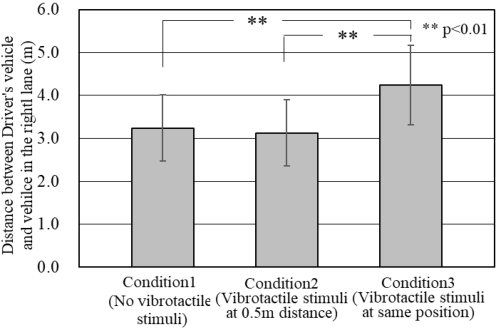
Next, the distance between the front and rear vehicles was examined when the lateral difference between the vehicle centre of the driver’s car and that of the interrupting vehicle was below 2 m from the vehicle centre. The width of a standard passenger car is approximately 2 m. If the width is less than 2 m, contact occurs between vehicles; this value is used to determine the distance between the two vehicles. The mean values and standard devia- tions are shown in Figure 7. The ANOVA showed a significant difference, F (2, 117) = 22.08 p <.01. Figure 7 shows that only condition 3 had a longer distance between vehicles, and the multiple comparison (Bonferroni) results showed a significant difference compared to conditions 1 and 2. Condition 3
Automotive Human-Machine Interface to Use Like a Peripersonal Space 7
was effective because the drivers could recognise the vehicles in the right lane by the vibration stimuli to the elbow, and adjust their driving behaviour quickly in preparation for danger after being informed that a vehicle in the right lane was passing beside the vehicle and was about to collide.
Figure 8: Experimental results of the distance between the driver’s vehicle and the vehicle in the right lane at 2 m distance in the horizontal direction.
DISCUSSION
Previous studies have shown that the farther away from the effective field of view, the closer the area is to the driver’s body. The effectiveness and challenges of HMIs, such as the peripersonal space, were confirmed by stimulating the elbow position to inform the driver of the behaviour of an interrupting vehicle from outside the field of view.
The driver’s response when alerted with a vibration stimulus about a car entering the right lane was not significantly different from the response with- out the vibration (comparing conditions 1 and 2). That is, the vibration stimulus on condition 2 is almost the same timing as visually recognising the interrupting vehicle and is less effective in reducing the visual load. However, the driver could react significantly more safely when a vibratory stimulus was applied at a position where the interrupting vehicle was directly next to the driver (comparison of condition 3 and the others). This indicates that the driver recognised the vehicle in the complete blind spot and reacted without relying on vision alone. Thus, the possibility of using an HMI as a periper- sonal space was confirmed. However, there are several issues to be identified. First, because there was a time lag between the stimulus and vehicle interrup- tion, it may have been possible to respond by stimulating other body parts. In the future, it will be necessary to investigate the differences in driver responses to different body parts. Subsequently, we must map the upper limb site to the location of the surrounding vehicle in detail. Furthermore, it is necessary to measure gaze behaviour to determine whether the vehicle is recognised by visual or vibration stimuli.
8 Furuya and Kawashima
CONCLUSION
In this study, we confirmed the driver’s reaction on a driving simulator by informing the driver of the vehicle situation using tactile stimulation to the elbow when a vehicle is interrupted from a completely blind spot to clarify the effects and challenges towards the realisation of an automotive human– machine interface for use as a peripersonal space. The results showed no significant difference in the effectiveness of the vibration stimulus when given at a visually recognisable position. However, it was confirmed that providing vibration stimuli before visual recognition was effective in ensuring driver safety. However, we could not determine whether there was an effect accord- ing to the stimulation site; therefore, it is necessary to make comparisons according to the differences between different upper limb parts and to make a detailed correspondence between the upper limb site and the location of the surrounding vehicles. We must also consider methods to be present in specific use cases (e.g., highly automated driving) and consider the form of the device in application to real vehicles. We believe that realising this HCI will reduce the visual load on the driver and contribute to safer driving.
ACKNOWLEDGMENT
This work was supported by JSPS KAKENHI Grant Number 23K11191.
REFERENCES
Enomoto, R. Yamagami, S. (2011) “Embodiment and multisensory integration: The mechanism of spatial perception through body representation”, Bulletin of Sen- shu University School of Human Sciences. Psychology, Vol. 1, No. 1, 61–69 (in Japanese). Furuya, T. Kawashima, T. (2022) “Transmitting the Movement of Surrounding
Objects through the Upper Limb Using Vibrotactile Apparent Motion”, 2022 JSAE Congress (Autumn), Literature No. 20226173 (in Japanese). Ho, C. Tan, H. Z. Spence, C. (2005) “Using spatial vibrotactile cues to direct visual attention in driving scenes”, Transportation Research Part F 8, 397–412. Hwang, S. Ryu, J. (2010) “The Haptic Steering Wheel. Vibro-tactile based Naviga-
tion for the Driving Environment”, 2010 8th IEEE International Conference on Pervasive Computing and Communications Workshops (PERCOM Workshops), 660–665. Murata, A. Tanaka, K. Morikawa, M. (2009) “Basic study on effectiveness of tactile interface for warning presentation in driving environment”, Fifth International Workshop on Computational Intelligence & Applications IEEE SMC Hiroshima Chapter, 242–247. Murata, A. Kemori, S. Moriwaka, M. (2011) “Basic Study on Automotive Warning
Presentation to Front/Rear Danger by Vibrotactile Stimulation”, The Japanese Journal of Ergonomics, Vol. 47, No. 5, 198–208 (in Japanese). Okuwa, M. Nakashima, A. Fujieda, N. (2008) “Development of a Tactile Driver Interface using Seat Vibrations”, The Transactions of Human Interface Society, Vol. 10, No. 3, 363–371 (in Japanese).
LISTED IN THE AHFE DIGITAL BOOKSTORE CATALOGUE
Explore the complete digital volume
Intelligent Human Systems Integration (IHSI 2024): Integrating People and Intelligent Systems
Read this individual research paper free through the original publisher, or explore the full digital proceedings book.
ISBN 978-1-958651-95-7
Explore this ISBN in the AHFE Bookstore ↗Listed in the July 2026 bookstore catalogue; search by ISBN to confirm current availability · Digital book purchase optional