Eisuke Okane, Tomokazu Furuya, Juntaro Sakazaki, Ken Kikuchi, Takahiro Higuchi (2024). Relationship between gaze behavior and whole-body movement during car ingress. In: Advances in Human Factors of Transportation. AHFE Open Access, vol. 148, pp. 344–353. https://doi.org/10.54941/ahfe1005225
Car ingress and egress are the most physically demanding activities in car use, particularly for older people with weak muscles. In a survey of elderly people in Japan regarding car use, the load on the legs and back during ingress and egress was ranked at the top of complaint. Reducing the load during car ingress and egress will make it easier for older people to use cars and is expected to contribute to maintaining and improving the quality of life for aging societies. Many studies regarding car ingress and egress have mainly focused on the motion analysis of the whole-body movement. However, the movement needs to be modified in response to the visual information regarding the spatial relationship between a narrow space of the car entrance and the body. We therefore investigated in the present study the relationship between gaze behavior and whole-body movement during car ingress. Based on the findings, we discussed whether patterns of whole-body movement to enter the car are related at least in part to how individuals look at the car entrance.12 young adults between the ages of 18 and 21(Mean =20.2, SD=0.94; 2 women and 10 men) participated. A mock-up of a car with doors was used to measure the gaze behavior and whole-body movement. There were two roof height conditions: high (1500 mm from the floor) and low (1330 mm). Gaze behavior was measured using a Pupil Labs eye tracker, while whole-body movement was measured using a Qualisys motion capture system capturing 25-point markers attached to the participant’s whole body. For the gaze behavior, fixated locations were categorized into one of four locations: roof area, door area, floor area, and other in cabin. The results of the cluster analysis using the total time spent gazing at each fixated location showed three main groups of gaze patterns. The first group was characterized with looking mostly on the floor, possibly perceiving the car entrance with the peripheral vision. The participants categorized in the first group tended to show bending the upper body in a forward-leaning position. The second group was characterized with looking around the area surrounded with the roof and door. The participants categorized in this group leaned their upper body backward when entering the car. The participants categorized into third group kept looking at the floor (i.e., with longer fixation time) bended the upper body in a sideways-leaning position. These findings suggest that patterns of whole-body movement to enter the car are related at least in part to the gaze behavior. The findings also suggest that technologies or other means that lead the car-user’s fixations in proper location will help not only to avoid collisions with the car frames but also to reduce the load of car ingress.
Car ingress/egress is the most physically demanding activity during car use, particularly for older people with decreased physical activities. A survey for older people regarding car use in Japan showed that the top complaint was strain on the legs and back during ingress and egress (Furukawa, 2011). In addition, a survey in Europe showed that the elderly group experienced greater difficulty than the younger group during car ingress and egress (Herriotts, 2005). These surveys suggest that careful consideration of the design of cars to reduce the physical load during car ingress and egress can lead older people to use cars for maintaining and improving their quality of life.
Many previous studies have conducted motion analyses of whole-body movements during car ingress and egress. Some studies identified movement strategies for ingress and egress from the driver’s seat in various vehicles
Relationship Between Gaze Behavior and Whole-Body Movement During Car Ingress 345
(Lu et al., 2016; Menceur et al., 2008). One of these studies suggested an acceptable roof height for car ingress/egress in response to the user’s body dimensions (Causse et al., 2011). Shino et al. indicated that raising the seat height can shorten the movement time during seating in older people, based on movement characteristics and muscle load tendencies (Shino et al., 2016). These findings suggest that investigation of whole-body movements during car ingress and egress is helpful for thinking about how car design, such as seat height affects the behavior of older persons.
Notably, whole-body movements for car ingress/egress are determined by considering the spatial relationship between the body and the narrow space of the vehicle entrance/exit. Visual information is dominant in perceiving such spatial relationships. So far, there are no studies on the way car users gaze at the car entrance/exit. Therefore, the aim of this study was to clarify where car users direct their gaze for safe ingress by measuring the gaze behavior and whole-body movements during ingress and to clarify the relationship between the two. Furthermore, we examined whether and how participant’s gaze and posture change when the position of obstacles changes. This study can contribute to technological advancements for reducing the physical load in older persons during car ingress.
METHOD
Participants Twelve young adults aged between 18 and 21 years (mean = 20.2, SD = 0.9; 2 women and 10 men) participated in the experiment. Their body height ranged from 156 to 178 cm. (mean = 168.3, SD = 6.5). They confirmed by self-report that they had no muscular or nervous system disorders. The experiment was approved by the Ethics Committee of the Arakawa Cam- pus of the Tokyo Metropolitan College of Industrial Technology (Approval Number: 2304), and informed consent was obtained from all participants.
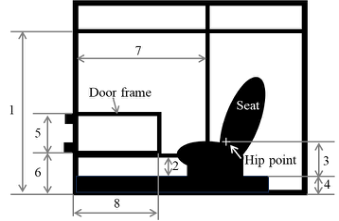
Apparatus A mock-up of car with doors was used to measure gaze behavior and whole- body movements. An overview of the mock-up from the side view is shown in Figure 1. The dimensions of the mock-up are listed in Table 1. We fol- lowed a relevant previous study (Causse et al., 2012) to determine the critical dimensions. As a result, the entrance width was set as that for mini-van. Two dimensions were used for the roof height (referred to as “the entrance height” in this study) to introduce spatial variation: 1500 mm, which is equivalent to a mini-van and 1330 mm, which is equivalent to a small car.
Gaze behavior was measured using a spectacle-type eye tracker (Pupil Invisible; Pupil Labs GmbH, Germany). The images were processed using a real-time neural network with an infrared camera (temporal resolution: 200 Hz) and a scene camera (temporal resolution: 30 Hz). The accuracy of the gaze was 4.6
, and no calibration was required. Body kinematics were recorded using a three-dimensional (3D) system for motion analysis (Qualisys Track Manager, Qualisys, Sweden) with 6 cameras operating at a
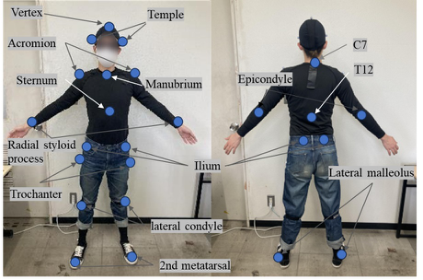
sampling frequency of 120 Hz. The 3D data for all markers were low-pass fil- tered at 6Hz with a fourth-order Butterworth algorithm and calculated using Visual 3D software (C-motion Inc., Rockville, MD, United States). Twenty- five-point markers (13 mm in diameter) were attached to the participants’ whole-body positions, as shown in Figure 2.
Figure 1: Side view of the car mock-up (see Table 1 for the dimensions).Table 1. Dimensions of the car mock-up (No. corresponds to the number shown in Figure 1).
Table available in the original PDF paper.
No. Definition (mm) 1 Roof height from the ground (High) 1500 (Low) 1330 2 Sill height from the car floor 160 3 Seat height from the car floor 355* 4 Car floor height from the ground 240 5 Door height 525 6 Door height from the ground 370 7 Doorway width 950 8 Door width 845
*The hip point is reference values measured when a person of 180 cm height is seated
Figure 2: Positions of 25 reflexive markers for motion analysis.
Relationship Between Gaze Behavior and Whole-Body Movement During Car Ingress 347
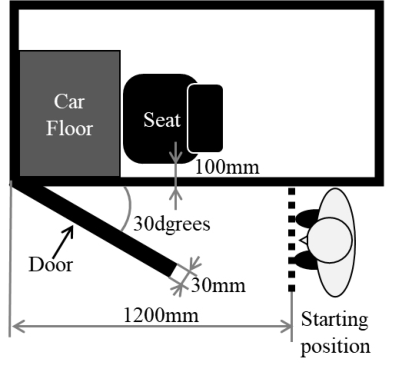
Experimental Procedure For each trial, participants initially stood at a distance of 1200 mm from the door of the mock-up, while facing the direction of the vehicle (Figure 3). After the start signal from an experimenter, participants manipulated the eye- tracker to start the recording of gaze behavior and then moved toward the entrance. The order in which the left and right feet entered the car was not indicated, and the participants were allowed to ingress. They performed a total of six trials: three trials for each of the two roof heights (high: 1500 mm; low: 1330 mm). All participants performed initially under the high roof condition, followed by the low roof condition. The door angle was set to 30
for all conditions.
Drivers pay attention to obstacles such as the roof height during car ingress the first use. However, they become accustomed to the obstacles as they become familiar with the car, and then ingress without paying much attention to the obstacles.
Figure 3: Experimental conditions (top view of the car mock-up).
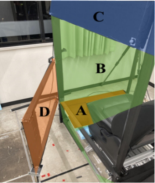
Data Analysis When moving through an opening, the gaze is fixed at the center of the entrance width while approaching the entrance (Higuchi et al., 2009). As the ingress motion starts near the entrance, it was expected that the fixations would be directed exclusively toward the car entrance or the door. Based on this assumption, we have made four categories for the fixated areas (some- times defined as “areas of interest” in other studies): the car floor (A), the car interior space (B), the roof (C), and doors (D; see Figure 4). Stabilization of the gaze at one location for a minimum of approximately 60ms was defined as a fixation. The durations of fixation (in msec) were measured.
Figure 4: Four defined fixation areas for analysis.
Whole-body movements were measured based on previous studies (Causse et al., 2011; Shino et al., 2016). The shoulder, neck, and hip angles were measured at the moment the right toe entered the mock-up. The shoulder rotation was defined as the angle between the horizontal axis Y and the line connecting the left and the right acromion markers. The neck flexion was defined as the angle between the markers placed at T12 and C7 and the ver- tex on the head. The left hip flexion was defined as the angle between the markers placed at T12 and the left ilium and the left trochanter. The distance between the roof and the top of the head was measured as a safety margin. We addressed whether the distance in the roof height would affect the safety margin.
Relatively large individual differences in the patterns of fixations were expected; so, we classified participants into groups based on the patterns of fixations. The differences in gaze behavior and whole-body movement among the groups were analyzed. Moreover, because the roof height can vary, the distance between the roof and the top of the head when passing through the roof was also confirmed.
RESULTS AND DISCUSSION
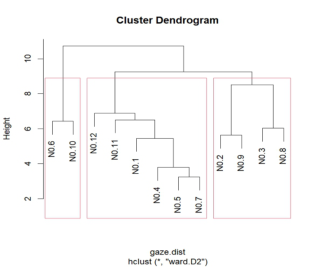
Gaze Behavior Classification The fixation time data in the four areas shown in Figure 4 (two roof condi- tions × three trials, six trials in total) were analyzed using hierarchical cluster analysis (Euclidean distance, Ward’s method), and the results were classified into three categories, as shown in Figure 5.
Figure 5: Cluster dendrogram of gaze behavior classification.
Relationship Between Gaze Behavior and Whole-Body Movement During Car Ingress 349
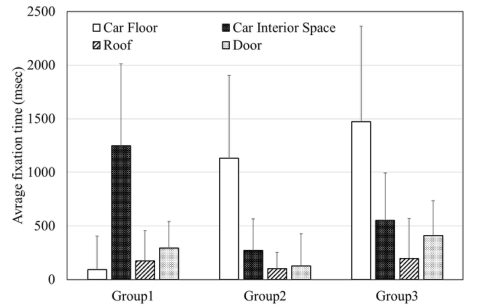
The means and standard deviations of the durations of fixation time for four areas in each group are shown in Figure 6. Group 1 tended to gaze into the car interior space during ingress. Groups 2 and 3 tended to gaze at the car floor, whereas Group 3 tended to gaze longer into the car interior space and at the doors. ANOVA showed a significant main effect of group in the car floor (F(2,69)=13.2, p<0.01), car interior space (F(2,69)=21.2, p<0.01), and door (F(2,69)=6.5, p<0.01), but no significant differences were found for the roof (F(2,69)=1.0, p = 0.36). Multiple comparisons (Bonferroni method) were conducted on the data with a significant main effect and showed significant differences (p<0.01 for each) Group1 < Group 2, Group 1 < Group 3 for the car floor, Group 1 > Group 2, Group 1 > Group 3 for the car interior space, and Group 2 < Group 3 for the door.
Figure 6: Fixation time in each group.
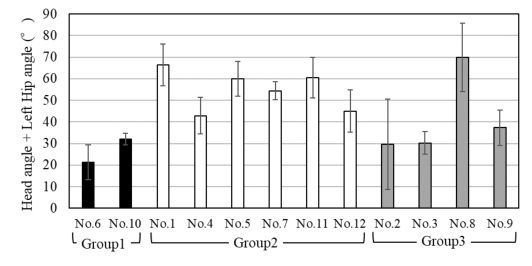
Whole-Body Movement in Each Group The mean and standard deviations of the combined values of the head and left hip angles for each participant are shown in Figure 7. Except for participant No.8, participants in Groups 1 & 3 showed a smaller angle. This suggests that participants in the two groups were likely to enter the car without bending their upper bodies. In contrast, participants in Group 2 entered the car while bending their upper-body.
Figure 7: Head angle + left hip angle (◦).
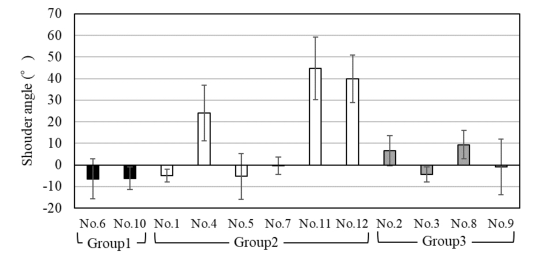
The means and standard deviations of the shoulder angles per participant are shown in Figure 8. A positive value indicates rotation in the clockwise direction, while a negative value indicates rotation in the counterclockwise direction. A large angle was observed in some participants of Group 2. Given that participants in Group 2 showed relatively greater bending of the upper- body (Figure 7), the greater rotation angle of shoulders might have been associated with such greater upper-body movement.
Figure 8: Shoulder angle (◦).
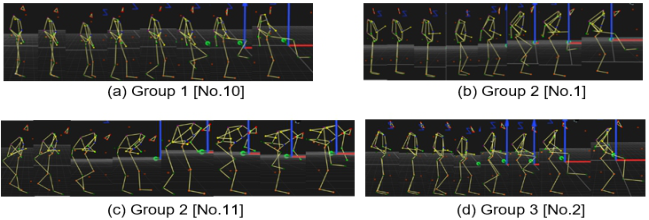
Figure 9 shows the four movement strategies for representative partici- pants in each group and representative participants with a greater shoulder angle from Group 2. For each image a stick picture of the whole-body is drawn every 250 ms. Based on these stick pictures, it is assumed that partici- pants in Group 1 entered the car with a backward leaning of the upper-body (Fig. 9(a)). One participant in Group 2 showed greater bending of the upper- body (Fig. 9(b)), whereas other participants 4, 11, and 12 in Group 2 entered the car by bending the upper-body from around the start position (Fig. 9(c)). A participant in Group 3 tended to lean side without bending the upper-body (Fig. 9(d)).
Figure 9: Motion strategies for each group.
The movement strategies of each group were similar to those confirmed in a previous study (Menceur et al., 2008); Group 1 matched the backward motion strategy, Group 2 matched the forward motion strategy, and Group 3 matched the lateral sliding strategy.
Relationship Between Gaze Behavior and Whole-Body Movement During Car Ingress 351
Relationship Between Gaze Behavior and Whole-Body Movement Based on the present findings, gaze behavior and whole-body movements for participants in each group are summarized as follows. Participants in Group 1 tended to fixate on the car interior space and lean backward during car ingress. It was thought that the direction of gaze was higher by fixat- ing on the interior space, and the body was leaning backward. Participants in Group 2 tended to fixate on the car floor, enter the vehicle with their heads and lean forward during car ingress. It was thought that the direction of gaze was lower by concerning around the car floor, and the body was leaning forward. In Group 3, participants tended to fixate on the car floor for a slightly extended duration, checking the door and car interior space and leaning toward side during car ingress. The unstable posture of participants in Group 3 indicated a fixation on door and concern about the foot area. These results demonstrate the potential for estimating movement strategies based on user gaze behavior. Now that the relationship between gaze and whole- body movements has been clarified, we aim to confirm whether whole-body movements can be changed by changing gaze position using gaze guidance with an LED light.
Comparison of Different Roof Heights
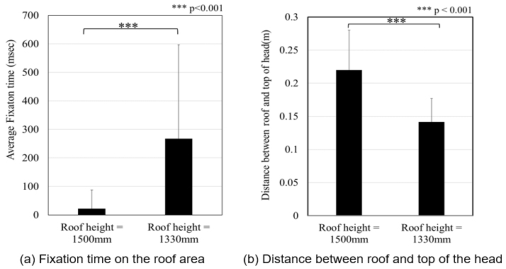
Figure 10 shows the effect of roof height on the duration of fixation time and the distance between the roof and the top of the head (i.e., the safety mar- gin). The duration of fixation for the 1500 mm height condition indicated that the participants hardly fixated toward the roof. This suggests the roof was not perceived as an obstacle at this height. In contrast, for the 1330 mm height condition, participants fixated toward the roof. Moreover, the safety margin was generally smaller for the 1330 mm height condition compared to the 1500 mm height condition. T-test results showed a significant differ- ence between the 1500 mm and 1330 mm height conditions in fixation time to the roof and safety margin. These findings suggest that the fixation time was longer for the 1330 mm height due to the smaller distance to the roof compared to the 1500 mm height, and the safety margin is smaller when the fixation time was longer, allowing for a more accurate perception of dis- tance. Thus, it was confirmed that when the position of the obstacle changed, participants gazed at the object and changed their posture.
Figure 10: Effect of roof height on the duration of fixation and safety margin.
CONCLUSION
In this study, we investigated where participants direct their gaze for safe ingress by measuring their gaze behavior and whole-body movements during ingress and clarified the relationship between the two. The results indicate that gaze behavior was mainly directed toward the car interior space and floor, which were classified into three groups, and the characteristics of each movement were clarified. Furthermore, we confirmed that participants gazed at the roof and changed their movements with changes in the roof height (entrance height), which was an obstacle. The basic characteristics could be confirmed, but it is not to be denied the possibility of other specific gaze behavior and whole-body movements due to the limited number of partici- pants. In addition, since the participants were young people and their muscle strength differs from that of older people, it is necessary to confirm whether older people would show similar trends. However, we have confirmed the possibility of estimating movement strategies based on the gaze behavior of users, which is likely to open possibilities for the development of engineering applications that can provide support according to movement strategies. In the future, we will confirm whether whole-body movements change with a change in the gaze position. We intend to achieve this by using gaze guidance with an LED light and technology that guides the user to an appropriate posi- tion and posture, thereby avoiding contact with the car frame and reducing the physical load during car ingress and egress.
ACKNOWLEDGMENT
This work was supported by the Tokyo Metropolitan Public University Cooperation, the University-College Collaboration Project Fund.
REFERENCES
Causse, J., Wang, X., Denninger, L. (2011) “Effects of roof height on car ingress/egress movement”, Proceedings of International Symposium of the Digital Human Modelling. Causse, J., Wang, X., Denninger, L. (2012) “An experimental investigation on
the requirement of the roof height and still width for car ingress and egress. Ergonomics, vol. 55, no. 12, pp. 1596–1611. Furukawa, H (2011) “Conceptual Framework for the Development of a Senior- Friendly Car”, IATSS Review, vol. 35, No. 3, pp. 30–37 (in Japanese). Herriotts, T. (2005) “Identification of vehicle design requirements for older driver”,
Applied Ergonomics, vol. 36, pp. 255–262. Higuchi, T., Cinelli, M. E., & Patla, A. E. (2009). “Gaze behavior during locomotion through apertures: The effect of locomotion forms”, Human Movement Science, vol. 28, no. 6, pp. 760–771. Lu, J-M., Tada, M., Endo, Y., Mochimaru, M. (2016) “Ingress and egress motion
strategies of elderly and young passengers for the rear seat of mini-van with sliding doors” Applied Ergonomics, vol. 53, pp. 228–240.
Relationship Between Gaze Behavior and Whole-Body Movement During Car Ingress 353
Menceur, M. O. Ait El, Pudlo, P., Gorce, P., Thevenon, A., Lepoutre, F. (2008) “Alternative movement identification in the automobile ingress and egress for young and elderly population with or without prostheses”, International Journal of Industrial Ergonomics, vol. 38, pp. 1078–1087. Shino, M., Sugiura, H., Iijima, K., Tanaka, T., Arai, K., Ito, M., Kitai, K. (2016)
“Analysis of Motion Features and Workload in Ingress for Elderly Users”, Trans- actions of Society of Automotive Engineers of Japan, vol. 48, no. 2, pp. 477–484 (in Japanese).
LISTED IN THE AHFE DIGITAL BOOKSTORE CATALOGUE
Explore the complete digital volume
Advances in Human Factors of Transportation
Read this individual research paper free through the original publisher, or explore the full digital proceedings book.
ISBN 978-1-964867-24-3
Explore this ISBN in the AHFE Bookstore ↗Listed in the July 2026 bookstore catalogue; search by ISBN to confirm current availability · Digital book purchase optional