Saptarshi Kolay, Bhavya Sihmar, Mahua Mukherjee (2023). Ways of Seeing: an Eye-tracking Study of Natural Viewing Behavior Towards Paintings. In: Human Factors in Communication of Design. AHFE Open Access, vol. 90, pp. 96–102. https://doi.org/10.54941/ahfe1003700
Interpretation of paintings is dependent on the visual saliency and focal points created in a painting. The self-expression of artist is perceived through the eyes of viewer to create a meaningful visual interpretation. It is important to know eye fixation points of viewer’s gaze behaviour coincides with the focal points created by the artist in a painting. The goal of this study is to analyse the natural viewing behaviour towards paintings, by tracking the eye movements of the human subjects when exposed to various paintings of different art movements. This study will deal with individual variations in perceptions related to the characteristics of the pictures. This visual data is generated through eye-tracking technology and articulated with the help of gaze plots, heat maps of eye movements of the human subjects. The paintings are categorized into two segments. One with distinct and hierarchical focal points and the other segment consists of paintings with more crystallographic balance and tessellations. Distinct variation of gaze behaviour is observed between these two different segments of paintings. The traditional theories of creation of focal points and principles of designs are correlated with the eye-tracking study. The study also attempts to focuses on the visual hierarchy within a painting and how the viewers’ eye movement it corresponding to the same. The outcome of the experiment shows the correlation of focal points on a two-dimensional static visual stimuli, i.e. paintings in the experiment, with the viewers’ gaze behaviour. This correlation can also be implemented into other form of two dimensional visual arts, like, graphic design, digital arts, poster design, etc.
There already exists a very considerable literature relating to the eye-movements in the process of reading pattern Nielsen and Pernice, 2010). The resulting analyses of the reading process hare been exceedingly valua- ble in developing improved methods for teaching reading. The nature of the eye-movements in reading has been traced from first grade through college period and has been studied for a great many different types of reading both in the vernacular and in several foreign languages. It should be clearly under- stood at the beginning that the movements of the eyes are significant only in so far as they are symptoms of the perceptual processes which appear while
Ways of Seeing: An Eye-Tracking Study of Natural Viewing Behaviour Towards Paintings 97
looking at a picture. Ordinarily, a person is entirely unconscious of the cha- racteristics of these tiny movements of his eyes, and he cannot describe them accurately even when he gives his close attention to them.
Eye movements are unconscious adjustments to the demands of attention during the visual experience. The underlying assumption in this study is that in a visual experience. Hence, the center of fixation of the eyes is the center of attention at a given time. If this is true, then the record of eye movements in looking at a picture supplies objective evidence of the pattern of perception during that experience. Since one’s response to a picture is, at least in the first instance, a matter of visual perception, any objective analysis of this process of perception should supply data of considerable significance to the artist. The present report does not treat in any manner the nature of the process of appreciation while looking at pictures. The evidence in regard to perceptual patterns is entirely objective, but it furnishes no indication, except by inference, as to what the nature of the subject’s emotional response to the picture may be. The writer prefers that the reader draw his inferences from the data presented.
For example, in looking at a landscape painting such as “The Silence of the Sight” the fact that one subject gives a large part of his visual attention to the small section of the picture at the end of the roar1 indicates without any question that the oh severe was interested in this particular part of the picture, at least to the extent of giving a considerable amount of his time to looking at it. However, the fact that he has a great cluster of eye fixations around this position indicates nothing at all as to whether he approved or disapproved of the artist’s treatment of that section, as to whether or not he liked it, or as to what might have been the character of his mental reflections during the time that he was looking at that part of the picture. Though some researches establishes the eye movement patterns in paintings shown digitally (Quiroga and Pedreira, 2011) or in a museum set up (Reitstätter et al., 2020), but the relationship with the focal points and visual hierarchy in a painting with the viewers’ eye movement requires further investigations.
METHODS OF EYE-TRACKING ANALYSIS There are different analysis methods to analyze the eye tracking data. These methods are used to derive three independent data dimensions and can be broadly classified as 1. Time-based analysis, 2. AOI based analysis and 3. Participants category based analysis. The Time based analysis methods give the ‘When’ of the first fixated areas of the image. Whereas AOI based analy- sis typically answers the ‘What’ and ‘Where’ of the fixated area. Participants based analysis is dependent on the participant’s background and category. This answers the certain viewing behavior and helps in mining the underl- ying thinking strategy of different people. Generally, various measurements for eye fixation data are obtained on the basis of AOI information. AOIs are drawn on the basis of object boundary and different metrics such as ‘fixation count’, ‘first fixation’ ‘visit counts’, ‘number of fixations’ etc. are calculated. Accordingly, the AOI with maximum fixation serves as the foreground.
VISUAL FIXATION ANALYSIS ON PAINTINGS In this experiment, the participants are exposed to the stimuli, i.e. two diffe- rent sets of paintings. Visual fixations and gaze behaviors are mapped based on the results.
The goal of this study is to analyze the natural viewing behavior towards art pieces by tracking the eye movements of the human subjects when expo- sed to an art piece of a particular art movement. This study will deal with individual variations in perceptions related to the characteristics of the pictu- res. This data is articulated with the help of gaze plots, heat maps of eye movements of the human subjects. The art pieces were shown to the viewer for 6 seconds with a two-second delay in which they were shown a comple- tely black screen. In total 20 art pieces were shown to 13 test subjects the ages of whom varied from age 13 to 42.
Participants Total 13 participants (11 males and 2 female) volunteered. The participants have normal or corrected to normal vision and lie in the age group of 13–42 years. In order to make the experiment unbiased, no prior information about the data set was given to the participants. They were asked to keep their head straight towards the screen and describe what they were seeing.
Experiment Setup For visual fixation testing eye tracking technology is used and fixation data is represented in form of heatmap. To identify the trend of users’ visual attention, 13 users (Quiroga and Pedreira, 2011) were employed to record their eye fixation for each painting. Each painting was shown for 6 seconds on computer screen of 1920x1200 resolution, interjected by a blank black screen to nullify the primordial effect (Sharma, Ghosh, and Kolay, 2020). To conduct the survey a mobile eye-tracker, Tobii Pro Glass 2 was used. All par- ticipants were asked for ‘free viewing’ task, while the distance between eye and computer screen was kept between 65 cm to 75 cm.
Stimuli are shown on the 52 × 32:57 cm screen having 1920x1200 pixel resolution. The distance from the screen to participant always lies in between 65–75 cm. To avoid distractions for the test subject and to provide better visibility of the screen, the experiment was done in dark room with little to no sounds. Further, a black frustum of tetrahedron made out of cardboard, without its parallel faces, is attached to the screen to act as a blinder. The images were shown for seconds with a blank screen in between each pair of images for 2 seconds to mitigate priming effect. For clear object recognition, images were shown with scaling. As the eye tracker used is glasses, this scaling does not affect the real fixation mapping on respective images.
Tool The Tobii Pro Glasses 2 wearable eye tracker is used for data collection. The instrument has been calibrated for each participant by using calibration card provided along with instrument by keeping in between the distance of 0.75 and 1.25 meters. The wearable technology gives the participants the freedom
Ways of Seeing: An Eye-Tracking Study of Natural Viewing Behaviour Towards Paintings 99
to view the stimuli in a more natural way for free viewing. Other than ‘think aloud’, no prior instruction is given before ‘free viewing’ task.
Stimuli Gestaltism is applicable in any visual elements, ranging from two dimensi- onal painting to urban space (Elshater, 2015). The principles of foreground and background plays a pivotal role of visual attention, and thus shaping our perception. Visual cognition of images depends on the focal points and eye fixation (Gregory, 1978; Goldstein, 1981; Gunay, 2007). Previous studies show that there are deviations of views eye movement patters as conceptuali- zed by the painters, viewers do not strictly follow the eye movement patters, envisioned by the creator of the art (Kirtley, 2018; Quiroga and Pedreira, 2011; Pihko et al. 2011). In this study the visual attention is compared instead of the sequence of visual attention.
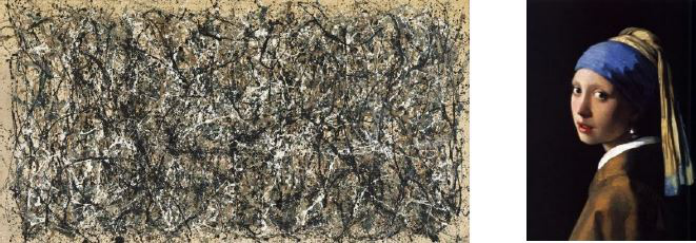
Categorization of Paintings There are paintings which can be classified under visually homogeneous and acts like a tessellation of texture, where visual attention points are more scat- tered all over the canvas. In many cases, the foreground and background infuses with each other in these examples, where the focal points are evenly distributed. Examples of Jackson Pollock’s work from de Stijl movement and William Morris’s work from Art and Craft movements are few examples of the same. The other typology of paintings has distinctive focal points with clear figure ground relationship with visual hierarchy. Baroque and Rococo paintings with high chiaroscuro and many Renaissance painting will fall under this category.
In this pilot study few selected paintings are categorized into two clusters—
Paintings with evenly distributed focal points (category 1)
Paintings with distinctive clustered focal points (category 2) These two categories of paintings are compared based on the visual fixation points. The objective was to check the hypothesis of a painting
Figure 1: Category 1 painting - action painting 31 by Jackson Pollock (source: MoMA); category 2 painting - girl with the pearl earring by Johannes Vermeer (source: google art and culture).
with homogeneous visual emphasis will have evenly distributed fixation points. Whereas there will be clustered visual attention for the paintings of category 2.
Selected paintings with different categories are listed in the following table.
Table 1. List of painting selected under category 1 and 2.
Table available in the original PDF paper.
Category 1 Category 2
The Scream, Edvard Munch, 1893
Action Painting (Number 31), Jackson Pollock, 1950
The Son of Man, René Magritte, 1964
Strawberry Thief, William Morris, 1883 Mona Lisa, Leonardo da Vinci, 1506 Colour study—square with concentric rings, Wassily Kandinsky, 1913 Dragons, Robert Fathauer, 2003 Girl with a Pearl Earring, Johannes Vermeer, 1665 Broadway Boogie Woogie, Piet Mondrian, 1943 The Great Wave off Kanagawa, Katsushika Hokusai, 1831
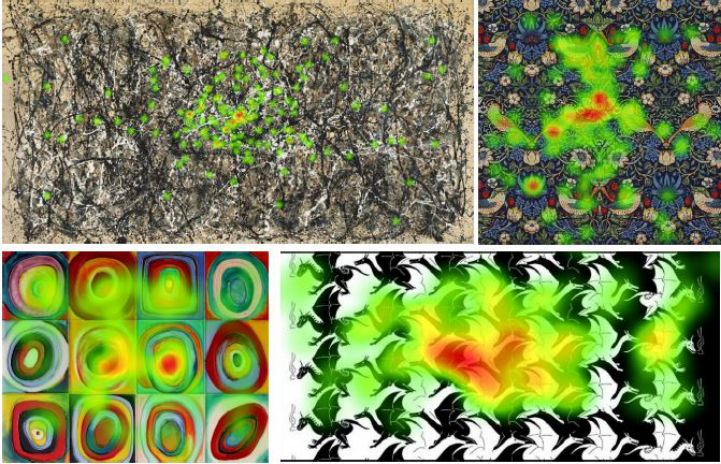
RESULTS AND ANALYSIS The first category of paintings clearly shows the even distribution of eye-fixation. There is a strong center-bias in these categories, as they have lesser visual pull of focal points towards any particular area within the pain- ting. In Kandinsky’s painting there are reputations of similar pattern, which splits the center bias into two regions of nearest module. While each modular segment at the periphery is attracting viewers’ attention.
Figure 2: Combined heatmap of category 1 paintings.
Ways of Seeing: An Eye-Tracking Study of Natural Viewing Behaviour Towards Paintings 101
To identify the modular pattern in category 1 paintings, viewers spend initial few seconds at the central module, and then glance throughout the painting to perceive the whole.
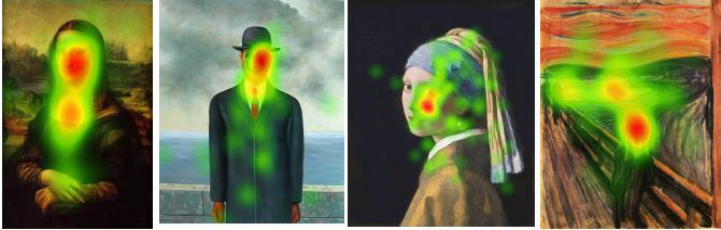
The other category, with distinctive focal points manifests a clustered hea- tmap of fixation data. Generated heatmaps clearly show that the areas with more visual information are attracting the viewer’s eye. Many of these cases deviate from the center bias. A major clustering of visual fixations is on the human faces present in these paintings.
Figure 3: Combined heatmap of category 2 paintings.
The study shows clearly distinctive eye movement in different categories of visual stimuli, based on their relative emphasis. This pilot study is then extrapolated to understand how urban fabric attracts the human eye in case of divergent scenarios.
CONCLUSION
Two general patterns of perception are apparent in the records. One of these consists of a general survey in which the eye moves with a series of relatively short pauses over the main portions of the picture. A second type of pattern was observed in which series of fixations, usually longer in duration, are concentrated over small areas of the picture, evidencing detailed examination of those sections. While many exceptions occur, it is apparent that the survey type of perception generally characterizes the early part of an examination of a picture, whereas the more detailed study, when it occurs, usually appears later. Many subjects in looking at a picture for only a short time revealed none except the general survey type of eye movements. It is probable that most of the visitors to an art gallery look at the pictures with this type of perception and that they see only the main centers of interest.
The study verified the nature of our eye movements with studies of the past and that too in a more precise manner. In the end, this study does not claim to have broken significant ground to find a big gem of information about art or psychovisuology but provides a necessary starting point for further discussi- ons about the structure of our unconsciousness by looking through the pupils of our eyes and the future we may be heading to in art and psychology.
REFERENCES
Elshater, A. M. 2015. Urban design redux: Redefining a professional practice of specialization. Ain Shams Engineering Journal, 6(1), 25–39. Goldstein, E. B. (1981). The Ecology of J. J. Gibson’s Perspective. Pergamon Press
Ltd. 191–195. Gregory, D. 1978. Ideology, science and human geography. Gunay, B. (2007). Gestalt Theory and City Planning Education. In METU JFA, Jan: 93–113. Kirtley, C. (2018). How Images Draw the Eye: An Eye-Tracking Study of Composi-
tion. In Empirical Studies of the Arts, 36(1), Sage Journals, 41–70. Nielsen, J., and Pernice, K. (2010). “Eyetracking web usability”, in New Riders. Pihko, E., Virtanen, A., Saarinen, V. M., Pannasch, S., Hirvenkari, L. Tossavainen, T., Haapala, A. and Hari, R., (2011) Experiencing Art: the influence of expertise and painting abstraction level. In Front Hum. Neurosci. 5 (94). Quiroga, R. Q. and Pedreira, C. (2011). “How do we see art: an eye-tracker study”,
in Frontiers in Human Neuroscience, Frontiers Media. Reitstätter, L. et al (2020). “The Display Makes a Difference: A Mobile Eye Tracking Study on the Perception of Art Before and After a Museum’s Rearrangement”, in Journal of Eye Movement Research. Sharma, A., Ghosh, J. K., and Kolay, S. 2020. Reference data preparation for complex
satellite image segmentation. IET Image Processing, 14(4), 628–637.
LISTED IN THE AHFE DIGITAL BOOKSTORE CATALOGUE
Explore the complete digital volume
Human Factors in Communication of Design
Read this individual research paper free through the original publisher, or explore the full digital proceedings book.
ISBN 978-1-958651-66-7
Explore this ISBN in the AHFE Bookstore ↗Listed in the July 2026 bookstore catalogue; search by ISBN to confirm current availability · Digital book purchase optional