Amic Ho (2023). Types and Role of the Bullet Point System in Reading Experience. In: Human Factors in Communication of Design. AHFE Open Access, vol. 90, pp. 128–136. https://doi.org/10.54941/ahfe1003704
In the age of information, information overload is projected to grow. The best techniques are sought to reach layperson audiences or readers with a unique message. Designers and information architects care about this. Thus publishing design and print communication must explore new ways to organise information for high reader impact and a more humanistic approach than before. This method requires writers to grasp readers' attention while reading. Hence, bullet points may highlight crucial themes when writing. Bullet points assist readers' reading and comprehension. Understanding ideas helps readers accept them and so bullet points improve information processing. Bullet points have been styled using points, lines, and various forms in publication design and commercial communication. However, there are not enough data to provide bullet point suggestions. Incorrect bullet point styles might impact information processing and document authority. Therefore, bullet points' effects on readers' emotions and information processing must be studied. This study examines the bullet point system and how it helps in the organisation and typesetting of texts. Bullet point categories' information-interpretation efficacy will be examined.
The relationship between bullet points and information communication is integral to effectively conveying information to a reader. Bullet points are a concise way to present information in a logical, organised manner that is easier to read and comprehend than a large block of text. By breaking up information into bullet points (Mills, 2019), the reader can quickly access the key points of the information and better understand its purpose. A system of bullet points is particularly useful in communication when presenting multiple points or ideas. By breaking information down into smaller, more digestible points, it becomes easier for the reader to distinguish the main points and easily spot any important details. This helps to keep the reader focused on the key ideas and prevents them from becoming overwhelmed by too much information.
Bullet points also add visual appeal to the information being communi- cated (Lenz et al., 2015). By using symbols or a visual format, bullet points can help draw the reader’s attention to the text and make it more inviting to read. Additionally, bullet points can help create a sense of structure and
Types and Role of the Bullet Point System in Reading Experience 129
order in the information, which in turn can help the reader better under- stand and remember the material. Through the organisation assisted by bullet points, information is more concise and avoids long-winded explanations. By condensing the information into short, concise points, the reader is able to quickly access the key points and move on to the next one. This is particu- larly useful when communicating complex information, as bullet points can help to break down the information into more manageable chunks. Hence, bullet points are an effective tool for communicating information clearly and concisely. By breaking down information into smaller, more digestible points, bullet points can help the reader quickly understand the purpose and key points of the information. Additionally, bullet points can add visual appeal and create a sense of structure and order. Finally, bullet points can help to make the information more concise and avoid long-winded explanations. All of these factors combine to make bullet points an invaluable tool for communicating information effectively.
READING PROCESS IN DIGITISATION MEDIA Korat and Shamir (2007) examined the influence of digital reading on adults. Digital reading had a positive impact on readers’ comprehension, fluency, and attention. Additionally, digital reading improved attitudes towards reading in general and increased the motivation to read. Yin et al. (2019) investigated the relationship between digital reading and the reading process. Digital rea- ding led to more efficient and effective comprehension. In addition, digital reading increased engagement with the text and improved attitudes towards reading among students. Mangen (2016) explored the impact of digitisation on the reading process. Digitisation led to improved comprehension, fluency, and engagement with the text. Furthermore, it found that digitisation impro- ved attitudes towards reading and increased motivation to read. Li and Chu (2021) found the effects on students’ digital reading was positive’ or simi- lar, which led to improved comprehension, fluency, and engagement with the text. Additionally, digital reading improved attitudes towards reading and increased motivation to read. Sutherland-Smith (2002) investigated the influence of digital reading on the reading process. Digital reading had a positive effect on readers’ comprehension, fluency, and engagement with the text. Digital reading also increased motivation to read and improved attitudes towards reading.
USAGE OF BULLET POINTS IN TYPOGRAPHY Early forms of communication included smoke signals, drumming, and light signals. The history of written communication dates back to the 4th mil- lennium BCE when the Sumerians developed the first written language, cuneiform. This was followed by the Egyptians and their hieroglyphics in the 3rd millennium BCE. The Phoenicians developed an alphabet in the 2nd millennium BCE. The Greeks created the first true alphabet in the 8th cen- tury BCE. By the 1st century BCE, writing had spread to Asia. The Roman alphabet had become widespread in Europe. During the Middle Ages, the
130 Ho
Latin alphabet was used throughout Europe, while in the Islamic world, the Arabic alphabet was used to write down many languages. In the 15th cen- tury, the printing press was invented by Johannes Gutenberg. Because of this, books could be produced in large quantities. In the 19th century, the inven- tion of the typewriter revolutionised the way people wrote, and in the 20th century, computers and the internet allowed for the digitalisation of written communication. Thus the development of writing allowed for information to be stored and transmitted over long distances. The invention of the prin- ting press in the 15th century allowed for the mass distribution of written information.
In the 19th century, the telegraph and the telephone were invented, which allowed for instantaneous communication. Bullet points were first used in the early 1920s to simplify information and increase readability. The origin of the bullet point is generally credited to the American engineer, inventor, and businessman, Arthur Seale. Seale was the first to use bullet points in the instruction manuals he wrote for the Remington Rand typewriters he sold. He believed that the bullet points helped readers to quickly identify the main points of the text and allowed them to easily scan the information. Soon, bullet points spread to other areas of business and communication and were used to highlight important information in documents, marketing materials, and presentations (Ledin & Machin, 2015). Today, bullet points are used in a variety of written media and are a popular way to make the text easier to read and comprehend. Bullet points are also used in a variety of communi- cation methods, from presentations to websites. They are an efficient way to communicate information concisely and clearly. The use of bullet points grew over the decades following their introduction and has become a common way to present information.
The use of bullet points in typography is a popular way to add empha- sis to a particular section or idea within a text. Bullet points allow readers to easily digest and comprehend the main points of a text quickly and effi- ciently. This style of typography is commonly used in many different types of documents, from presentations and reports to newsletters and brochures. Bullet points make content easier to read and understand by providing an organised structure for the text (Ledin & Machin, 2015). They are useful for breaking up long passages of text and emphasising key topics. By using bullet points, the reader is able to quickly identify the main points of the text and understand them more easily. Bullet points also make it easier to skim through large amounts of text and find relevant information quickly. In the 20th century, radio, television, and satellite communication were deve- loped. The internet was created in the late 20th century, which allowed for global communication. Bullet points can be used to emphasise key points and make them stand out from the rest of the text. They provide an aesthe- tically pleasing way to make important points stand out and draw attention to them. This can be especially useful in reports or other presentations, as it helps the audience to focus on the most important points. Hence, the use of bullet points may help the reader grasp the content by providing visual assistance.
Types and Role of the Bullet Point System in Reading Experience 131
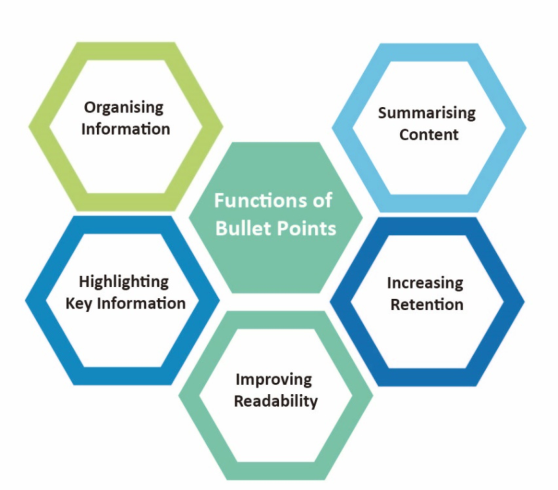
Functions of Bullet Points Bullet points are a popular way to present information in a clear, concise, and organised manner. They are often used in reading materials such as articles, reports, and presentations to highlight key points, ideas, or conce- pts. The application of bullet points in reading can enhance comprehension and improve retention of the information presented. Here are some ways in which the bullet point system can function in reading (figure 1).
1. Organising information: Bullet points are an effective way to organise information in a logical and clear format (Lenz et al., 2015). They may simplify difficult material by dividing it into bite-sized pieces that are easier to read and comprehend. 2. Highlighting key information: Bullet points can be used to highlight the most important information in reading material (Ledin & Machin, 2015; Oida et al., 2018). This can help readers quickly identify and understand the most critical information in a piece of text. 3. Improving readability: Bullet points can improve the readability of a text by making it easier to scan and skim (Duane et al., 2020). When used properly, bullet points can help to improve the flow and structure of a piece of text, making it more readable and engaging. 4. Summarising content: Bullet points can be used to summarise the main points of reading material (Kane et al., 2014). This can be especially helpful for readers who have limited time or who need to quickly review key concepts. 5. Increasing retention: By breaking down information into smaller, more manageable chunks, bullet points can improve retention of the material presented (Raynor & Dickinson, 2009). This is because bullet points
Figure 1: The functions of bullet points.
132 Ho
allow readers to focus on the most important information and can help to reinforce key concepts.
In summary, the bullet point system is a useful tool for improving compre- hension and retention of reading materials. When used properly, bullet points can help to organise information, highlight key points, improve readability, summarise content, and increase retention.
CATEGORIES There are different ways to categorise bullet points, but in the context of reading, the main categories of bullet points can be divided into two types: ordered and unordered.
Unordered bullet points: Unordered bullet points are those that are not necessarily listed in any specific order. They are often used to present a list of related items or ideas that do not need to be presented in a particular order. Unordered bullet points are often represented by small dots or other symbols.
Ordered bullet points: Ordered bullet points are those that are presented in a specific order. They are often used to present a series of steps, instructi- ons, or a sequence of events. Ordered bullet points are usually represented by numbers or letters that indicate the order in which the information should be read or followed.
Additionally, other types of bullet points can be used in reading, such as checkmarks, arrows, or other symbols that can help to illustrate a point or convey a specific message. It is important to note that, regardless of the type of bullet point used, it should be clear and concise and should effectively convey the information being presented. Bullets should be used sparingly and only when they help to enhance the readability and clarity of the text. Overusing bullet points can make the text appear cluttered and difficult to read.
HOW THE BULLET POINT SYSTEM AFFECTS READING INFORMATION HIERARCHY The bullet point system is an effective way of organising information into a hierarchy. It allows readers to quickly scan and identify key points in a piece of text and provides structure to information that would otherwise be diffi- cult to follow. By breaking down information into smaller, more manageable chunks, readers can quickly understand and absorb the key points of a docu- ment. The bullet point system also helps to create a visual hierarchy, as it visually separates the main points from the supporting details. This facilita- tes navigation and draws readers’ attention to the most crucial aspects of the text. When a person encounters an ineffective reading-information hierarchy, it can have an emotional impact on them. For example, if someone is reading a text that has been organised in a way that is difficult to understand, they may become frustrated and overwhelmed. This frustration can lead to fee- lings of anger, confusion, and even despair. Additionally, if the information is incorrect or misleading, it can create feelings of distrust and betrayal, as
Types and Role of the Bullet Point System in Reading Experience 133
the reader may begin to question the validity of the source of information. Finally, if the information has been organised in a way that seems biased or intended to deceive, it may evoke feelings of suspicion, disappointment, and even fear.
QUESTIONNAIRE FOR UNDERSTANDING AN AUDIENCE’S GENERAL KNOWLEDGE OF BULLET POINTS The research is meant to shed light on how students of the arts might actively engage in the pursuit of knowledge. There were 30 people who were asked to take part in the first phase of this study, during which they were asked to answer questions on their experiences with creative education and their thoughts on learning, thinking, and reflective assessment.
PROCEDURE The first step in conducting the questionnaire study was to clearly define the research objectives. This helped to ensure that the data collected were rele- vant and useful and that the information gathered was indeed helpful to the research study’s purpose and overall goal. The next step was to identify the target population for the research. This included defining the demographic characteristics, geographic location, and psychographic characteristics of the individuals who needed to be included in the study. Once the target popu- lation had been identified, the researcher developed the questionnaire that was used to collect the data. This included formulating questions that were relevant to the research objectives and ensuring that the questions were clear and unambiguous. Questions were developed as follows:
1. How familiar are you with bullet point presentations? 2. Have you ever seen a bullet point presentation before? 3. How often do you view bullet point presentations? 4. Are you comfortable reading and understanding bullet point presenta- tions? 5. Do you think those bullet point presentations are an effective way of communicating information? 6. How important do you think bullet point presentations are in modern communication? 7. Do you think those bullet point presentations are visually appealing? 8. What, in your opinion, makes for the best bullet-point presentation? 9. What do you think are the most common mistakes people make when creating bullet point presentations? 10. Do you have any tips or advice on how to create an effective bullet point presentation?
Before the questionnaire was distributed to the target population, it was important to pilot-test it. This helped to ensure that the questionnaire was understood by the respondents and that it produced the required data. Once the questionnaire had been developed and tested, it was distributed to the target population. The researcher then needed to gather the data from
134 Ho
the respondents and analyse it. The gathered data were analysed to draw conclusions and make recommendations. This included using the appropri- ate statistical techniques to analyse the data and interpret the results. After the data had been analysed, the researcher reported the results clearly and concisely. This included presenting the results in a manner that was simple to comprehend and interpret.
FINDINGS Most people are familiar with bullet point presentations and have seen them before but are not necessarily comfortable reading and understanding them. Most people also think that bullet point presentations can be effective when used correctly but that they are not particularly visually appealing. The survey results show that a majority of respondents (85%) are familiar with bullet point presentations and have seen them before. Around 75% of respondents view bullet point presentations often, while only 55% of respondents are comfortable reading and understanding them. Most respondents (75%) think that bullet point presentations can be effective when used correctly, however, only 40% think they are visually appealing. The survey found that the most important aspect of a successful bullet point presentation is to keep it simple and organised (75%), while the most common mistake is making the presen- tation too long and complicated (45%). Lastly, the best tips for creating an effective bullet point presentation are to keep it organised (65%), use short and concise points (55%), and use visuals to support the information (40%).
The most important aspect of a successful bullet point presentation is to keep it simple and organised, while the most common mistakes are making the presentation too long and complicated. Lastly, the best tips for creating an effective bullet point presentation are to keep it organised, use short and concise points, and use visuals to support the information.
DISCUSSION
The findings reflect the importance of the design’s role in the reading process and the motivation of the audience. They are supported by previous studies on the reading process and motivation. Reading motivation was studied by Cillo et al. (2019), who looked at how it affected the reading process, growth, and outcomes. Those authors found that reading motivation had a positive influence on the reading process, development, and achievement. Reading motivation, the actual reading process, and comprehension in adolescents were all aspects of reading that were investigated by Troyer et al. (2019). The findings indicated that a favourable correlation existed between reading motivation and both the act of reading and the understanding of what was read. Nurunnabi et al. (2020) examined the reading process among university students in China. The findings pointed to a favourable correlation between reading motivation and the act of reading itself. Wigfield et al. (2016) discove- red that reading motivation was positively associated with elementary school students’ reading progress. Third and fourth grade children’s reading desire and the learning process were studied by Kanonire et al. (2022). The findings
Types and Role of the Bullet Point System in Reading Experience 135
pointed to a favourable correlation between reading motivation and the act of reading itself. Reading motivation and scores on tests of reading compre- hension were studied by Bursali and Yilmaz (2019). The findings indicated a favourable correlation between reading motivation and scores on tests of rea- ding comprehension. High school pupils’ reading interests and the learning process were studied by Hebbecker et al. (2019). The findings pointed to a favourable correlation between academic development and the act of reading itself.
CONCLUSION
Bullet points are an effective tool for communicating information clearly and concisely. They provide a logical and organised way to present infor- mation that is easier to read and comprehend than a large block of text. Bullet points break down information into smaller, more digestible points, allowing readers to quickly access the key points and better understand the purpose of the information. They also add visual appeal to the information being communicated, drawing the reader’s attention and creating a sense of structure and order that helps readers better understand and remember the material. Bullet points help to make the information more concise and avoid long-winded explanations, particularly when communicating complex infor- mation. The most important aspect of a successful bullet point presentation is to keep it simple and organised, while the most common mistake is making the presentation too long and complicated. The best tips for creating an effe- ctive bullet point presentation are to keep it organised, use short and concise points, and use visuals to support the information. Although most people are familiar with bullet point presentations, many are not comfortable reading and understanding them, and only a minority find them visually appealing. However, when used correctly, bullet points can be an invaluable tool for communicating information effectively.
ACKNOWLEDGMENT
The work described in this paper was fully/substantially/partially suppor- ted by Hong Kong Metropolitan University Research Grant (No. HE- RD/2022/1.21).
REFERENCES
Bursali, H., & Yilmaz, R. M. (2019). Effect of augmented reality applications on secondary school students’ reading comprehension and learning permanency. Computers in Human Behavior, 95, 126–135. Cillo, V., Petruzzelli, A. M., Ardito, L., & Del Giudice, M. (2019). Understanding
sustainable innovation: A systematic literature review. Corporate Social Respon- sibility and Environmental Management, 26(5), 1012–1025. Duane, S., Vellinga, A., Smith, V., Tierney, M., Beecher, C., Burke, M., Murphy, A. W., & Devane, D. (2020, 30 March). The effectiveness of digital multimedia presentation of trial information on recruitment and retention of pati- ents: Protocol for a study within a trial (SWAT). HRB Open Research, 3, 10. https://doi.org/10.12688/hrbopenres.12994.1
136 Ho
Hebbecker, K., Förster, N., & Souvignier, E. (2019). Reciprocal effects between reading achievement and intrinsic and extrinsic reading motivation. Scientific Studies of Reading, 23(5), 419–436. Kane, G. C., Johnson, J., & Majchrzak, A. (2014, December). Emergent life cycle:
The tension between knowledge change and knowledge retention in open online coproduction communities. Management Science, 60(12), 3026–3048. https://do i.org/10.1287/mnsc.2013.1855 Kanonire, T., Lubenko, J., & Kuzmina, Y. (2022). The effects of intrinsic and extrinsic reading motivation on reading performance in elementary school. Journal of Research in Childhood Education, 36(1), 1–13. Korat, O., & Shamir, A. (2007). Electronic books versus adult readers: Effects on
children’s emergent literacy as a function of social class. Journal of Computer Assisted Learning, 23(3), 248–259. Ledin, P., & Machin, D. (2015, 27 May). How lists, bullet points and tables recontextualize social practice. Critical Discourse Studies, 12(4), 463–481. https://doi.org/10.1080/17405904.2015.1039556 Lenz, P. H., McCallister, J. W., Luks, A. M., Le, T. T., & Fessler, H. E. (2015, April).
Practical strategies for effective lectures. Annals of the American Thoracic Society, 12(4), 561–566. https://doi.org/10.1513/annalsats.201501-024ar Li, X., & Chu, S. K. W. (2021). Exploring the effects of gamification pedagogy on children’s reading: A mixed-method study on academic performance, reading- related mentality and behaviors, and sustainability. British Journal of Educational Technology, 52(1), 160–178. Mangen, A. (2016). The digitization of literary reading: Contributions from empiri-
cal research. Orbis Litterarum, 71(3), 240–262. Mills, E. (2019, 4 February). The art of visual notetaking: An interactive guide to visual communication and sketchnoting. Walter Foster. Nurunnabi, M., Hossain, S. F. A. H., Chinna, K., Sundarasen, S., Khoshaim,
H. B., Kamaludin, K., Gul M. B., Areej S., & Shan, X. (2020). Coping strategies of students for anxiety during the COVID-19 pandemic in China: A cross-sectional study. F1000Research, 9(1115), 1–16 Oida, Y., Hiekata, K., Mitsuyuki, T., Kamba, H., & Okada, I. (2018, December).
Development of presentation slide retrieval system based on visual information. Journal of Industrial Information Integration, 12, 3–12. https://doi.org/10.1016/ j.jii.2018.01.001 Raynor, D. K., & Dickinson, D. (2009, 31 March). Key principles to guide development of consumer medicine information – Content analysis of information design texts. Annals of Pharmacotherapy, 43(4), 700–706. https://doi.org/10.1345/aph. 1l522 Sutherland-Smith, W. (2002). Weaving the literacy Web: Changes in reading from
page to screen. The Reading Teacher, 55(7), 662–669. Troyer, M., Kim, J. S., Hale, E., Wantchekon, K. A., & Armstrong, C. (2019).
Relations among intrinsic and extrinsic reading motivation, reading amount, and comprehension: A conceptual replication. Reading and Writing, 32, 1197–1218. Wigfield, A., Gladstone, J. R., & Turci, L. (2016). Beyond cognition: Reading motivation and reading comprehension. Child Development Perspectives, 10(3), 190–195. Yin, C., Yamada, M., Oi, M., Shimada, A., Okubo, F., Kojima, K., & Ogata,
H. (2019). Exploring the relationships between reading behavior patterns and learning outcomes based on log data from e-books: A human factor appro- ach. International Journal of Human–Computer Interaction, 35(4–5), 313–322.
LISTED IN THE AHFE DIGITAL BOOKSTORE CATALOGUE
Explore the complete digital volume
Human Factors in Communication of Design
Read this individual research paper free through the original publisher, or explore the full digital proceedings book.
ISBN 978-1-958651-66-7
Explore this ISBN in the AHFE Bookstore ↗Listed in the July 2026 bookstore catalogue; search by ISBN to confirm current availability · Digital book purchase optional