Amic Ho (2022). Paradoxes in Typeface Design for creating new Digital Design Experience. In: Symposium on Creative Technology and Digital Media. AHFE Open Access, vol. 27, pp. 22–27. https://doi.org/10.54941/ahfe1001437
Generally speaking, the paradox of design elements brought about by visual conflict can attract people's attention. Many designers apply similar ideas to their work. However, seldom do designers investigate the reasons behind the paradox of typography, as well as the approaches to creating this contradiction. The research question of this study refers to how the paradox of typography work for communication. The function of typography is not only to deliver messages but also to serve as the foundation for compositional communication. Letterforms were regarded as one of the most valuable graphic elements as they worked as the representations of language and organising type to serve multiple roles within a composition. This paper focuses on the experience of emotions created by typographic design, in particular, it also suggested an example to demonstrate how the experience of typographic designing related to the paradox of typography, built a hypothesis of why these may impact one another. Thus, the finding of this study provide a richer understanding of the design and the development of design projects.
The function of typography is not only delivering messages but also serving as the compositional foundation for communication. Letterforms were regarded as one of the most valuable graphic elements as they worked as the represen- tations of language, as well as organising types to serve multiple roles in a composition. They are regarded as a reliable approach for elevating the qua- lity of design work and are applicable in various projects and media. The consideration of typography arrangement involved both language and com- position. To consider the approaches of organising the types, the imagination, accurate copy, and the letterforms of the typeface were transformed to add extra meaning to the typography design. Designers organised the typesetting fundamentals to explore more opportunities for interacting and storytelling with typography. They considered the original qualities of each typeface they selected for creating connections between the graphical forms and messages they aimed to reinforce.
This paper focuses on the experience of emotions created by typographic design in particular, and how the experience of typographic designing may relate to it, building a hypothesis of why they may impact one another.
Paradoxes in Typeface Design for Creating New Digital Design Experience 23
These insights are then used to formulate the hypothesis that the experi- ence of designing and design iteration may pose a continuous force (and have an indirect effect) towards the coupling, or pulling together, of dimen- sions of experience such as perception, cognition and action which, in emotions, are experienced as particularly fragmented. This paper provi- des a richer understanding of the design and the development of design projects.
DIMENSIONS OF EXPERIENCE Before further investigating how the typography be arranged in both langu- age and composition, there is a need to understand how the lived experience of designing was considered in the study of design. Frauenberger, Good, & Keay-Bright (2010) proposed that the study of consciousness provided a fra- mework for a designer to understand user experience. It offered a contextual perspective of the approaches users interacts with the environment around them. Their research team argued that consciousness also took a role to influ- ence participatory design critically. When consciousness was manipulated as an interpretive as well as the generative process in participatory design, the experience of the end-users was considered as an essential factor rather than the functions of outcomes.
On the other hand, research of emotions and treatment initiatives are moving away from traditional diagnostic categories and focusing on transdi- agnostic phenomena (Pienkos et al. 2019). These concerns led to alternative investigation and awareness of emotional experience. Indeed, as reviewed by Hamm et al. (2018), both the philosophical phenomenological model of emotions and the recovery model, focus on the first-hand experience of emo- tions, and although they differ in methodology and epistemology, they are both interested in the alterations of subjectivity that occur in emotions, and both contribute to interventions that are responsive to these alterations.
Most recently, psychiatry literature studies revealed changes in cognition, perception, personal experience, agency and embodiment were linked toge- ther (Pienkos et al. 2019). These studies from a phenomenological point of view provide an excellent opportunity to build a shared, interdisciplinary fra- mework in design studies to understand the experience of designing alongside the experience of these changes we find in emotions.
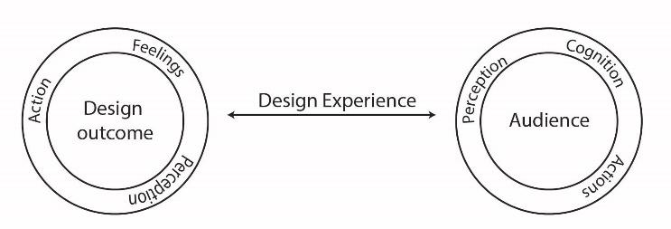
To review the potential of designing to help with managing the commu- nication, two common themes across the phenomenology of emotions and design literature were reviewed. Arguably, the themes of design outcome and audience were relevant to the experiences of designing and emotions. In design literature, we find these themes may function as fundamental pil- lars of the design experience process, and perhaps so implicit to the research agenda and to the practice of design which was rarely seen in the specks of current research papers. The organised summaries around two main the- mes, audience and design outcomes, which are, paramount to both research agendas were concerned. In the literature in emotions, we see these themes reflected upon from the point of view of what seemed disrupted on the expe- rience (Feelings, Preception, actions) but they were also seen as relevant for
24 Ho
Figure 1: Domains of human systems integration.
the proposed design experience to respond to the appearance and functions of design outcomes through design experience often associated with audience’s emotional changes (figure 1). With a primary interest in lived experience, this paper reviewed changes that could theoretically occur when the experiences of designing and the experiences of emotions interact and shaped the new model to explain the evoking of emotion from two fundamental pillars while processing alternatives design elements within the design experience.
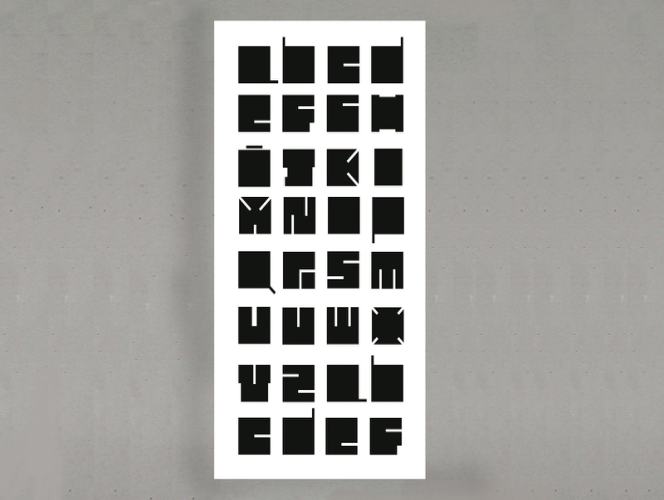
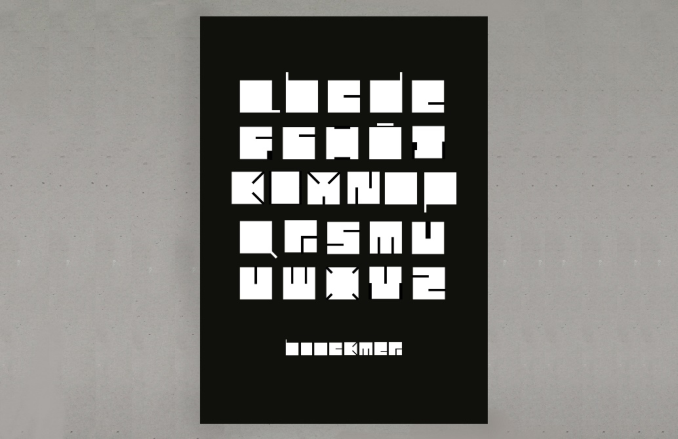
EXPERIMENTAL WORKS TO CHALLENGE THE PARADOX Some masterpieces of the typographic design were investigated and were categorised into several features for further analysis of some approaches for designers to apply in their typographic work. Designers often used con- tradictions for presenting the concept, solving the design problems. Then, designers decide how to organise types and other visual elements. The design thus can relate to those focal elements. Within Blockter’s typeface design (Figures 2 and 3), designers contradictive visual elements. According to the artist statement, decision-making processes of the designer are related to the activities done throughout the design communication with the audience. Within Blockter’s typeface design (Figures 2 and 3), decision-making pro- cesses are related to the activities done throughout the design process. They need the quasi-simultaneous integration of perception and action. For exam- ple, soliciting feedback, reviewing prototypes, drawing, doing calculations, and analysing shapes or forms all bring together elements of experience such as acting and seeing. Within a design process, drawing (as an example acti- vity) is governed by prior perception (the typeface’s negative space must be positioned in a certain area and form), via the body (the display typeface). Not only was the type selected by the designer involved in the design, but the approach that applied for presenting the concept. Types (in font/typographic design) were not only appeared on only one aspect, or be rendered in one dimension or one texture. Designers investigate methods to introduce variety to the visual elements in typographic work, and the designer should build bridges between the various styles applied.
In this experimental work, the negative space was minimised as well as repositioned to emphasise the outline shape of the letterforms. This appro- ach maximises the weight of each letterform. At the same time, the position
Paradoxes in Typeface Design for Creating New Digital Design Experience 25
Figure 2: Experimental typeface design to create a paradox (Ho, 2020).
of the little negative space was redesigned for preventing it from being overly bold—different letterform of typeface would provide the effect of creating a wedge through the middle of the design as well as removing any possibility for linkages among the two halves. This display typeface, most is notable in the top right, where the lectures subheading pivots off the serif (this is the most noticeable in the design). The applied approach was a particularly serendipitous consideration because that negative space is essential for set- ting the structure of the typeface design. It introduces half of the scheduling for the series. Many works were processed for creating success in this type- face design. Most typographic works were intimately familiar with different typefaces and giving designers themselves the space for trying unusual things with them. The term ‘paradox’ was used a few times to describe this typeface design, and that was a great way to describe this kind of typographic design feature in general. Every typeface design, even the most ideal one, is just a starting point. It’s up to the designer to optimise it for their design purposes. Applying display typeface would be the scaffolding concept for the remaining of the design work.
CONCLUSION
The theory was motivated by an experimental typeface design which is currently taking place with patients attending an experience. The method pre- sented here is based upon phenomenological descriptions of emotions about design and has been influenced by the very first interactions with the recruited participants. The more comprehensive research agenda includes generating
26 Ho
Figure 3: Optimised the typographic design arrangement according to the experimen- tal scaffolding.
alternative explanations alongside further data gathered through fieldwork. The intention is to create plausible explanations by constructing and testing different scenarios in practice. The project aims to experiment with the use of design as a way to help treat experience. Through this collaboration, parti- cipants are being encouraged and challenged to reflect upon designing, what it is and what it means, and the designer is encouraged and challenged to try to understand the experience of emotions, what it is and what it means.
REFERENCES
Frauenberger, C., Good, J. (2010). Keay-Bright, W., Phenomenology: A Framework for Participatory Design. Hamm, J. A., Leonhardt, B. L. (2018). Ridenour, J., Lysaker, J. T., Lysaker, P.H.,
Psychosis Psychological, Social and Integrative Approaches Phenomenological and Recovery Models of the Subjective Experience of Psychosis. Discrepancies and Implications for Treatment, Vol. 10, No. 4, pp. 340–350. Hay, L., Duffy, A., McTeague, C., Pidgeon, L. (2017). Vuletic, T., & Grealy, M., A systematic review of protocol studies on conceptual design cognition. Design as Search and Exploration. Design Science, Volume 3, No. 3. pp. 1–36. Ho, A. G. (2020). The Influence of Emotional Experience Relating to Communi-
cation from a Typographic Perspective. In: Markopoulos E., Goonetilleke R., Ho A., Luximon Y. (eds) Advances in Creativity, Innovation, Entrepreneurship and Communication of Design. AHFE 2020. Advances in Intelligent Systems and Computing, volume 1218. Springer, Cham. https://doi.org/10.1007/978-3-030- 51626-0_40 Laing, R. (2010). The divided self: An existential study in sanity and madness.
Penguin UK.
Paradoxes in Typeface Design for Creating New Digital Design Experience 27
Leonhardt, B. L. et al. (2017). Recovery and Serious Mental Illness: A Review of Current Clinical and Research Paradigms and Future Directions. Expert Review of Neurotherapeutics, Volume 17, No. 11, pp. 1117–30. Parnas, J. (2011). A Disappearing Heritage: The Clinical Core of Schizophrenia.”
Schizophrenia Bulletin, Volume 37, No. 6, pp. 1121–30. Pienkos, E. et al. (2011). Hallucinations Beyond Voices: A Conceptual Review of the Phenomenology of Altered Perception in Psychosis. Schizophrenia Bulletin, Volume 45, No. 1, pp. 67–77, 2019. Sterzer, P., Mishara, A. L., Voss, M., Heinz, A. (2016). Thought Insertion as a
Self-Disturbance: An Integration of Predictive Coding and Phenomenological Approaches. Frontiers in human neuroscience, Volume 10, No. 502.
LISTED IN THE AHFE DIGITAL BOOKSTORE CATALOGUE
Explore the complete digital volume
Symposium on Creative Technology and Digital Media
Read this individual research paper free through the original publisher, or explore the full digital proceedings book.
ISBN 978-1-958651-03-2
Explore this ISBN in the AHFE Bookstore ↗Listed in the July 2026 bookstore catalogue; search by ISBN to confirm current availability · Digital book purchase optional