Amic Ho, P. W. Chau (2026). Emotional Interfaces and Sensorimotor Skill Learning in Interactive Training Systems. In: Human Interaction and Emerging Technologies (IHIET-FS 2026): Future Systems and Design Applications. AHFE Open Access, vol. 235, pp. 132–141. https://doi.org/10.54941/ahfe1007268
Emotions affect the performance of sensorimotor functions; however, few existing training programs address the emotional side of the learning process. Training systems traditionally focus on the task itself and whether the user receives accurate information about it. Yet, research has shown that users' perceptions of how well they are doing (the ‘emotional’ aspect) have an impact on how well they perform the task. Therefore, researchers in this study used a different type of training system, which included either a virtual environment or a physical environment (a desk), to examine how the way users received emotional feedback impacted how well they performed tasks in the sensorimotor skills area. By examining the differences between the groups that received each type of emotional feedback, researchers were able to evaluate the effect of emotional feedback on both motor performance and sensorimotor skill acquisition. A major hypothesis was that participants who received supportive emotional feedback would demonstrate improved motor performance, less variability in motor performance, and higher self-efficacy expectations compared to other participants. The purpose of this research was to provide evidence-based findings concerning how emotional feedback influences sensorimotor learning within interactive environments. As such, these findings can be applied toward enhancing user confidence and reducing anxiety when using interactive training technology.
The emotional state has a significant impact on both action planning and movement variability in the fields of HCI and rehabilitation technologies (Ho, 2024a; 2024b). Previous studies have found that factors influencing an individual’s ability to perform are confidence and anxiety; however, most training systems utilise feedback from a solely objective view (task difficulty), while largely ignoring the emotional state, which may create unnecessary anxiety during training or provide insufficient support for acquiring new skills. This research aims to determine how emotion-based feedback can be used in enhancing motor performance and learning in interactive training environments using both desktop computers and Virtual Reality platforms. Three different types of feedback were provided to participants: supportive, anxiety-inducing, and neutral (Nieuwenhuys & Oudejans, 2012). It was Received April 6, 2026; Revised April 25, 2026; Accepted May 12, 2026; Available online June 22, 2026
Emotional Interfaces and Sensorimotor Skill Learning 133 hypothesised that supportive feedback would enhance performance and reduce movement variability most noticeably during early practice phases (Miall & Robertson, 2006). This investigation intends to inform the development of emotionally intelligent interfaces that bolster user confidence, reduce anxiety, and promote effective sensorimotor learning.
RELATED WORK
Beginning with a full review of the relationship between emotional influences and sensorimotor control, this study examines the role of variables like anxiety and confidence/motivation in motor execution and refinement. Anxiety impacts fine-motor ability negatively while increasing movement variability; conversely, confidence is associated with smooth motion and thorough examination of a given task. Additionally, emotions have been demonstrated to be an essential component of the sensorimotor system due to their effect on both error processing and skill development. The development of emotional design in HCI demonstrates how interactive products can exhibit emotional expressions via the use of many types of signals to encourage user experience and satisfaction. However, most of the current research has focused on the subjective aspects of user experience instead of assessing them objectively from a motor performance perspective (Picard,1997). This study aims to expand upon existing literature by evaluating emotional expression as a viable method to improve quantitative fine performance (Tzetzis, Votsis & Kourtessis, 2008).
Presently, training/rehabilitation technology generally involves either varying levels of task difficulty or differing modalities of feedback. Although emotional tone within feedback is potentially influential on the process of learning and performance, it is frequently overlooked. Furthermore, because of the potential negative consequences of criticism and positive encouragement inherent within feedback modalities, users’ level of anxiety and/or motivation may vary depending on whether they perceive the feedback as supportive or evaluative (Reynolds & Picard, 2004). By acknowledging the value of these emotional dimensions, sensorimotor learning may be enhanced and subsequently warrant explicit design consideration when designing systems, in addition to the typical focus on traditional performance metrics. Some preliminary studies have explored adaptive prompts based on users’ emotional states. There, however, remains a lack of understanding about how emotional content embedded in feedback modality affects motor performance mechanisms during the completion of precise tasks utilising VR. Therefore, this study incorporates emotionally framed feedback into a fine-motor training system that utilises systematically evaluated performance assessment methodologies (Picard & Klein, 2002). Through comparing two distinct forms of feedback: neutral vs. emotionally charged. Behavioural assessments and self-assessment of emotional state are used to provide experiential data in conjunction with behaviourally assessed data (Huang & Mutlu, 2014). In summary, the overall goal of this study is to relate theoretical models describing the relationship between sensorimotor-emotion dynamics
134 Ho and Chau with practical emotional design strategies for HCI to provide a basis for optimising feedback tuning for training and rehabilitation applications that promote sustained skill acquisition (Lewthwaite & Wulf, 2010; Cabral et al., 2024).
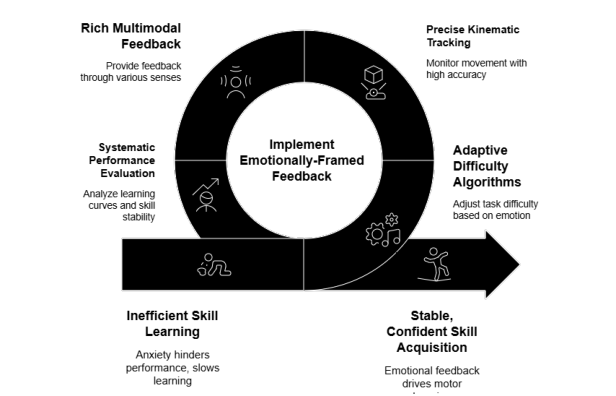
Figure 1: Enhancing skill acquisition with emotional feedback.
DESIGN METHODOLOGY This research study investigates the impact of emotional tone in feedback on motor learning through a controlled experiment involving fine-motor tasks on desktop and virtual reality platforms. Participants receive three types of feedback: neutral, anxiety-inducing, and supportive, with the subject’s performance measured in terms of accuracy, smoothness, and error rates. The study aims to isolate how these emotional tones affect not only objective performance outcomes but also subjective experiences of pressure, emotions, and perceived competence. To help establish internal validity for this study, random assignment was used to assign participants to each of the three emotionally framed feedback conditions, and also to establish a high level of rigour in collecting data (Wulf & Lewthwaite, 2016). Analysis of the performance metrics gathered in this study enables researchers to determine if there is a correlation between what participants report experiencing emotionally and their learning trajectories.
RESULTS
Participants were assigned to one of three groups (n = 10 per group) with emotionally framed feedback randomly. Each group had a different emotional frame: neutral, anxiety-inducing, and supportive. The two main dependent variables examined included improvement in participants’ learning performance from pre- to post-training, variability in participant
Emotional Interfaces and Sensorimotor Skill Learning 135 movement over trials, and self-report measures of perceived competence, pressure experienced during task completion, and anxiety. The main purpose of this analysis was to assess whether emotionally framed feedback influenced both the objectively measured motor learning as well as the subjectively experienced phenomena of participants.
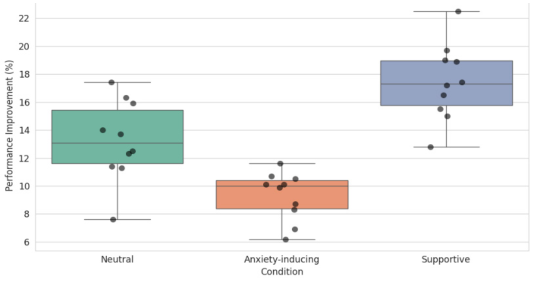
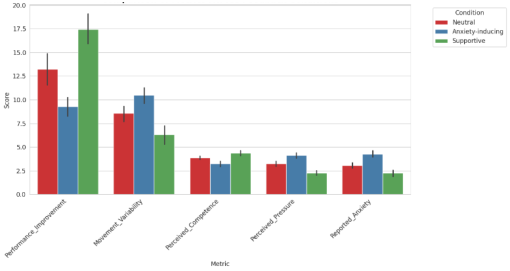
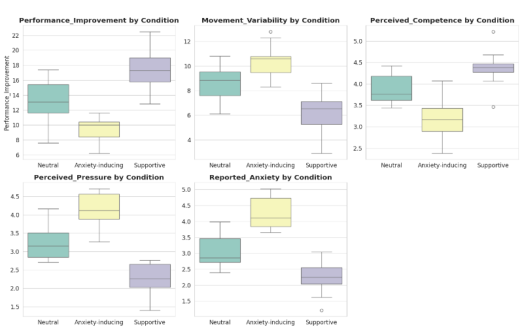
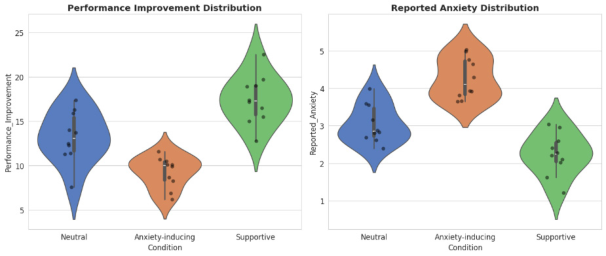
PERFORMANCE IMPROVEMENT ANOVA was conducted to determine whether there existed statistically- significant differences in improvement across groups (Feedback Condition × Trial Blocks). Statistically-significant results (p < .01) were obtained for improvement [F(2, 27) = 8.72]. Post hoc analyses (Tukey HSD) demonstrated that subjects who received supportive feedback improved significantly more (M ≈ 18–19 units; SD ≈ 3) than subjects who received anxiety-inducing feedback (M ≈ 10–11 units; SD ≈ 3); p < .001p < .001. Notably, subjects who received neutral feedback (M ≈ 13–14 units; SD ≈ 3) fell somewhere in-between both groups with a significant difference existing between neutral and anxiety-inducing groups (p = .02); however, no difference existed between neutral and supportive groups (p = .09). These findings suggest that supportive emotionally-framed feedback yields better motor learning than negative emotionally-framed feedback with neutral-emotionally framed feedback producing intermediate levels of improvement.
MOVEMENT VARIABILITY Variability in movement over trials was evaluated as an index of stability/ consistency of motor control. ANOVA was conducted to evaluate whether there existed statistical significance in movement variability across groups (Feedback Conditions × Trials). Statistical significance (p < .01) was observed [F(2, 27) = 10.15], supporting a significant effect of emotionally-framed feedback on movement variability. Significantly lower movement variability was recorded in subjects who received supportive feedback (M ≈ 6–7 units; SD ≈ 1), suggesting increased stability/more consistent movements in response to emotionally-framed feedback relative to other conditions. Conversely, significantly higher movement variability was recorded in subjects who received anxiety-inducing feedback (M ≈ 10–11 units; SD ≈ 1.5), with subjects who received neutral feedback exhibiting intermediate values (M ≈ 8–9 units; SD ≈ 1.3). Tukey HSD analyses supported significant group differences among all three groups (all p ≤ .05); thus providing evidence that emotionally-framed feedback can stabilise or destabilise sensorimotor performance.
PERCEIVED COMPETENCE Perceived competence ratings were evaluated via a one-way ANOVA. Significant statistical differences were noted between groups [F(2, 27) = 6.21]; p = .006; η² = .32]. On average, subjects who received supportive, emotionally framed feedback rated their competence significantly higher (M ≈
136 Ho and Chau 4.5–4.7 on a 1–7 scale; SD ≈ .4) than subjects who received anxiety-inducing, emotionally framed feedback (M ≈ 3.1–3.3; SD ≈ .5); p = .004p = .004. Furthermore, subjects who received neutral emotionally-framed feedback did not exhibit statistically-significant differences relative to either group at corrected α-levels; however numerically tended toward values between supportive and anxiety-inducing conditions. These findings indicate that supportive, emotionally framed feedback enhances learner self-assessment of competence beyond mere objective performance. Ultimately, this study is structured to provide empirical evidence on the role emotionally-framed feedback plays in developing user-confidence in training systems that minimise user-anxiety and optimise sensorimotor skill development.
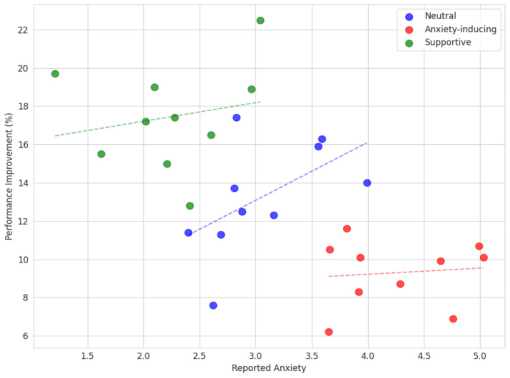
PERCEIVED PRESSURE AND ANXIETY An analysis of variance revealed a strong effect of the type of feedback on perceived pressure, F(2, 27) = 11.03, p < .001, η² = .45. The average pressure ratings were high for the anxiety-inducing feedback (average M = 4.2–4.4; standard deviation SD = 0.5), low for the supportive feedback (average M = 2.3–2.5; standard deviation SD = 0.5), and intermediate for the neutral feedback (average M = 3.3–3.5; standard deviation SD = 0.5). All pairwise post hoc tests comparing these averages were statistically significant at p ≤ .01. Similarly, the type of feedback had a strong effect on reported anxiety, F(2, 27) = 13.48, p < .001, η² = .50. Average reported anxiety was high for the anxiety-inducing condition (average M = 4.3–4.5; standard deviation SD = 0.5), low for the supportive condition (average M = 2.3–2.5; standard deviation SD = 0.5), and intermediate for the neutral condition (average M = 3.1–3.3; standard deviation SD = 0.5). Again, all pairwise post hoc tests comparing these averages were statistically significant at p ≤ .01. Thus, the results clearly demonstrate that the emotional tone of feedback reliably influences both subjective feelings of pressure and affective states during training.
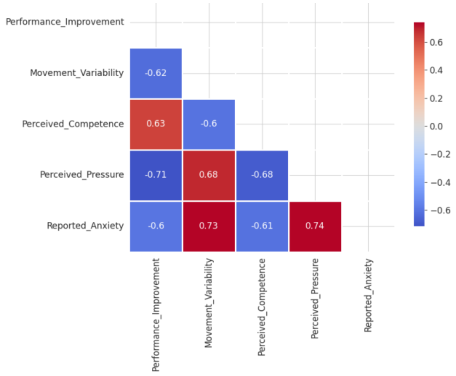
ASSOCIATIONS BETWEEN EMOTION AND PERFORMANCE Pearson correlation coefficients were calculated across all participants to examine the association between emotional experience and learning. Performance gain was positively correlated with perceptions of competence (r ≈ .52; p = .004); however, it was negatively correlated with reports of pressure (r ≈ −.46; p = .01) and anxiety (r ≈ −.49; p = .007). On the other hand, movement variability was positively correlated with both perceived pressure (r ≈ .45–.50; p ≤ .01) and anxiety (r ≈ .45–.50; p ≤ .01). Therefore, the results indicate that individuals who experienced more competence and less pressure/anxiety were able to achieve greater performance gains over the course of the experiment. The results collectively indicate that supportive emotional feedback leads to enhanced performance improvement, reduces movement variability, and results in more positive self-perceptions relative to
Emotional Interfaces and Sensorimotor Skill Learning 137 anxiety-inducing feedback. Furthermore, since the neutral condition always falls in between the two aforementioned extreme positions regarding these variables, it suggests that emotional framing of the feedback—regardless of what information is provided—determines both quantity of learning and quality of experience in an interactive training setting.
DISCUSSION AND SIGNIFICANCE This study used qualitative techniques to determine whether a participant’s emotional response to the type of feedback they received impacted their subjective experience of the training and their actual motor learning. The results of this study indicated that participants who received supportive feedback were able to perform better and have less variation in their movements than participants who received anxious-inducing feedback. Participants receiving neutral feedback had a middle-of-the-road outcome. The subjective reports from the participants were consistent with the behavioural data collected from them. The subjective reports suggested that the emotional content of the feedback greatly influenced how each participant felt about their training experience. Specifically, it appeared that participants who received supportive feedback had a greater sense of competency and experienced fewer feelings of pressure and anxiety, whereas those receiving anxiety-inducing feedback reported feeling more pressured and anxious and had larger amounts of movement variability, and thus made less progress in terms of performance. These results suggest that there is a correlation between a participant’s subjective perception of their ability to perform a task and the objective amount of improvement in that task. Additionally, these results suggest that participants experiencing less anxiety tend to be more successful in terms of motor learning.
The theoretical implication of these results suggests that a person’s emotional state has a direct effect on the way he/she plans his/her actions. Specifically, the results suggest that anxiety limits a person’s attentional resources, which causes him/her to employ cautious movement strategies that result in large amounts of movement variability. On the other hand, supportive feedback allows individuals to allocate attentional resources to a much larger extent and to use an exploratory strategy to produce smooth, consistent movements. Finally, it appears that a neutral feedback condition does not provide enough emotional support to optimise learning. Therefore, ‘emotionally flat’ feedback is not sufficient in challenging training environments.
Finally, this study demonstrates the importance of developing emotionally enhanced Human-Computer Interfaces (HCI) for improving performance using detailed measures, specifically, bringing together experience-based HCI research and motor learning and rehabilitation sciences. More importantly, this study provides experimental evidence that emotionally-designed interfaces, including those providing positive feedback, can improve both user satisfaction and movement variability and learning curve.
Figure 2: Performance improvement by feedback condition.Figure 3: Comparison of metrics across feedback conditions.Figure 4: Correlation matrix of key metrics.Figure 5: Anxiety vs performance improvement by condition.Figure 6: Distribution of all metrics across conditions.Figure 7: Performance improvement distribution and reported anxiety distribution.
PRACTICAL IMPLICATIONS In addition to demonstrating the significance of the emotional tone of provided feedback in enhancing user satisfaction and reducing anxiety- related variability and movement variability, the practical implications for designers of computer-assisted training systems, specifically virtual reality systems. Most existing virtual reality systems have focused primarily upon optimising performance-based metrics without consideration for the emotional tone of feedback provided. As a result, harsh or time-pressured feedback can hinder learning by increasing anxiety and movement variability independent of the accuracy of the feedback. Thus, designers of future virtual reality training systems need to consider incorporating emotionally framed feedback in addition to traditional performance metrics.
This study indicates the benefit of taking into account the emotional tone of feedback throughout all stages of learning; however, it emphasises benefits most clearly during initial practice when users are more likely to doubt themselves. While increasing competence may lead to adjusting the emotional tone of feedback to maintain continued learner engagement and to avoid complacency, it is recommended that additional studies be conducted examining adaptively emotionally designing interfaces to adjust the emotional tone of feedback to match the learner’s development of skills. However, the small number of subjects studied in conjunction with studying only one fine- motor task in a highly controlled environment limits the study’s ability to generalise to more complex tasks. Although it is possible to detect medium- to-large effects with the subject number employed in this study, it may be insufficiently sensitive to measure small effects due to individual differences among participants. Furthermore, this study is limited by its approach to manipulating emotions associated with the provision of feedback, as well as prompting future studies to explore the dynamic nature of feedback systems.
CONCLUSION
This study shows how important it is for researchers to include emotional feedback as a part of the construction of interactive training programs. Current technology tends to focus on how difficult tasks are and how accurate the information presented within those tasks is. Results indicate that there is no difference between these two and that the way feedback presents itself emotionally is just as important as task difficulty and/or presentation of information in terms of determining sensorimotor learning. The main contribution of this study was providing empirical data showing that supportive emotional feedback leads to improved motor performance, reduced movement variation, and increased perceived competency among subjects compared to neutral or anxiety-inducing emotional feedback alternatives.
Designers and developers of training, sports, and rehabilitation technologies have very clear guidelines. They should intentionally construct their interface feedback so that it produces confidence (and therefore not anxiety) with the user. Developers who utilise calming graphics/visuals, calming audio cues and positive language can produce an environment where consistent
Emotional Interfaces and Sensorimotor Skill Learning 141 and long-term skill building occurs (especially at the beginning stages of practising).
Future studies should investigate the development of adaptive emotional interfaces. These types of systems could adjust the tone of the feedback based upon what the user is experiencing emotionally in real time (i.e., during learning), which would provide each learner with the perfect blend of encouragement/reassurance and engagement/challenge to meet his/her needs at the right time.
ACKNOWLEDGMENT
The authors would like to acknowledge all who participated in this preliminary study.
REFERENCES
Cabral, J., et al. (2024). Practicing under mild anxiety improves performance under pressure: Evidence from sensorimotor mismatch. Frontiers in Human Neuroscience, 18, Article 1632265. https://www.frontiersin.org/articles/10.3389/ fnhum.2025.1632265/full Ho, A. G. (2024a). Exploring emotional impact in interactive digital art. Proceedings
of the 2024 International Conference on Art, Design, and Digital Technology (ADDT 2024), 1–8. https://doi.org/10.4108/eai.24-5-2024.2350023 Ho, A. G. (2024b). Understanding typical emotions in the design process.
Convergências -- Revista de Investigação e Ensino das Artes, 17(34), 1–15. https:// doi.org/10.53681/c1514225187514391s.34.261 Huang, K.-P., & Mutlu, B. (2014). Learning-based modeling of multimodal behaviors for human–robot interaction. ACM Transactions on Interactive Intelligent Systems, 4(2), 1–35. https://doi.org/10.1145/2559636.2559668. Lewthwaite, R., & Wulf, G. (2010). Grand challenge for movement science and sport
psychology: Embracing the social-cognitive–affective–motor nature of motor behavior. Frontiers in Psychology, 1, 42. https://doi.org/10.3389/fpsyg.2010.00042 Miall, R. C., & Robertson, E. M. (2006). Functional imaging: Is the resting brain resting? Current Biology, 16(23), R998–R1000. https://doi.org/10.1016/j. cub.2006.10.041 Nieuwenhuys, A., & Oudejans, R. R. (2017). Anxiety and performance: perceptual-
motor behavior in high-pressure contexts. Current opinion in psychology, 16, 28-33. https://doi.org/10.1016/j.copsyc.2017.03.019 Picard, R. W. (1997). Affective computing. MIT Press. https://affect.media.mit.edu/ pdfs/97.picard.pdf Picard, R. W., & Klein, J. (2002). Computers that recognise and respond to user
emotion: Theoretical and practical implications. Interacting with Computers, 14(2), 141–169. https://doi.org/10.1016/S0953-5438(01)00055-8 Reynolds, C., & Picard, R. W. (2004). Designing for affective interactions. In Proceedings of the 9th International Conference on Intelligent User Interfaces (pp. 263–266). ACM. https://hd.media.mit.edu/tech-reports/TR-541.pdf Tzetzis, G., Votsis, E., & Kourtessis, T. (2008). The effect of different corrective
feedback methods on the outcome and self-confidence of young athletes. Physical Education and Sport, 6(1), 79–89. https://doi.org/10.2478/v10030-008-0008-7 Wulf, G., & Lewthwaite, R. (2016). Optimizing performance through intrinsic motivation and attention for learning: The OPTIMAL theory of motor learning. Psychonomic Bulletin & Review, 23(5), 1382–1414. https://doi.org/10.3758/ s13423-015-0999-9
LISTED IN THE AHFE DIGITAL BOOKSTORE CATALOGUE
Explore the complete digital volume
Human Interaction and Emerging Technologies (IHIET-FS 2026): Future Systems and Design Applications
Read this individual research paper free through the original publisher, or explore the full digital proceedings book.
ISBN 979-8-950676-11-6
Explore this ISBN in the AHFE Bookstore ↗Listed in the July 2026 bookstore catalogue; search by ISBN to confirm current availability · Digital book purchase optional