Rabaa Alabdulrahman (2026). Human-AI Collaborative Learning: AI-Enhanced Project-Based Learning for Future Technology Prototyping in Higher Education. In: Human Interaction and Emerging Technologies (IHIET-FS 2026): Future Systems and Design Applications. AHFE Open Access, vol. 235, pp. 121–131. https://doi.org/10.54941/ahfe1007267
Higher education has debated the thin line between AI literacy development and cognitive disengagement in AI-supported learning environment. This paper presents a detailed AI-Enhanced Conceptual Prototyping (A-ECP) framework that integrates human-AI interaction into project-based learning through interactive design, structured monitoring, and AI-assisted visualization of abstract Management Information Systems (MIS) concepts. The study was conducted at the undergraduate level at the College of Business at Prince Mohammad bin Fahd University in Saudi Arabia. Using ChatGPT as a human-centred generative AI tool, students transformed theoretical MIS concepts into future technology prototypes through iterative prompting, visualization, and reflective refinement. ChatGPT was selected due to its familiarity and accessibility among students, reducing technological barriers and supporting collaborative human-AI learning experiences. The framework was evaluated through a post-intervention survey, which indicated a mean score of x̄ = 4.64 and 92.9% confidence in AI integration within academic settings. Themes identified from qualitative thematic analysis include AI-Augmented Creativity and Visual Clarity in Learning, highlighting the role of human-AI collaboration in supporting conceptual understanding and engagement. Academic performance improved by 6.05 percentage points from the previous semester, rising from 77.34% to 71.29%, with a moderate effect size (Cohen's d = 0.60). The findings show that integrating human-centred AI in a structured way can improve conceptual understanding, student engagement, and AI literacy while still maintaining critical thinking. Additionally, the study confirms the pedagogical significance of the A-ECP framework, aligning it with the SAMR model, AI-TPACK, Cognitive Load Theory, and Saudi Vision 2030’s goals for a digital workforce.
The rapid increase in the use of generative artificial intelligence (AI) tools in education, especially large language models such as ChatGPT, has reshaped the educational paradigm, introducing both learning opportunities and challenges, especially regarding academic integrity. It supports a knowledge- based, digitally empowered one that will position the Kingdom as a
122 Alabdulrahman global leader in technological innovation and human capital development (SaudiVision2030, 2016). AI tools offer promising opportunities in education, including personalized learning, student engagement, and material preparation. However, it is crucial to weigh the benefits of these opportunities against genuine concerns about academic honesty and the potential decline of cognitive skills (Wirzal et al., 2024).
This paper introduces the AI-Enhanced Conceptual Prototyping (A-ECP) framework, a pedagogical model designed to bridge the skill gap by integrating generative AI as a scaffold for complex conceptual application rather than a replacement. The paper then describes a specific instructional intervention based on project-based learning (PBL), implemented generative AI and reports the effects of this implementation on student engagement, conceptual application, comfort with AI tools, and academic performance (Chung et al., 2019; Thomas, 2000). This intervention required students to apply a comprehensive understanding of theoretical MIS concepts covered throughout the semester in traditional learning settings. These concepts, among others, include business intelligence (BI), the Internet of Things (IoT), wireless networks, database management systems, and information security. The aim is to create a “future technology” prototype that leverages the learned concepts, using ChatGPT for ideation and visualization.
The significance of this research extends beyond its relevance to education in Saudi Arabia. Institutions worldwide struggle with key questions about how to responsibly incorporate AI tools while maintaining educational standards and integrity. This paper contributes to the growing literature on the responsible use of AI in higher education by introducing a new implementation design, documenting the intervention’s outcomes, and reporting improvements in academic performance.
The following research questions have been developed and considered for guiding this study: RQ1: What effect does the AI-Enhanced Conceptual Prototyping
(A-ECP) framework have on student engagement, understanding of theoretical business technology ideas, and academic performance in an introductory Management Information Systems (MIS) course? RQ2: What are students’ perceptions of how generative AI technologies, particularly ChatGPT, help them learn? RQ3: How does the A-ECP framework align with other teaching theories
and frameworks that encourage the use of technology in the classroom? RQ4: What actionable insights can inform future applications of AI-enhanced project-based learning within business education environments?
LITERATURE REVIEW AND THEORETICAL FRAMEWORK ChatGPT and other AI tools are rapidly being integrated into educational institutions and various fields worldwide. When they became widely available in late 2022, most institutions didn’t know how to control student use. Initial responses often involved bans, fearing misuse or neglect (Wirzal et al., 2024). However, this perspective has shifted. Leaders now recognize AI’s permanence
Human-AI Collaborative Learning: AI-Enhanced Project-Based Learning 123 and that universities should teach students to use it responsibly instead of trying to prevent it (Su et al., 2023).
PBL has been shown to help bridge the gap between theory and practice in an educational context by helping students learn not just the “what” of theory but also the “how” of practice. However, for successful implementation, educators must include clear learning expectations, appropriate scaffolding, a clear plan for assessing students, and adequate tech support (Thomas, 2000). Generative AI tools like ChatGPT have rapidly entered classrooms worldwide. Students have diverse views on AI. Some praise its potential to improve study quality, save time, or provide quick feedback (Kasneci et al., 2023). Others worry about over-reliance or hindering deep thinking. Frameworks like AI-TPACK stress developing educators’ skills in technical use and critical awareness of AI’s capabilities, limitations, biases, and appropriate use in specific disciplines (Mishra et al., 2023).
Cognitive Load Theory (CLT), pioneered by Sweller (1988), states that learning effectiveness depends on managing the cognitive demands placed on learners’ working memory. The theory identifies three types of cognitive load. First, “intrinsic load,” which reflects the cognitive demands caused by the inherent complexity of the learning material. Second, “extraneous load,” which represents unnecessary cognitive demands resulting from poor instructional design. Lastly, “germane load,” which involves the productive cognitive effort directed toward schema development and knowledge integration.
Saudi Vision 2030 is a comprehensive national transformation plan designed to diversify the Kingdom’s economy, develop its public service sectors, and enhance the quality of life for its citizens and residents. It aims to equip students with practical experience in emerging AI technologies, foster advanced critical thinking and innovation skills, and connect academic learning with real-world technological applications.
METHODOLOGY
This study employs a case study research design (Yin, 2018) to examine the implementation and outcomes of the A-ECP framework in a specific educational setting.
The research was conducted during the spring semester of 2025 at Prince Mohammad bin Fahd University, a private non-profit university in Saudi Arabia. The university has a diverse student body and is highly committed to exploring innovative teaching and learning methods, making it an ideal location for investigating new pedagogical strategies.
Participants The research was conducted in an MISY 2311 course at the College of Business with 88 students participating. All students majoring in fields such as Accounting, Finance, HR, MIS, Marketing, and Business Admin took the course as a core requirement to gain technical skills and experience. Participation in surveys and comments was optional, but the project was mandatory. Students consented to anonymized data use, and the university approved the study ethically.
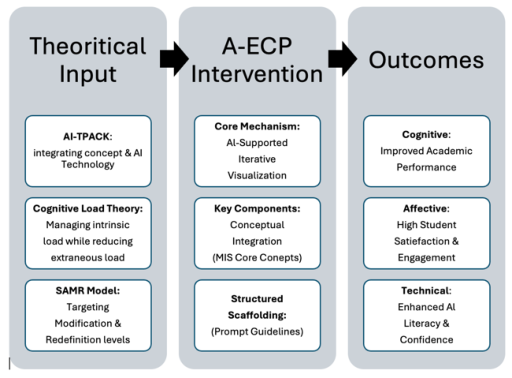
Figure 1 illustrates the A-ECP framework. This framework was developed based on the following key ideas: concept integration, using structured AI, iterative refinement, real assessment, and scaffolded support.
Figure 1: Conceptual framework of the AI-enhanced conceptual prototyping (A-ECP) model.
Selection of ChatGPT as the AI Tool There were several educational and practical reasons for selecting ChatGPT as the main AI tool for this intervention. Among undergraduate students, ChatGPT has become the most recognized and user-friendly generative AI tool. Most students preferred ChatGPT and had used it for various tasks, which made them more comfortable with unfamiliar technology. Since the main goal was to understand MIS topics, not master the AI tool, this familiarity was crucial. Its widespread use in business and tech offered practical experience aligned with Saudi Vision 2030’s workforce goals.
Project Structure and Requirements In this project, students used the A-ECP framework to complete a comprehensive assignment called “The Future Technology Prototyping” project. The project occurred over three phases.
Phase 1: Conceptualization and Research. Initially, students had to select a problem area and choose at least three MIS ideas from the course that could be used in a future technological solution.
Phase 2: AI-Assisted Visualization and Refinement. Students used ChatGPT to create visual representations of their prototypes, refining prompts for better accuracy and clarity through multiple iterations and documenting their progress.
Human-AI Collaborative Learning: AI-Enhanced Project-Based Learning 125 Phase 3: Presentation and Reflection. Students presented their future technology prototype and submitted a reflection on MIS concepts, AI use, challenges, and lessons learned.
Each project was evaluated using a rubric covering: Conceptual Integration (40%); Innovation and Creativity (25%); Visual Communication (15%); and Critical Reflection (20%). The rubric was shared at the start to guide students.
Data Collection Data were collected through multiple sources to enable a comprehensive understanding of the intervention. Data source included academic performance data, post-intervention surveys, student project submissions, and instructor observations.
RESULTS
Quantitative Findings The post-intervention survey results in Table 1 show high average scores for engagement, application, and recommendation.
Outcome Variable Mean (x̄) Std Dev (σ) Recommendation for Future Classes 4.64 0.98 Visual Clarity of Concept 4.52 1.11
Enjoyment using ChatGPT 4.50 1.13 Understanding of MIS Concepts 4.38 1.17
Felt Engagement 4.38 1.13 Application of MIS Topics 4.33 1.12
Academic Performance Outcomes The Grade Comparison indicated that student performance improved notably following the intervention. In the previous semester (Control), the average course grade was 71.29% without the A-ECP framework. In the current semester with the A-ECP framework, the average grade increased to 77.34%. This represents a 6.05 percentage point absolute increase and an 8.49% relative increase over the baseline average. The calculated effect size (Cohen’s d = 0.60) indicates a moderate effect and a meaningful practical impact on learning outcomes.
This 6.05 percentage-point increase is a significant and positive development in student performance. The effect size of d = 0.60 falls within the medium range according to standard benchmarks (Cohen, 2013), indicating that the improvement is not only statistically significant but also substantial in terms of learning outcomes.
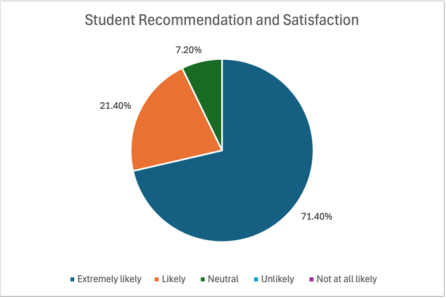
The post-intervention survey showed very high levels of student satisfaction with the A-ECP framework. When asked to rate how likely they were to recommend this project format to other students on a 5-point Likert scale, the average response was 4.64 (σ = 0.58), indicating that most students enjoyed it. The reactions were mostly positive, as illustrated in Figure 2. This distribution shows that over 92% of students rated their likelihood of recommending the experience as four or five, suggesting strong perceived value in the learning experience.
Figure 2: Student recommendation and satisfaction.
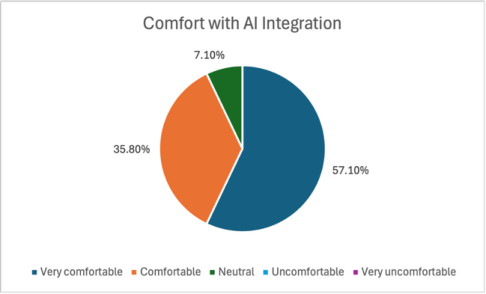
Comfort With AI Integration Students reported feeling far more comfortable using AI tools in academic contexts. After the intervention, 92.9% of students reported being “comfortable” or “very comfortable” with using AI tools. Before the intervention, about 45% of students said they were “comfortable” or “very comfortable” with using AI tools based on informal polling at the start of the semester. The distribution of post-intervention comfort levels is reported in Figure 3.
Figure 3: Comfort level with AI integration.
Human-AI Collaborative Learning: AI-Enhanced Project-Based Learning 127 Perceived Learning Value
To evaluate subjective learning experience, students rated various aspects of the project’s contribution to their learning on 5-point scales. Key findings are shown in Table 2. These results consistently demonstrate high perceived value across multiple dimensions of learning outcomes, with all means above 4.3 on the 5-point scale, reflecting strong agreement that the A-ECP framework positively influenced their learning.
Table 2: Post-intervention ratings of key learning outcomes.
Table available in the original PDF paper.
Key Learning Outcomes Mean (x̄) Std Dev (σ) Enhanced conceptual understanding 4.52 0.63 Increased engagement with course material 4.48 0.71
Development of practical technology skills 4.38 0.74 Improved creative thinking 4.55 0.59
Qualitative Findings Thematic analysis of open-ended survey responses and student reflections identified two main themes and several sub-themes, offering valuable insights into students’ experiences with the A-ECP framework.
Theme 1: AI-Augmented Creativity The most notable theme emerging from student reflections was ChatGPT’s role as a catalyst for creative thinking rather than a substitute for it. Students consistently described the AI tool as expanding their imaginative potential and helping them explore ideas they might not have considered on their own.
Students described AI as functioning like a “creative partner” or “thinking tool,” requiring them to articulate their ideas with precision, evaluate outputs critically, and maintain creative control throughout the process.
Theme 2: Visual Clarity in Learning Students noted that translating abstract MIS concepts into visual prototypes required them to think more concretely and accurately about how these concepts operate within integrated systems. Moreover, students noted that visualization served multiple roles: It clarified their thinking, facilitated communication with peers and the instructor, and fostered emotional investment in their projects by making abstract concepts tangible and personally meaningful.
Sub-Theme: Productive Struggle With AI Tools While generally positive about the experience, students also acknowledged challenges and frustrations, particularly in the early stages of working with ChatGPT. However, these difficulties were often seen as valuable learning
128 Alabdulrahman opportunities rather than just negative obstacles, aligning with the idea of “productive failure” in learning (Loibl et al., 2017).
Sub-Theme: Confidence in Future Technology Use Several students expressed increased confidence in their ability to work with emerging technologies in their future careers, viewing the project as a link between academic learning and professional practice. This growing confidence directly supports Saudi Vision 2030’s goals of developing a digitally skilled, innovation-ready workforce.
Observed Outcomes of the Project About 83% of the students were able to include three or more MIS principles in their prototypes. Many demonstrated an understanding of how these concepts interact within complex systems. About 28% of projects included a combination of IoT sensors, cloud computing, and business intelligence. Whereas 19% included database management, information security, and mobile. Then, wireless networks, e-commerce, and customer relationship management were included in 15% of projects, and 12% included Blockchain, supply chain management, and data analytics. A small percentage of 9% included intelligence, healthcare information systems, and data privacy. The remaining 17% of projects integrated one or two concepts, usually because they focused on narrower problem areas rather than due to a lack of understanding.
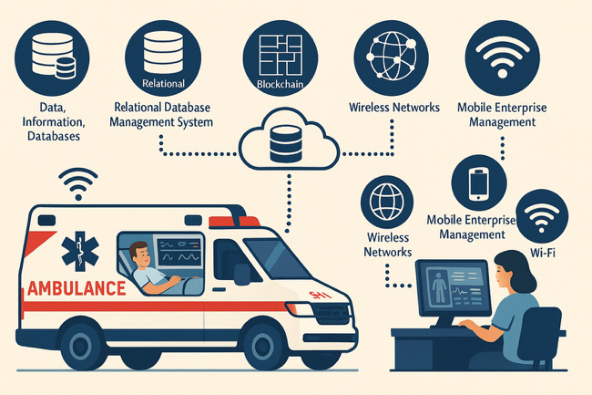
Most prototypes demonstrated varying levels of technical feasibility but showed creative use of MIS principles aligned with Saudi Vision 2030, such as digital transformation and sustainability. For example, a student-designed “Smart Ambulance” uses IoT and cloud tech to improve emergency response, as shown in Figure 4.
Figure 4: Sample of student prototype generated by ChatGPT.
Human-AI Collaborative Learning: AI-Enhanced Project-Based Learning 129 Analysis of ChatGPT prompt logs showed AI interactions grew more sophisticated over time. Initially, prompts were vague, e.g., “Create a smart home system,” but later became more specific, e.g., “Generate a visual prototype showing IoT temperature and humidity sensors connected via wireless mesh network to a central cloud database with a Business Intelligence dashboard displaying real-time analytics and predictive alerts for building facility managers.” This indicates students gained subject knowledge and developed AI literacy, including effective communication to achieve goals. Students averaged 5.3 prompt iterations (3-12) before final visualization, showing high engagement in the iterative process.
Table 3 shows high ChatGPT adoption and increased student comfort after the intervention. Table 4 highlights common MIS concepts and themes of student enjoyment, validating the project’s academic and creative focus.
Table 3: AI integration and comfort frequencies.
Table available in the original PDF paper.
Equation reproduced from the original PDF.
Somewhat helpful 14.30% Post-Project AI Comfort Very comfortable 61.90%
Somewhat comfortable 31.00% Still unsure 7.10%
Prior AI Use Used AI in other courses (Yes) 85.70% Discouraged or prohibited 22.20%
Table 4: Conceptual application and qualitative frequencies.
Table available in the original PDF paper.
Metric Category Percentage/Count Top MIS Concepts Applied AI or Machine Learning 73.80%
Business Intelligence 52.40% Wireless Networks 50.00%
Primary Source of Enjoyment Working creatively 90.50% Using ChatGPT 64.30%
Top Challenge Faced (Count) Nothing was challenging 13 Coming up with the idea 7
DISCUSSION
The findings of this case study provide strong evidence for the effectiveness of the A-ECP framework in improving student engagement, conceptual comprehension, proficiency with AI tools, and academic achievement.
The most significant finding is that AI integration appears to increase cognitive engagement when it is properly planned, rather than reduce it. Students said that ChatGPT encouraged deeper thinking by providing quick feedback, alternative perspectives, and helping them clarify their ideas. The
130 Alabdulrahman findings support the theoretical idea that well-designed AI integration can reduce unnecessary cognitive load while preserving relevant mental effort at the intended level (Sweller, 1988; Weidlich et al., 2025).
The framework effectively incorporates AI-TPACK principles by integrating content knowledge (MIS concepts), pedagogical knowledge (PBL principles, scaffolding, assessment), and technological knowledge (ChatGPT capabilities and limitations) into a cohesive instructional design (Koehler et al., 2013; Mishra & Koehler, 2006).
This intervention supports Saudi Arabia’s Vision 2030 by advancing economic and educational goals. Students gained practical AI experience, increasing confidence from 45% to 92.9%, preparing them for a job market where AI literacy is crucial.
CONCLUSION
This case study shows that when carefully used within strong educational frameworks, generative AI tools can significantly enhance students’ learning experiences and academic success in higher education. The A-ECP framework effectively fostered deep conceptual understanding, innovative application, improved skills in using AI tools, and measurable gains in academic performance among undergraduate business students in Saudi Arabia.
The highly positive student response (𝑥̄ = 4.64 recommendation score), qualitative signs of greater engagement and understanding, and objective improvements in performance (77.34% vs. 71.29% average grades, σ = 0.60) indicate that the framework successfully achieved its main goals.
These findings challenge traditional views that position the use of AI tools as a threat to student learning. Instead, they support a growing view that AI can be a valuable educational resource when properly implemented in well-designed learning environments. The key is not the technology itself but how educators use it, as they must ensure AI supports and expands student thinking rather than replacing it.
The A-ECP framework offers an approach grounded in well-established learning theories (SAMR, AI-TPACK, Cognitive Load Theory), aligned with institutional and national priorities, and demonstrated through positive student outcomes This study suggests future research directions, including comparing AI-enhanced PBL with standard methods through experimental designs, tracking long-term retention and AI literacy, replicating the A-ECP framework across disciplines and cultures, and exploring the development of AI tool comparison and assessment tools. It also recommends using process- tracing methods to understand student interactions and investigating design parameters for AI integration.
REFERENCE Chung, C.-j., Hwang, G.-j., & Lai, C.-l. (2019). A review of experimental mobile learning research in 2010–2016 based on the activity theory framework. Computers & education, 129, 1–13.
Human-AI Collaborative Learning: AI-Enhanced Project-Based Learning 131 Cohen, J. (2013). Statistical power analysis for the behavioral sciences. routledge. Kasneci, E., Seßler, K., Küchemann, S., Bannert, M., Dementieva, D., Fischer, F.,…
Hüllermeier, E. (2023). ChatGPT for good? On opportunities and challenges of large language models for education. Learning and individual differences, 103, 102274. Koehler, M. J., Mishra, P., & Cain, W. (2013). What is technological pedagogical content knowledge (TPACK)? Journal of education, 193(3), 13–19. Loibl, K., Roll, I., & Rummel, N. (2017). Towards a theory of when and how problem
solving followed by instruction supports learning. Educational psychology review, 29(4), 693-715. Mishra, P., & Koehler, M. J. (2006). Technological pedagogical content knowledge: A framework for teacher knowledge. Teachers college record, 108(6), 1017–1054. SaudiVision2030. (2016). Saudi Vision 2030. https://www.vision2030.gov.sa/en Su, J., Ng, D. T. K., & Chu, S. K. W. (2023). Artificial intelligence (AI) literacy in
early childhood education: The challenges and opportunities. Computers and Education: Artificial Intelligence, 4, 100124 Sweller, J. (1988). Cognitive load during problem solving: Effects on learning.
Cognitive science, 12(2), 257–285. Thomas, J. W. (2000). A review of research on project-based learning. In: San Rafael, CA, USA. Weidlich, J., Gasevic, D., Drachsler, H., & Kirschner, P. (2025). ChatGPT in education:
An effect in search of a cause. PsyArXiv Preprints. Wirzal, M. D. H., Nordin, N. A. H. M., Abd, N. S., & Halim, M. (2024). Generative AI in Science Education: A Learning Revolution or a Threat to Academic Integrity? A Bibliometric Analysis. Journal of Educational Research and Studies: e-Saintika, 8(3), 319–351. Yin, R. K. (2018). Case study research and applications (Vol. 6). Sage Thousand
Oaks, CA.
LISTED IN THE AHFE DIGITAL BOOKSTORE CATALOGUE
Explore the complete digital volume
Human Interaction and Emerging Technologies (IHIET-FS 2026): Future Systems and Design Applications
Read this individual research paper free through the original publisher, or explore the full digital proceedings book.
ISBN 979-8-950676-11-6
Explore this ISBN in the AHFE Bookstore ↗Listed in the July 2026 bookstore catalogue; search by ISBN to confirm current availability · Digital book purchase optional