Rabaa Alabdulrahman, Shubashini Velu (2026). User Acceptance and Perceptions of IoT-Based Smart Trash Bin Systems for Smart Waste Management. In: Human Interaction and Emerging Technologies (IHIET-FS 2026): Future Systems and Design Applications. AHFE Open Access, vol. 235, pp. 356–364. https://doi.org/10.54941/ahfe1007289
Waste management remains a growing challenge in universities and office settings due to increased waste production, a shortage of cleaning staff, hygiene issues, and ineffective monitoring of traditional trash bins. This research explores users’ perceptions, acceptance, and expectations of IoT-based smart trash bins designed at improve waste management efficiency in business environments. It focuses on user opinions about features like automated lid opening, dual notification alerts, automatic locking, and hand sanitizer integration, which aim to enhance hygiene, prevent overflow, and boost operational efficiency. The study employed a mixed-method design, using questionnaires and interviews to assess user perceptions and acceptance of smart waste management solutions.The results show strong user support for smart waste management systems, especially for features that enhance hygiene, automate monitoring, and decrease reliance on manual inspections by cleaning staff. Participants stressed the significance of automatic lid-opening, notification alerts, and smart monitoring for improving waste management efficiency. Feedback also raised concerns about costs, network reliance, and user adaptability. Overall, the findings reveal positive attitudes toward IoT-enabled waste systems and highlight the potential of smart trash bins to advance smart campus initiatives and sustainable operations. This study adds to the expanding research on smart technologies by exploring user-focused viewpoints on IoT-driven waste management systems and highlighting practical factors for future deployment in business and office settings.
The amount of waste generated today is increasing rapidly due to the growing population (Poddar et al., 2017). Although trash bins are ubiquitous in modern society, making it easy for people to dispose of their daily waste, some places, such as offices and universities, have limited cleaning staff who cannot always realize the trash is full on time. This not only damages the appearance of the city but also exacerbates environmental pollution. As garbage increases, the complexity of waste management is also rising. This change may mean that more cleaners are needed to maintain environmental hygiene, leading to a shortage of cleaners in many areas and putting a huge strain on human resources (Bui et al., 2020).
User Acceptance and Perceptions of IoT-Based Smart Trash Bin Systems 357 On the other hand, although smart trash bins can solve the problems of traditional trash bins, such as the limited number of cleaning staff, which makes it impossible to deal with full trash bins promptly, and have been sold in many countries, traditional trash bins are still commonly used in many places. This is because traditional trash bins are easy to use and do not require additional maintenance, they only need to be emptied regularly within fixed schedule. However, the long-term use of traditional trash bins is one of the main causes of environmental pollution. It cannot effectively monitor the capacity of the trash bin, nor can it alert the cleaning staff when the bin is full, resulting in poor waste management (Pal et al., 2018).
Traditional trash bins require manual operation, which means that people need to have direct contact with the trash bin, causing the hygiene and increase health risk. Since many people do not disinfect in time or wash their hands after touching the trash bin, which means the bacteria remain on their hands, causing an increase in bacterial infection. Additionally, many people are reluctant to touch the trash due to hygiene reasons, thus they throw garbage all over the place, leading to deteriorating environmental sanitation (Pal et al., 2018).
Besides, the cost issues are one of the main limitations of the existing system due to waste production increasing rapidly day by day, causing the cost of expenditure to rise (Bui et al., 2020). Among them, the most significant factor is investment in human resources, such as hiring more cleaners to handle the growing amount of garbage. This makes the use of traditional trash bins gradually become a burden, because the amount of garbage generated is difficult to predict, forcing managers to arrange more cleaners to handle garbage regularly.
Finally, current smart trash bins require stable power support to operate. For example, functions such as automatically opening the lid of a trash bin and sending dual notifications are driven by electricity. This means that the installation site of the smart trash bin should be able to provide a continuous power supply to ensure that the trash bin can function well (Mdukaza et al., 2018). Based on the above discussion, this study focuses on user acceptance and perceptions of smart trash bin technologies rather than the system’s technical implementation. The research emphasizes user expectations, perceived usefulness, hygiene improvements, and operational efficiency in office and university environments.
The objectives of this study are to investigate user perceptions of the limitations of traditional and existing smart trash bin systems; to evaluate user acceptance of IoT-based smart trash bin technologies; to identify the most preferred smart features for waste management systems in office environments; and to examine potential challenges affecting the adoption of smart waste management systems.
LITERATURE REVIEW
As modern society advances rapidly day by day, technology never stops, and, in essence, IoT must be used most of the time. It connects devices
358 Alabdulrahman and Velu and systems through the internet and allows real-time data collection and communication with it, creating smarter decision-making processes that will be more automated.
IoT has revolutionized the areas of waste management in this context, thus offering smart solutions for collection and waste disposal. On the one hand, conventional bins rely on manual monitoring and emptying, which are usually inefficient or labour-intensive in large environments such as offices and universities. However, IoT-enabled smart waste management bins can track the fill level of their contents in real time and issue notifications when approaching full capacity, even automating functions such as lid opening and closing.
The intelligent waste management system seeks to decrease littering by providing a convenient, hands-free way to dispose of waste. It also aims to improve public health by reducing contact with contaminated surfaces (Sohag and Podder, 2020).
The results of the study by Kanade et al. (2021), emphasize that improved waste management due to enhanced collection schedules. Hence, the study bridges the gap by minimizing trash bin overflow issues, which leads to a reduction in environmental pollution and effectively lowers the operational cost.
A study by Kamm et al. (2020), emphasized that the usage of IoT technologies is crucial because it may create more efficient manpower management, which leads to fewer employees required for waste collection. As a result, the findings of this study provided insight into the impact of financial benefits, which decreases the operating and overhead costs.
Therefore, embracing new technologies is a vital initiative in creating a sustainable and green environment approach to support users for better hygiene awareness, and it helps to reduce physical contact with contaminated surfaces.
METHODOLOGY
Data Collection For this study, both questionnaires and interviews were employed in this study to investigate the relationship between the user‘s expectation and perceptions of the smart waste management system, particularly regarding features such as fill-level indication and auto operations. Concurrently, interviews were conducted to gather users’ opinions and stakeholders’ perceptions to gather rich qualitative data. Therefore, in this research, through this method of mixed methods, the accuracy of the investigation is ensured to be holistic and more accurate rather than just a quantitative approach.
Questionnaire The questionnaire contains 20 questions in total and is organized into four sections to ensure broad feedback on both the current and proposed trash bins. In this quantitative methodology approach, the collected data were examined to identify the current trash bin users’ perspective and the new approach of IoT embedded bins features in order to determine the improved value or to detect the relationship between IS Artifact and resilience factors. Further, to determine the possible impact on the shared work environment.
User Acceptance and Perceptions of IoT-Based Smart Trash Bin Systems 359 In the present research, questionnaires with four sections were distributed to respondents to collect vital data. They comprise four sections: (A) demographics ; (B) Users’ current trash bin information ; (C) respondents’ perspectives on proposed system features, capabilities towards hygiene and overall sustainability ; (D )feedback on possible enhancements and suggestions for the proposed system. The questionnaire applied the 5-point Likert scales during the survey.
FINDINGS AND INTERPRETATION Questionnaire Findings
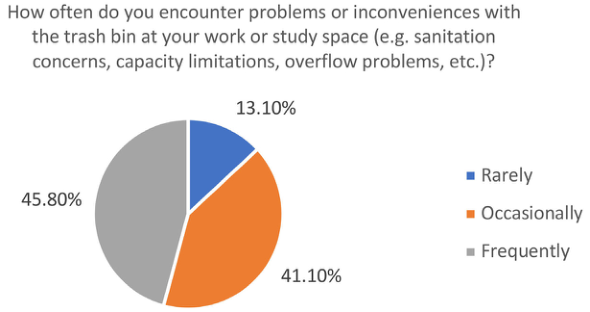
One of the important analyses used to validate our research problem and gaps is through the measurement of the questionnaire and respondent feedback. The findings of the questionnaire results in highlighting the major concerns that are experienced with the current trash bins and respondents’ perceptions of the IoT smart trash bin system. In our study, we investigated the frequency of respondents who have encountered the inconveniences with the regular trash bin in work or study places. The frequency of problems encountered is shown in Figure 1. The results show that 45.8% of respondents often experience inconveniences with regular trash bins, and 41.1% experience them occasionally, and only 13.1% reported rarely facing any issues with the regular bins. For those who reported no concerns, this result clearly shows that even though regular trash bins are in use, their use is probably low, or respondents work in very small offices with a very small number of employees, and regular bins are adequate for their business environment. However, due to rapid industry and business development in KSA, the Vision 2030 highlights the importance of digital transformation and smart technologies for sustainability and a green environment. Therefore, this research aligns with the national agenda of developing cleaner, smarter and more sustainable solutions in office and university environments.
Figure 1: Issues encountered with the usage of regular trash bin.
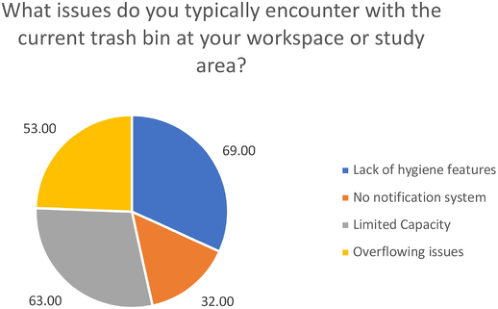
360 Alabdulrahman and Velu The nation’s development is evident in the questionnaire feedback, as the use of the current trash bin has negatively impacted their business environment. Hence, the results show that the lack of hygiene features was the highest, with 69% responses, followed by limited capacity, with 63%. 32% of responses were on the lack of a notification system because the regular trash bin does not have these features, while overflow issues received 53% of responses. The results shown in Figure 2 indicate that hygiene, waste capacity, and monitoring functionality are the major concerns for existing waste management systems. Therefore, the statistical feedback shows a direct correlation between users and the risk of bacterial transmission with the manual bin operation, as 69 participants clearly identified hygiene as their primary concern.
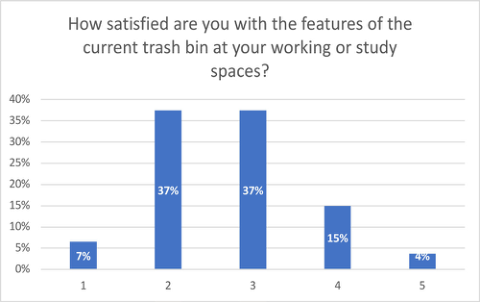
Figure 2: Issues encountered by respondents with trash bin currently in use.Figure 3: Level of satisfactory of respondents on the current trash bin in use.
In this research, we also measured the level of satisfaction with the existing trash bin in use. The results of our data collection show that a large percentage of respondents’ satisfaction with the existing features and functionalities of the current trash bins was low, particularly in criteria such as hygiene concerns, waste overflow, and operational efficiency and effectiveness.
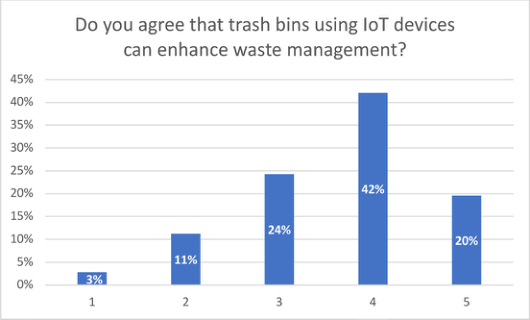
Figure 4: Level of consent of respondents on the proposed smart trash bin.
Figure 4 above illustrates respondents’ consent on IoT smart trash bin would improve waste management in their work environment. Therefore, the results indicated a positive perception of the IoT smart trash bin system and its ability to improve waste management efficiency in office and shared settings. Another key important data revealed in Figure 3 is the lack of real- time data is related to the satisfaction gap observed. The user indicated that 32% experienced a lack of notifications, which is a key feature for avoiding bin overflows. This is the key feature to improve the environment, with users stating that the lack of notification systems leads to unavoidable bin overflows. This, therefore, worsens workplace sanitation. Thus, it is broadly agreed that IoT-enabled systems are a necessity for sustaining institutions’ hygiene requirements rather than just an upgrade to a regular bin.
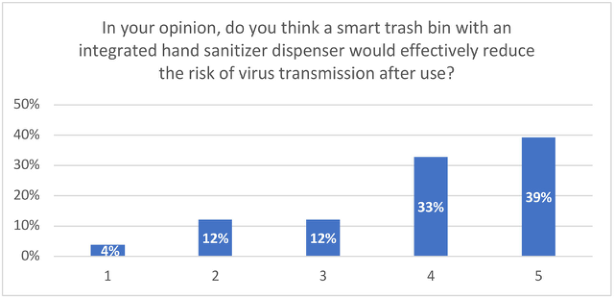
Figure 5: Effectiveness of reducing the virus for the smart trash bin with hand sanitizer dispenser.
Many problems have been identified and discussed above. The results show that users are facing some problems with the current system. Additionally, the participants mentioned that a hand sanitizer dispenser is an effective measure and that the smart trash bin with a dispenser is effective in reducing
362 Alabdulrahman and Velu the spread of the virus and improving sanitary level. The findings shown in Figure 5 indicate that 39% of responses are in favour to include the hygiene features in the smart bin, to improve further cleanliness green environment ambiance.
The results of the data analysis summarize the key problems identified with traditional trash bins, including overflow, hygiene concerns, lack of monitoring, and operational inefficiency. In the following section, we highlight the major themes derived from the individual interviews.
Interview Findings In this section, we further investigate the user experience of waste disposal. Conducting individual interviews with several participants provided in depth qualitative context and enable us of finding general themes. For this paper, reporting the major emerging themes is sufficient, however, further statistical analysis and qualitative investigation could be considered for in-depth analysis. Several participants have reported that the current manual scheduling for cleaning the trash bin are inadequate specially in busy shared spaces.
In previous section, the questionnaire results indicated that many participants have sanitary concerns over the use of regular trash bins. Also, waste overflow due to the lack of real-time monitoring can be a major challenge. Hence, discussing this further in these interviews revealed that trash bin usually fills up quickly in crowded areas. Whereas the same area might have empty trash bin on other days. This inconsistent situation create inconvenient situation to the waste management team where is the decision of adding more cleaning staff and schedule can create extra unnecessary cost. Further, participant noted the possibility of hygiene risk when touching the pin lid. Hence, asking the participant about their views of having embedded IoT smart trash bin systems where the usage status is monitored on real- time and automated lid and hand sanitizer dispenser features are available, participants responded positively. Despite these concerns, participants believed that these features will not only solve major challenges but could promote clean work environment with convenient on demand cleaning schedule noting the unstable traffic in shared work environment.
Another questionnaire finding discussed in previous section indicated several concerns regarding the implementation cost, the technology maintenance need, and the reliability on stable internet connectivity for the notification systems. interviews revealed that the majority indicated that the positive daily outcome may overcome these challenges on the long run.
In overall, smart monitoring and automated lid where IoT technology is utilized received positive responses. The overall interview result shows that participants perceived of IoT enabled waste management systems are practical and have beneficial outcome both on short and long term in modern business environment. Many reported that these systems could result in positive result such as enhancing operational efficiency, lessening the need for manual inspection, aiding in scheduling for cleaning staff, enhancing environmental cleanliness, and offering convenience to users.
User Acceptance and Perceptions of IoT-Based Smart Trash Bin Systems 363 User Acceptance Testing (UAT)
User Acceptance Testing (UAT) was conducted to evaluate the usability and functionality of the IoT-enabled waste management system. The testing focused on key system features, including automatic lid opening and closing, notification systems, and hand sanitizer dispensing (Ramson et al., 2020).
Participants showed high satisfaction as 40% provided 5-star ratings while 20% chose 4 stars demonstrating that the lid control feature functioned well. Occasionally users reported moderate problems (2–3 stars) with delays and sensitivity while using the function. The automated lid functionality proved acceptable to users since it reached their desired expectations.
Regarding clear notification system of bin status with locking mechanism when bin status is full, the majority (70%) gave this function a rating of four or five stars, indicating that the locking and bin full warning were typically prompt and clear. A few users may have had minor concerns, according to some responders who rated the product with two to three stars. The feature was dependable and useful overall.
As for the hand sanitizer feature, 10% of users gave the disinfectant five stars for its functionality, while 60% gave it four stars. A very small number of consumers gave it a lower rating, indicating that while most users found the disinfectant trustworthy, some found slight differences in its activation effect or release volume.
The discussed results indicated positive acceptance of the smart trash bin system highlighting the potential improvement in waste management in shared business environment.
CONCLUSION
This research explored the user perceptions and acceptance of an IoT-based smart trash bin system developed for office and shared environments. The proposed system includes several automated functions including touchless lid opening, dual notifications, automated locking system, and integrated hand sanitizer dispensing.
The results demonstrated strong favourable perceptions and opinions toward the adoptions of smart waste management technologies. Many respondents believed that IoT-enabled smart trash bins could significantly improve waste collection management and contributing to cleaner and greener sustainable surroundings.
However, the findings also revealed several concerns related to practical implementation. Participants identified issues such as implementation and installation cost, network dependency, and user adaptability to the new technologies. These findings emphasize that successful implementation required careful consideration on both technological advancement and operational feasibility.
Overall, this research contributes to the growing body of knowledge on smart business technologies by offering user-focused insights into the perceived usefulness and acceptance of IoT-based waste management solutions. Future studies may expand this work by investigating large-scale deployment, long- term system effectiveness, and integration with wider smart infrastructure ecosystems.
REFERENCES
Al-Saqqa, S., Sawalha, S. and AbdelNabi, H. (2020) ‘Agile software development: Methodologies and trends’, International Journal of Interactive Mobile Technologies, 14(11). Bui, T.D., Tsai, F.M., Tseng, M.L. and Ali, M.H. (2020) ‘Identifying sustainable solid
waste management barriers in practice using the fuzzy Delphi method’, Resources, Conservation and Recycling, 154. Mdukaza, S., Isong, B., Dladlu, N. and Abu-Mahfouz, A. (2018) ‘Analysis of IoTenabled solutions in smart waste’, IECON 2018 - 44th Annual Conference of the IEEE Industrial Electronics Society. Navghane, S.S., Killedar, M.S. and Rohokale, V.M. (2016) ‘IoT based smart garbage
and waste collection bin’, International Journal of Advanced Research in Electronics and Communication Engineering. Pal, A., Hazra, S., Dan, A. and Gupta, S. (2018) ‘Smart street dustbin: A smarter way to manage waste’, CBS Journal of Management Practices. Poddar, H., Paul, R., Mukherjee, S. and Bhattacharyya, B. (2017) ‘Design of smart
bin for smarter cities’, IEEE. Ramson, S.J., Moni, D.J., Vishnu, S., Anagnostopoulos, T., Kirubaraj, A.A. and Fan, X. (2021) ‘An IoT-based bin level monitoring system for solid waste management’, Journal of Material Cycles and Waste Management, 23(2), pp. 516–525. Samann, F. (2017) ‘The design and implementation of smart trash bin’, Academic
Journal of Nawroz University. Sultan, M.N., Ali, E., Ali, M.A., Nadim, M. and Habib, M.A. (2017) ‘Smart campus using IoT with Bangladesh perspective: A possibility and limitation’, International Journal of Research in Applied Sciences and Engineering Technology.
LISTED IN THE AHFE DIGITAL BOOKSTORE CATALOGUE
Explore the complete digital volume
Human Interaction and Emerging Technologies (IHIET-FS 2026): Future Systems and Design Applications
Read this individual research paper free through the original publisher, or explore the full digital proceedings book.
ISBN 979-8-950676-11-6
Explore this ISBN in the AHFE Bookstore ↗Listed in the July 2026 bookstore catalogue; search by ISBN to confirm current availability · Digital book purchase optional