Jiayi Chen, Xingting Wu (2026). Generative AI in Clothes Design: A Scoping Review of Workflows, Challenges, and Future Pathways. In: Human Dynamics, Product Evaluation and Quality. AHFE Open Access, vol. 212, pp. 65–76. https://doi.org/10.54941/ahfe1007814
The clothes design and development sector is under growing pressure to accelerate workflows as product lifecycles shrink. Generative AI (GenAI), driven by diffusion models, Generative Adversarial Networks (GANs), and Large Language Models (LLMs), is reshaping this process, yet existing studies often examine individual tools in isolation, overemphasise 2D visual outputs, and largely overlook real-world production. Following PRISMA-ScR, this scoping review examines 57 peer-reviewed articles on AI-assisted clothes design from Web of Science and Scopus (2021–2026), spanning computer science, HCI, textile engineering, and design. Studies cluster in early stages: ideation (29.8%) and sketch rendering (35.1%) make up nearly two-thirds, while physical-engineering stages combined (pattern-making and fabric visualization) account for only 24.5%, with pattern-making and structural design alone at 10.5%. This imbalance reveals a visual-engineering disconnect: AI still struggles to produce production-ready structures. To synthesize these insights, the review proposes a comprehensive diagram identifying four systemic challenges, future pathways, and stage-specific design implications.
Clothes design is undergoing a systemic transformation driven by Generative AI (GenAI). In 2023, the market size of AIGC applications in the clothing sector reached USD 1.27 billion and is expected to exceed USD 5 billion by 2028 (Market.US, 2023). AI has entered fashion workflows, from design briefs to 3D virtual garments and AI Fashion Week (Rizzi and Vandi, 2026).
Academic research has examined AI-assisted clothes design through creative generation, workflow integration, engineering verification, and cultural heritage. Systems such as HAIGEN, CoCoStyle, and CrossGAI support human-AI collaboration and designer intent preservation (Jiang et al., 2024; Kim et al., 2024; Deng et al., 2024), while LLMs, DrapeNet, and AIGC-based approaches have been applied to fit diagnosis, fabric drape simulation, and ethnic garment reconstruction (Kachbal and El Abdellaoui, 2026). However, these directions remain fragmented.
66 Chen and Wu Existing reviews provide limited coverage of the full clothes design workflow. They often focus on isolated technical components and early-stage visual generation, while overlooking the transition from visual concepts to physical production. Because clothes design involves fabric drape, body deformation, and sewing construction constraints, a systematic review grounded in designers’ practice and covering the complete workflow remains absent (Rizzi and Bertola 2025). Therefore, this study adopts a scoping review method to examine 57 articles published between 2021 and 2026, guided by two questions:
RQ1: What design tasks does AI perform at each stage of clothes design? RQ2: What core challenges, future research opportunities, and practical implications currently exist in AI-driven clothes design?
To address these questions, this study maps AI technologies across clothes design stages, describes human-AI task allocation, and identifies the disconnect between visual aesthetics and physical engineering, providing a cross-stage synthesis diagram and practical recommendations for human-AI co-creation.
METHODOLOGY
Research Design This study adopts a scoping review method to map the research distribution of AI-driven clothes design as an interdisciplinary field, rather than to quantitatively evaluate the effects of a specific intervention (Arksey and O’Malley, 2005; Peters et al., 2020). The reviewed literature spans computer science, human-computer interaction, design, and textile engineering. The review followed the PRISMA-ScR guidelines (Tricco et al., 2018), covering literature identification, screening, eligibility assessment, and final inclusion.
Search Strategy A systematic search was conducted in the Web of Science (WoS) Core Collection and Scopus. These databases cover major journals and conference proceedings in computer science, engineering, art and design, and textile and apparel studies. The search strings combined a “technology dimension” focused on artificial intelligence and representative generative technologies with a “design dimension” covering the main stages of the clothes design workflow, including ideation, sketching, pattern-making, and textile pattern design. Equivalent search strings were used in both databases, as shown in Table 1.
Table 1: Search strings and initial screening results.
Table available in the original PDF paper.
138
Database Search String Search Fields Initial Results Web of Science
Title, abstract, and keywords
TS=((“artificial intelligence” OR “generative AI” OR “generative artificial intelligence”) AND (“fashion design” OR “clothing design” OR “apparel design” OR “garment design” OR “costume design” OR “fashion ideation” OR “fashion sketch*” OR “garment development” OR “pattern design” OR “textile pattern design” OR “fashion creat*”))
341
Title, abstract, and keywords
Scopus TITLE-ABS-KEY((“artificial intelligence” OR “generative AI” OR “generative artificial intelligence”) AND (“fashion design” OR “clothing design” OR “apparel design” OR “garment design” OR “costume design” OR “fashion ideation” OR “fashion sketch*” OR “garment development” OR “pattern design” OR “textile pattern design” OR “fashion creat*”)) Total 479
Search Date and Scope. The search was completed on April 14, 2026. Only peer-reviewed journal articles and conference papers written in English were included. No publication-year restriction was applied in advance to retain the full developmental trajectory of the field.
Inclusion and Exclusion Criteria The inclusion and exclusion criteria were developed based on Arksey and O’Malley (2005). Three inclusion criteria (IC) and five exclusion criteria (EC) were established, as shown in Table 2.
Table 2: Inclusion and exclusion criteria.
Table available in the original PDF paper.
Code Criterion Inclusion Criteria IC1 Studies that explicitly examine the application of AI in one or more stages of clothes design, including ideation, sketching, pattern-making, textile design, and garment visualization. IC2 Studies that not only address the technology itself, but also describe, test, or evaluate its impact on design tasks, design workflows, or designer-tool interaction. IC3 Peer-reviewed journal articles or high-quality conference papers written in English. Exclusion Criteria EC1 Purely algorithmic studies that focus only on model architecture optimization, such as improving GAN loss functions or increasing image resolution, without discussing their application in designers’ workflows.
(Continued)
Table 2: Continued.
Table available in the original PDF paper.
Code Criterion EC2 Downstream business or consumer-side studies, such as intelligent recommendation systems, consumer virtual try-on, sales forecasting, inventory management, and fashion marketing. EC3 General art or design studies that broadly discuss “AI-generated art” or “AI industrial design” without focusing on clothes- or textile-specific contexts. EC4 End-stage production and manufacturing studies, such as sewing robot automation, fabric defect detection, and factory process optimization. EC5 Duplicate publications of the same research output, for which only the most complete version was retained.
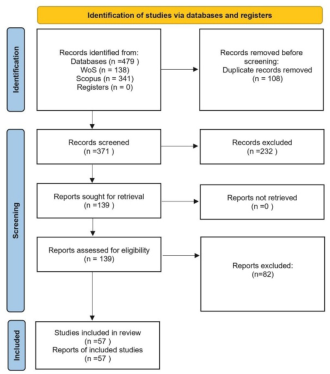
Screening Process The screening process followed the four-stage PRISMA-ScR procedure and was supported by Covidence. A total of 479 records were retrieved from WoS and Scopus. After 108 duplicates were removed, 371 records remained for title and abstract screening. At this stage, 232 records were excluded because they were unrelated to clothes design, were not empirical studies, or did not provide a systematic review of the field. The remaining 139 records were assessed in full text, and 82 were excluded because they lacked real design tasks, did not address workflows, or were not available in full text. Finally, 57 core articles were included, as shown in Figure 1.
The full 57-article corpus was retained as the coding dataset. The final corpus included 48 empirical studies, such as system development and user experiments, and 9 review-based studies, including 6 domain reviews and 3 theoretical frameworks. Review-based studies supported the analytical framework, while their contributions were distinguished from empirical studies in the statistical analysis.
Figure 1: PRISMA-ScR flow diagram of the review process.
Generative AI in Clothes Design: A Scoping Review of Workflows 69 Data Extraction and Coding
Following the “data charting” strategy proposed by Arksey and O’Malley (2005), this study conducted structured feature extraction for the 57 included articles. The extracted items included basic metadata, AI models used, AI-involved design activities, research aims and methodological orientation, and human-AI task allocation.
A multi-label coding scheme was adopted because the same article could involve multiple design activities or research aim types. Each article’s core contribution was used as the basis for primary classification, with secondary labels added where appropriate. The inductive process referred to Frich et al.’s (2019) classification of HCI creativity support tools. The coding results were summarized in Excel and analyzed through Python using Pandas and Matplotlib for descriptive statistics and visualization.
DESCRIPTIVE FINDINGS Temporal, Methodological, and Disciplinary Distribution
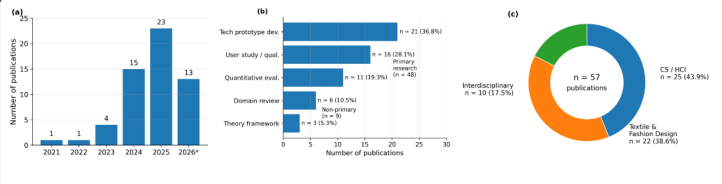
The included articles (2021–2026) show a two-stage pattern: only two articles were published before 2023 (Melnyk, 2021; Lee, 2022), after which output increased sharply. Using publisher-recommended citation years, 51 articles (89.5%) were published after 2023, including 38 articles in 2024–2025 and 13 in 2026. This rise aligns with Stable Diffusion, Midjourney v4, and ChatGPT.
Empirical studies accounted for 84.2% (n = 48), including technical prototypes (43.75% of empirical studies), user studies (33.33%), and quantitative evaluation (22.92%); 15.8% were review-based. Computer science contributed 43.8% (n = 25), textile engineering and design 38.6% (n = 22), and interdisciplinary areas (including HCI and cross-disciplinary design studies) 17.6%, showing growth toward workflow integration but limited dialogue between technical evaluation and design practice.
Figure 2: Distribution of publication year, research type, and disciplinary field.
FINDINGS AI Applications Across Design Stages: Addressing RQ1
AI research is unevenly distributed across stages (Table 3). Sketching and style rendering (35.1%) and ideation and concept generation (29.8%) dominate
70 Chen and Wu the corpus, while pattern making and structural design account for 10.5%. AI is therefore more mature in visual aesthetics than in physical engineering.
Table 3: Distribution of articles across clothes design stages.
Table available in the original PDF paper.
Design Stage Articles (n) Share (%) Core Functional Role Ideation and concept generation
17 29.8% Information processing; visual generation Sketching and style rendering
20 35.1% Visual generation; execution acceleration Pattern making and structural design
6 10.5% Systematic frameworks and workflow integration
Stage-wise AI Functions In ideation, AI supports trend research, creative exploration, and semantic translation. CNNs cluster runway attributes, while text-to-image models and LLMs turn abstract or cultural ideas into prompts (Choi et al., 2023; Kim et al., 2024). Yet outputs often lack sewing logic, sizing constraints, and sustainability considerations, causing rework (Rizzi and Bertola, 2025; Schneider et al., 2026).
In sketching and style rendering, AI increasingly preserves designers’ personal styles rather than only producing images. HAIGEN, StyleMe, ControlNet-based tools, and StyleWe support personalized lines, shape- texture control, sketch coloring, and privacy-aware style fusion (Jiang et al., 2024; Wu et al., 2023; Wu et al., 2024a). Designers retain structural intent and final judgment.
In pattern making and structural design, AI shifts to engineering support. LLM-based fit diagnosis can identify structural issues but still misreads wrinkles and requires manual adjustments (Knisely-Medina and Jo, 2026). DeepModelA supports fast base-pattern optimization for multiple body types (Chen et al., 2026b), while DrapeNet enables physics-based drape simulation yet still requires manual calibration (Kachbal and El Abdellaoui, 2026). AI remains a diagnostic aid, not a replacement for expert pattern-making.
In fabric physics and 3D visualization, AI supports textile presentation through simulation and neural rendering. Neural-accelerated simulation and 3D Gaussian Splatting improve wrinkles, frame rates, and virtual display fidelity (Kachbal and El Abdellaoui, 2026). However, realism still depends on manual tuning and sensory judgment, and special fabrics require physical validation (Kachbal and El Abdellaoui, 2026; Chen et al., 2026b).
Challenges, Opportunities, and Design Implications: Addressing RQ2 Limitations and Challenges
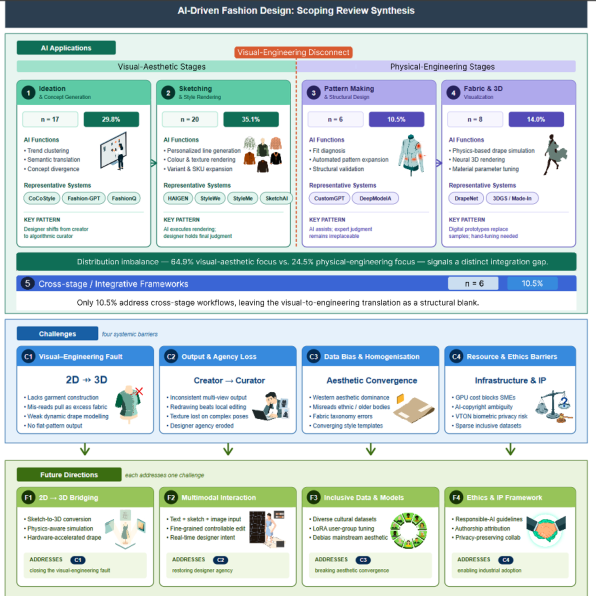
The central limitation is the disconnect between visual generation and engineering structure. Current models produce 2D images that cannot directly become production-ready flat patterns or 3D structural data
Generative AI in Clothes Design: A Scoping Review of Workflows 71 (An and Park, 2026). LLMs also lack tacit pattern-making knowledge, while complex drape remains difficult to simulate (Knisely-Medina and Jo, 2026).
Collaboration is further limited by stochastic outputs, weak local editing, and data bias. AI content can be inconsistent or faster to redraw than repair (An and Park, 2026), while datasets may encode Western dominance, cultural misinterpretation, fabric taxonomy errors, and aesthetic convergence (Chen et al., 2025b; Chen et al., 2026a; Schneider et al., 2026). Resource, copyright, and privacy risks also restrict adoption (Kachbal and El Abdellaoui, 2026).
Future Research Opportunities Future work should bridge visual concepts and manufacturing through stronger 2D-to-3D transformation, physics-based fabric simulation, and controllable multimodal interfaces for adjusting materials, silhouettes, and details while preserving personal style (Utami et al., 2026). Inclusive datasets and specialized models should reduce bias, while ethical and copyright mechanisms should support privacy, originality tracing, and adoption (Rizzi and Casciani, 2025; Schneider et al., 2026).
Design Implications For ideation and concept generation, AI should support trend clustering, image screening, and conceptual expansion while designers retain final evaluative judgment, as overreliance may narrow creative directions too early (Chen et al., 2025c; Jang, 2026). For sketching and style rendering, systems should prioritize personal-style preservation and local editability to reduce rework and protect designers’ authorship (Jiang et al., 2024; Wu et al., 2023). For pattern making and structural design, AI should be positioned as a preliminary diagnostic aid rather than a substitute for expert pattern-making, because senior makers remain skeptical of LLM-based fit guidance (Knisely-Medina and Jo, 2026). For fabric and 3D visualization, digital prototypes can reduce part of physical sampling, but complex or special materials still require physical validation (Chen et al., 2026b).
DISCUSSION AND CONCLUSION AI shows an uneven pattern of penetration in clothes design. Generative technologies demonstrate strong capacity for ideation and sketch rendering, but their involvement remains limited in pattern making, structural design, and 3D simulation, where manufacturing knowledge is required. This gap reflects a deeper technical challenge: existing models map 2D visual space effectively but lack a foundational understanding of 3D geometric topology, fabric mechanics, and sewing construction.
Figure 3 synthesizes the core findings: 64.9% of studies concentrate in visual-aesthetic stages, while physical-engineering stages account for 24.5% and cross-stage integration for 10.5%. It also links four systemic challenges to future directions, showing how technical gaps increase rework, data bias reduces designer agency, and computational, copyright, and ethical barriers
72 Chen and Wu restrict industrial adoption (Kachbal and El Abdellaoui 2026; Rizzi and Bertola 2025).
As a scoping review, this study focuses on distribution and themes rather than levels of evidence or meta-analytic effectiveness. The English-language, peer-reviewed search scope may underestimate progress in industry practice, ethnic garments, and local design workflows.
Overall, the reviewed articles point to a structural mismatch between the capability boundaries of AI tools and the engineering requirements of clothes design. AI currently functions more as an uneven set of tools than as a collaborative system connecting the full workflow. Future research must move beyond screen-based visual generation and address the specific engineering details needed to support physical production.
Figure 3: Comprehensive synthesis diagram of stage-wise distribution, challenges, and future research directions.
REFERENCES
An, H. and Park, M. (2026). AI tools and fashion design education: instructor perspectives on student challenges and design process tool support. Fashion and Textiles, 13(1). Argyrou, G. et al. (2025). Automatic Generation of Fashion Images Using Prompting
in Generative Machine Learning Models. In: Computer Vision – ECCV 2024 Workshops, pp. 286–302. Springer Nature Switzerland, Cham.
Generative AI in Clothes Design: A Scoping Review of Workflows 73 Arksey, H. and O’Malley, L. (2005). Scoping studies: towards a methodological
framework. International Journal of Social Research Methodology, 8(1), 19–32. Balloni, E. et al. (2025). Made-In: An immersive human-in-the-loop analytics platform for enhancing creative processes in fashion. Computer Vision and Image Understanding, 260. Besana, N. et al. (2025). Co-designing with the archive: a new way of interacting
with fashion design heritage. European Journal of Cultural Management and Policy, 15. Chen, H. et al. (2025b). A Human-Centered AIGC Framework for Inclusive Fashion Design: Mitigating Bias for East Asian (Chinese) Elderly. Textile and Leather Review, 8, 1013–1043. Chen, H. et al. (2026a). Technology as cultural translator: artificial intelligence
adaptation and reconstruction in Global South fashion design. AI & Society, 41, 2003–2019. Chen, K., Xu, L. and Qiu, Z. (2026b). Utilizing Artificial Intelligence (AI)- Assisted Digital Modelling for Modern Chinese Qipao 3D Visualization. In: HCI International 2025 – Late Breaking Papers, pp. 63–74. Springer Nature Switzerland, Cham. Chen, L. and Zhao, Y. (2025a). A New Paradigm of Apparel Design Path in the
Human-Machine Collaborative Model. In: Cross-Cultural Design, pp. 184–199. Springer Nature Switzerland, Cham. Chen, Z. et al. (2025c). Human-AI Collaborative Design for Ethnic Fashion: A Four-Diamond Model Driven by AIGC. In: Proceedings of the 2025 International Conference on Artificial Intelligence, Virtual Reality and Interaction Design, pp. 637–647. ACM, Dongguan China. Cheng, X., Chen, Y. and Jing, Z. (2025). Research on Digital Innovation Design and
Application of Hakka Costume Patterns Empowered by AIGC. In: Proceedings of the 2025 International Conference on Computer Technology, Digital Media and Communication, pp. 163–171. ACM, Chengdu China. Choi, W. et al. (2023). Developing an AI-based automated fashion design system: reflecting the work process of fashion designers. Fashion and Textiles, 10(1). Davis, R.L. et al. (2025). SketchAI: A “Sketch-First” Approach to Incorporating
Generative AI into Fashion Design. In: Proceedings of the Extended Abstracts of the CHI Conference on Human Factors in Computing Systems, pp. 1–7. ACM, Yokohama Japan. Deng, H. et al. (2024). CrossGAI: A Cross-Device Generative AI Framework for Collaborative Fashion Design. Proceedings of the ACM on Interactive, Mobile, Wearable and Ubiquitous Technologies, 8(1), 1–27. Franzo, P., Quartu, A. and Cianfanelli, E. (2024). Co-Designing Fashion with AI in
the Phygital Scenario. Convergencias: Revista de Investigacao e Ensino das Artes, 17(34), 81–92. Frich, J. et al. (2019). Mapping the Landscape of Creativity Support Tools in HCI.
In: Proceedings of the 2019 CHI Conference on Human Factors in Computing Systems, pp. 1–18. ACM, Glasgow Scotland UK. Guo, Z. et al. (2023). AI Assisted Fashion Design: A Review. IEEE Access, 11, 88403–88415. Huang, S. and Zhang, Z. (2024). The Application of Interactive AI-Based Narrative
Translation Model in Fashion Design. In: 2024 International Conference on Interactive Intelligent Systems and Techniques (IIST), pp. 326–331. IEEE, Bhubaneswar, India. Jang, S.Y. (2026). From designer to curator: cognitive and creative trade-offs in GenAI-assisted design. Fashion and Textiles, 13(1).
Creativity and Style Generation in Fashion Design. Proceedings of the ACM on Interactive, Mobile, Wearable and Ubiquitous Technologies, 8(3). Jin, Y. et al. (2024). Understanding Fashion Designers’ Behavior Using Generative AI for Early-Stage Concept Ideation and Revision. Archives of Design Research, 37(3), 25–45. Jung, D.W. and Suh, S. (2024). Enhancing Soft Skills through Generative AI in
Sustainable Fashion Textile Design Education. Sustainability, 16(16). Kachbal, I. and El Abdellaoui, S. (2026). Computer Vision for Fashion: A Systematic Review of Design Generation, Simulation, and Personalized Recommendations. Information (Switzerland), 17(1). Katsuragi, M. and Tanaka, K. (2025). Comparing AI-Generated and Human-Crafted
T-Shirt Layouts through an XAI Lens: Key Design Elements and Implications for Co-Creative Tools. In: Proceedings of the Extended Abstracts of the CHI Conference on Human Factors in Computing Systems, pp. 1–10. ACM, Yokohama Japan. Kim, M., Joo, M. and Han, K. (2024). CoCoStyle: Mixed initiative co-creative system to support creative process of fashion design. SoftwareX, 27, 101857. Kim, M., Joo, M. and Han, K. (2025). Understanding the Differences in an AI-Based
Creativity Support Tool Between Creativity Types in Fashion Design. International Journal of Human–Computer Interaction, 41(18), 11881–11894. Kim, S.J. (2024). Generative Artificial Intelligence in Collaborative Ideation: Educational Insight From Fashion Students. IEEE Access, 12, 49261–49274. Knisely-Medina, A. and Jo, J. (2026). Apparel pattern modification guidance of
competing LLMs: ChatGPT, Claude and Gemini. Research Journal of Textile and Apparel, 1–16. Lee, J. and Suh, S. (2024). AI Technology Integrated Education Model for Empowering Fashion Design Ideation. Sustainability, 16(17). Lee, Y.K. (2022). How complex systems get engaged in fashion design creation:
Using artificial intelligence. Thinking Skills and Creativity, 46, 101137. Market.US. (2023). Generative AI in fashion market to expand at a CAGR of 36.9%, witnessing a surge in growth opportunities by providing unique experiences. GlobeNewsWire, April 3, 2023. Melnyk, V. (2021). Punch Card Knitting Pattern Design in Collaboration with GAN.
Proceedings of the 12th International Conference on Computational Creativity (ICCC ’21), 336–341. Mohankumar, V.K. and Roy, S. (2025). Responsible Design Solutions: A Comparative Study of Creativity Between AI Image Generators and Designers. In: Responsible and Resilient Design for Society, Volume 7, pp. 309–319. Springer Nature Singapore, Singapore. Ngai, E.W.T., Lee, M.C.M. and Kei, B.C.W. (2025). A Generative Artificial
Intelligence (GenAI) System for Fashion Design: A Case Study. IEEE Transactions on Engineering Management, 72, 1320–1333. Nguyen-Truc, N. et al. (2025). Advancing Fashion Design Through Intelligent Sketchpad Studio. In: Proceedings of the 33rd ACM International Conference on Multimedia, pp. 13534–13536. ACM, Dublin Ireland. Nik Harun, N.A., Md Syed, M.A. and Abdullah, F. (2025). Revolutionising costume
design education: a case study on the impact of Microsoft Copilot. Quality Assurance in Education, 33(2), 321–335. Peters, M.D.J. et al. (2020). Updated methodological guidance for the conduct of scoping reviews. JBI Evidence Synthesis, 18(10), 2119–2126.
Generative AI in Clothes Design: A Scoping Review of Workflows 75 Qiu, Q., Luo, S. and Xing, Y. (2026). Research on the improved design of lightweight
outdoor apparel for urban travel based on the integration of AHP-KE and artificial intelligence techniques. Journal of Engineered Fibers and Fabrics, 21, 15589250261431460. Rachana Harish, A. et al. (2025). Collaborative garment design through group chatting with generative industrial large models. Advanced Engineering Informatics, 65, 103366. Rizzi, G. and Bertola, P. (2025). Exploring the generative AI potential in the fashion
design process: an experimental experience on the collaboration between fashion design practitioners and generative AI tools. European Journal of Cultural Management and Policy, 15. Rizzi, G. and Casciani, D. (2025). Scouting emerging AI applications in fashion heritage and archival practices. European Journal of Cultural Management and Policy, 15. Rizzi, G. and Vandi, A. (2026). Towards Synthetic Imaginaries: Augmenting
Fashion Product, Communication, and Retail Design with GAI. In: Fashion Communication in the Digital Age. FACTUM 2025. Springer Proceedings in Business and Economics, pp. 211–224. Springer, Cham. Rockett, E. (2026). Innovative solutions to fashion’s biggest problems – the impact of artificial intelligence on solutions for Sustainable Development Goals 9 and 12. A case study from London College of Fashion. International Journal of Educational Management, 40(1–2), 194–208. Ryu, C. and Lee, Y.K. (2026). Effective Fashion Design Collection Implementation
with Generative AI: ChatGPT and Dall-E. Clothing and Textiles Research Journal, 44(1), 125–140. Schneider, T. et al. (2026). Strategic use of generative AI in fashion collections: from creation to promotion. AI & Society. Sharma, M.N. et al. (2025). Virtual Fashion Design Studio: AI-Driven Co-Creation
Platform for Designers and Machines. ShodhKosh: Journal of Visual and Performing Arts, 6(4s). Tocchetti, A. et al. (2025). Human-AI Collaboration in the Fashion Design Process.
Proceedings of the AAAI Symposium Series, 5(1), 115–118. Tricco, A.C. et al. (2018). PRISMA Extension for Scoping Reviews (PRISMA-ScR): Checklist and Explanation. Annals of Internal Medicine, 169(7), 467–473. Utami, N.W. et al. (2026). Generative AI for Fashion Innovation: A Systematic
Literature Review of Models and Applications. In: 2026 20th International Conference on Ubiquitous Information Management and Communication (IMCOM), pp. 1–8. IEEE, Hanoi, Vietnam. Veselá, Z. et al. (2024). Creative Approaches to Teaching Sustainable Design. Vlakna a Textil, 31(3–4), 31–50. Wang, H.Y. and Utama, S. (2023). Investigating the Generative-AI Evaluation
Methods and Correlation with Fashion Designers. In: 2023 7th International Conference on Information Technology (InCIT), pp. 508–513. IEEE, Chiang Rai, Thailand. Wang, W., Yang, Y. and Fang, Y. (2026). Synergising Computational and Design Thinking in Design Education: A Dual-Process Framework to Enhancing Creativity and Appropriateness. International Journal of Art & Design Education, jade.70017. Wei, C. et al. (2025). The current research status of Kansei engineering in the field
of emotional clothing design. International Journal of Clothing Science and Technology, 37(1), 93–114.
Style. In: Proceedings of the 2023 CHI Conference on Human Factors in Computing Systems, pp. 1–16. ACM, Hamburg Germany. Wu, D. et al. (2024a). StyleWe: Towards Style Fusion in Generative Fashion Design with Efficient Federated AI. Proceedings of the ACM on Human-Computer Interaction, 8(CSCW2), 1–31. Wu, J.X. and Li, L. (2025). AI-driven computational creativity in fashion design: a
review. Textile Research Journal, 95(5–6), 658–675. Wu, X. and Li, L. (2025). Qualitative-empirical insights into generative AI for textile design in the fashion design process. International Journal of Design Creativity and Innovation, 13(4), 322–357. Wu, X.P. and Li, L. (2024). An application of generative AI for knitted textile design
in fashion. The Design Journal, 27(2), 270–290. Wu, Z. et al. (2024b). The Research and Design of an AIGC Empowered Fashion Design Product. In: Human-Computer Interaction, pp. 413–429. Springer Nature Switzerland, Cham. Yu, D. and Zhao, P. (2024). Research on Network Clothing Design System Based on
Artificial Intelligence. Procedia Computer Science, 247, 27–35. Zhang, Y.B. and Liu, C.L. (2024). Unlocking the Potential of Artificial Intelligence in Fashion Design and E-Commerce Applications: The Case of Midjourney. Journal of Theoretical and Applied Electronic Commerce Research, 19(1), 654–670. Zhu, W. et al. (2025). GAI4DE: Harnessing the Design Process to Integrate GAI into
Design Studios. International Journal of Human–Computer Interaction, 1–24.
LISTED IN THE AHFE DIGITAL BOOKSTORE CATALOGUE
Explore the complete digital volume
Human Dynamics, Product Evaluation and Quality
Read this individual research paper free through the original publisher, or explore the full digital proceedings book.
ISBN 978-1-964867-88-5
Explore this ISBN in the AHFE Bookstore ↗Listed in the July 2026 bookstore catalogue; search by ISBN to confirm current availability · Digital book purchase optional