Uwe Reischl, Budimir Mijovic (2026). Optimizing Garment Material Selection to Reduce Solar Heat Radiation Exposure. In: Human Dynamics, Product Evaluation and Quality. AHFE Open Access, vol. 212, pp. 37–43. https://doi.org/10.54941/ahfe1007811
Workers exposed to high levels of solar radiation are at elevated risk of heat-related disorders, with infrared (IR) radiation representing a significant external heat load that can exacerbate physiological heat strain. Protective clothing is widely used to mitigate solar exposure; however, reductions in IR transmission may be counteracted by IR absorption and heat accumulation within garment materials, potentially increasing overall heat stress. To clarify these competing mechanisms, controlled laboratory experiments were conducted to independently quantify IR transmission and IR-induced heat absorption for cotton, polyester, cotton/polyester blend, silk, paper, and Mylar materials. Temperature measurements be-neath and in direct contact with each material allowed separation of transmitted radiative heat from conductive heat resulting from material IR absorption. The conventional textile fabrics tested exhibited net increases in thermal burden, with net heat gains of up to 50%, despite partial attenuation of incident IR radiation. In contrast, the reflective Mylar material produced a net reduction in heat exposure of about 15% by substantially limiting IR absorption while reflecting incident radiation. These findings demonstrate that reduced IR transmission alone is an insufficient indicator of thermal protection and underscore the importance of minimizing IR absorption in garment design. The experimental methodology presented pro-vides a practical and reproducible framework for evidence-based evaluation and selection of garment materials aimed at reducing solar IR heat stress in occupational outdoor environments.
Occupational exposure to solar heat radiation is a major contributor to heat stress among outdoor workers in agriculture, construction, wildland firefighting, and other physically demanding occupations performed under direct sunlight. Heat stress occurs when the body’s ability to dissipate metabolic and environmental heat is exceeded, resulting in an increased risk of heat-related illnesses (Bernard, 1999, Casa, 2017, Casa, 2002). As global temperatures rise and heat waves become more frequent and intense, occupational exposure to solar heat radiation is expected to intensify. This will further increase the health risks for vulnerable worker populations (Brotherhood, 2007).
Solar heat stress is driven by a combination of ambient air temperature, humidity, and radiative heat exchange. Among these factors, infrared (IR) Received December 27, 2025; Revised March 31, 2026; Accepted April 14, 2026; Available online July 20, 2026
38 Reischl and Mijovic radiation from the sun represents an important external heat load that can directly elevate skin and clothing surface temperatures (Havenith, 1999, Holmer, 1995). Unlike convective and evaporative heat transfer mechanisms, radiative heat gain can occur even in the presence of airflow and sweating. This can impair thermoregulation under high solar exposure (Kenny, 2017). The magnitude of this radiative burden is influenced by the thermal properties of clothing materials worn by a worker. In general, protective clothing is used as a method to reduce exposure to solar radiation and other occupational hazards. The thermal effectiveness of the garments depends on multiple factors such as fiber composition, thickness, IR absorptivity, and air permeability (Mccullough, 1985, Gavhed, 1991). While many protective garments are intended to block incoming solar radiation, studies have shown that clothing can also impede heat dissipation by increasing insulation and reducing sweat evaporation that leads to an increase in heat stress (Bernard, 1999, Holmer, 2006). An often-overlooked issue is the interaction between clothing materials and IR radiation. Some fabrics may reduce IR transmission while simultaneously absorbing a significant fraction of radiant energy. This leads to heat accumulation within the garment itself (Yihang, 2024, Zhihao, 2022). The stored heat can then be transferred to the wearer, potentially increasing the net heat load rather than reducing it. Studies based on thermal manikin simulations and radiant heat exposure systems have demonstrated that conventional fabrics such as cotton and polyester may offer only limited protection against radiative heat (Gao, 2018, Reischl, 2013). Newly developed reflective and spectrally selective materials have shown promise in reducing solar heat gain by reflecting incoming radiation while minimizing internal heat absorption (Song, 2004, Zhao, 2021). However, quantitative methods that clearly distinguish between IR radiation penetration and IR-induced heat gain within clothing materials remain limited.
The lack of data separating IR attenuation from IR absorption represents a significant gap in the occupational heat stress literature. Without such differentiation, garments may be incorrectly assumed to provide protection based solely on reduced radiation transmission, despite increasing thermal burden through material heat accumulation (Gao, 2011, Vecellio, 2023). Developing experimental methodologies that isolate and quantify these competing mechanisms is essential for evidence-based selection of protective clothing materials. Improved understanding of these interactions will support safer garment design and more effective heat stress mitigation strategies for workers exposed to intense solar IR radiation.
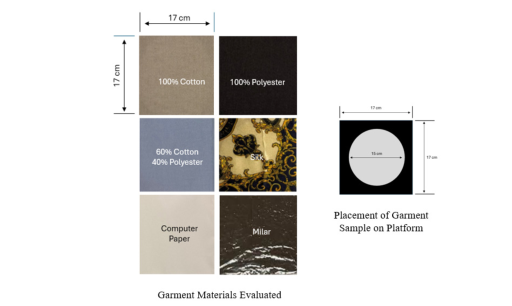
METHODS AND MATERIALS Twenty-two garment samples were evaluated, including cotton, polyester, cotton–polyester blend, and silk. Paper and Mylar samples were also evaluated for comparative purposes. The sample types included in this study are illustrated in Figure 1. Each sample measured 17cm × 17cm in size and each sample was exposed to a constant infrared (IR) radiation intensity level for a duration of 5 min. Each test was performed three times and the values averaged.
Figure 1: Illustration of garment samples evaluated in this study with placement of samples onto an exposure disc of 177cm2. Each sample was 17cm x 17cm in size.
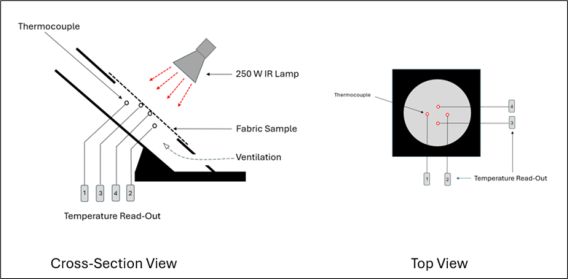
Infrared radiation was generated using a 250 W infrared lamp positioned 22 cm above and perpendicular to the test platform. The design of the experimental test platform is illustrated in Figure 2. Temperature measurements were obtained using four thermocouple sensors positioned beneath the test platform. Two thermocouples were placed in direct contact with the underside of each sample to quantify temperature changes resulting from IR heat absorption and subsequent heat accumulation within the material. The two additional thermocouples were positioned 1cm below the sample measuring the temperature changes associated with direct IR radiation penetration through the material. Heating of the thermocouples in contact with the fabric sample represents conductive heat transfer from the absorbed IR energy, whereas heating of the thermocouples positioned below the sample indicated the direct transmission of IR radiation through the material. These two mechanisms collectively contribute to the overall heat exchange associated with a garment material. The experimental set-up provided protection against interference from any other IR radiation sources in the laboratory.
Figure 2: Illustration of test platform used in the experiments including thermocouple sensor placement relative to the IR exposure disc.
40 Reischl and Mijovic Measurements were conducted for single-layer configurations only. Prior to each experiment, the test platform was exposed to direct IR radiation creating a “baseline” for the thermocouples by exposing all four thermocouples to the same IR radiation intensity. Laboratory air temperature was maintained at 22°C throughout all experiments establishing a constant ambient air temperature against which temperature changes induced by the IR radiation could be quantified. Net garment heat gain (%) was determined based by combining the IR penetration and IR absorption values.
RESULTS
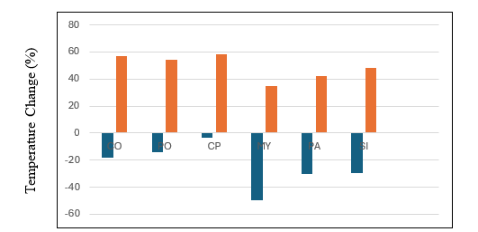
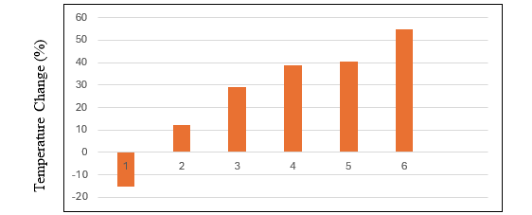
Table 1 summarizes the results obtained for the cotton, polyester, cotton/ polyester blend, silk, paper and mylar materials. The observed temperature changes associated with each sample indicate the IR radiation absorbed by the material and the IR penetration through a sample. Temperature decreases when the IR radiation is attenuated by a sample. The total heat burden imposed on the different materials is calculated by combining IR penetration with the heat gain due to IR absorption. The results are summarized in Table 2. Figure 3 illustrates graphically the reduction of heat radiation due to reduced IR penetration and heat gain due to IR absorption by a sample. Table 2 ranks the resulting net heat gain associated with the six materials tested.
Table 1: Summary of temperature changes associated with lower IR penetration values and increased garment temperatures due to IR absorption. Net heat gain values were obtained by combining IR penetration temperatures with IR absorption temperatures.
Table available in the original PDF paper.
Garment Material
IR Penetration Temperature Decrease (%)
IR Absorption Temperature Increase (%)
Net Garment Heat Gain (%) Cotton (CO) −18.3 57.0 +38.7
Paper (PA) −30.2 42.4 +12.2 Silk (SI) −29.4 48.4 +29.0
Table 2: Rank order of the six garment materials tested showing Mylar with a reduction in heat while the cotton/polyester blend contributed to the highest increase in net temperature.
Table available in the original PDF paper.
Rank Garment Material Net IR Heat Gain (%) 1 Mylar −15.1
2 Paper +12.2 3 Silk +29.0
4 100% Cotton +38.7 5 100% Polyester +40.3
6 Cotton/ Polyester +54.9
Figure 3: Graphic illustration of IR penetration temperature decreases (blue) with associated IR absorption increases (red) for cotton, polyester, cotton/polyester blend, mylar, paper and silk.Figure 4: Illustration of net IR temperature changes observed for mylar (1) paper (2), silk (3) cotton (4), polyester (5), and cotton/polyester blend (6).
DISCUSSION
The results of this study show that garment materials commonly assumed to provide thermal protection can substantially differ in their net impact on heat exposure when both IR transmission and IR absorption are considered. While cotton, polyester, silk, and blended fabrics attenuated a portion of incident IR radiation, this benefit was offset by heat accumulation within the garment material due to IR absorption. This resulted in net increases in the thermal burden. The cotton/polyester blend produced the greatest net heat gain, highlighting that blended fabrics may combine unfavorable radiative and absorptive properties rather than mitigating them. In contrast, Mylar exhibited a fundamentally different behavior, reflecting a large fraction of incident IR radiation while limiting internal heat absorption. This led to a net reduction in heat exposure. These findings align with previous work demonstrate the importance of reflective and spectrally selective materials in reducing radiative heat load. The experimental approach used addressed an important gap by providing a practical method to evaluate competing thermal mechanisms, underscoring that reduced IR transmission alone is an insufficient indicator of protective performance. For occupational settings with intense solar exposure, failure to account for IR absorption may lead to clothing choices that inadvertently exacerbate heat stress.
CONCLUSION
This study demonstrated that optimizing garment selection for heat stress reduction requires consideration of both IR radiation transmission and IR-induced heat absorption by the garment material. Controlled laboratory measurements showed that most conventional textile fabrics tested contributed to net heat gain under IR exposure, despite partially attenuating incoming radiation, whereas a reflective material such as Mylar achieved a measurable reduction in overall heat load. These findings emphasize that garments designed to reduce solar heat stress must consider reflective properties while minimizing internal heat accumulation. The experimental methodology presented offers a reproducible framework for assessing garment thermal performance under radiant heat exposure and can be applied to evaluate emerging textile technologies. Incorporating such evidence-based material selection into protective clothing design has the potential to reduce occupational heat stress and associated health risks for workers exposed to high solar radiation in outdoor environments.
A limitation of this study is that testing was conducted on single-layer fabric samples under controlled laboratory conditions, which does not fully represent the thermal behavior of multilayer clothing systems commonly worn in real-world settings. In practice, factors such as fabric layering, garment fit, air gaps, moisture from sweat, body movement, and convective airflow can substantially alter heat transfer dynamics. Additionally, environmental variables including wind speed, solar angle, and intermittent shading were not replicated in the experimental setup. As a result, the net thermal effects observed will likely differ from those experienced during actual wear.
REFERENCES
Bernard TE, Pourmoghani M. (1999) Prediction of workplace wet bulb global temperature. Appl Occup Environ Hyg. 14(2):126–34. doi: 10.1080/ 104732299303296. PMID: 10457639. Bernard TE. (1999) Heat stress and protective clothing: an emerging approach from
the United States. Ann Occup Hyg. 43(5):321–7. PMID: 10481631. Brotherhood JR. (2007). Heat stress and strain in exercise and sport. J Sci Med Sport.
2008 Jan;11(1):6-19. doi: 10.1016/j.jsams.2007.08.017. PMID: 17997136. Casa DJ, DeMartini JK, Bergeron MF, Csillan D, Eichner ER, Lopez RM, Ferrara MS, Miller KC, O’Connor F, Sawka MN, Yeargin SW. (2015) National Athletic Trainers’ Association Position Statement: Exertional Heat Illnesses. J Athl Train. doi: 10.4085/1062-6050-50.9.07. Casa, K. (2002). Human Thermal Environments: The Effects of Hot, Moderate, and
Cold Environments on Human Health, Comfort, and Performance, Third Edition (3rd ed.). CRC Press. https://doi.org/10.1201/b16750 Gavhed, D.C.E., Nielsen, R. & Holmer, I. (1999). Thermoregulatory and subjective responses of clothed men in the cold during continuous and intermittent exercise. Europ. J. Appl. Physiol. 63, pp. 29–35. https://doi.org/10.1007/ BF00760797 Gao C, Kuklane K, Holmer I. (2011). Cooling vests with phase change materials:
the effects of melting temperature on heat strain alleviation in an extremely hot environment. Eur J Appl Physiol. 111(6):1207–16. doi: 10.1007/s00421-010- 1748-4. Epub 2010 Dec 3. PMID: 21127896.
Optimizing Garment Material Selection to Reduce Solar Heat Radiation Exposure 43 Gao C, Kuklane K, Östergren PO, Kjellstrom T. (2018). Occupational heat stress
assessment and protective strategies in the context of climate change. Int J Biometeorol. 62(3):359–371. doi: 10.1007/s00484-017-1352-y. Epub 2017 Apr 25. PMID: 28444505; PMCID: PMC5854720. Havenith G. (1999) Heat balance when wearing protective clothing. Ann Occup Hyg. 43(5):289–96. PMID: 10481628. Holmer I. (1995) Protective clothing and heat stress. Ergonomics. 38(1):166–82. doi:
10.1080/00140139508925093. PMID: 7875118. Holmer I. (2006). Protective clothing in hot environments. Ind Health. 44(3):404–13.
doi: 10.2486/indhealth.44.404. PMID: 16922184. Kenny GP, Notley SR, Gagnon D. (2017). Direct calorimetry: a brief historical review of its use in the study of human metabolism and thermoregulation. Eur J Appl Physiol. 117(9):1765–1785. doi: 10.1007/s00421-017-3670-5. Epub 2017 Jul 8. PMID: 28689303. Mccullough, Elizabeth A. et al. (1985). A comprehensive data base for estimating
clothing insulation. Ashrae Transactions 91: 29–47. Reischl, U, Sun, G, Bahramian, Q, Xue, ZQ. (2013). Optimizing protective clothing design for hot outdoor environments. Advanced Engineering Forum. 10:89–92. Song G, Barker RL, Hamouda H, Kuznetsov AV, Chitrphiromsri P. (2004) Modelling
the thermal protective performance of heat-resistant garments in fire exposures. Text Res J. 74, 12 pp. 1033–1040; ISSN 0040-5175 Vecellio DJ, Cottle RM, Tony Wolf S, Larry Kenney W. (2023). Critical Environmental Limits for Human Thermoregulation in the Context of a Changing Climate. Exerc Sport Mov.10.1249/esm.0000000000000008. PMID: 38344340; PMCID: PMC10857870. Yihang Ji, Guodan Liu, Yao Zhang, Songtao Hu, Mingli Lu (2024). Effects of
the clothing colors on heat transfer and thermal sensation under indoor solar radiation in winter, Case Studies in Thermal Engineering, Volume 53, 103899, ISSN 2214-157X.
LISTED IN THE AHFE DIGITAL BOOKSTORE CATALOGUE
Explore the complete digital volume
Human Dynamics, Product Evaluation and Quality
Read this individual research paper free through the original publisher, or explore the full digital proceedings book.
ISBN 978-1-964867-88-5
Explore this ISBN in the AHFE Bookstore ↗Listed in the July 2026 bookstore catalogue; search by ISBN to confirm current availability · Digital book purchase optional