Susan Xu, Weihuan Zhao (2026). Design of Phase Change Material Integrated Firefighters’ Turnout Gear Considering Moisture Content Effects in Heat and Post-Heat Exposure. In: Human Dynamics, Product Evaluation and Quality. AHFE Open Access, vol. 212, pp. 28–36. https://doi.org/10.54941/ahfe1007810
Phase change materials (PCMs) have been widely used for thermal management due to their ability to absorb, store, and release heat during phase transitions (typically between solid and liquid states). This study explores the enhanced thermal protection of turnout gear with integrated PCMs in various moisture conditions. A unique 3D turnout-gear-equipped manikin thermal model was developed, and heat and moisture transfer simulations were conducted under both heat and post-heat exposure scenarios. The effects of moisture concentration (MC) levels (ranging from 0% to 100% water added) in turnout gear fabrics were simulated. Results showed that MC impacted thermal protection during heat exposure, with the shortest protection times occurring for PCM-integrated gear at MC levels between 30% and 60% compared to MC from 0% to 100%. However, MC had minimal impact on thermal performance during post-heat exposure. A 2-mm-thick PCM segment was found to be the optimal choice, balancing both thermal protection during heat exposure and efficient cooling during post-heat exposure.
Firefighters can be exposed to a wide range of thermal conditions. In a recent report from the National Fire Protection Association (NFPA), more than 10% of injuries incurred in fire fields were caused by thermal stress and burns (Campbell and Hall, 2024). Hence, new research is needed to explore novel materials that can better protect firefighters from burn injuries and thermal stress at a fire scene. Phase change material (PCM) can absorb large amounts of heat while maintaining a constant melting temperature. In this study, we use this phenomenon of PCM to significantly enhance the thermal protection of current commercial firefighters’ turnout gear. A 3D human thermal model equipped with turnout gear is vital for exploring the feasibility of integrating PCM into turnout gear and evaluating the resulting improvements in thermal
Design of Phase Change Material Integrated Firefighters’ Turnout Gear 29 protection. This is the first study to simulate, and numerically explore, the heat and moisture transport phenomenon in PCM-integrated turnout gear on a human body, under heat and post-heat exposure, by using a 3D human model equipped with turnout gear.
In addition to heat exposure, turnout gear can be easily wetted by external water hose spray as well as the wearer’s sweat. The effect of various moisture concentrations (MCs) on thermal behavior of PCM-integrated firefighter turnout gear is still unknown. Hence, this study explored the thermal transport phenomenon in the PCM-integrated turnout gear when there was moisture present in the fabrics. The optimum design of PCM segment thickness was determined by considering the thermal performance of turnout gear under both heat and post-heat exposures. This research aims to contribute to firefighter protection efforts as well as aid manufacturers who are developing and manufacturing advanced PCM-integrated firefighter turnout gear. The results from this study can be used to guide future experimental design and testing.
METHODS
A 3D human thermal body model was built by COMSOL Multiphysics (COMSOL, Inc., Burlington, MA 01803, USA). The coupled Heat Transfer in Porous Media and Transport of Diluted Species in Porous Media modules in COMSOL were used for the heat and moisture transfer simulations (Xu et al., 2025).
3D Turnout Gear-Equipped Human Thermal Model The human thermal model was built based on the 50 percentile anthropometric data of male firefighters’ bodies collected by NIOSH (Hsiao et al., 2014). The firefighters’ turnout gear model was built outside the human thermal body. The overall thickness of the clothing was 6 mm, which included the outer shell, moisture barrier, and thermal barrier), measured based on commercial firefighters’ protective clothing (GLOBE GX-7 44 × 32 Firefighter Turnout Bunker Gear COAT JACKET RESCUE TOW).
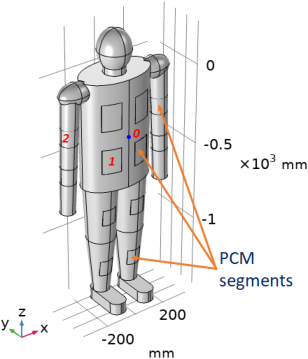
The 3D heat and moisture transfer simulations (Xu et al., 2025) were performed to investigate the thermal and moisture transport behaviors in PCM-integrated turnout gear during heat and post-heat exposures. The hazardous condition of an external heat flux of 8.3 kW/m2 (Coletta et al., 1976) was applied at the outer surface of turnout gear in heat exposure. Natural convection from the surrounding environment (air temperature at 25°C, standard ambient temperature) was used as the boundary condition at the outer surface in post-heat exposure to mimic firefighters leaving the fire scene (Xu et al., 2025). Figure 1 shows the 3D human thermal model equipped with turnout gear. A bio-based PCM from PureTemp LLC, with a 60°C melting point (PureTemp LLC), was applied in turnout gear. To maintain firefighter movements and activities in fire scenes, PCM segments were used in the clothing instead of a whole layer of PCM. The PCM segments covered the important body thermal zones (ASTM F1291 – 16). The sizes of PCM segments were in the range of 4”-6.5”, depending on the locations they covered (Xu et al., 2024). We investigated the temperature control performance of
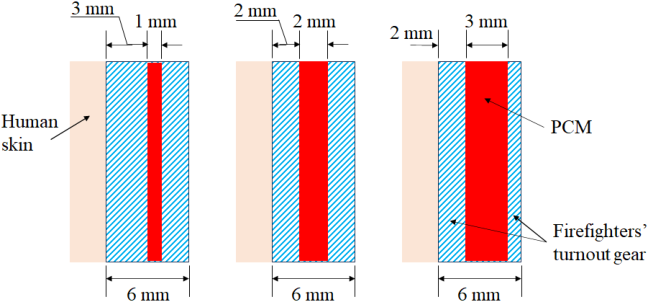
30 Xu and Zhao turnout gear for the human trunk (e.g., abdomen) and limbs (e.g., arms), including the skin areas covered by PCM segments and those with no PCM covering. Three different thicknesses of PCM segments were studied under post-heat exposure, i.e., 1-mm, 2-mm, and 3-mm thick PCM (Figure 2). In addition, the effects of moisture concentrations (MCs) in the turnout gear were explored. The MC was determined by Equation (1) (Xu et al., 2025):
( ) [Equation or mathematical symbol available in the original paper PDF][Equation or mathematical symbol available in the original paper PDF] = − × [Equation or mathematical symbol available in the original paper PDF][Equation or mathematical symbol available in the original paper PDF] / 100% wet dry dry MC M M M (1) where wet M is the total mass of wet turnout gear; dry M is the total mass of dry firefighters’ turnout gear. The MC is the weight percentage of water added to the turnout gear fabrics (Xu et al., 2025).
Various MCs in firefighters’ turnout gear (0-100 wt% of water added in clothing fabrics) were investigated to evaluate their effects on the thermal performance.
Figure 1: The 3D turnout gear-equipped human thermal model with PCM segments embedded in clothing (Numbers 0, 1 and 2 are the locations of probes to detect temperatures on the skin surface at those places).Figure 2: Thickness distribution of PCM segments in firefighters’ turnout gear (showing 1-mm, 2-mm, and 3-mm thickness PCM segments).
Design of Phase Change Material Integrated Firefighters’ Turnout Gear 31 The material properties of PCM, human skin, and firefighters’ turnout gear as well as the properties of water moisture are listed in Table 1, which were used for numerical simulations.
Table 1: Thermophysical properties of human skin, firefighters’ turnout gear, PCM, and water moisture (ASTM F1930 – 18; Harris et al., 1982; Incropera and DeWitt, 2002; PureTemp LLC; Ventura and Martelli, 2009; Xu et al., 2022; Xu et al., 2024).
Water moisture 997.0 0.61 4.18 2442 (vaporization)
Mesh for Modelling and Numerical Solution Reading Points The finite element method was adopted for the numerical simulations. Free tetrahedral elements were used to establish the mesh structure for the 3D model (Xu et al., 2024). The finer element size in COMSOL was chosen based on mesh independent study (Xu et al., 2024). Three (3) representative probes were built on the skin surface of the human model to record the skin surface temperature data during the heat and post-heat exposures, as shown in Figure 1. Probe 0 was at the location where there was no PCM segment directly covering (protecting). It was used as the baseline for the comparison study. Probes 1 and 2 were at the locations directly protected by PCM segments. Probe 1 was located at the abdomen (human trunk area). Probe 2 was located at the arm (human limbs area).
HEAT AND MOISTURE TRANSFER ANALYSIS RESULTS
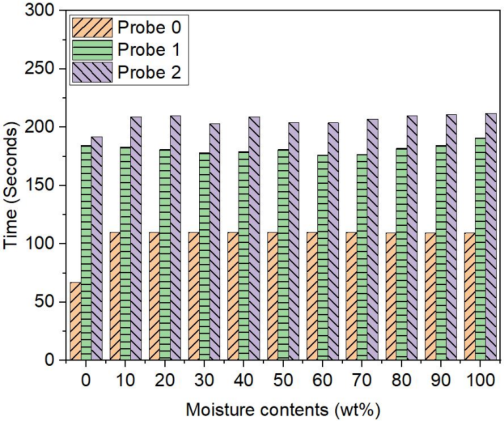
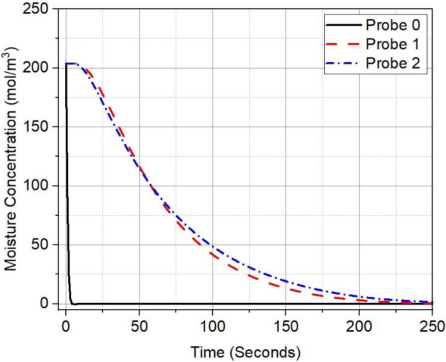
Figure 3 displays the times for the skin surface to reach second degree burn injury (~60°C (Coletta et al., 1976)) under hazardous condition (heat flux of 8.3 kW/m2 (Coletta et al., 1976)). The thermal protection times for the PCM-covered skin areas (e.g., Probes 1 and 2) were the shortest when the MCs were in the range of 30-60 wt% in wetted turnout gear. Figure 4 shows moisture concentrations on skin surface during the heat exposure under hazardous condition.
In addition, the effect of MC and PCM thickness on the thermal dissipation of skin surface during post-heat exposure was investigated. Figures 5 and 6 display the skin temperature changes under different initial MCs and thicknesses of PCM segments under post-heat exposure, respectively.
DISCUSSION
The 3.0-mm PCM segments could significantly extend the thermal protection time on skin (Figure 3). The skin areas protected by PCM segments could double the protection time. The moisture contents would also affect the thermal performance in turnout gear. The MC increases the overall thermal conductivity (k) and heat capacity (c) of fabrics (see Table 1 material properties). Thus, the thermal protective performance of wet gear was the combined results from the increased k and c. The increased heat capacity value of wet gear played a major role in the area not covered by PCM segment. Hence, the thermal protection time at the uncovered area in turnout gear (Probe 0) extended when adding MC and MCs had a minor effect in wet gear. Both increased k and c affected the thermal protective performance at the areas covered by PCM segments (Probes 1 and 2) in turnout gear. The increased k value could increase the heat transfer rate (reduce the protection time), while the increased c value could decrease the heat transfer rate (extend the protection time) in turnout gear. Thus, the thermal protection times of the PCM-covered areas varied with MCs. They were the shortest when the MC was in the range of 30-60wt%. It is likely that the increased k dominated the heat transfer in this MC range. The protection time increased when the MC was beyond this range potentially due to the increased c.
For the area with no PCM coverage (Probe 0), the moisture transported (MC dropped) rapidly through the porous medium of the turnout gear, as shown in Figure 4. For the PCM-covered areas in turnout gear (Probes 1 and 2), the moisture transfer rate was slower potentially due to being blocked by the PCM segments (Figure 4). This moisture could still be dissipated t (shown in Figure 4) through the areas not covered by PCM segments.
Figure 3: Times for skin surface to reach 60°C (second degree burn temperature) at various moisture concentrations under hazardous condition (external heat flux at 8.3 kW/m2 (Coletta et al., 1976)). Note: Probe 0 detects the area not covered by PCM; Probes 1 and 2 detect the areas covered by PCM segments at human trunk and limb, respectively (see Figure 1). The 3-mm thick PCM segments were applied.Figure 4: Moisture concentration on skin surface during heat exposure (hazardous condition: external heat flux at 8.3 kW/m2 (Campbell and Hall, 2024)). The 3-mm thick PCM segments were applied with 100 wt% initial MC in turnout gear.
Moisture could help reduce the skin temperature rise in the area not covered by PCM (Probe 0) due to the efficient water evaporation during post-heat exposure (Figure 5(a)). The effect of different MCs in the area covered by PCM segment (Probe 1) was minor under post-heat exposure (Figure 5(b)), potentially because the PCM segment was able to block the efficient moisture transport (Figure 4) and therefore led to inefficient water evaporation. The PCM segments reduced the cooling rate in turnout gear during post-heat exposure because they needed to release large amount of latent heat of fusion for solidification process. Hence, the skin area with no PCM coverage (Probe 0) cooled down faster, compared to that covered by PCM (Probe 1), as shown in Figures 6(a) and (b). The cooling rate at Probe 0 was not affected by the thickness of PCM, while that at Probe 1 changed with respect to the thicknesses of PCM segment. The thinner PCM segment resulted in a faster cooling rate on skin surface than the thicker PCM in post-heat exposure (Figure 6(b)), although the thicker PCM segment could provide better thermal protection under heat exposure (Xu et al., 2024). Therefore, the PCM thickness selection was based on the combined consideration between heat and post-heat exposures. The previous study by our team found that the 2-mm and 3-mm thick PCM segments showed good thermal protection performance in heat exposure (Xu et al., 2024). The 2-mm thick PCM also showed an efficient cooling rate (skin surface temperature did not exceed 50°C) in post-heat exposure in this study.
Figure 5: Skin temperatures at various MCs under post-heat exposure. (a) Temperatu be 0 (area with no PCM coverage); (b) Temperatures at Probe 1 (PCM covered area); (The 3-mm thick PCM segments were embedded in turnout gear. (a) (b)
Figure available in the original PDF paper.
Figure 6: Skin temperatures for various thick PCM segments under post-heat exposure. (a) Temperatures at Probe 0 (area with no PCM coverage); (b) Temperatures at Probe 1 (PCM covered area). The case of 100 wt% initial MC was applied in turnout gear.
Figure available in the original PDF paper.
LIMITATIONS The 3D numerical model used regular geometries, such as cylinders, cones, and ellipsoids, to build a human body (Figure 1). It was not a exact human body configuration due to the limitation of geometry building in COMSOL Multiphysics. This might affect the simulation results, but the influence is expected to be minor and not impact the trends identified. The cylinders, cones, and ellipsoid geometries used to build the human body were very close to the configurations of real human body parts. The sizes and ratio of the cylinders and ellipsoids were based on the anthropometric data from real firefighter’s calf, thigh, waist, chest, arm, shoulder and neck (Hsiao et al., 2014). Therefore, the model configuration was comparable to a real firefighter to achieve accurate simulations. In addition, although one piece of clothing with the average properties’ values of fabrics was applied instead of separate layers of turnout gear, the simulation results may still well represent
Design of Phase Change Material Integrated Firefighters’ Turnout Gear 35 the overall heat and moisture transfer behaviors in turnout gear. However, the limited environmental condition, PCM thicknesses and conditions, and turnout gear designs studied limit the generalizability of the findings. In the future, a more accurate model with separate layers will be studied to explore more detailed transport phenomena inside turnout gear.
CONCLUSION
The 2-mm thick PCM segment in turnout gear seems to provide a good balance between thermal protection and decent heat dissipation rate when considering heat and post-heat exposures, respectively. Moisture concentration affects the thermal protection time during heat exposure but has only a minor effect during post-heat exposure in PCM-integrated turnout gear.
ACKNOWLEDGMENT
The authors would like to thank the CDC NIOSH Nanotechnology Research Center (NTRC) for its financial support of this research. The authors also thank Jay Tarley and Jeff Powell for their thoughtful review of this manuscript.
DISCLAIMER The findings and conclusions in this report are those of the authors and do not necessarily represent the official position of the National Institute for Occupational Safety and Health, Centers for Disease Control and Prevention. Mention of any company or product does not constitute endorsement by the National Institute for Occupational Safety and Health, Centers for Disease Control and Prevention.
REFERENCES
ASTM F1291 – 16 (2016). Standard Test Method for Measuring the Thermal Insulation of Clothing Using a Heated Manikin. ASTM F1930 – 18 (2018). Standard Test Method for Evaluation of Flame-Resistant
Clothing for Protection Against Fire Simulations Using an Instrumented Manikin. Campbell, R. and Hall, S. (2024). United States Firefighter Injuries, NFPA Research.
November 30, 2024, https://www.nfpa.org/education-and-research/research/ nfpa-research/fire-statistical-reports/firefighter-injuries-in-the-united-states. Coletta, G.C., Arons, I.J., Ashley, L.E., Drennan, A.P. (1976). The Development of Criteria for Firefighters’ Gloves Volume II: Glove Criteria and Test Methods. National Institute for Occupational Safety and Health (NIOSH) Publication, No. 77-134-B. GLOBE GX-7 44 × 32 Firefighter Turnout Bunker Gear COAT JACKET RESCUE
TOW: https://www.ebay.com/itm/144844892175, September 30, 2025. Harris, J.P., Yates, B., Batchelor, J., Garrington, P.J. (1982). The thermal conductivity of Kevlar fibre-reinforced composites. Journal of Materials Science 17:2925-2931. Hsiao, H., Whitestone, J., Kau, T.-Y., Whisler, R., Routley, J.G., and Wilbur, M. (2014).
Sizing Firefighters: Method and Implications. Hum Factors 56(5):873–910. Incropera, F.P., DeWitt, D.P. (2002). Fundamentals of Heat and Mass Transfer. 5th edition. John Wiley & Sons.
from: https://puretemp.com/, September 30, 2025. Ventura, G., Martelli, V. (2009). Thermal conductivity of Kevlar 49 between 7 and 290 K. Cryogenics 49:735–737. Xu, S.S., Pollard, J., Zhao, W. (2022). Modelling and analysing for thermal protection
of firefighters’ glove by phase change material. Journal of Environmental and Occupational Health 12(2):118–127. Xu, S.S., Pollard, J., Zhao, W. (2024). 3D Numerical simulation for thermal protection of phase change material-integrated firefighters’ turnout gear. AHFE International, Human Dynamics and Product Evaluation and Quality 131:1–9. Xu, S.S., Pollard, J. and Zhao, W. (2025). Three-dimensional heat and moisture
transfer analysis for thermal protection of firefighters’ gloves with phase change materials. International Journal of Occupational Safety and Ergonomics (JOSE) 31(1):214–230.
LISTED IN THE AHFE DIGITAL BOOKSTORE CATALOGUE
Explore the complete digital volume
Human Dynamics, Product Evaluation and Quality
Read this individual research paper free through the original publisher, or explore the full digital proceedings book.
ISBN 978-1-964867-88-5
Explore this ISBN in the AHFE Bookstore ↗Listed in the July 2026 bookstore catalogue; search by ISBN to confirm current availability · Digital book purchase optional