Susan Xu, Jonisha Pollard, Weihuan Zhao (2024). Optimization of the Size and Distribution of Phase Change Material (PCM) in Firefighters’ Turnout Gear. In: Human Factors in Design, Engineering, and Computing. AHFE Open Access, vol. 159, pp. 2239–2246. https://doi.org/10.54941/ahfe1005792
In 2022, approximately 65,650 firefighter injuries were recorded on duty, marking an 8% rise from the 2021 tally of 60,750 injuries [1]. The majority of these injuries took place during fireground operations, with burns and thermal stress accounting for about 15% of such incidents [1]. Given this problem,a pressing need exists to advance turnout gear technology for better thermal protection for firefighters. Our proposal involves integrating phase change material (PCM) into firefighters' turnout gear to enhance its protective capabilities through utilizing the large amounts of latent heat of fusion. Our study involves numerical simulations, serving as a guide for future experimental designs and testing protocols to streamline efforts and time investment. Notably, existing numerical investigations on fire protective clothing predominantly employ one-dimensional (1D) models [2], lacking a comprehensive three-dimensional (3D) turnout gear-equipped human thermal model to assess the overall thermal performance of turnout gear on the body. Therefore, our study represents a pioneering effort, being the first 3D numerical analysis aimed at determining the optimal dimensions of PCM and strategically placing PCM segments within the turnout gear to maximize thermal protection coverage while minimizing the PCM quantity required. MethodsWe conducted 3D heat transfer simulations using COMSOL Multiphysics (COMSOL, Inc., Burlington, MA 01803, USA). To accommodate firefighters' movements and activities in fire scenes, PCM was divided into multiple segments covering the main body while avoiding joints to maintain firefighter body movement and activities. The bioheat transfer module in COMSOL was utilized to model the human body's thermal regulation. The equivalent heat capacity method was employed to simulate the phase change process. Adhering to the guidelines of the National Fire Protection Association (NFPA 1971), Standard on Protective Ensembles for Structural Fire Fighting and Proximity Fire Fighting [3], heat fluxes of 83 kW/m2 and 8.3 kW/m2 were applied to the outer surface of turnout gear to replicate flashover and hazardous conditions, respectively [4]. These heat fluxes represented the radiant/convective heat sources in fire scenarios. Utilizing 3.0-mm-thick PCM segments with a melting temperature of 60°C, as established in prior research by our team [5], we investigated three different sizes of PCM segments and their corresponding distributions within the turnout gear. These sizes included small (1"-2") segments ranging from 4 to 12 pieces, medium (2"-4") segments with 2 to 6 pieces, and large (4"-6") segments with 1 to 2 pieces distributed in each thermal zone of the human body. Using a larger number of small PCM segments can maintain the same latent heat capacity as the large PCM segments but have more efficient heat absorption.ResultsThe size of PCM segments did not significantly affect the thermal protection time as long as there were enough PCM segments to cover the area. These segments proved effective in reducing temperature increases in areas not directly shielded by PCM segments during periods of intense heat.ConclusionThis computational study has demonstrated that the segment size of PCM has minimal impact on the overall thermal protection efficacy of PCM-integrated firefighters’ turnout gear, provided there is sufficient coverage of PCM pieces within the gear. However, smaller PCM segments are recommended for enhanced flexibility and comfort in firefighters’ turnout gear. The findings from 3D modeling can serve as a foundation for the advancement of next-generation firefighter turnout gear.DisclaimerThe findings and conclusions in this report are those of the authors and do not necessarily represent the official position of the National Institute for Occupational Safety and Health (NIOSH), Centers for Disease Control and Prevention (CDC). Mention of any company or product does not constitute endorsement by the NIOSH, CDC
Currently, 33% of all reported firefighter injuries in the U.S. (i.e., more than 20,000 injuries) occurred on the fireground (Campbell and Hall, 2022). Thermal stress and thermal burn account for more than 10% of total fireground injuries (Campbell and Hall, 2022). Thermal injuries can significantly affect firefighters’ health and performance in rescue tasks. The resulting skin damage can also increase the risk for infection and other side effects, resulting in the burden of medical costs and affecting the daily life of firefighters. Firefighters wear turnout gear as personal protective equipment (PPE) to reduce the thermal risk of injuries. The current
turnout gear must satisfy the minimum requirement of a thermal protective performance (TPP) rating of 35.0, equating to 17.5 seconds until second- degree burns occur in a flashover situation (NFPA 1971). However, exposure to a high-temperature environment can be much longer than several seconds. Therefore, phase change material (PCM) was proposed to be integrated into firefighters’ turnout gear to enhance thermal protection performance. PCM absorbs large amounts of latent heat while maintaining a constant temperature during melting, which can help significantly extend the thermal protection time of turnout gear for the human body under extreme heat conditions.
In previous studies, the performance of PCM in firefighter protective clothing has been studied under various high-heat conditions. Researchers have developed one-dimensional (1D) numerical models to investigate the thermal protection enhancement of PCM-integrated structural firefighter protective clothing (Fonseca et al., 2018; Fonseca et al., 2021; Hu et al., 2013; McCarthy and di Marzo 2012; Zhang et al., 2021). These studies examined how PCM thermophysical properties—e.g., mass, melting point, and latent heat of fusion, as well as their position within the clothing—affect thermal protection performance. They simulated heat transfer from low-heat intensity (5 kW/m2) to flashover conditions (84 kW/m2). The findings indicate that PCM can significantly improve the thermal protection performance of firefighter turnout gear. However, 1D models fail to represent the full-body turnout gear worn by firefighters accurately due to the complicated geometry of the human body. The size and configuration of PCM segments throughout the entire gear significantly influences its overall thermal performance.
This work proposed a three-dimensional (3D) numerical model to optimize the size and distribution of PCM segments within turnout gear to improve its thermal protection capabilities for firefighters. The study hypothesized that smaller PCM segments, when distributed in greater quantities across the gear, will achieve more efficient heat absorption. This configuration is expected to enhance the protective performance of the gear, thereby providing better protection against thermal burn injuries for the entire human body.
METHODS
A 3D human thermal body model was built in COMSOL Multiphysics (COMSOL, Inc., Burlington, MA 01803, USA). The Bioheat Transfer module in COMSOL was used for the heat transfer simulations.
3D Turnout Gear-Equipped Human Thermal Model The model’s human body was built based on the anthropometric data of firefighters’ bodies and limbs collected by NIOSH, including the sizes of calf, thigh, waist, chest, arms, and shoulders (Xu et al., 2024). Firefighters’ turnout gear was built outside the human body. The overall thickness of the clothing was 6 mm (including the outer shell, moisture barrier, and thermal barrier), measured based on commercial firefighters’ protective clothing (Globe GX- 7 Firefighter JACKET Coat Size 36/32 Turnout Gear). Bio-based PCM was used and embedded in the clothing material for thermal protection due to its nontoxic and thermally and chemically stable nature.
Optimization of the Size and Distribution of Phase Change Material (PCM) 2241
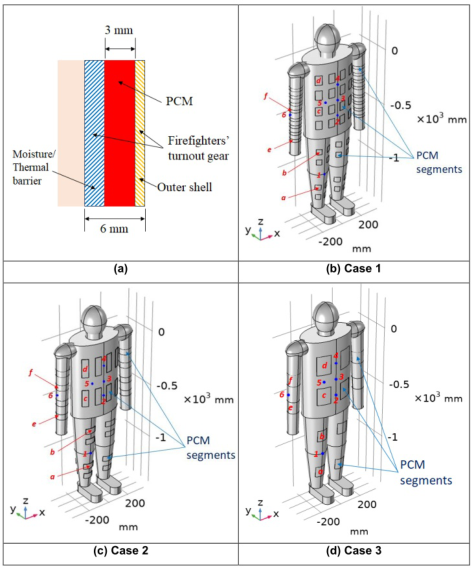
The PCM was broken into several segments to cover the important body parts (e.g., body thermal zones – calf, thigh, abdomen, chest, back, arms (ASTM F1291 – 16)) but to avoid blocking joints in order to maintain firefighters’ activities. Based on the previous study, we found that 3-mm-thick PCM segments could achieve good thermal protection while not affecting firefighters’ movements (Xu et al., 2024). Hence, the 3-mm-thick PCM segments were applied to this study. They were located between the outer shell and the moisture/thermal barrier, as shown in Figure 1(a). The PCM could replace part of the thermal barrier, which did not increase the overall thickness of the turnout gear (i.e., 6 mm). Figures 1(b)-(d) display three cases of PCM segments’ distributions throughout the entire turnout gear, including small-, medium-, and large-size PCM segments’ distributions. The total amount of PCM in firefighters’ turnout gear was the same for each case to maintain the total energy storage capacity. Thus, more pieces were required for smaller-size segments to cover the body, while fewer pieces were required for larger-size segments. Small (1”-3”) segments ranged from 4 to 8 pieces, medium (2”-6”) segments ranged from 2 to 4 pieces, and large (4”-6”) segments ranged from 1 to 2 pieces in each thermal zone of the human body studied (Figure 1).
Figure 1: (a) 3-mm-thick PCM segments in firefighters’ turnout gear; (b) Case 1: Small- size PCM segments; (c) Case 2: Medium-size PCM segments, and (d) Case 3: Large- size PCM segments distribution in turnout gear (the front side of the human). Probe locations are labelled where a-f indicate the locations of probes on the skin in areas directly protected by PCM segments and 1–6 indicate locations of probes on the skin in areas without PCM coverage.
Three-dimensional heat transfer simulations were conducted for the firefighters’ turnout gear-equipped human body using COMSOL Multiphysics. The transient conduction heat transfer was applied to simulate the turnout gear and PCM segments. A bioheat source term was added to the conduction heat transfer for the human body to account for the effect of blood circulation on body heat transfer (Su et al., 2020; Xu et al., 2022).
The equivalent heat capacity method was used to simulate the phase changing process of PCM segments (Xu et al., 2022; Xu et al., 2024). This method integrated the latent heat of fusion into the overall heat capacity of PCM (Xu et al., 2022; Xu et al., 2024).
The thermophysical properties of human skin, firefighters’ turnout gear, and PCM were input into the model for numerical simulations. The material properties included thermal conductivity, density, specific heat, and latent heat of fusion (only for PCM), with these values listed in Table 1.
Table 1. Thermophysical properties of human skin, firefighters’ turnout gear, and PCM (ASTM F1930 – 18; Harris et al., 1982; Incropera and DeWitt, 2002; PureTemp LLC; Ventura and Martelli, 2009; Xu et al., 2022; Xu et al., 2024).
The surface of firefighters’ turnout gear was exposed to radiant/convective heat sources, mimicking the fire scenes. The heat fluxes of 83 kW/m2 and 8.3 kW/m2 were applied at the outer surface of the turnout gear in the simulation model as the external heat sources, representing the flashover and hazardous conditions in the fire scene, respectively (Coletta et al., 1976).
The initial temperature of firefighters’ turnout gear was assumed to be 25
C (typical room temperature). The initial human body temperature was maintained at 37
C (the normal human core temperature) (Xu et al., 2022; Xu et al., 2024).
Mesh for Modelling and Numerical Solution Reading Points The finite element method was adopted for the numerical simulations. Free tetrahedral elements were used to establish the mesh structure for the 3D model (Xu et al., 2024). The Quadratic Lagrange discretization method was applied to enhance the accuracy of the solutions (Xu et al., 2024). The numerical stability analysis indicated that the finer mesh size in COMSOL was sufficient for the human thermal model. Twelve (12) representative probes were built on each case (human model) to record the skin surface temperature data during the heat exposures, as shown in Figures 1(b)-(d). Probes 1–6 are at the locations where there are no PCM segments directly covering the skin surface. These probes were fixed at the exact locations on
Optimization of the Size and Distribution of Phase Change Material (PCM) 2243
the skin surface for different cases. Probes a-f are at the locations directly protected by PCM segments. The probes were located on the skin surface beneath the PCM segments, which varied in different cases, as shown in Figures 1(b)-(d).
HEAT TRANSFER ANALYSIS RESULTS
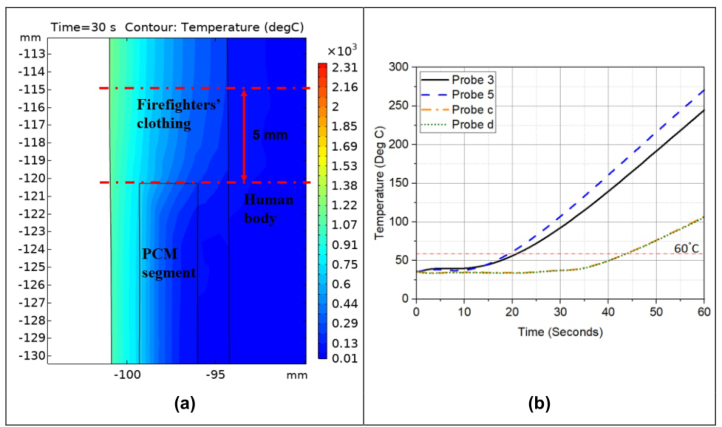
Figure 2 displays temperature profiles in firefighters’ turnout gear and on human body skin surface under flashover condition (heat flux of 83 kW/m2). It shows the case for medium-size PCM segments. Figure 2(a) is the temperature contour in the turnout gear under the high-heat exposure. The PCM segment could alter the temperature profiles in the clothing and, therefore, reduce the temperature rise on the human skin surface. Figure 2(b) shows the skin surface temperatures at various locations of Probe 3, 5, c, and d (refer to Figure 1(c) for the Probe locations). Probes 3 and 5 are located at the skin surface areas that were not directly covered by PCM segments, while Probes c and d are in the areas that were directly beneath the PCM segments. Hence, the skin surface temperatures at Probes c and d were better controlled under the high-heat exposure compared to the areas with no direct PCM covering (Probes 3 and 5).
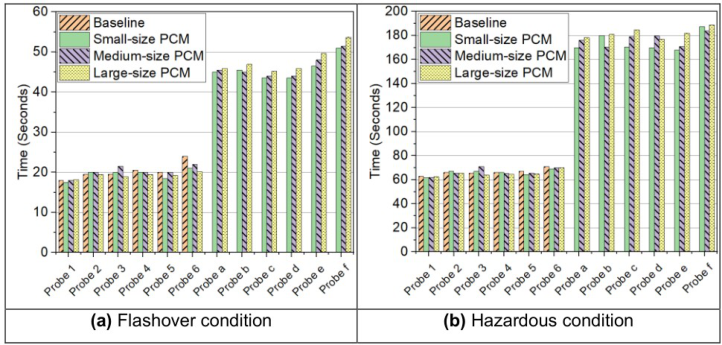
Figure 3 shows the times for skin surfaces at various locations on the human body to reach second-degree burn temperature (around 60
C (Coletta et al., 1976)) under flashover and hazardous conditions.
Figure 2: Temperatures in firefighters’ turnout gear and on human body skin surface for the medium-size PCM segment case under flashover condition. (a) Temperature contours in the PCM-integrated firefighters’ turnout gear after 30 seconds of heat exposure (the area between the two dash-dot lines shows the affected temperature pattern in clothing by PCM segment; (b) Human body skin surface temperatures at the locations of Probes 3, 5, c, and d.Figure 3: Time for the human body skin surface to reach second-degree burn temperature (60
C) under (a) flashover and (b) hazardous conditions. (Baseline indicates turnout gear without PCM segments; Small-size PCM is for Case 1, Medium- size PCM is for Case 2, and Large-size PCM is for Case 3 (referring to Figure 1(b)-(d))).
DISCUSSION
This study investigated how the PCM segment size and distribution in firefighters’ turnout gear affected the overall thermal protection capability. The PCM segment could affect the temperature gradient in firefighters’ clothing when exposed to high heat flux, as shown in Figure 2(a). Hence, the rise in temperature on the skin surface beneath the PCM segment was remarkably mitigated. It was noticed that the influenced area was limited to the PCM segment. The affected region was within 5-mm distance from the edge of the PCM segment. The temperature gradient in areas more than 5 mm away from the PCM segment (e.g., medium-size segment) was not affected (Figure 2(a)). Therefore, the times to reach second-degree burn injury (60
C) for the areas not directly covered by PCM (Probes 1-6) were similar to the baseline case (no PCM segments integrated into turnout gear), as shown in Figure 3. The thermal protection times for the areas directly protected by PCM segments (Probes a-f) could be extended significantly by more than one time compared to Probes 1–6 under both flashover and hazardous conditions (Figure 3). The size of PCM segments did not significantly affect the thermal protection time as long as there were enough PCM segments to cover the area. When considering clothing flexibility, small-size PCM segments can keep the flexibility in turnout gear in order not to compromise the performance and comfort of firefighters when they conduct rescue tasks on a fire scene. The large-size PCM segment, on the other hand, has less flexibility, which could affect the performance of firefighters.
Limitations The human body was simplified by various geometries, such as cylinders, cone shapes, ellipsoids, etc. (Figure 1), instead of using the actual human body curvatures in the simulation model. Nevertheless, the dimensions of
Optimization of the Size and Distribution of Phase Change Material (PCM) 2245
the geometries were based on the anthropometric data of firefighters. In addition, the primary aim of this study was to compare the thermal protection capabilities of PCM-integrated firefighters’ turnout gear with various PCM segment sizes and distributions. The simplified model geometry did not detract from the validity of the overall trends observed in the results for the human body and limbs. Experimental studies will be conducted to validate the numerical model and demonstrate the thermal protection performance of PCM-integrated firefighters’ turnout gear.
CONCLUSION
This computational study has demonstrated that the segment size of PCM has minimal impact on the overall thermal protection efficacy of PCM-integrated firefighters’ turnout gear, provided there is sufficient coverage of PCM pieces within the gear. However, smaller PCM segments are recommended for enhanced flexibility and comfort in firefighters’ turnout gear. To ensure comprehensive thermal protection, especially in critical areas of the human body like the chest, abdomen, waist, and back, it is advisable to maintain a gap of no more than 5 mm between PCM segments.
ACKNOWLEDGMENT
The authors would like to thank the CDC NIOSH Nanotechnology Research Center (NTRC) for its financial support of this research. The authors also thank Jay Tarley, Jeff Powell, and John Wu for their thoughtful review of this manuscript.
DISCLAIMER The findings and conclusions in this report are those of the authors and do not necessarily represent the official position of the National Institute for Occupational Safety and Health, Centers for Disease Control and Prevention. Mention of any company or product does not constitute endorsement by the National Institute for Occupational Safety and Health, Centers for Disease Control and Prevention.
REFERENCES
ASTM F1291 – 16 (2016). Standard Test Method for Measuring the Thermal Insulation of Clothing Using a Heated Manikin. ASTM F1930 – 18 (2018). Standard Test Method for Evaluation of Flame-Resistant
Clothing for Protection Against Fire Simulations Using an Instrumented Manikin. Campbell, R., Hall, S. (December 2022). United States firefighter injuries in 2021, NFPA Res. Coletta, G. C., Arons, I. J., Ashley, L. E., Drennan, A. P. (1976). The Development
of Criteria for Firefighters’ Gloves Volume II: Glove Criteria and Test Methods. National Institute for Occupational Safety and Health (NIOSH) Publication, No. 77-134-B.
Fonseca, A., Mayor, T. S., Campos, J. B. L. M. (2018). Guidelines for the specification of a PCM layer in firefighting protective clothing ensembles. Applied Thermal Engineering 133: 81–96. Fonseca, A., Neves, S. F., Campos, J. B. L. M. (2021). Thermal performance of a PCM
firefighting suit considering transient periods of fire exposure, post-fire exposure and resting phases. Applied Thermal Engineering 182:115769. Globe GX-7 Firefighter JACKET Coat Size 36/32 Turnout Gear: https: //www.ebay.com/itm/166423306258?chn=ps&mkevt=1&mkcid=28&srsltid=Af mBOopxhitCL0f7u0B9VaHQKzReVDVAJpfLvufRo5XV4enm0_nAFzxH33I Harris, J. P., Yates, B., Batchelor, J., Garrington, P. J. (1982). The thermal conductivity of Kevlar fibre-reinforced composites. Journal of Materials Science 17: 2925–2931. Hu, Y., Huang, D., Qi, Z., He, S., Yang, H., Zhang, H. (2013). Modeling
thermal insulation of firefighting protective clothing embedded with phase change material. Heat Mass Transfer 49: 567–573. Incropera, F. P., DeWitt, D. P. (2002). Fundamentals of Heat and Mass Transfer. 5th edition. John Wiley & Sons. McCarthy, L. K. and di Marzo, M. (2012). The application of phase change material
in fire fighter protective clothing. Fire Technology 48: 841–864. NFPA 1971 (2018). Standard on Protective Ensembles for Structural Fire Fighting and Proximity Fire Fighting. PureTemp LLC: https://puretemp.com/ Su, Y., Li, R., Yang, J., Song, G., Li, J. (2020). Effect of compression on contact heat
transfer in thermal protective clothing under different moisture contents. Clothing and Textiles Research Journal 38: 19–31. Ventura, G., Martelli, V. (2009). Thermal conductivity of Kevlar 49 between 7 and 290 K. Cryogenics 49: 735–737. Xu, S. S., Pollard, J., Zhao, W. (2022). Modelling and analysing for thermal protection of firefighters’ glove by phase change material. Journal of Environmental and Occupational Health 12(2): 118–127. Xu, S. S., Pollard, J., Zhao, W. (2024). 3D Numerical simulation for thermal
protection of phase change material-integrated firefighters’ turnout gear. AHFE International, Human Dynamics and Product Evaluation and Quality 131: 1–9. Zhang, H., Liu, X., Song, G. & Yang, H. (2021). Effects of microencapsulated phase change materials on the thermal behavior of multilayer thermal protective clothing. The Journal of The Textile Institute 112(6): 1004–1013.
LISTED IN THE AHFE DIGITAL BOOKSTORE CATALOGUE
Explore the complete digital volume
Human Factors in Design, Engineering, and Computing
Read this individual research paper free through the original publisher, or explore the full digital proceedings book.
ISBN 978-1-964867-35-9
Explore this ISBN in the AHFE Bookstore ↗Listed in the July 2026 bookstore catalogue; search by ISBN to confirm current availability · Digital book purchase optional