Li Yuan (2026). Application and Development of Chinese Nationality Symbols in Smart Textile Design. In: Human Dynamics, Product Evaluation and Quality. AHFE Open Access, vol. 212, pp. 56–64. https://doi.org/10.54941/ahfe1007813
From a design perspective, this paper reviews literature and practical cases, categorizing the application of ethnic symbols in smart textile design into three types: static expression, dynamic interaction, and functional narrative. Through analysis of typical cases including digital inheritance of Yi embroidery and cultural wearables, the study reveals an evolving trend from formal borrowing to meaning construction. By comparing Western and Asian research paradigms, this paper proposes establishing a smart textile design framework based on cultural ontology, promoting the transformation of ethnic symbols from decorative elements to meaning carriers.The evolution of textiles is, in a sense, a history of the continuous redefinition of the relationship between humans and objects. In primitive societies, the weaving of plant fibers addressed the fundamental needs for shelter and warmth. The Industrial Revolution subsequently propelled textiles toward large-scale standardization through mechanized production. Since the 1990s, however, as breakthroughs were achieved in flexible electronics, nanomaterial science, and Internet of Things (IoT) communications, textiles have acquired an unprecedented capacity: the ability to sense, respond, and interact.Yet, as technical developers concentrate on functional realization and performance optimization, a fundamental design dilemma has begun to surface. This issue is rooted not in technology, but in value: as a form of intimate attire, smart textiles share a far more profound bond with the wearer than smartphones or smartwatches. When a fabric can sense body temperature, monitor heart rate, or respond to touch, it effectively permeates the boundaries of the body. Within such an intimate relationship, purely technical functionality is insufficient to satisfy the wearer's deep-seated needs for identity, cultural belonging, and emotional connection. Smart textiles must transcend their status as mere technological carriers to become mediators of cultural significance and emotional value.The integration of ethnic symbols serves as a strategic response to this demand. These symbols represent visual expression systems distilled through the historical evolution of specific cultural groups. Distributed across all facets of production and daily life, ethnic symbols serve as representative markers and perform various practical functions within minority societies. Consequently, the synthesis of these symbols constitutes a profound cultural phenomenon and a vital branch of minority culture; the preservation of these symbols is, in essence, the inheritance of the culture itself [1]. From the geometric patterns of Chinese Miao batik to Indian Lambani embroidery, and from the Japanese kimono crests (Kamon) to the color coding of African Kente cloth, these symbols carry historical memory, aesthetic preferences, and value systems, functioning as potent markers of identity. However, under the pressures of globalization, market demand, and fashion trends, these ethnic palettes have begun to simplify, gravitating toward a homogenized aesthetic [2]. In the pursuit of commercialization, certain design elements have been weakened or distorted, leading to a gradual erosion of cultural depth [3].The responsive properties of smart materials can serve as the "innovative element" required to reconstruct the meaning of traditional symbols. The alienation of the younger generation from traditional crafts, the conflict between manual production and industrial efficiency, and the tension between local culture and global consumption have created a structural predicament for the contemporary fate of ethnic symbols. How to activate these cultural resources within the context of technological innovation—granting them new modes of existence and pathways for dissemination—has become a contemporary imperative for the design discipline and serves as the logical starting point of this paper.By systematically reviewing existing research and practices, this paper aims to reveal the internal logic of merging ethnic symbols with smart textiles. It analyzes design strategies and the divergent effects of various application types, ultimately exploring the possibility of methodological construction within this interdisciplinary field.
INTRODUCTION: THE DUAL DEMANDS OF TECHNOLOGICAL ADVANCEMENT AND CULTURAL EXPRESSION Human Factors Engineering involves understanding the need for comprehensive The evolution of textiles represents, in a sense, a history of the continuous redefinition of the relationship between humans and material objects. While the plant-fiber weaving of primitive societies addressed the fundamental needs of protection and thermal comfort, the mechanized production ushered in by the Industrial Revolution propelled textiles toward large-scale standardization. More recently, following the breakthrough advancements in flexible electronics, nanomaterial science, and Internet of Things (IoT) communications since the 1990s, textiles have acquired an unprecedented suite of capabilities: perception, responsiveness, and interaction.
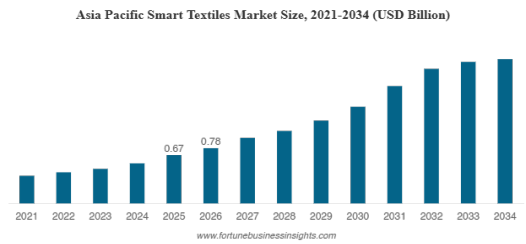
Figure 1: Market size of smart textiles in the Asia-Pacific region (2021–2034).
However, as technical development prioritizes functional realization and performance optimization, a fundamental design challenge has begun to surface. This issue is rooted not in technical constraints but in the realm of values: as “near-body” objects, smart textiles maintain a far more intimate relationship with the wearer than smartphones or smartwatches. By sensing body temperature, monitoring heart rate, and responding to touch, these textiles effectively permeate the boundaries of the body. Within this intimate dynamic, purely technical functionality is insufficient to satisfy the wearer’s deeper needs for identity, cultural belonging, and emotional connection. Consequently, smart textiles must transcend their role as mere technical conduits and evolve into media that encapsulate cultural significance and emotional value.
The integration of ethnic symbols emerges as a direct response to this necessity. Ethnic symbols, defined as visual semiotic systems crystallized through the long-term historical evolution of specific cultural groups, permeate every facet of communal production and daily life. These symbols serve as critical signifiers of identity and perform various pragmatic functions within their respective societies; collectively, they constitute a significant cultural phenomenon and represent a vital branch of ethnic heritage. Consequently, the preservation of these symbols is inherently a preservation of the culture itself (Xie and Xiao, 2017). From the geometric patterns of Chinese Miao batik to the intricate Lambani embroidery of India, and from the Japanese Kamon (family crests) to the chromatic coding of African Kente cloth, these motifs encapsulate historical memory, aesthetic preferences, and core values, functioning as potent identifiers.However, the accelerating forces of globalization and external cultural influx, compounded by the pressures of market demand and fashion trends, have led to a gradual simplification and homogenization of these ethnic expressions (Fu, 2025). In the pursuit of commercialization, certain design elements have been diluted or distorted, resulting in a progressive erosion of their underlying cultural depth (Qin and Xiao, 2024). Here, the responsive properties of smart materials can serve as the “innovative catalyst” required to reconstruct the meaning of traditional symbols. Amidst structural quandaries—such as the alienation of the younger generation from traditional craftsmanship, the friction between manual production and industrial efficiency, and the tension between local
58 Li culture and global consumption—the contemporary fate of ethnic symbols has become increasingly precarious. How to activate these cultural resources within the context of technological innovation, thereby facilitating new modes of existence and channels of dissemination, has become a critical mandate for the design discipline and serves as the logical point of departure for this research.
This paper aims to systematically synthesize existing literature and practice to reveal the intrinsic logic governing the fusion of ethnic symbols with smart textiles. By analyzing the design strategies and functional efficacy of different application modalities, the study further explores the potential for methodological construction within this interdisciplinary domain.
ECHNOLOGICAL CONTEXT AND THEORETICAL FRAMEWORK OF SMART TEXTILE DESIGN Technological Architecture and Functional Classification of Smart Textiles
Before delving into the specific applications of ethnic symbols, it is essential to delineate the technical framework of smart textiles. The intent of this overview is not to provide an exhaustive account of technical specifications, but rather to establish the necessary technical context for the subsequent design analysis.
The essence of smart textiles lies in the integration of functional materials— those possessing specific responsive properties—with traditional textile substrates. This integration imbues fabrics with advanced functionalities that transcend basic protection and thermal comfort. Currently, the most prevalent smart materials include: conductive fibers and coatings, which enable the intra-textile transmission of electrical signals via metallic filaments, carbon nanotubes, or conductive polymers; thermochromic and photochromic materials, which leverage reversible changes in molecular structure under thermal or light stimuli to achieve chromatic responsiveness; and shape memory alloys and polymers.
Table 1: Comparison of different types of smart materials.
Table available in the original PDF paper.
Classification Case Study Data Figure Conductive Fibers and Coatings Silver Nanowire (AgNW)/MXene Core-Sheath Composite Conductive Fibers Response time: 440 ms; maintains responsiveness under 100% large-scale deformation.
(Sun et al., 2024) (Continued)
Table 1: Continued.
Table available in the original PDF paper.
Classification Case Study Data Figure Thermochromic Materials Dual-responsive (temperature/ humidity) color- changing textiles
(Liu et al., 2024)
Green to magenta transition at 30–80 °C; purple to green transition across 0%–100% humidity.
Shape Memory Alloys (SMAs)
NiTi shape memory knitted firefighting suit
(Šalej Lah et al., 2019)
Austenitic transformation temperature of 75°C; formation of 12–25 mm protrusions upon heating to 100°C; two-way shape memory effect achieved after 15 training cycles.
A Design Perspective on Ethnic Symbols From a semiotic perspective, ethnic symbols constitute a synthesis of visual form and cultural significance, where the generation of meaning is deeply contingent upon specific cultural contexts. Regarding the definition of a “sign,” the renowned Harvard logician and mathematician Charles Sanders Peirce proposed that a sign is something which stands to somebody for something in some respect or capacity, creating in the mind of that person an equivalent or more developed sign—the interpretant—thereby establishing a triadic relationship between the sign vehicle, the object, and the interpretant (Maquet, 2016).
Peirce’s trichotomy—comprising icon, index, and symbol—provides a robust analytical framework for deciphering the semantic layers of ethnic patterns. Depending on the situational context, the emphasis of these patterns may shift among three dimensions: the pragmatic utility of the object, symbolic representation, and artistic expression (Zhang, 2019). Taking traditional Chinese cloud motifs (Yunwen) as an example, their curvilinear, flowing forms serve as an iconic simulation of natural atmospheric clouds; specific variations of these motifs may indexically point to particular social statuses or ritual occasions; and the overarching concept of “auspiciousness” (Jixiang Ruyi) embodied by the motif represents its symbolic meaning, established through long-standing social convention. This multi-layered semantic stratification accounts for the profound semiotic richness inherent in ethnic symbols.
60 Li Furthermore, the meaning of symbols is not static; rather, it is continuously reconstructed through historical evolution and cross-cultural dissemination. Consequently, the integration of ethnic symbols into smart textiles should not be viewed as a mere “copy-paste” of traditional patterns, but rather as a process of recontextualizing semiotic meaning within a new technological paradigm.
In design practice, ethnic symbols exist at a delicate equilibrium between authenticity and innovation. These symbols are essentially linear designs or structural frameworks shaped by specific cultural influences; should they lose their distinctive cultural characteristics, they become unrecognizable and indistinguishable from generic signs. On one hand, an overemphasis on authenticity may reduce design to a form of “archaeological restoration,” thereby severing its connection to contemporary life. On the other hand, the uncritical pursuit of innovation risks the dilution and distortion of cultural semantics. Therefore, when incorporating ethnic symbols into smart textile design, the primary task is to identify their “distinctive features”—the intrinsic logic that differentiates them from other signs—through rigorous cultural research. Ultimately, the application of ethnic symbols in smart textiles should be neither a unidirectional, technology-driven modification nor a passive, culture-centric preservation. Instead, it represents a bidirectional negotiation between technical affordances and cultural significance within the space of design practice.
APPLICATION MODALITIES AND REPRESENTATIVE CASE STUDIES OF ETHNIC SYMBOLS IN SMART TEXTILE DESIGN To a significant extent, the recurrence of high-frequency keywords in scholarly literature serves as an indicator of prevailing research focuses and priorities within a given period (Su et al., 2024). Building upon a systematic synthesis of domestic and international academic literature and practical projects, this paper categorizes the application of ethnic symbols in smart textile design into three primary modalities: static expression, dynamic interaction, and functional narrative. These three categories do not constitute a strictly diachronic evolutionary sequence; instead, they represent the synchronic coexistence of distinct technological trajectories and design strategies.
Static Modality: Digitally Enabled Pattern Reconstruction The static modality represents the nascent stage of applying ethnic symbols to smart textiles. Its core mechanism involves leveraging digital technologies to collect, analyze, and reconstruct traditional motifs, subsequently applying these generated patterns to the visual design of smart textiles. In this modality, an organic linkage between the functional properties of smart materials and the cultural semantics of ethnic symbols has yet to be established; symbols serve primarily as decorative visual elements applied to the textile surface. Nevertheless, research within this category has made significant contributions to establishing digital archives for ethnic patterns and exploring algorithm- driven generative design methodologies.
Application and Development of Chinese Nationality Symbols in Smart Textile Design 61 From a methodological perspective, the integration of shape grammar with Artificial Neural Networks (ANNs) exemplifies a prominent research trajectory. Hu Tao et al., focusing on the bronze drum motifs of Guizhou batik, employed shape grammar to extract fundamental morphological units and combinatorial rules (Hu et al., 2021). They utilized a three-layer ANN to construct a nonlinear mapping model between design parameters and visual cognitive imagery, further optimizing parameter combinations through genetic algorithms. The innovation of this approach lies in its incorporation of consumers’ affective cognitive needs into the algorithmic framework. However, its limitations are also evident: the quantitative evaluation of visual cognitive imagery relies heavily on Semantic Differential (SD) scales, offering scant discussion on the deeper semantic layers of cultural symbols.
The introduction of Generative Adversarial Networks (GANs) has opened new possibilities for static modality research. For instance, the FST- EPI method published in Expert Systems with Applications (2024) utilizes VGGNet for feature extraction, enabling the fusion of ethnic motifs with diverse artistic styles (Zheng et al., 2024). Similarly, in a study of Northern ethnic minority textile design, Fu Leimeng noted that “totemic elements originally signifying tribal identity, status, and sacred meaning have been repackaged and processed for the market to align with fashion trends, yet have consequently lost their cultural uniqueness” (Fu, 2025). While these studies are valuable for expanding the creative design space, from the perspective of cultural heritage, such style-transfer techniques risk the “semantic dilution” of traditional motifs.
Dynamic Modality: Responsive Cultural Expression via Smart Materials The dynamic interaction modality represents a substantive breakthrough in the integration of ethnic symbols and smart textiles. Distinguishing itself from the static modality—where symbols are treated as fixed motifs printed onto textile surfaces—this approach enables patterns to emerge, disappear, change color, or undergo morphological transformation in response to environmental stimuli or user behavior, thereby imbuing traditional iconography with a temporal dimension and a sense of “vitality.” In the Autumn/Winter 2025 “SCREEN” collection by the fashion brand ANREALAGE, designers integrated photosensitive fibers with LED textile technology to facilitate real-time synchronization between electronic soundtracks and garment patterns. With LED dot motifs refreshing at a frequency of 30 frames per second, the wearer is effectively transformed into a “mobile digital art installation” (Gao and Zhang, 2025).
Significant technical maturity has also been achieved in the field of thermochromic textiles. Research has evolved from fundamental temperature- or humidity-responsive color-changing fabrics to the implementation of dynamic QR code display and recognition. A study published in Progress in Organic Coatings (2024) reported on a dual-responsive textile that exhibits a continuous chromatic transition from green to magenta within a temperature range of 30–80°C (Liu et al., 2024). Furthermore, in 2022, Professor Tao Guangming’s research group at Huazhong University of Science
62 Li and Technology developed a flexible display textile utilizing thermochromic fibers, which successfully enables the display and recognition of dynamic QR codes (Li et al., 2022).
These technological advancements provide a robust material foundation for the dynamic manifestation of ethnic motifs, suggesting a novel application trajectory: traditional patterns need no longer be restricted to visual ornamentation; instead, they can function as digital information carriers. By scanning these “living” patterns, users can directly access in-depth digital content regarding the origin, craftsmanship, and cultural symbolism of the motifs. Strictly speaking, while solutions dependent on external devices diverge slightly from the autonomous definition of “smart textiles,” these interactive advancements offer a cost-effective and highly implementable alternative for ethnic cultural preservation projects operating with limited resources.
Narrative Modality: The Deep Coupling of Technical Functionality and Cultural Semantics The functional narrative modality represents an advanced manifestation of the integration between ethnic symbols and smart textiles. Its defining characteristic lies in the establishment of an intrinsic semantic linkage between technical functionality and cultural significance, effectively unifying “what the technology does” with “what the technology signifies.”
Methodological insights for this approach can be found in the research conducted by a team at the Indian Institute of Technology (IIT) Guwahati, which explored the transformation of e-textile wearables. The researchers observed that the visual composition of Lambani embroidery—specifically its motif elements, border decorations, mirror-work (shisha), and stitch trajectories—exhibits structural homologies with the layout requirements of electronic components. Building upon this observation, the team proposed a design strategy that integrates electronic components into traditional decorative elements: circular sensors can replace conventional mirror embellishments, while conductive pathways follow the lines of traditional embroidery stitches. In this light, the “symbolic” dimension of the sign brings disparate objects into a unified relational framework. Crucially, the definition of “smart functionality” is intrinsically linked to cultural contexts of use: conveying celebratory affect through LED pulsations during traditional festivals, or articulating non-verbal emotional signals via chromatic shifts in everyday social interactions.
Another salient example of the coupling between technical implementation and semantics is the air-quality-sensing garment developed by the UK-based studio Holition for a luxury brand. This project embeds air quality sensors within the textile and links the monitored data to thermochromic coatings; as pollution levels rise, the garment undergoes a gradient shift from gray to pink. The designers noted that while wearers may not prioritize raw pollution metrics, they are highly attuned to their visual appearance; when the garment’s color changes, a collective awareness of environmental conditions is subtly
Application and Development of Chinese Nationality Symbols in Smart Textile Design 63 fostered. Symbols are thus transformed from static ornamentation into dynamic health narratives, and wearers from passive subjects of monitoring into co-creators of cultural meaning. Progressing from formal appropriation to responsive manifestation and ultimately to semantic coupling, ethnic symbols are transitioning from being “objects carried by technology” to becoming “subjects co-authoring narratives alongside technology.”
CRITICAL REFLECTION While the integration of ethnic symbols into smart textile design has achieved notable progress, an evaluation of current research depth and practical maturity reveals that this interdisciplinary domain remains in an exploratory phase. Consequently, several critical issues persist that require further scholarly attention.
Technical Impediments and Commercial Viability The stability, durability, and launderability of smart materials remain critical bottlenecks hindering their large-scale implementation. For instance, thermochromic microcapsules exhibit a gradual attenuation in color-forming efficacy following repeated thermal cycling, while the electrical conductivity of conductive fibers undergoes significant degradation when subjected to mechanical friction and chemical laundering. These technical impediments preclude the transformation of numerous proof-of-concept prototypes into commercially viable, mass-producible products.
Augmenting the Focus on Cultural Context The application of ethnic symbols is characterized by a pervasive tendency toward “decontextualization,” wherein symbols are stripped from their original cultural ecosystems and reduced to readily appropriable visual resources. This practice not only risks the distortion and dilution of cultural semantics but also ignites ethical controversies regarding cultural appropriation. Whether smart textiles can effectively serve as a novel medium for sustaining cultural memory hinges upon the ability of designers to transcend superficial, formalist borrowing and engage profoundly with the underlying cultural contexts and semiotic systems inherent in these symbols.
CONCLUSION
The application of ethnic symbols in smart textile design serves as a microcosm of the dialogue between traditional cultural resources and contemporary technological modalities; it further represents a proactive endeavor within the design discipline to address the critical imperatives of our time. By systematically synthesizing domestic and international literature and practical case studies, this paper has established a typological framework comprising three dimensions: static expression, dynamic interaction, and functional narrative.
64 Li The evolutionary trajectory—progressing from static expression to dynamic interaction and culminating in functional narrative—reveals a fundamental shift from formal appropriation toward semantic construction. Ethnic symbols are no longer merely decorative patterns superimposed upon textile surfaces; instead, they are evolving into substantive carriers of meaning, deeply coupled with technical functionality. In conclusion, this paper proposes the establishment of a design framework for smart textiles grounded in cultural ontology. This framework designates in-depth cultural research as the design prerequisite, function-semantic coupling as the core strategy, digital resource platforms as the foundational knowledge support, and cultural fitness as the primary evaluative dimension. Future research should aim to deepen interdisciplinary collaboration to foster the synergistic development of technological and cultural innovation, thereby contributing the unique strengths of the design discipline to the creative transformation and innovative development of traditional culture.
REFERENCES
Fu, Leimeng. (2025). Research on the aesthetic characteristics and innovative development of textile design of northern ethnic minorities, Western Leather, Volume 47, No. 5. pp. 124–126. Gao, Mingjun and Zhang, Shitong. (2025). Transformation of outdoor sportswear
design driven by “Guochao” culture: Integrated innovation of digital communication, smart technology, and ethnic symbols, Huaxia Culture Forum, No. 3. pp. 285–294. Hu, T. Xie, Q. S. Yuan, Q. N. and et al. (2021). Design of ethnic patterns based on shape grammar and artificial neural network, Alexandria Engineering Journal, Volume 60, No. 1. pp. 1601–1625. Li, P. Sun, Z. Wang, R. and et al. (2022). Flexible thermochromic fabrics enabling
dynamic colored display, Frontiers of Optoelectronics, Volume 15, No. 3. p. 40. Liu, X. X. Wang, X. X. Zhang, X. X. and et al. (2024). Reversible dual-responsive color-changing fabric based on thermochromic microcapsules for textile fashion and intelligent monitoring, Progress in Organic Coatings, Volume 195. Article 108637. Maquet, Jacques. (2016). Aesthetic experience. Lyu, J. (Trans.). Beijing: Commercial
Press. Qin, Xiaowen and Xiao, Aimin. (2024). Analysis on the current application of digital generation methods for textile patterns, Wool Textile Journal, Volume 52, No. 08. pp. 131–142. Su, Fangfang. Jing, Yuan. Song, Lixin and et al. (2024). Current status and research
hotspots in the field of electrospinning in China: A visual bibliometric analysis based on CNKI database, Journal of Donghua University (Natural Science Edition) Volume 50, No. 1. pp. 45–54. Xie, Hongyu and Xiao, He. (2017). Educational guidance and inheritance of ethnic symbolic culture, Guizhou Ethnic Studies, Volume 38, No. 4. pp. 228–231. Zhang, Liwen. (2019). Symbol and emotion: A reinterpretation of rock art of Helan
Mountain sheep—Based on Geertz’s art-symbol perspective, Journal of Lanzhou University (Social Sciences Edition), Volume 47, No. 4. pp. 157–162. Zheng, Y. Jiao, J. Ye, F. and et al. (2024). Fast style transfer for ethnic patterns innovation, Expert Systems with Applications, Volume 249 Part B. Article 123627.
LISTED IN THE AHFE DIGITAL BOOKSTORE CATALOGUE
Explore the complete digital volume
Human Dynamics, Product Evaluation and Quality
Read this individual research paper free through the original publisher, or explore the full digital proceedings book.
ISBN 978-1-964867-88-5
Explore this ISBN in the AHFE Bookstore ↗Listed in the July 2026 bookstore catalogue; search by ISBN to confirm current availability · Digital book purchase optional