Chang Guo, Xinyun Li, Baofa Wang (2026). Spreading Jiangnan Tea Charm via the Grand Canal: AR Interaction and IP Design for Yangzhou Famous Tea. In: Human Factors in Communication of Design. AHFE Open Access, vol. 216, pp. 123–133. https://doi.org/10.54941/ahfe1007630
Tea culture is an important symbol of Chinese traditional culture. In the context of the deepening integration of cultural creativity and cultural tourism, tea sets not only carry cultural memories but also become an important medium for activating intangible cultural heritage resources and promoting cultural consumption and communication experience. ( Qiuli Qin,2025) Yangzhou’s famous tea culture is a significant local Intangible Cultural Heritage (ICH) and regional cultural symbol. However, when communicating to the 18-35 age group and non-local tourists, it faces digital communication dilemmas such as lack of experientiality, single narrative, and insufficient cultural recognition. Based on the Cultural Communication Theory, this study constructs a digital cultural communication system integrating AR interaction technology and IP image design. The system aims to vitalize Yangzhou's famous tea culture through multi-scenario and immersive experience design, enhance its communication power and influence, thereby providing methodological references and practical cases for the digital innovative communication of similar traditional cultures.
Under cultural and tourism integration, Yangzhou’s tea culture has great development potential. It needs innovative communication and integration with tourism and technology to revitalize traditional culture. In 2020, three ministries issued guidance to integrate tea industry with culture, tourism and other sectors, and cultivate new models (Wang, 2020). In 2019, Chinese tea processing techniques were inscribed on the UNESCO Intangible Cultural Heritage List (Li, 2019). Driven by national policies, tea-tourism scenic spots have emerged nationwide. The government has introduced support measures for in-depth industry integration and heritage experience innovation. Regions have built integrated scenic spots to boost tea industry transformation.
Yangzhou’s four tea-producing areas have obvious communication shortcomings. Cultural exploration is superficial, lacking integration with local history and canal heritage and emotional narratives. Communication relies on traditional offline methods, with insufficient use of digital tools and immersive experiences for young people and foreign visitors: The traditional model has weak appeal to young audiences and fails visitor expectations due to poor experience, simplistic storytelling and weak identity. This limits cultural influence and market vitality. Thus, we propose the following key points:
(1) How to rely on AR technology to cater to the characteristics of young people, transform the connotation of Yangzhou's famous tea culture into perceptible interactive content, and enhance cultural communication. (2) How to innovate communication forms by integrating cultural IP and
AR technology based on the needs of young users, make Yangzhou's famous tea culture participatory and easy to learn, and realize emotional connection and value resonance between Yangzhou's famous tea culture and contemporary audiences.
Based on the digital communication dilemmas of Yangzhou's famous tea culture, this study takes cultural IP as the core carrier, integrates AR interaction design to construct a digital communication system for traditional culture. By sorting out and presenting cultural characteristics, creating multi-scenario experiences, and conducting user tests, it provides practical references for the digital communication of local characteristic cultures.
RELATED WORK
Current Research Status of Cultural and Creative Products In digital innovation of cultural heritage, academia focuses on two dimensions: transforming cultural content into creative products and empowering experiences via digital technology. Based on Sihui orchid culture and industry, Simin Chen promotes orchid culture communication and local industry revitalization. By defining cultural scope, exploring connotations, extracting elements, and case studies, she summarizes orchid cultural product design strategies, providing a new path for local orchid culture- tourism development (Chen, 2023). Based on “Internet + Cultural Relic Vitalization”, Huiming Fan meets users’ cultural consumption needs, creates a Palace Museum AR calendar, and reconstructs the ICH IP “Rabbit King”. Through social media and online promotion, cultural relics and ICH IPs break physical boundaries, gaining market recognition and realizing efficient traditional culture communication (Fan, 2025).
Current cultural products emphasize cultural connotation extraction and digital integration to enhance market appeal. However, many lack in-depth cultural exploration, focusing only on external forms. Some technical applications are misaligned with needs, costly, and poorly adaptable. Additionally, poor coordination between cultural research, design, and marketing limits their impact on local industries.
Spreading Jiangnan Tea Charm via the Grand Canal: AR Interaction 125 Current Research Status of AR-Related Cultural and Creative Products
There are abundant research cases on AR technology application in tea culture worldwide. Through literature review and empirical research, Kaiyuan Meng analyzes the feasibility of VR technology in tea culture display, studies the design and application mechanism of a tea culture VR display system, and provides references for relevant applications (Meng, 2022). Based on the concept of “AR Technology Empowering Tea Packaging Upgrade and Visual Communication of Tea Culture”, Shiyao Li optimizes Longjing tea packaging into reusable crafts, develops AR software with Auto CAD and Unity, realizes 3D tea information display and packaging reuse, and provides an innovative path for tea culture communication and green packaging design (Li, 2020). Based on “Technology Empowering the Interesting Communication of Museum Knowledge” and targeting dull traditional museum displays, Yang Xu develops an AR tour guide game on the Unity 3D platform with Vuforia plug-ins and UGUI controls. This realizes vivid exhibition storytelling, shifts audiences from passive learning to active exploration, and enhances the interest and knowledge acquisition of museum visits (Xu, 2023).
Domestic research focuses on two major directions: cultural and creative products and AR related cultural and creative products. The former studies local culture transformation methods and pain points such as insufficient cultural connotation exploration and single communication forms, proposing VR/AR as the key to breaking bottlenecks. The latter explores shortcomings in technology enabled traditional culture vitalization, including insufficient local cultural expression, low IP technology integration, and insufficient online offline linkage, and emphasizes the need for deeper technology culture integration.
SOLUTIONS Focusing on the digital communication and IP innovation of Yangzhou’s famous tea culture, this study proposes an integrated solution. Firstly, construct a virtual IP image carrying Yangzhou’s regional cultural genes as the main body of cross-media narrative. Secondly, develop a multi-functional mini-program integrating AR interaction, gamified learning and offline tour guidance as a technical platform for immersive experience. Thirdly, plan an online-offline linked content communication system targeting young people and tourists.
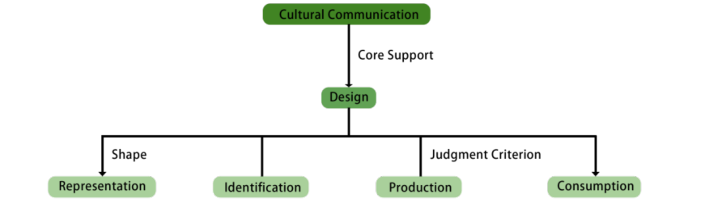
Overview This study takes the Cultural Communication Theory as the core theoretical support. The theory holds that the effective communication of culture needs to go through four key links: representation, identification, production, and consumption, and design plays a core supporting role in this process. Cultural representation is shaped by design; whether the audience identifies with it depends on the design goals (Zhang, 2025). At the same time, the production
and consumption links also need to be included in the scope of design research to determine design decisions and value orientations. In the practice of digital communication of Yangzhou’s famous tea culture, relying on this theory can clarify the core direction of AR design. Creating immersive display scenarios that conform to the connotation of tea culture can stimulate the audience’s interest in understanding Yangzhou’s famous tea. Optimizing the interaction method based on the audience’s acceptance preferences can promote tea culture from the cognitive level to the identification level. Incorporating the promotion of tea culture and audience experience consumption into the design can make the measures of AR technology assisting tea culture communication more operable and make the entire communication process more organized and goal-oriented, as shown in Figure 1.
Figure 1: Relationship between design and representation, identification, production, and consumption under cultural communication.
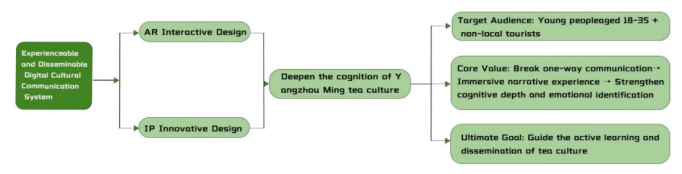
Research Framework By systematically sorting out the historical context, characteristics of producing areas, and production techniques of Yangzhou’s famous tea culture, focusing on the four core links of representation, identification, production, and consumption in the Cultural Communication Theory, and targeting users’ cultural cognition and emotional identification needs, this study takes design as the core support to achieve three integrations: the adaptation of cultural connotations and AR technology, the linkage of online immersive experience and offline participation, and the matching of communication content and audience needs. It shapes a distinct representation of tea culture, optimizes interaction to promote the audience from cognition to identification, and integrates cultural promotion and experience consumption into design decisions. This not only enables users to deeply perceive the unique charm of Yangzhou’s famous tea culture and deepen their understanding of local ICH but also provides a reusable case reference framework for the digital inheritance of traditional culture, as shown in Figure 2.
Figure 2: Research framework.
Core Design Modules Cultural dissemination is an important way to enhance public recognition. This design takes ‘Tea Flower’ as the core IP. It is precisely because Yangzhou's tea culture has a profound heritage and high regional distinctiveness that it is a highly representative intangible cultural heritage symbol. In order to make traditional tea culture more accessible to the younger generation and modern communication methods, combining the IP image with AR can enable Yangzhou’s tea culture to reach the public in a fresher and more acceptable way. The IP is named ‘Tea Flower’, which is affectionate, lively, concise, and easy to remember. It can not only reflect regional cultural characteristics but also possess the affinity of tradition and modernity, effectively enhancing the cultural dissemination power and memory.
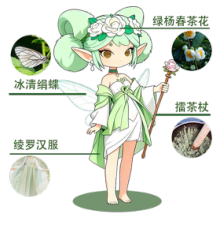
IP Image Design The design of the virtual IP image “Cha Xiaohua (Little Tea Flower)” focuses on the communication of Yangzhou’s famous tea culture. She wears costumes integrating silk Hanfu elements, with fresh and natural green as the main color, adorns her hair with Lvyangchun Tea flowers, holds a tea pestle, and has the wings of the Aporia Glacial Apollo (Parnassius glacialis) on her back. This fresh and vivid visual image not only vividly shows the regional characteristics of Yangzhou’s four major famous tea-producing areas but also combines traditional charm with modern affinity, enabling Yangzhou’s famous tea culture to be understood and loved by the public in a more intimate and vivid way, as shown in Figure 3.
Figure 3. IP image design.Table 1: Character positioning design for Cha Xiaohua.
Table available in the original PDF paper.
Item Details Character Name Cha Xiaohua / CHAXIAOHUA
Character Personality Lively and lovely, clever and playful, full of curiosity about everything in the tea town, with both agile and gentle and approachable temperament
Character Hobbies Obsessed with tea planting, tea making, and tea tasting, willing to explore the natural mysteries in the tea garden, and likes to share the fun of tea culture with others in a vivid way Character Costumes The main visual costume is in the style of Hanfu integrating silk fabrics, matched with tea flower crown decorations and butterfly wing ornaments, with an overall fresh and agile style
Character Colors Take tender green and soft white as the main colors, echoing the natural colors of tea flowers and tea gardens Character Expressions Adopt a vivid and smiling main image expression, and extend rich expressions such as curiosity and playfulness
Character Hairstyle Take Lvyangchun Tea flowers as the core hair accessories, matched with green flower bud buns, and dotted with silk butterfly decorations Narrative Background of the IP Image
To strengthen the correlation between the IP and producing area culture, a complete growth story line is built around “Understanding Tea from a Single Leaf”. The system story is set in Yangzhou’s four major tea gardens. The protagonist, tea culture IP “Cha Xiaohua”, is tasked with “awakening the memory of Yangzhou’s famous tea”. Endowed with the exclusive identity of “tea culture experience officer”, she serves as a cultural explainer and interactive guide, connecting the full tea-making process from planting and picking to fixation, rolling, and roasting. It vividly narrates the differentiated tea culture stories of the four producing areas shaped by soil and climate, rendering abstract regional features concrete. Users become “cultural explorers” and embark on an exploration journey with her.
The story line is divided into four core plot units corresponding to the four producing areas’ characteristic cultures: Geological Origin of Nashan: Users explore volcanic rock landforms’ impact on tea growth with Cha Xiaohua, unlocking the mystery of Yangzhou’s famous tea formation; Ecological Picking in Zaolinwan: Guided by Cha Xiaohua, users experience tea picking and learn relevant knowledge and skills; Humanistic Origin of Cangjie Village: Users access the ancient tea garden via AR virtual technology to understand local tea planting history; Craft Decryption of Fenghuangshan Tea Factory: Users follow Cha Xiaohua into the traditional workshop to observe the full process of ancient tea-making techniques including fixation, rolling, and roasting.
Systeminteraction Interface Design The system’s interaction interface is organized around five core functional modules, aiming to build a coherent digital cultural experience. The main
Spreading Jiangnan Tea Charm via the Grand Canal: AR Interaction 129 menu corresponds to the modules of “IP Story”, “AR Scanning”, “Tea Garden Reservation”, “Game Center”, and “Social Sharing”. Among them, the “IP Story” module narrates the growth process of the virtual IP in the form of pictures, texts, and animations, laying the foundation for users’ emotional cognition. The personal center corresponds to the functions of “Personal Information”, “Achievement Wall”, and “Point Exchange”. Among them, the “Achievement Wall” allows users to obtain corresponding point rewards based on the achievements they have obtained, and exchange gifts in the “Point Exchange”, thereby stimulating users’ desire to explore the garden. The overall interface takes the tender green of the tea garden as the main tone, creating a natural and fresh visual atmosphere.
Table 2: Interface design.
Table available in the original PDF paper.
Interface Design
Core Functions Characteristics of the Four Producing Areas
Characteristic narrative routes of the four producing areas: Nashan, Zaolinwan, Cangjie Village, and Fenghuangshan Tea Factory.
Provide online reservation channels for the four producing areas and generate exclusive AR tour routes.
Generate random IP personalized reservation certificates and unlock relevant experiences of the producing areas with reservation records. AR Scanning
Unique scannable objects in the four producing areas, which can unlock different easter eggs to trigger adventures.
Scan exclusive markers to trigger 3D animations and provide intelligent situational explanations.
Support AR real-scene interaction to view the tea tree structure and tea-making process animations from 360 degrees. Game Center
Develop tea culture interactive games and set up multi-dimensional achievement systems and reward mechanisms.
Points can be exchanged for various gifts; those at the top of the list can obtain offline research and study opportunities and customized tea gifts.
Exclusive knowledge points of the four producing areas; searching for unique tea elements in the scenes of each producing area; simulating the growth of tea trees in each producing area.
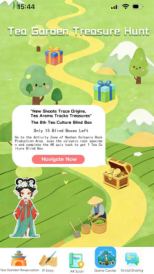
Game UI Design The “Game Center” module includes two themes: Tea Garden Treasure Hunt and Four-Season Tea Garden Simulator, focusing on the interesting dissemination of knowledge, as shown in Figure 4.
Figure 4: Game UI design.
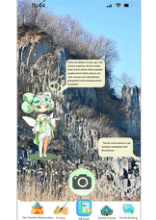
AR Scanning Interface As the core interaction entrance, “AR Scanning” is deeply integrated with the characteristic cultures of Yangzhou’s four producing areas. When users scan exclusive markers, they can trigger the “Tea History Time Tunnel” effect, immersively restore the key development nodes of tea culture through 3D animations, and support time-axis sliding operations to explore different historical stages. This module provides intelligent situational explanations: when scanning tea trees, the virtual IP “Cha Xiaohua” will explain the variety characteristics and picking standards by voice; when scanning tea-making tools, it will disassemble the process steps such as fixation and rolling through 3D animations; when scanning product packaging, it can explain the tasting methods and humanistic allusions in detail. The explanation supports the switching of voice, picture-text, and animation modes to adapt to different user preferences, as shown in Figure 5.
Figure 5: AR scanning interface design.
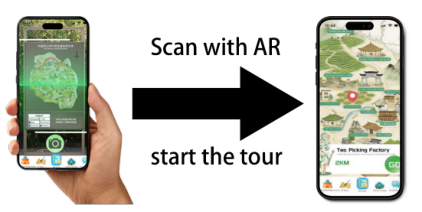
The AR tour experience is based on the AR scanning function and is closely linked to the tea gardens of the four producing areas. After users book a tea garden visit through the mini program, they can obtain an exclusive AR tour route by scanning any road sign at the location. During the on-site tour, the system will trigger interactive tasks according to the user’s location: scan tea trees in the tea planting area to unlock variety knowledge, and scan tools
Spreading Jiangnan Tea Charm via the Grand Canal: AR Interaction 131 in the tea-making workshop to watch process demonstrations. This guides users to transform from “passive viewing” tourists to “active exploring” cultural experiencers, realizing the seamless connection of online and offline AR experiences, as shown in Figure 6.
Figure 6: AR tea garden tour map.
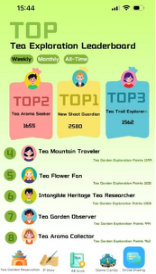
Finally, when users collect all tea culture badges and climb the tea culture points ranking list, they can unlock the “Yangzhou Famous Tea Culture Atlas” together with Cha Xiaohua and deeply understand the cultural value and protection significance of Yangzhou’s famous tea. This process not only enables users to master tea culture knowledge but also cultivates the awareness of inheriting traditional ICH, as shown in Figure 7.
Figure 7: Ranking list design.
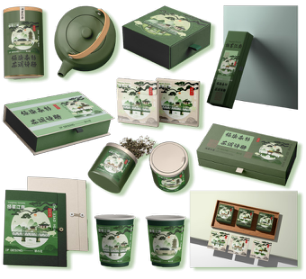
This series of cultural and creative products takes Yangzhou’s famous landmarks as the visual core, covering tea packaging, tea utensils, and cultural stationery. Its core values for tea culture communication include: Lowering the cultural cognition threshold: Using Yangzhou’s landmarks as visual symbols, it transforms abstract tea culture into concrete visual elements, enabling intuitive perception of regional tea characteristics.
Realizing daily cultural integration: Covering daily scenarios such as tea storage, drinking, and writing, it integrates tea culture into users’ daily lives. Expanding communication scope: Practical products with both use value and cultural attributes promote tea culture from niche groups to the public.
Reaching young groups: With a fresh visual style and youth-oriented forms, it breaks age stereotypes and penetrates into young people’s lives, as shown in Figure 8.
Figure 8: IP cultural and creative design.
CONCLUSION AND FUTURE OUTLOOK This study integrates AR interactive technology and IP image design to construct a multi-scenario, immersive digital communication system for Yangzhou’s famous tea culture, combining virtual content with offline tea garden scenes. Grounded in Cultural Communication Theory, this design addresses the digital challenges of Yangzhou’s famous tea culture in youth and non-local tourist communication, including insufficient experience, monotonous narrative, and weak cultural recognition. It effectively revitalizes tea culture connotation, enhances its communication power and influence, and provides references for the digital communication of similar traditional cultures. Future work will optimize AR hardware adaptability and offline positioning accuracy to improve virtual-real integration, explore in-depth cultural content to enrich communication dimensions, and reduce system costs to promote large-scale application, enabling wider recognition of Yangzhou’s famous tea culture.
REFERENCES
K. Y. Meng, “Research on the Application of Virtual Reality Technology in Tea Culture Exhibition,” Fujian Tea, vol. 44, no. 05, pp. 26–28, 2022. G. Y. Fan, H. Ming, and X. Y. Tan, “Research on the Operation and Development
Strategy of Archival Cultural and Creative Products under the Internet+ Thinking— Enlightenment from Successful Cases of Cultural and Creative Products in the Cultural Relics and Museum Field,” Open Journal of Social Sciences, vol. 13, pp. 411–422, 2025.
Spreading Jiangnan Tea Charm via the Grand Canal: AR Interaction 133 Q. Qin, S. Z. Abidin, and N. Li, “Optimizing the Tea Set Experience in Tea Culture
Communication Activities for Innovative Economy: Taking Wuyishan Tea Expo as an Example,” Int. J. Environ. Sci., pp. 701–711, 2025. S. Li, “A Brief Discussion on the Significance and Approaches of the Integrated Development of Tea and Tourism,” Journal of Tea, vol. 45, no. 02, pp. 93–96, 2019. S. Chen, J. Ao, and S. Wang, “Research on the Design Strategy of Cultural and Creative
Products Based on Orchid Culture—Taking Sihui Orchids as an Example,” Voice of the Publisher, vol. 9, pp. 283–294, 2023. S. Y. Li, Z. J. Si, and H. O. Li, “Design and Development of Longjing Tea Packaging APP Based on AR Technology,” Packaging Engineering, vol. 41, no. 15, pp. 176–180, 2020. X. Yang, “AR Technology-Based Game for Finding Treasures in Museums,” Journal
of Computer and Communications, vol. 11, pp. 43–52, 2023. Y. Zhang, X. Xia, and Y. X. Zheng, “The Theoretical Construction Foundation of Design and Cultural Communication,” Art & Design Research (Chinese & English), vol. 2025, no. 02, pp. 72–76+137–138, 2025. Z. Wang, M. Zhao, and S. Li, “Research on the Countermeasures for the Integration
Development of Tea Culture and Tourism in Longjing Village, Hangzhou,” Anhui Agricultural Science Bulletin, vol. 26, no. 05, pp. 154–156, 2020.
LISTED IN THE AHFE DIGITAL BOOKSTORE CATALOGUE
Explore the complete digital volume
Human Factors in Communication of Design
Read this individual research paper free through the original publisher, or explore the full digital proceedings book.
ISBN 978-1-964867-92-2
Explore this ISBN in the AHFE Bookstore ↗Listed in the July 2026 bookstore catalogue; search by ISBN to confirm current availability · Digital book purchase optional