Sining Li (2025). The Co-evolution of Museum User Experience and Technology: A Systematic Literature Review. In: Human Factors in Design, Engineering, and Computing. AHFE Open Access, vol. 199, pp. 462–469. https://doi.org/10.54941/ahfe1006858
The form of museum user experience (UX) is undergoing a transformation from “information delivery” to “immersive experience” ,in recent years, the rapid development of UX design theory and technology has provided new possibilities for museum experiences. However, museum UX design, technology, and practical applications are still largely situated within relatively independent disciplinary systems ,lack systematic cross-integration ,which makes literature retrieval and comprehensive research difficult. This paper adopts the methods of literature review and case analysis ,analyze the phased development of museums from multiple dimensions: functions, user experience, and technology to form a contrasting framework. Research has found that the development of museum UX lags behind user experience research, technological advancements, and practical applications ,existence a problem of misalignment between theory and practice. The rapidly developing technologies and UX practices have not yet been systematically incorporated into the framework of museology research ,which limits researchers to the knowledge system of a single field. This paper aims to help designers better understand the development process of museums, balance multidisciplinary theories in design, and remind designers to pay attention to the importance of interdisciplinary applications.
Nowadays, museums are shifting from being “relic storage institutions” to “cultural experience venues”, technology and user experience design (UX) have transformed from auxiliary tools into an important part of museum design (Pine, 2001). Although there is abundant UX, technical literature, and case studies related to museums, however, this information is scattered across different fields, and the lack of connections between these fields hinders practitioners’ learning and research. This issue highlights the importance of focusing on user experience and building a clear framework for museum technology and user experience (Innocente, 2023).
This paper adopts the methods of literature review and case analysis,systematically reviewed the literature from 1900 to 2025 on
The Co-Evolution of Museum User Experience and Technology 463
museology, museum UX, and technological developments,meanwhile, longitudinally select actual museum cases as references. Integrate and analyze the data from multiple perspectives, including UX, technology, and museology based on above information.
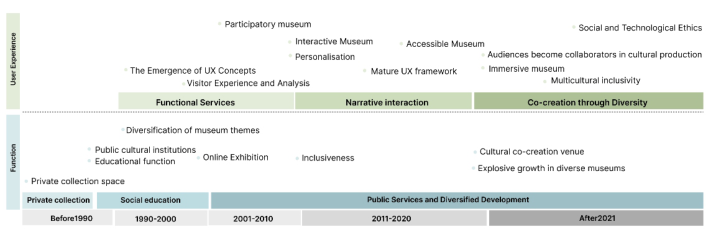
From the above research, it can be seen that there is a lag between the development of museum technology, its practical application, and academic perspectives. There is a disciplinary divide in the current practical applications and research structure of museums. Fields such as museology, user research, and human-computer interaction (HCI) are relatively independent, and information fragmentation which restricts comprehensive innovation in museums.
THE EXPANSION OF FUNCTIONS The development of Western museums can be roughly divided into three stages. First stage, before the 17th century, museums were mainly private collections and social venues for nobles or wealthy merchants. Second Stage: 18th-19th Century,Museums became institutions of popular culture, such as the Louvre, which opened to the public in 1793, begin services for public education and cultural exhibitions. Third stage after the 20th century,Museums are beginning to emphasize their service functions (Victoria Cain, 2017), being regarded as institutions capable of promoting social, economic, and political development. At this stage, the service attributes of museums become more prominent, and their relationship with society undergoes a fundamental conceptual shift, its service focus has also shifted from objects to people (Hooper-Greenhill, 2020; Cameron, 2004).
The role positioning and content richness of the museum were further expanded in the third stage. In addition to serving educational purposes, museums at this time have entered the realm of socialization,become a part of popular culture in social development. Museum service systems and business models are becoming diversified, and specialty museums focusing on user personalization and inclusivity are beginning to emerge. For example, the United States has the Disney Archives since 1970, Japan has the Nissin Cup Noodles Museum, and in 2024, China has the Guangdong Museum of Visual Accessibility. The number of this type of specialty museum has rapidly increased in recent years and has further entered the public eye. On the other hand, in terms of commercialization, cultural and creative products are gradually becoming industrialized and have become an important part of museum operations.
Figure 1: The development of the role of museums.
464 Li
With the changes in the social role of museums, the forms and attitudes of museum services to users have also transformed, the development process of museum UX can likewise be presented in a three-stage evolution.
THE THREE-STAGE EVOLUTION OF MUSEUM USER EXPERIENCE PARADIGMS Functional Service Paradigm (1990s–2009s): In the early stages, the goal of museum UX is to optimize the educational and communication functions of the museum,The user experience framework has taken an initial shape, with concepts such as user analysis and frontend research being proposed. Although UX research is still mainly focused on user learning and travel efficiency in the this term,but it laid the foundation for the subsequent development of UX theory (Falk & Dierking 1992). Linear information transmission during this stage is the core of most museum designs and services. Practitioners rely on standardized images, text, and audio to enhance the efficiency of information dissemination,therefore, users are under a passive acceptance position, and their experience is limited by space and devices (Economou, 1998).
Narrative Interaction Paradigm (2010s–2019s): The concepts of interactive technology, museum user research, and UX evaluation have matured and developed, however, there is a lack of standardized and generalizable quantitative analysis and research results in related research (Pallud, 2010 ; MacDonald, 2015). Many museums have started to use interactive technologies such as touch screens and holographic projections to optimize user experience. Situational storytelling and interactive design, as part of museum UX, are beginning to integrate into the field of museum studies research (Ogawa & Crain, 2009; Simon, 2010). Meanwhile, the concepts of personalization and inclusivity in museums are beginning to emerge, for example, the M-PIRO project attempts to achieve multilingual personalized descriptions of exhibits through a database.
At this stage, the practical application of technology in museums is ahead of academic research and the systematic construction of terminology. Much of the literature is scattered across museology, visitor studies, HCI, and interaction design. Although the above academic systems are simultaneously applied in design practice, there is a lack of in depth interdisciplinary research and discussion in the academic field.
The Co-Creation Paradigm (2020s–present): Since 2016, the number of publications on museum interactions has increased significantly, reaching a temporary peak in 2019. A large number of technologies and concepts have begun to be systematically introduced into the museum UX system. The importance of immersive museum experiences and technological applications in enhancing user experience, cultural impact, and acceptance has been affirmed. Museum UX is entering the stage of ’cultural interaction and co- creation’ driven by digitalization and technology,new forms such as NFT digital collectibles and brainwave interaction have been proposed, further expanding the depth and ways in which users engage with museum culture (Lee, 2020). At the same time, museum UX began to consider inclusivity,
The Co-Evolution of Museum User Experience and Technology 465
personalization, and commercialization. Such as MoMA’s tactile and audio guides for visually impaired visitors, as well as multi-sensory explorations combining 3D printing, audio descriptions, smell, and touch, are also used to enhance the museum’s appeal and inclusivity for people with disabilities (Karaduman, 2023).
In summary, at this stage, the development of museum academic research, technical research, and practical applications shows a multi-directional expansion, with diverse perspectives in literature on museum UX and related technologies and theories. However, there is a lack of an authoritative unified framework and theory in academic research (Lu, 2023).
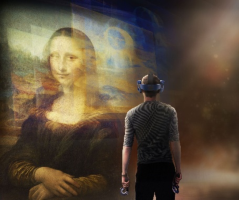
Figure 2: The Mona Lisa at the louvre and the MOMA tactile exhibition (adapted from Louvre museum, 2019; the museum of modern art, New York, 2023).Figure 3: The role of museums and the development of user experience.
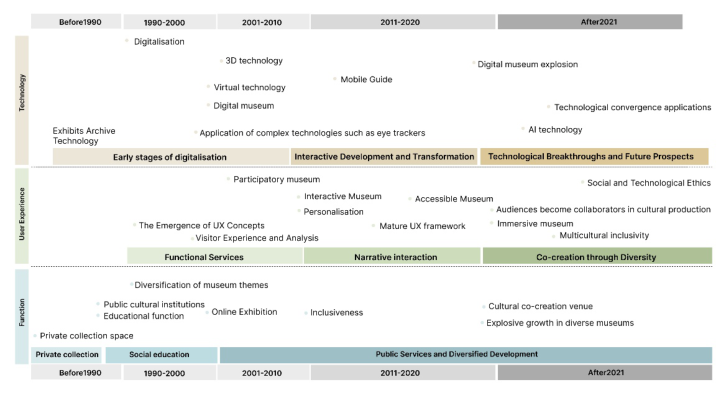
The focus of museum UX is gradually showing trends of entertainment, mass appeal, digitalization, and personalization. The overall development trend of UX research slightly lags behind the transformation of museum functions. However, with the transformation of museum UX, the richness and applications of technology have also been further enhanced.
THE HISTORY OF TECHNOLOGY DEVELOPMENT Early stages of digitalisation: Early museum technology focused on managing and improving the organization and retrieval of museum information, for example, the naming system developed by Robert G. Chenhall in 1978 was used to classify collections of items. Audio guides from the same period
466 Li
mainly consisted of simple, uniform narratives, visitors’ exploration of the space is limited.
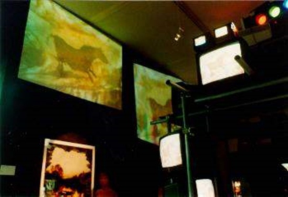
In addition, although the technology at this stage is still primarily focused on exploratory experiments,even enhancing user experience is not the primary goal of technology, many new technologies and design concepts are still worth paying attention to. For example, the concept of digital museums, as well as early cases of virtual museums, also emerged around 1994, lay the foundation for explosive growth in the later stage. Eye trackers were also attempted in 1988 to record visitor attention (Buquet, 1988). Meanwhile, early VR applications and digital projects began to emerge. For example, in 1995, Benjamin Britton created a virtual reality exhibition based on French caves. Although this exhibition faced much skepticism, it can still be regarded as an inspirational case for the development of interactivity.
Interactive Development and Transformation (2007–2016–2019): With the popularity of mobile devices and user demand, museums have entered a period of digital and interactive transformation development (Marty, 2007). Electronic display devices and multimedia are used to optimize the user experience in museums, while quantitative and qualitative research is widely used to enhance the user experience (Bearman, 2008).
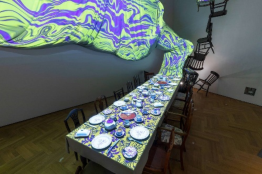
Between 2016 and 2019, research related to museum interaction and technology experienced explosive growth, the technical acceptance model is widely used in museum interaction and design. The technological features of this phase include the widespread use of mobile guide devices,for example, the 2012 Museums & Mobile survey showed that most museums with more than 250,000 on-site visitors were using new mobile guide devices. Otherwise, technologies such as 3D and VR are developing systematically in interactive devices, making museum digitalization an important trend. Technology is used to enhance the user browsing experience and engagement, and to transform the way of browsing. For example, starting in 2017, the Van Gogh Exhibit: The Immersive Experience, which uses large-scale projections and interactions of VR, sound, and light, began its touring exhibition.
Figure 4: Benjamin Britton’s cave VR exhibition and the Van Gogh travelling exhibition (adapted from Kwang-Ju international Biennale, 1995; Grande Experiences, “Van Gogh Alive”, 2025).
Technological Breakthroughs and Future Prospects (2020–Present) Since 2020, COVID-19 has impacted physical museums, and technologies such as AI have experienced explosive development. Meanwhile, museum visitors
The Co-Evolution of Museum User Experience and Technology 467
are showing a trend towards younger ages, with the 19–25 age group in China accounting for 57.9% of the audience. Museum UX is influenced by both technological environments and users, prompting further digital transformation(Giannini & Bowen, 2022). Concepts and technologies such as narrative immersive experiences, mixed reality interactions, and multi modal interactions are being extensively applied in both online and offline museums. At the same time, technology is beginning to appear as a focal analysis case in some museum studies centered papers.
Figure 5: The V&A museum and the AI art museum (adapted from Victoria & Albert museum, 2021; Dataland, 2025).Figure 6: The role of museums, user experience and stages of technological development.
For example, Google Arts & Culture, as a virtual museum project, brings together nearly 500 online museums. 2022 the V&A Museum’s immersive exhibition “Alice: Curiouser and Curiouser” also showcased the interactive effects achieved through a combination of technologies such as VR, storytelling, multi modality, and the integration of online and offline experiences. On the other hand, museums have begun to leverage data analysis, user modeling, and big data to learn from and respond to users’
468 Li
decisions and preferences, thereby providing a personalized user experience (Shani, 2020; Trichopoulos, 2023).
In recent years, AI has become a hot topic in technological development, whether in terms of visitor engagement or behind-the-scenes operations, AI has demonstrated the potential to change both the form and significance of museums. In 2025, Refik Anadol claimed open the world’s first artificial intelligence art museum.
In recent years, technology and practical cases were developed explosively, but due to the wide ranging overlap between museum user experience and technology, many technologies have not been even defined within a museological framework when proposed and studied. For example, museum AI and multi modal museum retrieval are mostly concentrated in the technological field, lacking interdisciplinary analysis that combines museology and museum UX.
DISCUSSION
Based on the above analysis, the museum’s user experience design and technological development mainly include three stages. It can be observed significantly that the functions of museums usually change first, most technological developments serve the needs of museums, and the systematic summary of museum UX is the last to be developed and supplemented.
Therefore, the development of museum UX generally lags behind the transformation of museum functions and technological advancements. Many technical and design concepts are only systematically incorporated into the museum UX system after being applied in practice for some time. However, the explosive development of technology in promotion also depends on a systematic UX framework and evaluation system. Meanwhile, although many technologies were proposed early, their explosive development lags behind the initial proposal stage and often occurs after changes in museum functions. From this, it can be seen that the current surge in practical design and technological development will promote the enrichment and expansion of the museum UX system, creating new gaps for theoretical research.
This framework help designers understand the developmental stages of museums, conduct comprehensive design from multiple disciplines and dimensions, and lays the foundation for interdisciplinary research and practice.
CONCLUSION
In the development of museums, museum functions drive technological advancements, which subsequently extend further into the field of museum UX. With the recent trend towards diversified museum design, there is an urgent need in the discipline for comprehensive comparative analyses that span multiple fields such as design, technology, humanities, and information science. Museum UX requires holistic integration and evaluation. Future research should combine various new technologies and concepts to provide clear definitions for interdisciplinary research areas and establish a more accurate terminology retrieval system.
The Co-Evolution of Museum User Experience and Technology 469
REFERENCES
Bearman& Geber, KD, (2008). Transforming cultural heritage institutions through new media. Museum Management and Curatorship, 385–399. BuquetCharlier, J. R., & Paris, VC., (1988). Museum application of an eye tracker.
Medical and Biological Engineering and Computing, 277–291. CameronD. (2004). The museum, a temple or the forum. Reinventing the museum: Historical and contemporary perspectives on the paradigm shift, 61–73. EconomouM. (1998). The evaluation of museum multimedia applications: lessons
from research. Museum Management, 173–187. Falk, J. H., & Dierking, L. D. (2016). The museum experience. Routledge. Giannini, T., & Bowen, J. P. (2022). Museums and Digital Culture: From reality to digitality in the age of COVID-19. Heritage, 5(1), 192–214. Hooper-GreenhillE. (2020). Museums and the Interpretation of Visual Culture.
Routledge. InnocenteUlrich, L., Moos, S, & Vezzetti, EC, (2023). A framework study on the use of immersive XR technologies in the cultural heritage domain. Journal of Cultural Heritage, 268–283. KaradumanAlan, Ü., & Yi˘git, E. ÖH, (2023). Beyond “do not touch”: The
experience of a three-dimensional printed artifacts museum as an alternative to traditional museums for visitors who are blind and partially sighted. Universal Access in the Information Society, 811–824. Lee, H., Jung, T. H., tom Dieck, M. C., & Chung, N. (2020). Experiencing immersive virtual reality in museums. Information & management, 57(5), 103229. LuE., Moyle, B., Reid, S., Yang, E, & Liu, BS. (2023). Technology and museum
visitor experiences: A four stage model of evolution. Information Technology & Tourism, 151–174. Marty, P. F. (2007). Museum websites and museum visitors: Before and after the museum visit. Museum management and curatorship, 22(4), 337–360. Ogawa, R. T., Loomis, M., & Crain, R. (2009). Institutional history of an interactive
science center: The founding and development of the Exploratorium. Science Education, 93(2), 269–292.). Pine& Gilmore, J. H. (2001, September) J, (2001). Welcome to the experience economy. In Health Forum Journal, 10–16. Shani& Gunawardana, A. G, (2020). Evaluating recommendation systems. In
Recommender systems handbook, 257–297. Simon, N. (2010). The participatory museum. Museum 2.0. TrichopoulosKonstantakis, M., Alexandridis, G, & Caridakis, GG, (2023). Large language models as recommendation systems in museums. Electronics. Victoria CainA. RaderKaren. (2017). ’Science Communication and Museums’
Changing Roles’. The Oxford Handbook of the Science of Science Communication, 205–212.
LISTED IN THE AHFE DIGITAL BOOKSTORE CATALOGUE
Explore the complete digital volume
Human Factors in Design, Engineering, and Computing
Read this individual research paper free through the original publisher, or explore the full digital proceedings book.
ISBN 978-1-964867-75-5
Explore this ISBN in the AHFE Bookstore ↗Listed in the July 2026 bookstore catalogue; search by ISBN to confirm current availability · Digital book purchase optional