Jiaming Day, Shun Wen Chao, Lien-cheng Wang, Yi Shan Lan, Yu-hsuan Lin (2025). EAT Da Vinci 3.0_Translating Cinematic Narrative into Media Art Installation. In: Human Factors in Design, Engineering, and Computing. AHFE Open Access, vol. 199, pp. 11–19. https://doi.org/10.54941/ahfe1006813
Transforming a cinematic narrative into an interactive media art installation requires more than aesthetic adaptation; it demands a structural rethinking of how stories are embodied, perceived, and enacted. EAT Da Vinci 3.0 reinterprets Ang Lee’s film, Eat Drink Man Woman (1994) as a participatory culinary experience, focusing on the film’s emotional themes—familial tension, emotional restraint, and symbolic gesture—rather than its plot or characters. This paper outlines the theoretical underpinnings, design strategies, and interactive components of the installation, emphasizing how cinematic language is reconfigured through embodied interaction, spatial design, and multisensory engagement. By embedding performative interfaces within a rotating dining table and dynamic smart-glass environment, EAT Da Vinci 3.0 establishes a media art form that translates narrative into ritual practice, revealing the cultural and emotional dimensions of food as both medium and message.
In recent years, interactive cinema and immersive installations have become increasingly relevant in the field of new media art. Projects such as teamLab’s multisensory environments or The Wizard of Oz at Sphere exemplify how cinematic narratives can be spatialized into walkable, interactive experiences. These precedents highlight not only the technological sophistication but also the cultural and affective implications of rethinking cinema beyond the screen. This paper situates EAT Da Vinci 3.0 within this lineage, expanding the discourse on how cinematic storytelling can be reimagined through participatory design.
The adaptation of cinematic narratives into interactive formats has become an increasingly prominent approach in media art and immersive experience design. While early works focused on spatializing visual motifs or offering fragmented narrative choices, recent practices aim to structurally transform the narrative logic itself (Dixon, 2007; Manovich, 2001). EAT Da Vinci 3.0 seeks to translate the affective and symbolic undercurrents of Eat Drink Man Woman into a media art installation that engages users through gesture, spatial interaction, and culinary metaphor.
This paper examines the theoretical rationale and design implementation of EAT Da Vinci 3.0, which premiered at Neiwei Arts Center, Kaoshung, Taiwan in 2024. Moving beyond representational adaptation, the project explores how narrative can be transformed into ritualized, participatory media, inviting audiences to become co-creators of meaning through embodied interaction.
THEORETICAL FRAMEWORK Cinematic Affect and Embodiment
While affect in cinema has often been theorized as a primarily perceptual and sensory event, its role becomes intensified in interactive installations, where embodiment takes precedence. Unlike the relatively passive reception of film, such installations demand kinesthetic participation, requiring audiences to rotate, touch, and manipulate objects. This shift redefines the audience’s role, transforming them from interpretive viewers into embodied performers of narrative meaning.
Cinema’s affective power resides not only in plot but also in micro-gestures, silences, and spatial arrangements that generate visceral identification (Marks, 2000). In Eat Drink Man Woman, the tension between tradition and emotional expression is conveyed most vividly through food preparation sequences that function as nonverbal dialogue. As Sobchack (2004) argues, cinematic viewing entails a “film-body” relationship in which perception becomes intersubjective. EAT Da Vinci 3.0 extends this framework by relocating spectatorship into an active, corporeal mode of engagement, wherein narrative is not merely received but enacted through ritualized interaction.
Interactive Narrative and Procedural Storytelling As Murray (1997) observes, interactivity transforms the temporal and causal structures of narrative. Rather than unfolding through linear progression, interactive installations foreground the role of user agency and procedural meaning-making. EAT Da Vinci 3.0 reframes narrative as a constellation of performative interfaces—operating through touch, rotation, and timing— that echo Wardrip-Fruin’s (2009) conception of “playable media” as procedural systems endowed with semiotic depth.
Beyond Murray’s foundational insights, game studies have provided crucial models for theorizing agency within narrative environments. Aarseth’s (1997) concept of “ergodic literature,” for instance, offers a framework for analyzing texts that demand nontrivial effort from users in order to be traversed. EAT Da Vinci 3.0 resonates with this paradigm by construing narrative not as a pre-scripted sequence but as an emergent process shaped by participants’ procedural interactions.
Food and Cultural Ritual Several contemporary art practices position food as an interface between intimacy and cultural critique. Works such as Rirkrit Tiravanija’s relational
EAT Da Vinci 3.0: Translating Cinematic Narrative into Media Art Installation 13
aesthetics dinners and Marina Abramovi´c’s staged feasts demonstrate how eating can become a performance of social negotiation, memory, and identity. Building on these precedents, EAT Da Vinci 3.0 emphasizes food as both narrative material and sensory interface, grounding cinematic affect in embodied ritual.
In Ang Lee’s original film, food operates simultaneously as medium and metaphor. As Appadurai (1981) observes, culinary rituals encode memory, identity, and affect within symbolic acts. Similarly, in media art discourse, food has been theorized as a sensory bridge between intimacy and cultural narrative (Parasecoli, 2008). EAT Da Vinci 3.0 situates this intersection at the core of its design strategy, translating cinematic motifs of preparation, tension, and gesture into participatory acts of collective performance.
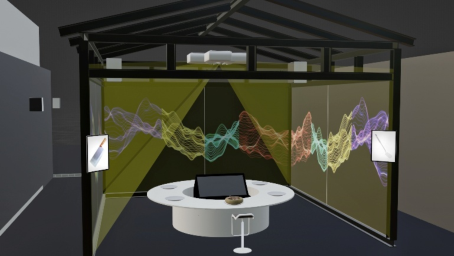
SYSTEM AND INSTALLATION DESIGN At the center of the installation is a Chinese-style round table, integrated with a DCRA (Dihedral Corner Reflector Array) floating projection system, rotational sensors, and sensor-activated sound design. The table presents six dishes, each corresponding to an emotional vignette drawn from Eat Drink Man Woman. As users rotate the table, the sensors trigger thirty- second floating animations that visualize the preparation of each dish. These sequences contrast the film’s refined culinary techniques with the playful, dance-like movements of the ingredients. Following each animation, the completed dish is projected directly onto the plate, bridging the virtual and the physical.
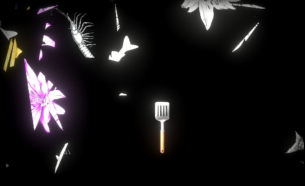
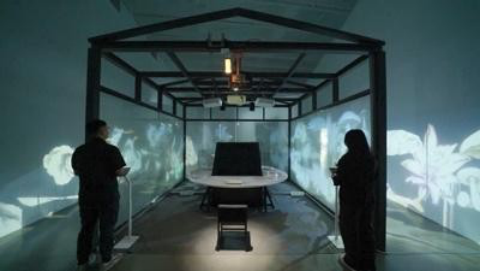
On both sides of the table, two tablet-based tools—shaped as a chef’s knife and a spatula—enable participants to interact with projected ingredients on the surrounding wall. These tools simulate cooking gestures such as slicing or stir-frying, mapping tactile actions onto symbolic narrative components.
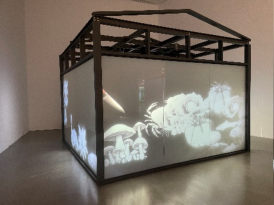
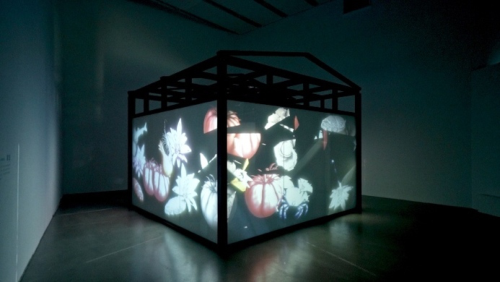
The installation is enclosed within a house-like structure constructed from PDLC (Polymer-Dispersed Liquid Crystal) smart glass, which dynamically shifts between transparency and opacity. This modulation responds to user presence and interaction, producing a rhythm of visibility and concealment that mirrors the film’s emotional arcs.
Figure 1: Installation design diagram.
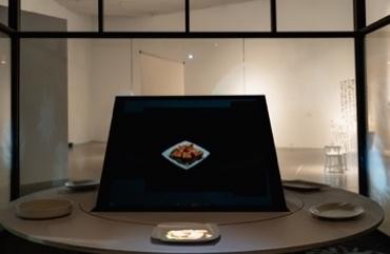
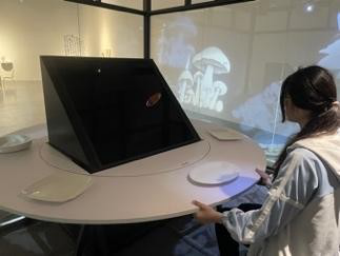
Dinner’s Table: Interactive Table With Floating Animation The installation features a Chinese-style round tabletop device that encircles a floating projection screen. Six dishes are positioned around the table, and users can rotate the surface left or right to access each dish. This motion activates a photoresistor beneath the table, which transmits signals to the control center via Arduino, triggering the corresponding floating animation. Once the animation concludes, the associated dish is projected onto an initially empty white dinner plate. The floating projection is realized through DCRA (Dihedral Corner Reflector Array) technology, producing a seamless and immersive visual dining experience.
Figure 2: Left: Front view of dinner’s table, Right: Photoresistor under the table.Figure 3: Left: User rotates the table, Right: The structure of DCRA.
Six Floating Animations The floating animations of these six dishes are derived from the film’s classic recipes, rendered as imaginative 30-second sequences. Table 1 lists snapshots of the six animations, while Table 2 shows the projected images on the plates at the end of each sequence.
EAT Da Vinci 3.0: Translating Cinematic Narrative into Media Art Installation 15
Table 1: Snapshots of six animations.
Table available in the original PDF paper.
Lotus Leaf-Wrapped Beggar’s Chicken
Squirrel-shaped Mandarin Fish
Dongpo Pork
Chrysanthemum Hot Pot
Stuffed Mushrooms with Shrimp
Roast Duck
Table 2: Six dish images projected on the plates.
Table available in the original PDF paper.
Dongpo Pork
Lotus Leaf-Wrapped Beggar’s Chicken
Squirrel-Shaped Mandarin Fish
Continued
Table 2: Continued
Table available in the original PDF paper.
Roast Duck
Chrysanthemum Hot Pot Stuffed Mushrooms with Shrimp
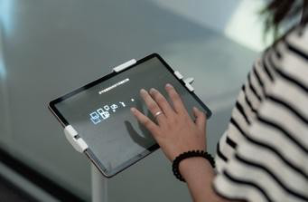
Chef’s Knife and Spatula Both devices function as interactive tools on a tablet interface, each offering a distinct mode of interaction. The knife allows users to cut images apart: when it touches virtual ingredients, they split into pieces. Using Wi-Fi OSC (Open Sound Control), the system tracks the positions of the knife and the spatula. In Unity, ingredient models are dynamically sliced along the plane of collision, calculated from the normal vectors at the impact point. The spatula enables users to flip images and alter their colors. The entire wall projection modifies the virtual objects’ gravity toward the left, producing a drifting effect due to the reduced gravity value. Two users stand in front of the tablet interface, assuming the roles of the knife and spatula, and engage in a collaborative, interactive experience.
Figure 4: Left: Interactive interface of knife and spatula, Right: Two tablets on the corners.Figure 5: Left: Spatula flip color, Right: Knife split images.
EAT Da Vinci 3.0: Translating Cinematic Narrative into Media Art Installation 17
Transparency: Spatial Transparency Switch The walls of the installation are clad in PLDC film that can shift between opacity and transparency, creating a dynamic transition between interior and exterior. This transformation opens the once-enclosed immersive space, producing a moment of sudden revelation—like returning from a fantasy world to reality—and echoes the film’s final misunderstanding. When transparent, the walls allow outside viewers to glimpse participants seated at the table with their empty plates, provoking curiosity and the desire to enter. Situated near the entrance corner, the installation enables audiences to experience the wall projection effects even as they pass through the threshold. The timed modulation between transparency and opacity not only heightens immersion but also subtly guides viewers into the house-like structure.
Figure 6: Left: PLDC film without transparency, Right: PLDC film with transparency.
Control Center: Interaction and Transparency Management The control center regulates both interactivity and transparency within the environment. The surrounding walls are clad in PDLC film, capable of shifting between opaque and transparent states. While one participant rotates the dining table to reveal a virtual dish, others assume the roles of knife and spatula, contributing to a dynamic, narrative-driven experience. Unity functions as the computational hub, coordinating five displays: three wall projections, one floating projection, and the projected dinner plate. By precisely synchronizing timing and visuals, the system produces a cohesive and immersive environment.
Figure 7: View from inside of EAT Da Vinci 3.0.
From a design perspective, one of the central challenges was achieving seamless integration between sensor input, projection mapping, and smart- glass modulation. Latency or misalignment could easily undermine the immersive illusion, necessitating extensive calibration. Users testing further revealed the importance of intuitive feedback: users favored interfaces that replicated real cooking gestures over abstract symbolic actions. These findings informed refinements to the knife and spatula tools, ensuring that interactivity remained both accessible and meaningful.
Figure 8: View from outside of EAT Da Vinci 3.0.
DISCUSSION
The transformation from dialogue to gesture resonates with theories of postdramatic theater, where meaning arises through performative action rather than scripted text. In this sense, the installation aligns with Hans- Thies Lehmann’s (2006) claim that contemporary performance privileges embodiment and spatial arrangement over linear plot. Likewise, the shift from plot to structure echoes Lev Manovich’s theorization of database logic, in which narratives are reorganized as modular, navigable systems rather than fixed scripts. Finally, the movement from viewing to performing draws on performance studies discourses of audience co-presence, emphasizing the dissolution of boundaries between artwork and participant Rather than staging a literal adaptation, EAT Da Vinci 3.0 undertakes a narrative transposition, reconfiguring affective content into ritualized, multisensory experience. The project foregrounds three key transformations:
From dialogue to gesture: Emotion is enacted through embodied action and interface rather than spoken language.
From plot to structure: Narrative is reorganized into a spatialized sequence of affective events.
From viewing to performing: The audience becomes co-performers within a mediated ritual.
These shifts expand the expressive possibilities of interactive installation, proposing a methodology for translating cinematic narratives into embodied spatial media. Moreover, the emphasis on food as both content and interface
EAT Da Vinci 3.0: Translating Cinematic Narrative into Media Art Installation 19
highlights cultural memory, familial intimacy, and emotional repression— motifs central to both the film and the installation.
CONCLUSION
EAT Da Vinci 3.0 offers a model for reframing cinematic narrative as participatory, embodied ritual. Through its integration of tangible interfaces, responsive architecture, and multisensory storytelling, the project challenges conventional boundaries between spectator and performer, narrative and interaction. As immersive art continues to evolve, such hybrid forms open new avenues for emotional engagement, cultural storytelling, and ritualized media experience.
Future iterations may incorporate biometric sensing—such as eye-tracking or heartbeat monitoring—to more directly integrate participants’ emotional states into the narrative environment. This would not only intensify the affective resonance of the work but also extend its methodological contributions to human–computer interaction research. More broadly, EAT Da Vinci 3.0 articulates a framework for merging cultural ritual, cinematic storytelling, and embodied interaction into a cohesive media art form, offering fertile ground for both artistic experimentation and theoretical inquiry.
REFERENCES
Aarseth, E. J. (1997). Cybertext: Perspectives on Ergodic Literature. Baltimore, MD: Johns Hopkins University Press. Appadurai, A. (1981). “Gastro-politics in Hindu South Asia. American Ethnologist,
8(3), 494–511. Dixon, S. (2007). Digital Performance: A History of New Media in Theater, Dance, Performance Art, and Installation. MIT Press. Lee, A. (Director). (1994). Eat Drink Man Woman [Film]. Central Motion Picture
Corporation. https://www.tfai.org.tw/en/program/movieDetail/2c9580827e 58477e017e6c0ba607000f. Retrieved March 20, 2024. Lehmann, H.-T. (2006). Postdramatic Theatre (K. Jürs-Munby, Trans.). London: Routledge. Manovich, L. (2001). The Language of New Media. MIT Press. Marks, L. U. (2000). The Skin of the Film: Intercultural Cinema, Embodiment, and
the Senses. Duke University Press. Murray, J. H. (1997). Hamlet on the Holodeck: The Future of Narrative in Cyberspace. MIT Press. Parasecoli, F. (2008). Bite Me: Food in Popular Culture. Berg. Skenderija-Bohnet, N. (2019). “Eat the pain”. Food in the work of Marina
Abramovi´c. E|C Serie Speciale – Anno XIII, n. 27, 2019. Sobchack, V. (2004). Carnal Thoughts: Embodiment and Moving Image Culture.
University of California Press. Tiravanija, R. (2007). Rirkrit Tiravanija: A Retrospective (Tomorrow is Another Fine Day). JRP|Ringier. Wardrip-Fruin, N. (2009). Expressive Processing: Digital Fictions, Computer Games,
and Software Studies. MIT Press.
LISTED IN THE AHFE DIGITAL BOOKSTORE CATALOGUE
Explore the complete digital volume
Human Factors in Design, Engineering, and Computing
Read this individual research paper free through the original publisher, or explore the full digital proceedings book.
ISBN 978-1-964867-75-5
Explore this ISBN in the AHFE Bookstore ↗Listed in the July 2026 bookstore catalogue; search by ISBN to confirm current availability · Digital book purchase optional