With the advent of the COVID-19 post-epidemic era, human life has gradually transformed into a new form: less contact, avoiding dining together and reducing open shared spaces. The traditional lifestyle of human interaction, cultural participation, and sharing of emotions has changed, and this has become a new issue that needs to be resolved. This project aims to develop a naked-vision multi-level optical projection system as a cultural carrier and construct a new catering cultural field. We projected beautiful images of solar terms, poetry, and natural scenery on the dining table. The virtual animation mixed with the tableware in three-dimensional space to construct an immersive field of naked mixed reality. Innovative technical indicators are three-dimensional floating and touchable projection images. A multi-mirror staggered array optical element combined with a directional light projection system will achieve floating projection for engineering technology. The virtual image is projected into the physical space and completes the effect that the virtual image is "touchable and unavailable" (that is, it will pass through the virtual image when touched by the hand). To achieve the function of the interaction between floating images and people, we will use hand posture information to control the interface, define the floating image's imaging position through leap motion, match the operation behavior's position, and trigger the pre-designed animation content. This paper focuses on the display issue, and we will present another paper on the interactive issue.
This multi-level floating projection technology can truly realize virtual-reality mixing (or mixed reality) and adopts the naked-view method without wea- ring AR/MR goggles. Simply put, objects in the physical space can be superimposed with virtual animation images to form an effect that is difficult to distinguish between virtual and reality. Although the traditional semi- transparent cone/semi-reflective glass/phantom film method of spectroscopic projection can also achieve the above goals, as mentioned in the previous paragraph: virtual images and physical objects will fall on the inner side of the floating screen. They cannot be in contact with people. However, mesh scattering projection (floating gauze), light field display projection, water
Innovative Dining Experience Realized by Developing Naked-Vision Floating Projection 171
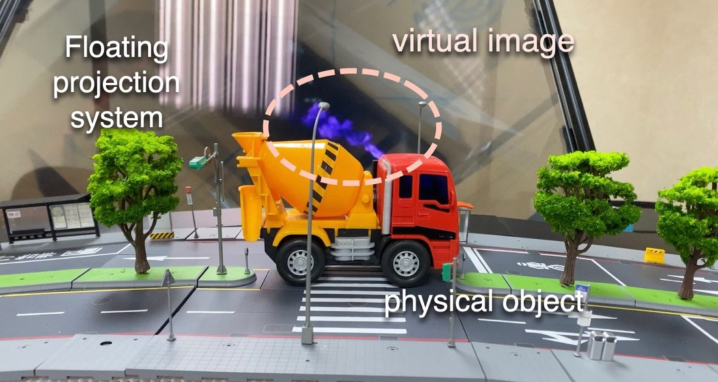
Figure 1: Naked-view fusion of virtual image and physical object.
mist screen projection, a smart display screen with adjustable transmitta- nce, etc., are even less likely to interact with the material because the virtual image is exposed on the screen—superimposed display. Figure 1 illustrates our implementation through a small mirror-staggered optical element array. The smoke emitted by the rear engine of the toy car is an animation, not real smoke. We presented in the “AQI Air Quality Sensor Achievement Exhibi- tion” exhibition at the 2020 TAIROS of the TIRI. To create realistic smoke without polluting the scene, we designed a simulated exhibit to surprise the audience. That is to say, we can project virtual flames on real candles, vir- tual bouquets on empty vases, and the light and shadow material of drinks in empty cups. When we raise our hands and try to touch, we will touch candles, vases, and cups, but when we touch flames, bouquets, and drinks, we will be surprised to find that our hands pass through them, and the palm is empty. Such a hybrid structure of virtual and real provides more creative ideas and applications. Furthermore, this effect still needs to be added to the interactive function. The virtual image can interact with people when we judge gestures and behavior through the body’s sensory detector.
In our last project, “An installation on immersive dining of image and food,” we presented an immersive installation that describes creating the image related to the food taste, traceability, and surrounding environment. This paper advanced our research with floating images on a table. We create dynamic pictures full of warmth and integrate them into physical catering. Because of the immersive effect of virtual and real integration, vie- wers (dinners) can experience a beautiful and moving story process. The floating virtual animation is projected onto the tableware and cups, reve- aling the solar terms of the world, the tea smoke in the image of poetry, and the symbolic pictures of local culture. Combining the five senses of audio-visual, taste, smell, and touch makes the process both cultural and enjoyable.
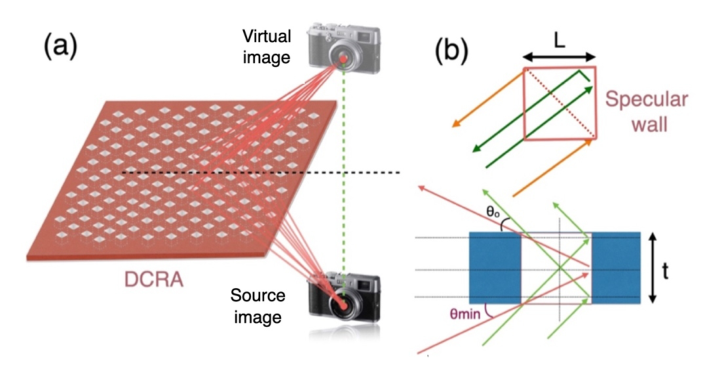
MIRROR INTERLACED ARRAY OPTICAL ELEMENT Dihedral Corner Reflector Array Device (DCRA)1-4 is a brand-new com- ponent that has been developed in recent years. Please refer to Figure 2(a). Since this structure does not use refractive or diffractive components (such as glass lenses and diffractive structure) are made purely with reflective components, so the distortion and deformation that are prone to occur in traditional floating projection will not occur, and there will be no aberra- tions such as spherical aberration and chromatic aberration. Moreover, the object and image distance are equivalent, so the magnification value is con- stant. Figure 2(a) shows that DCRA is composed of many square holes, so it has a high penetration of direct light and forms a transparent texture. Each hole has a mirrored inner wall, which can have high reflectivity at a lateral angle and project image information. The substrate is typically a metal plate. When the real object is place in the object space, many microlenses can make the light beam converge and reflect the other side of the element, forming a real floating image. This means that we can place the physical image informa- tion to be displayed in the lower space and make the observer in the upper space, coexisting with the floating virtual image. Figure 2(b) shows secon- dary reflections on DCRA when light passes through a single hole. L is the side length of the square hole, and t is the thickness of the substrate. Due to the condition of the included angle limitation of the secondary reflection, the optimized angle can obtain, through calculation, the observer’s most effective viewing angle for DRCA. Generally, at least about 45 ∼60
.
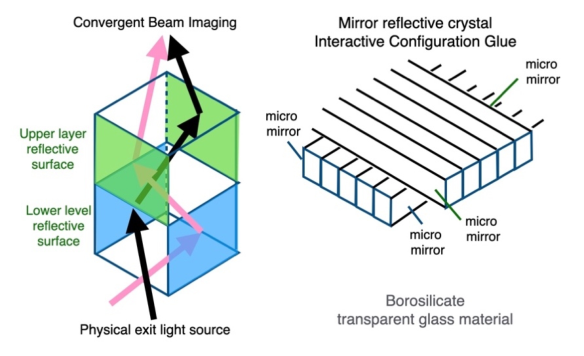
Light-controlling panel for stereo imaging apparatus5-6 is the inverted ver- sion of the double-sided angular reflective optical array structure, as shown in Figure 3. The reflector is coated on both sides of the glass or transparent plastic, and then a whole optical module is formed by stacking multiple cry- stal units. Figure 3(a) shows the lens composition and optical trajectory of each smallest optical unit. The source of the physical object (an object or a
Figure 2: (a) Schematic diagram of optical reflection array structure imaging, (b) optimization angle and minimum angle of double reflection hole of microarray lens.
Innovative Dining Experience Realized by Developing Naked-Vision Floating Projection 173
Figure 3: (a) optical principle of single mirror interlaced element, (b) actual composition of mirror interlaced array optical element.
display) comes from below, and the light beam falls above two reflections, converges, and forms an image. The size of the unit is its floating quality resolution, and the current processing specifications can be about ≤1mm in length and width. Figure 3(b) shows the composition of the component when it is modularized. It is necessary to cut out many rectangular parallelepiped glass columns with high flatness through ultra-precision machining, coat the reflective film on both sides, and then glue them together to form an array optical surface. The double-sided array optical surface glass is staggered and laminated and then optically glued. The flatness and levelness of any sur- face in the component will determine whether the image is distorted, so it depends on high-precision forming, grinding, polishing, and coating proce- dures. Although the manufacturing process is cumbersome, the difficulty and processing cost are still lower than the manufacturing process of the double- sided angular reflective optical array structure, so this scheme implements this project.
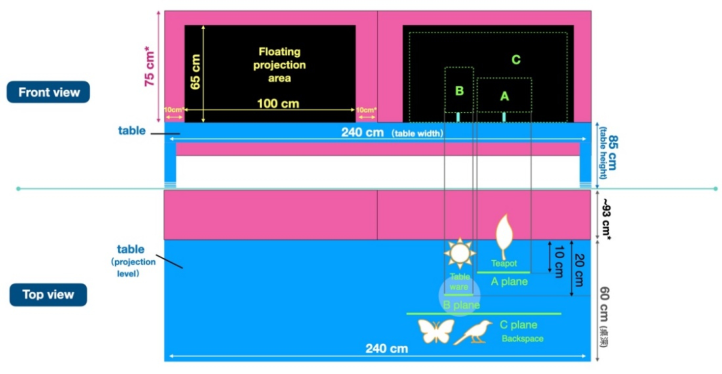
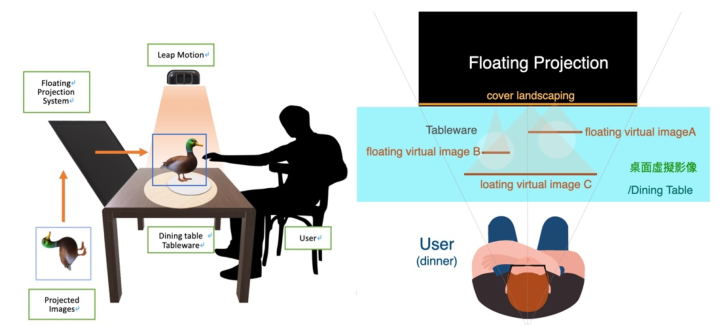
DEVELOPING NAKED-VISION FLOATING SYSTEM To realize the display situation and architecture design of the dining experi- ence, we precisely designed the relationship between the floating projection source, the table, and the animation focal plane. As shown in Figure 4, the top is the front view, and the bottom is the Top view. We planned a meal expe- rience with two viewers (dinners), so the floating projection system is preset to 2 groups. Its effective maximum projection area is about 100 × 65 cm, but we will not use all of it to avoid visual blind spots caused by differences in viewing angles due to the different heights of each person. About 80% of the internal projection area will be used. Two floating projection systems are used shoulder-to-shoulder and connected through knocking rings. The reasons for not making one large device are the ease of transportation, the symmetrical
Figure 4: Schematic diagram of system size, effective projection area and focal plane geometry.
structure, and the size restrictions of the entrances and exits of various exh- ibition areas. The focal plane of the floating projection is divided into three areas, namely the rear focal A plane, the middle focal B plane, and focal C plane, each of which has a different size. The focal plane C is the largest and is used for situational landscaping (backspace), such as birds and but- terflies around, the focal plane A is for the display of independent dynamic objects (such as smoke), and the focal plane B is for the fusion and interaction of tableware (such as solar and earth). The distance between the dining table and the floating projection source is controlled to make the virtual image appear at a sufficient distance. A, B, and C are about 10, 20, and 35 cm, respectively. These parameters are determined precisely because the floating virtual image is more long distances will start to degrade the quality. When we composed these basic conditions, it can be concluded that the dining table size is 240 × 60 cm, which needs to be a particular custom-made size. To faci- litate desktop projection, its surface needs to be treated with white surface atomization. The height of the table is 85 cm, which is higher than ordinary tables. The purpose is to balance the viewing angle of the viewer (dinner) because the floating projection device has a viewing angle limit (about 50
), which is the parameter for optimizing the viewing experience.
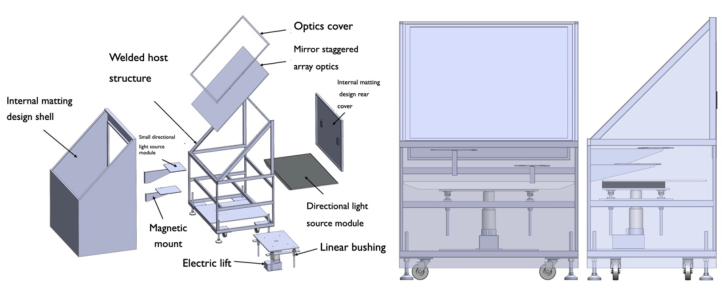
The naked-view virtual-reality hybrid hardware shows in Figure 5. The whole device is composed of four modules, namely (1) a double-sided angu- lar reflective optical array structure module, (2) an image output module, (3) an extinction mechanism module, and (4) an electric lifting support mecha- nism module. The system’s height is about 160 cm, the width is 120 cm, and the best viewing height range recommends to be 85 ∼140 cm. The internal structure of the main body adopts an aluminium extrusion assembly configu- ration to increase the flexible configuration of the internal space in the future and expand the device’s functionality. Within the scope of the image output path, it is necessary to add a surface matting design inside the machine. We
Innovative Dining Experience Realized by Developing Naked-Vision Floating Projection 175
design the material to avoid direct contact with the metal support surface during the locking process, causing damage to the optical module. The image output module includes a large, directional light source module and two small light source modules. The former is a fixed-height type, while the latter is con- nected to a free-dimensional arm and a magnetic mount, which is conducive to the freedom of the floating image imaging position according to the use situation. A set of electric lift modules is added to the support plate under the image output module. The electric lift module includes a cylindrical bamboo- type electric lift, two sets of round bolt linear guide rods, and two sets of linear bushings, which can provide step-less. With the distance adjustment function, the moving stroke of the lift is 30 cm. The hardware equipment has completed the production, component inspection, and assembly procedures at the end of 2022.
Dining Experience Appropriate tableware, drinking utensils, and decorations, such as teapots, vases, and dinner plates, will be arranged on the table. According to our plan of solar terms and catering, the floating virtual images will match each other. For example, the physical teapot with the virtual poetry and smoke form a humanistic image, the physical backspace with virtual birds and but- terflies symbolizes the spring equinox season, and the physical dinner plate is matched with the virtual solar term of animation to explain the ideas of con- forming to the heaven and earth. The optical system and multimedia content developed in this project integrate into the new media catering venue. The goal is to create an innovative and warm humanistic experience and display the results. This research will benefit the development of science and tech- nology, cultural knowledge, and the enhancement of public perception. We want to combine the power of technology and art to give people hope and inspiration in the era of post epidemics. Fig. 6 shows the dining design with a naked-view floating projection.
The table is present in dynamic graphics, animation, video, and audio. In this case, at least three floating projection animations combined on the
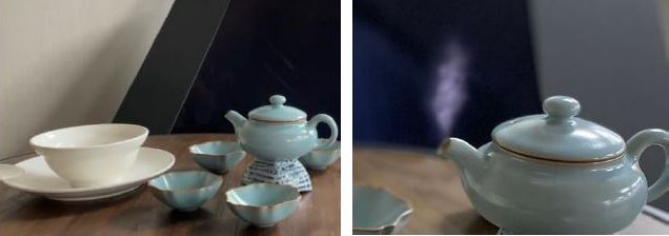
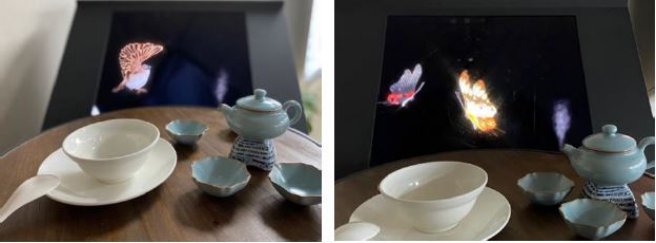
Figure 6: Naked-view mixed reality-dining experience platform design.Figure 7: Left: without virtual image, Right: teapot with virtual image of smoke.
table: backspace, teapot, and tableware. When the physical menu is opened, 3D floating will appear. The floating projected solar, and butterflies in the physical space symbolize the vernal equinox, etc. The dynamic content of the animations mainly produced in 3D program, with the primary purpose of creating a situational atmosphere with flowing animation. The 3D virtual image is projected into the physical object and performed together on the solar term dining table.
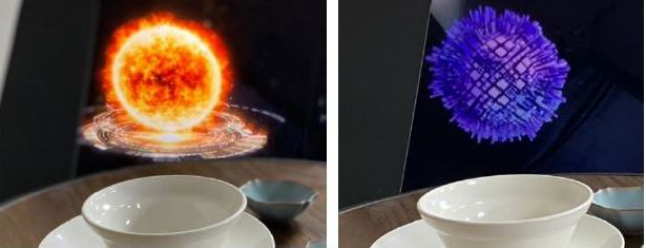
Realization of ancient poetry animation and 3D floating projection obje- cts on the dining table, we chose several images to present cultural symbols. Drinking tea is a process of relaxation and meditation. A slow-motion image of smoke in the air refer to the physical teapot floating in the air to display smoke and poetry to symbolize “humanities”. The concept image shows in Fig. 7. When eating food is getting energy from the earth, especially solar mea- ning, we put an animation of solar change by four seasons diet to show the body with nature in Fig. 8. As a dining space surrounded by nature creature is always pleasant, we put birds and butterfly flying around the back space of projection area except for teapot and tableware, as Fig. 9 shows, Birds are swimming around the dining table, and butterflies are dancing. These are very typical descriptions in oriental poetry.
Innovative Dining Experience Realized by Developing Naked-Vision Floating Projection 177
Figure 8: Table ware with various virtual images of solar term.Figure 9: Backspace with virtual images of birds and butterfly.
CONCLUSION
This project eliminates wearing objects through naked-eye floating proje- ction so that the audience can experience multi-layered virtual images in free space and perfectly integrate with physical objects. In this case, the floating volumetric display technology was achieved by using a light-controlling panel for stereo imaging apparatus, using directional projection light source control to create projections with three different focal planes. Multi-layered floating images will be visible on the display platform (dining table). The advantage of this technology is that the virtual image and the operator (observer) are located in the same physical space rather than on the screen or inside it. There is no need to wear a wearable device, when gestures are used to touch, inte- ract and manipulate virtual images, they are not blocked and interfered with by any optical screen. This project can immerse the audience and create a free and unobstructed dining experience.
REFERENCES
Miyazaki, D., Hirano, N., Maeda, Y., Yamamoto, S., Mukai, T., & Maekawa, S.
(2013). Floating volumetric image formation using a dihedral corner reflector array device. Applied optics, 52(1), A281-A289. Miyazaki, D., Maeda, Y., & Maekawa, S. (2015, May). Floating three-dimensional image display using micro-mirror array imaging element. In Three-Dimensional
Imaging, Visualization, and Display 2015 (Vol. 9495, p. 949508). International Society for Optics and Photonics. Miyazaki, D., Onoda, S., Maeda, Y., & Mukai, T. (2015, August). Blurring correction for aerial image formed by dihedral corner reflector array. In Conference on Lasers and Electro-Optics/Pacific Rim (p. 25B1_3). Optical Society of America. Yamaguchi, A., Maekawa, S., Yamane, T., Okada, I., & Utsumi, Y. (2015). Fabri-
cation of a dihedral corner reflector array for a floating image manufactured by x-ray lithography using synchrotron radiation. Transactions of The Japan Institute of Electronics Packaging, 8(1), 23–28. Yoshimizu, Y., & Iwase, E. (2019). Radially arranged dihedral corner reflector array for wide viewing angle of floating image without virtual image. Optics express, 27(2), 918–927. Zhang, H. L., Deng, H., Ren, H., Yang, X., Xing, Y., Li, D. H., & Wang, Q. H. (2020).
Method to eliminate pseudoscopic issue in an integral imaging 3D display by using a transmissive mirror device and light filter. Optics Letters, 45(2), 351–354.
LISTED IN THE AHFE DIGITAL BOOKSTORE CATALOGUE
Explore the complete digital volume
Affective and Pleasurable Design
Read this individual research paper free through the original publisher, or explore the full digital proceedings book.
ISBN 978-1-958651-47-6
Explore this ISBN in the AHFE Bookstore ↗Listed in the July 2026 bookstore catalogue; search by ISBN to confirm current availability · Digital book purchase optional