Shuichi Fukuda (2023). Enjoy Life from Within: A Proprioception Way. In: Affective and Pleasurable Design. AHFE Open Access, vol. 71, pp. 102–109. https://doi.org/10.54941/ahfe1003249
Brain is getting wide attention these days. Until very recently. it is deeply associated with Digital Computing. But Recently the importance of Analog is getting wide attention and such word as Brain-morphic Computing (BMC) is emerging. Although whether it is Digital or Analog, the attention is focused only on Brain. But as William Wordsworth indicated "Our heart leaps up when we behold a rainbow in the sky", our heart plays a very important role in our Emotion. The world has been the Industrial World and Euclidean Approach (EA) played a leading role. EA is interval scale-based with units and requires orthonormality among their datasets. But as the curse of dimensionality teaches us, we cannot solve the problem, if its number of dimensions becomes too large. The environments and situations of our daily life, however, change from moment to moment. But we spend our daily life safely and happily. Change is related with movement. And human movement is divided into two: Motion, which can be observed from outside and Motor, which is the movement inside of us, such as those of muscles, etc. Our discussion on human movements has been focused on Motion. Our muscles harden when we get close to the target object and they move together with our skeleton, forming the musculoskeletal system. Thus, we can control our motion trajectories. But at the first stage, our motion trajectories vary widely from time to time. This is because the environment and the situation vary from time to time and we make our efforts to adapt to these external changes. We coordinate all body parts to balance our body to adapt to the changing environment and the situation. In other words, our internal Motor or such parts as Muscles. etc. come to play an important role. Coordination becomes more and more important. In short, sensorimotor or proprioception has come to play an important role.
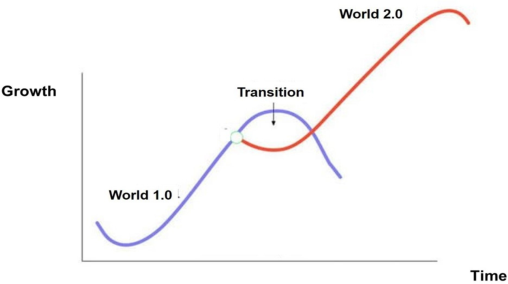
The current socity is the Industrial Society (shown as World 1.0 in Fig. 1). But the Industrrial Society is getting close to its ceiling and many issues are emerging such as the decreasing labor force, excessive energy consumption, etc. Therefore, we need to develop a new society World 2.0 for the next generation.
The World 1.0 is product-based, so quantitative and objective evaluation has been emphasized. And the current computing is based on 0–1 basis, so this evaluation method is highly compatible with it.
Digitalization has been the keyword and today DX (Digital Tranformation) is getting wide attention.
But the Industrial Revolution introduced “Division of Labor” to increase productivity. It brought about “Mass Production”.
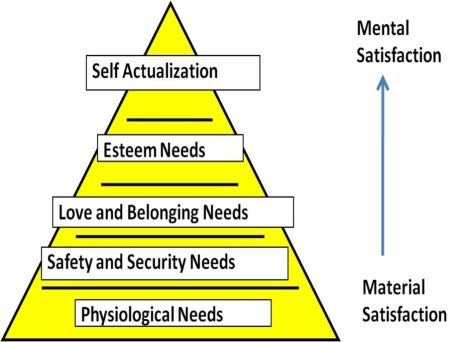
Abraham Maslow clarified Human Needs (Maslow, 1943), (Figure 2). First, we try to satisfy material needs just like animals. But human needs change from material to mental over time. And finally we seek “Self-Actualization”. You would like to demonstrate how you, yourself, is capable. In other words. we, humans, like challenges. Challenge is the core and mainspring of all human activities.
What characterizes humans is we can think about the future. We can dream. So, we made efforts to make our dream come true. That is World 0.0 before the Industrial Revolution. To describe it another way, the Industrial Revolution changed our world from engineering-focused to technology-centric. Technology calls for quantitative, objective and reprodu- ctive approach. The outcome is important in Technology. But what matters in Engineering is the Process.
Figure 2: Maslow’s hierarchy of human needs.
104 Fukuda
Edward Deci & Richard Ryan proposed Self-Determination Theory (Deci & Ryan, 1985). They made it clear that we get the maximum feeling of sati- sfaction and the sense of accomplishment, when we do the job internally motivated and self-determined, which no external rewards can provide. And this contributes to our growth.
FROM MATERIAL TO MENTAL As Maslow and Deci & Ryan pointed out, our needs move toward men- tal over time. Ironically enough, the Division of Labor brought forth by the industrial Revolution increased production, but it also increased Diver- sity and Personalization. People would like to have better products. So the producers increase the variety of their products and it results in increasing Diversification and Personalization.
The Industrial Society is product-based, so that their performance was important. But when products were diversified. we bacame aware of “Self”. We are different from person to person. In short, we have been “Consumers”, but we realized we are “Customers”.
Yesterday, we bought products based on its reputations, or brands. We did not care how they were produced. We just wanted better performing ptoducts. Today, however, even famous brand companies let their workers tell us how their products are being produced. We buy those products that agree us emotionally.
FROM HARDWARE TO SOFTWARE Another change is objects are getting softer and softer with the progress of materail engineering. They have been hard until today. So, we can easily iden- tify what it is and how we should handle it with our eyes alone. And even from a distance. But objects change from hard to soft. They are now “Software”.
So, we need to interact with them directly. For example, we try to pick it up, but if it does not work, then we scoop it. We need to determine how we should handle the object from case to case by trial and error.
HUMAN MOVEMENTS Let us consider human movements. Human movements are divided into two: One is “Motion”, which is external. The other is “Motor”, which is internal such as muscles.
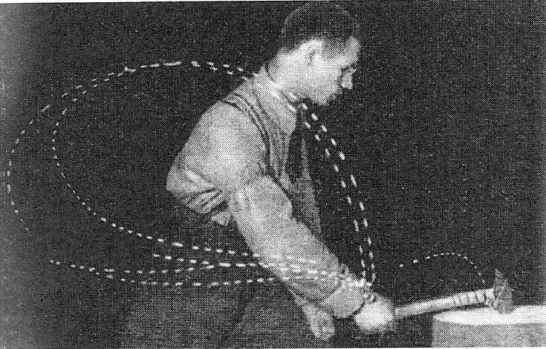
Nikolai Bernstein clarified Motion (Bernstein, 1967), (Figure 3). At the first stage, our trajectories vary widely from time to time. But as we get close to the target object, our muscles harden and move together with our skeleton. So, we can easily identify parameters and control the traje- ctory. Thus, in the age when objects were Hardware, we could control our movements.
Then, why our trajectories vary so much at the first stage. It is for coping with the changing environments and situations. We use all body parts to coordinate our body balance to adapt to the changes. We mobilize not only
Enjoy Life From Within: A Proprioception Way 105
Figure 3: Motion.
Motion but Motor as well. In the case of the latter stage, we can apply math- ematical approaches, but we cannot at this early stage. We must “Feel” the internal movement, such as muscles. But muscles are “Analog”. And Blood that drives the muscle is also Analog. We need Analog approach, Thus, “Proprioception” or Perception or Awareness of the position and movement of the body becomes crucial.
FROM BRAIN TO HEART With the rapid progress of digitalization, “Brain” is getting wide attention these days. Indeed, Brain plays an important role in DX. But we must remem- ber that even after the death of Brain, Blood is flowing and while it is flowing, we can transplant his or her body parts to somebody else. True Death comes when Heart stops working and Blood flow stops.
Blood is Analog and although some parts of Brain processes Analog data, most of its functions process Digital data. In short, Brain is a discrete mathematics tool, while Heart is a continuous mathematics tool. Discrete mathemacis is bounded and is composed of a finite point cloud. Thus, Network plays an inportant role in Brain. But we must remember it can pro- cess only the current datasets. In other words, it provides us with the status quo information. It is Euclidean Space approach.
But to predict the future, we need Continuous Mathematics. It is com- posed of infinite number of data points. If the issue can be mathamatically described, we can differentiate and predict the future. But as the curse of dimensitonality tells us, if the number of dimensions becomes too large, we cannot process it mathematically.
Then, how can we process Analog data? Although it is widely pointed out that changes become frequent and extensive today, and what makes the problem difficult is changes were smooth yesterday, but they change sharply today. So we cannot differentiate and cannot predict the future. But come to
106 Fukuda
think, our daily life is full of unexpected and sharp changes. Still, we enjoy our daily life.
Then, what helps us to live a safe dialy life? It is “Instinct”. Our inborn “Intelligence”. When we say Intelligence, we are thinking about Knowledge. Knowledge is the structured accumulation of our daily experience. But our life comes to change rapidly and extensively today. Therefore, accumulation of the past, personal experience does not work anymore. We need something to prepare for the unexpected. It is “Natural Intelligence” or “Instinct”.
MOTION AND MOTOR Motion can be observed from outside, but Motor is movement inside of us. So, we cannot see. What we can is to “Feel from Within”. When our body moves as we wish, we feel extremely happy. We are actualizing “Self” and we feel “Achievement”. We are truly satisfying what Maslow and Deci & Ryan pointed out as important. That is why sports attract us. And why young ones are motivated and grow and seniors gradually lose their vigor.
Living things are called “Creatures”. We create movement to survive. But we must remember there are movements inside us as well. Motor is being studied, but most of them discuss issues of functions. Very few discuss from the standpoint of psychology.
“Emotion” and “Motivation” come from the same Latin “Movere”, i.e., “Movement”. Emotion means to move out into Nature to develop the world of “Self”. What we pursue is to harmonize with Nature and develop a world of “Self” there. It is a challenge. But this process provides us with vigor and prepare us for tomorrow.
If we can provide such environments, then even seniors will start preparing for tomorrow.
INSTINCT: HOW CAN WE MAKE THE MOST OF IT?
Knowledge is a sttructured accumulation of personal experience. But today, envrionments and situations change drastically, so knowledge does not work effectively anymore. It worked when environments and situations changed smoothly and slowly.
But we we can adapt to the rapidly and extensively changing environments and situations of today and spend our daily life without any trouble. Why? it is because our “Instinct” helps us adapt to such changes. Instinct is inborn, so we have ignored it until now, especially in the field of technology and engineering.
However, come to think, engineering started to make our dream come true. We have no other tool but Instinct. Thus, we made efforts to utilize Instinct to the maximum, until we developed technology to produce products. We should remember engineering started to make the most of Instinct to make our dreams come true. We enjoyed the process of challenging.
In addition, what we should remember is Instinct plays a very important role in communication. And it should be emphasized that we communicate not only with humans, but also with nature or the Real World.
Enjoy Life From Within: A Proprioception Way 107
Jean Piaget proposed “Cognitive Development Theory” and made it clear that babies directly interact with the outside Real World and self-learn to scrall, walk and talk until two years old (Jean Piaget, 2023). They have nothing other than Instinct, but they grow this way by learning by themselves.
SOMATIC PSYCHOLOGY Then, what motivates babies to interact with the outside world? Piaget does not mention anything about this. But Maslow and Deci & Ryan give us the answer. Humans feel the maximum happiness and the sense of achievement, when we do the job internally motivated and self-determined. When babies try to interact with the outside world and succeed to do as they wish, they feel the maximum happiness and the sense of achievement. This success moti- vates them to do more and drive them to interact in more elaborate and sophisticated way.
Let us call this behavior “Somatic Psychology”. This term is used in con- ncetion with therapy. But most therapies and rehabiliatations are considering how they can put us back to the physically unimpaired days. But even when we are healthy, our bodies move differently from day to day. It is not for adaptation, but for growth. What is important for us is we need to grow. We need to cultivate the new world. We must be explorers.
Why sports provide joy to us? It is because it is nothing other than explo- ration. We explore the new frontier of how we can move our internal Motor such as muscles to achieve our goal. Sports, therefore, is nothing other than “Self- Actualization”.
DEVELOPMENT OF INSTINCT SUPPORT TOOL: MAHALAOBIS DISTANCE-PATTERN (MDP) APPROACH Thus, what is important for making the most of Instinct is how we can sup- port it. The role of Instinct is not quantitative and objective evaluation, i.e., it is not tactical. What Instinct plays is to provide us the strategy to make decisions what actions we should take. In decision making, what is impor- tant is to prioritize the decisions. P. C. Mahalanobis developed Mahalanobis Distance (MD), which is ordinal scale distance. Therefore, we can prioritize our decisions (Mahalanobis, 1936).
Let us change the discussion and focus our attention to another important point. Around 2000, we studied to detect emotion from face. We tried many different image processing techniques, but they took too much time and did not produce satisfactory results. Then, during these challenges, Fukuda sud- denly realized that we can detect emotion from chartoon characters at once and without any diificulties. At that time, many cartoons are still images and in black and white. But we could esaily understand their emotions. Then, we realized we are paying attention in temporal area, but what we are looking at still cartoons is pattern. We came to realize what Fourier Transform teaches us. So, we developed cartoon face model and succeeded in developing a tool for instantaneous and trouble- free detection of emotion from face.
108 Fukuda
In 2001, Genichi Taguchi developed Mahalanobis-Taguchi System (Taguchi, 2001), which evaluates qualty holistically on the basis of factory or company. His approach is static pattern matching. To make it dynamic, we can introduce Recurrent Neural Network (RNN). But RNN manages the system itself automatically. It is a blackbox to us.
So, I introduce Rservoir Computing (RC), which enables us to manage the system at the output. But what is more important in introducing RC is it ena- bles ut to introduce micro technologies. We can make sensors and actuators extremely small, so we can make them part of our body.
This means that we can let sensors and actuators work together at the same time, i.e. in real time. Until then, actuators process what sensors detected. It is sequential processing. But RC enables simulataneous processing.
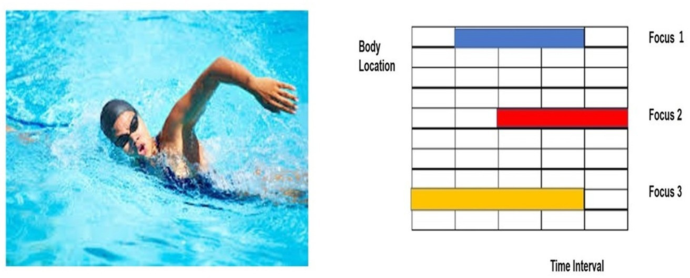
Thus, I developed Mahalanobis Distance-Pattern Approach. Let me explain how it works by taking swimming as an example (Figure 4).
Water changes continuously, so we cannot identify parameters and can- not apply mathematical approaches. But if we put wearable sensors on the swimmer, we can produce such data sheet as shown on the right.
P. C. Mahalanobis proposed Mahanalanobis Distance to remove outliers from his datasets for design of experiments. But it can be used for another purpose. As MD is ordinal scale distance, we can prioritize our decisions.
As the Real World hanges from moment to moment, just as water does, we need to adapt to the rapidly changing environments and situations. In the Industrial Society, which is product-based, quantitative and objective evalua- tion was important. This is Euclidean Space Approach. Datasets are required to be orthonormal and distance is cardical scale with unit.
But to cope with the rapidly changing, unexperienced environments and situations, we need to make decisions what actions to take and as the enviro- nemtns and situations are unexperienced, we need to make decisions by trial and error.
When MD is decreasing, it means that we are approaching our goal. If it is increasing, then we need to change movements. As each row represents each muslc at its location, we can calculate MD between T1 and T2. If MD is decre- asing, then we are moving the muscle in the right way. If MD is increasing,
Figure 4: Mahalanobis distance-pattern approach.
Enjoy Life From Within: A Proprioception Way 109
we need to change its movement. Thus, we can grasp which muscles are wor- king appropriately and which ones we need to change. Thus, we can grasp the whole picture of our body movement. How we coordinate our muscles and balance our body to swim is left to Instinct. But this MDP Approachpro- vides the guidelines for Instinct and facilitate self-learning. By this way, we can self-learn to swim in much shorter time.
As MDP Approach is a support tool for Instinct to make decisions, it can be used for many different application such as business, etc. It should be pointed out that this realizes Self-Actualization. And as Maslow and Deci & Ryan pointed out we can get the maximum happiness and the sense of achievement.
In short, we can realize self-sustaining and self-satisfying society. Such a society will free us from issues of decreasing workforce, excessive consum- ption of energy, etc. and let us enjoy our life in our own way without hurting nature.
REFERENCES
Bernstein, Nikolai, A. (1967) The co-ordination and regulation of movements, Oxford, Pergamon Press. Deci, Edward, L., Ryan, Richard. M. (1985) Intrinsic motivation and self-
determination in human behavior (Perspectives in social psychology), New York, Springer. Mahalanobis, Prasanta. C (1936) “On the generalized distance instatistics”, Proceedings of the National Institute of Science of India, Volume 2, No. 1, pp. 49–55. Maslow, A. H. (1943) “A theory of human motivation”, Psychological Review,
Volume 50, No. 4. pp. 370–396. Piaget, Jean. (Retrieved 2023) https://en.wikipedia.org/wiki/Jean_Piaget. Taguchi, Genichi., Chowdhury, Subir., Wu, Yuin (2000) The Mahalanobis-Taguchi System, New York, McGraw-Hill.
LISTED IN THE AHFE DIGITAL BOOKSTORE CATALOGUE
Explore the complete digital volume
Affective and Pleasurable Design
Read this individual research paper free through the original publisher, or explore the full digital proceedings book.
ISBN 978-1-958651-47-6
Explore this ISBN in the AHFE Bookstore ↗Listed in the July 2026 bookstore catalogue; search by ISBN to confirm current availability · Digital book purchase optional