Shuichi Fukuda (2024). Increasing Importance of Body Intelligence-The Age of Feeling. In: Affective and Pleasurable Design. AHFE Open Access, vol. 123, pp. 239–244. https://doi.org/10.54941/ahfe1004696
Changes in our world is occurring rapidly, with yesaterday's changes being smooth and predictable, while today's changes are sharpt and unpredictable, Therefore,, it is essential to be context-aware at all times, as immediate decision-making is crucial. Sensation and feeling , rather than reason, play a significant role in the process, with germplasm being a necessary component.
This paper discusses how our world changes with time. At the start of the century, i.e., about 20 years of each century, new world starts “Culture” and with time this “Culture” grows into “Civilization”.
The big difference between “Culture” and “civilization” is “Culture” is focused on “Process”, while “Civilization” is focused on Products. In each Century, early years are spent for establishing “Culture” which agrees with the environments and situations of that century. And about half of the century, this “Culture” gets mature and turns into “Civilization”.
As “Culture” is “Process-centric”, the challenge itself generates value. It is not the outcome, but how you can enjoy the process is important.
Among living things, only humans can think about the future. Yes, we can dream and we would like to make our dreams come true. We, humans, live for tomorrow. But other animals live for today. They do their best to adapt to the current environment and situation. Thus, the species of one animal is adapted to the today’s environment and situation. Therefore, when the environment and situations change, they cannot adapt to the new context. Thus, such species die out.
But humans live for tomorrow and our dreams are different from person to person, because our body builds and how we move our body and how we think are very much different from person to person. In other words, humans are diverse, while other animals are homogenous if the species are the same. This is the reason why human living area has expanded so much on earth.
“Culture” is in essence “diverse”. We mix them up and breed “new Cul- ture” as the Century shifts to the next. And around half of the century, we brush them up to “Civilization”. While “Culture” is looking for diversity,
“Civilization” is going the other way. We move toward sharing our world, i.e., community. To achieve this goal, we must develop tools for sharing.
Computer is the tool to achieve this purpose. But current computers pro- cess data on the 0–1 basis. In other words, black or white. But as we know well, most of our world is gray. The color of gray varies with the environment and situation.
The main purpose of this paper is to point out the importance of the gray world.
We make decisions in this gray world. In fact, our world is changing from second to second. The importance of “Digital Processing” is emphasized today, as the fact that he word “DX (Digital Transformation)” is attracting wide attention indicates. But we must remember that in our daily life, every- thing varies from moment to moment. Thus, how we can interact directly with the outside world and make appropriate decisions to cope with its changes becomes increasingly crucial.
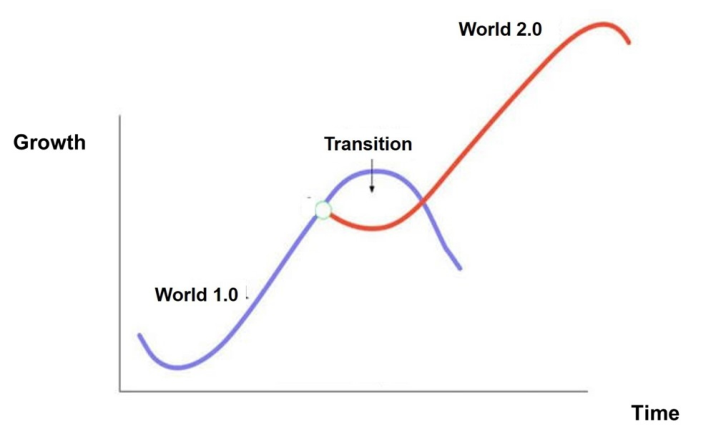
WORLD CHANGES WITH TIME World changes from one to another with time (Figure 1).
Figure 1: Changes of world with time.
As humans live for tomorrow, we would like to make our dreams come true. In the old days, we had no tools other than our bodies. Thus, we made efforts to make the most of our bodies. Body movements is important in the different sense from the animal needs.
BIG CHANGES OF THE REAL WORLD
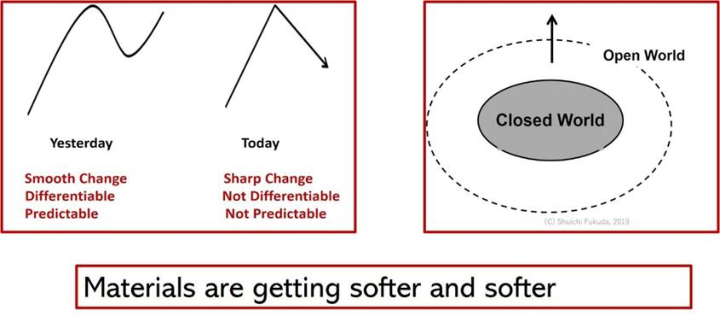
Figure 2 shows how the Real World is changing today.
Increasing Importance of Body Intelligence: The Age of Feeling 241
Figure 2: Changing real world.
There were changes yesterday. But these changes were smooth, so that we could differentiate them and could predict the future. But today, they became sharp. So, we cannot differentiate them anymore. Tomorrow becomes unpredictable.
And yesterday, we lived in a closed world with boundary. But now our area of activity expanded tremendously. Boundary disappears and our world become open. Therefore, it becomes extremely difficult to apply mathematical approaches.
Further greater change is products are getting softer and softer with the progress of material engineering. Yesterday, products were hard as the fact that they were called “Hardware” indicates. But today they are “Software”.
As products were hard, we could identify what it is and how to handle it with our eyes alone. And even from a distance. But today they become soft, so we need direct interaction. When we try to pick it up and if it does not work, then we need to scoop it.
MOVEMENT IS INDISPENSABLE FOR LIVING Living things are called “Creatures”, because living things create movement to survive.
Movements are divided into two. One is external called “Motion” and the other is internal called “Motor”, which includes movements of muscles, etc. Bernstein studied motion and clarified that at first stage our motion trajec- tories vary each time. But as we get close to the target object, our muscles harden and move together with our skeleton. Thus, we can easily “Control” our movement.
Then, why does our motion vary each time? It is to adapt to the changing environment and situation. To adapt to its change, we “Coordinate” all of our body parts (Bernstein, 1967).
In the case of other living things, they live for now and their environments and situations do not change much. So they learn to control their movement
242 Fukuda
and this works. But in the case of humans, our world is expanding and we live for tomorrow. So we cannot “Control”our world. We need to “Coordinate”.
Thus, when the environment and situation of the Real World changes, animals which adapted to the current context become extinct.
That is why “Control” was a key idea yesterday. But today, as the word “VUCA” indicates, our world is full of Volatility, Uncertainty, Complexity and Ambiguity (Bennis and Nanus, 1985) idnicates, we need to shift from “Control” to “Coordination”.
HUMAN NEEDS Maslow clarified “Human Needs” (Maslow, 1943). He pointed out that the final need of humans is “Self-actualization”. At first, we made efforts to sat- isfy material needs just in the same way as animals do. But with time, human needs shift from material to mental. And at the final stage, we, humans, would like to actualize ourselves. As our body builds, our movements, etc. vary widely from individual to individual, human world is truly diverse. So no matter how the Real World varies, there are humans who overcome these changes and survive. Thus, no matter how the Real World varies, human species never become extinct.
Maslow’s Human Needs is clarified in his “Human Motivation” paper. And about 40 years later, Deci and Ryan proposed “Self-Determination Theory” (Deci, Ryan, 1985). They pointed out that humans get the maxi- mum happiness and the feeling of achievement, when we do the job we wish to do. And no external reward can provide this maximum happiness.
The Industrial Society introduced “Division of Labor” to increase produc- tion efficiency and it brought The Industrial Society. Thus, in the Industrial Society we work for others and our need as humans is not fully satisfied.
Come to think, in the old days, we worked for ourselves. We challenged to make our dreams come true. As humans, we enjoyed the maximum hap- piness. But the Industrial Society brought forth very convenient world, but it took our maximum happiness away. And the Industrial Society, World 1.0, is getting close to its end and many issues such as decreasing workforce, excessive consumption of energy, etc. are emerging.
So, it is time now to design and develop the next world 2.0. But we need to remember that although ChatGPT, Generative AI, etc are getting wide atten- tion today, these tools consumes a lot of energy. And beside, the population is decreasing.
To cope with this difficulties, we can look back into world 0.0. We enjoyed challenging individual by individual. So the number of people does not matter. Each can sustain each life and enjoy. Energy is consumed in a very small amount just for self-sustaining and self enjoyment. But our life as a human is fully satisfied.
IMPORTANCE OF INSTINCT Come to think, what do we have to overcome these difficulties. We need to do it all by yourself alone. To deal with this problem, it is necessary to switch
Increasing Importance of Body Intelligence: The Age of Feeling 243
from the interval scale (one, two, --) that was the basis of industrial society to an ordinal scale (first, second, --) that is based on one’s emotions and value judgments.
MAHALANOBIS DISTANCE FOR PRIORITIZATION To introduce ordinal scale, Mahalanobis Distance works very well. Maha- lanobis developed Mahalanobis Distance (MD) to remove outliers. He is a researcher of design of experiments and in order to brush up his data, he developed MD. We can prioritize the removal of outliers. So, instead of removing, we use MD to prioritize our decision making.
MAHALANOBIS DISTANCE-PATTERN (MDP) APPROACH To support “Instinct”, Mahalanobis Distance-Pattern (MDP) Approach is developed.
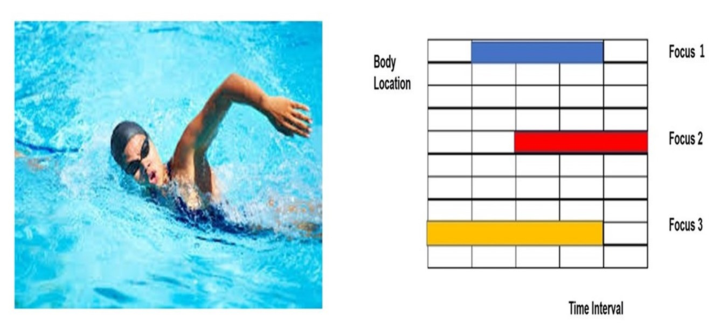
To make it easier to understand, let us take swimming as an example. In swimming, water changes continuously. Its changes are just the same as those of the Real World. We put wearable sensors on the swimmer. Then, we can obtain a table shown on the right of Figure 3.
Figure 3: Mahalanobis distance-pattern approach.
Each row corresponds to each muscle at that location and horizontal axis is time elapsed. We calculate MD for each row. If MD decrease, then that muscle is moving good. If MD increases, then you need to change the movement of that muscle.
In this way, we can support Instinct to help it make decisions. As horizontal axis is time elapsed. we can evaluate distance, and by dividing this distance by time elapsed, we can obtain speed and acceleration. Thus, we can grasp the movements of the muscles holistically and we can learn how to swim. In this way, you can learn how to swim according to your individual body.
244 Fukuda
CONCLUSION AND NEXT STEP The world 1.0 of the Industrial Society today is coming to an end and it is time now for us to design and develop the world 2.0 for tomorrow, which does not need much energy and a large number of workers.
In order to achieve this goal, a self-sustaining world which satisfy our human needs and satisfy us to the maximum is desired.
We realized that physical or body sensation plays a very important role in our life and our well-being as a human, and instinct plays an important role in our decision-making. Therefore, in order to move ahead in this direction, we developed a tool to help instinct make decisions immediately and effectively.
REFERENCES
Bennis, W, Nanus, B, (1985) Leaders: Strategies for taking charge, New York, Harper & Row. Bernstein, Nikolai (1967) The coordination and regulation of movements, Oxford,
Pergamon Press. Deci, E. L., Ryan, R. M. (1985). Intrinsic motivation and self-determination in human behaviour. New York, NY: Plenum. Maslow, A. H. (1943). “A theory of human motivation”. Psychological Review,
Volume 50, No. 4, pp. 370–396.
LISTED IN THE AHFE DIGITAL BOOKSTORE CATALOGUE
Explore the complete digital volume
Affective and Pleasurable Design
Read this individual research paper free through the original publisher, or explore the full digital proceedings book.
ISBN 978-1-958651-99-5
Explore this ISBN in the AHFE Bookstore ↗Listed in the July 2026 bookstore catalogue; search by ISBN to confirm current availability · Digital book purchase optional