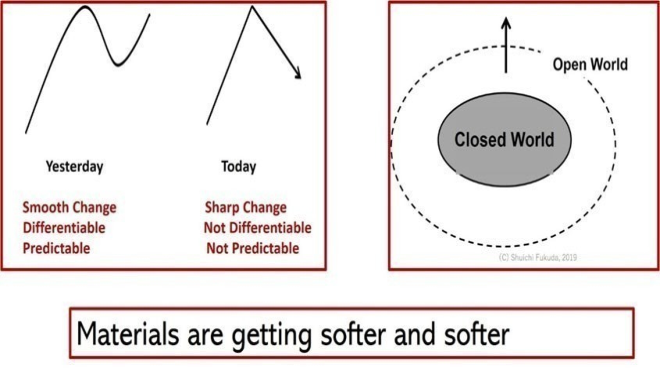
Today, our world changes drastically. Yesterday, however, changes were smooth, so we could differentiate and predict the future. Today, changes become sharp. So,we cannot predict the future. Yeseterday, our world was closed with boudnary , but todayour world becomes open. yesterday, materials or products were hard so we could apply mathemacial approaches and control them/. Today, materials are getting softer and softer with the progress of material engineering. When things were hard, we could understand what it is and how we should handle it with our eyes alone. But today, we need to interact with them directly. To cope with such drastically changing real world, we need to coordinate all parts, Our current world is the Industrial society, which is based on quantitative and reasonalble evaluation/ In other words, it is based on Euclidean approach which is interval scale and cardinal based. But human needs shifts from material to mental or from product to emotion. And Maslow pointed out "Self-Actuatlization" is our final need and Deci and Ryan proposed Self-Determination Theory and we get the highest satisfaction and feeling of achievement, when we do the job we wish to accomplish and in our own way. They also pointed out this is very important for our growth. The Industrial Society is getting close to its end and now we need to design and develop the next Society. In a word, our world is changing quicklly to the world of "Self". How we can enjoy our life in our own way becomes cruciallly important. As materials are getting softer and softer, we need to develop a tool to deal with physically soft world. The world focusing on musculoskeltel system and processing externally obaservable movement is going out.We need to consider how our internal body parts such as muslces move to respond to the radicallly changing Real World. In short, we need to shift from Digital to Analog. We need AnalogIntelligence, which is the next AI. To achieve such a goal, our instinct plays a very important role. Therefore, we developed a Mahalanobis-Distance approach to support our instinct in orderfor it to fully coordinate our Motor (Internal Movement) movents.
Yesterday, changes were smooth, so we could differentiate them so that we could predict the future. Today, changes become sharp. So, we cannot predict the future. Yesterday, our world was closed with boundary, but today our world becomes open. Yesterday, materials or products were hard so we
Mahalanobis Distance-Pattern Approach to Body Coordination in Motion 903
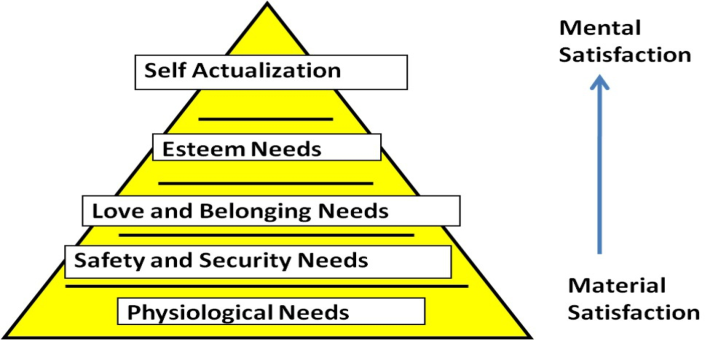
Figure 1: World is changing.Figure 2: Maslow.
could apply mathematical approaches and control them. Today, materials are getting softer and softer with the progress of material engineering.
When things were hard, we could understand what it is and how we should handle it with our eyes alone. But today, we need to interact with them directly. To cope with such drastically changing Real World, we need to coordinate all body parts.
Our current world is the Industrial society, which is based on quantitative and objective evaluation. In other words, it is based on cardinal Euclidean approach. It requires orthonormality and interval scale distance with unit.
Abrahalm Maslow pointed out that human needs shifts from mate- rial to mental or from product to emotion (Figure 2). He pointed out “Self-Actualization” is our final need (Maslow, 1943) and Deci & Ryan pro- posed Self-Determination Theory (Deci and Ryan, 1985) and they made it
904 Fukuda
clear that we get the maximum satisfaction and the highest sense of accompli- shment, when we do the job internally motivated and self-determined. They also pointed out this plays an important role for our growth.
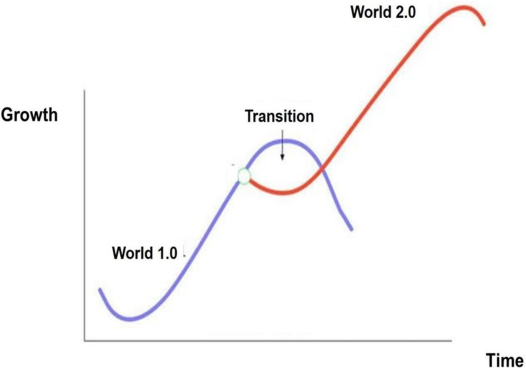
Figure 3: Growth curve.
As Figure 3 shows, our world shifts from one world to another. Current Industrial Society is known as World 1.0 here. But it is getting close to its end and many issues are emerging such as decreasing labor force, excessive consumption of energy, etc. Therefore, it is time now to prepare for the next world “World 2.0”.
HOW CAN WE SOLVE THE ISSUES OF THE INDUSTRIAL SOCIETY?
The issues of the Industrial Society is not easy to solve. The decreasing labor force comes from the decreasing childbirth, but even if we try to increase childbirth, it takes times. And although in developing countries, the popula- tion is increasing, the current technology has developed too much and their literary does not satisfy these needs.
Thus, we need to solve the problem by developing another solution. What would it be? Let us get back to the starting point. Why has the human world expanded so much? it is because humans can think of the future. Animals live for now. But humans live for tomorrow. We would like to make our dreams come true. This is how engineering started. We, Humans are growth oriented, so we aim for higher levels of achievement. That is why we fell deeper and deeper into the depth of material richness. Let us think what value is important for us, humans.
VALUE VARIES WIDELY, DEPENDING UPON HOW YOU LOOK AT IT AND HOW YOU FEEL Living Things are called “Creatures”, because we “Create Movement to Survive”. Movement is essential for living things. So, let us consider the human movement.
Mahalanobis Distance-Pattern Approach to Body Coordination in Motion 905
Human movement is divided into two: One is external movement called Motion. The other is called Motor, which is movement inside of us, such as muscles.
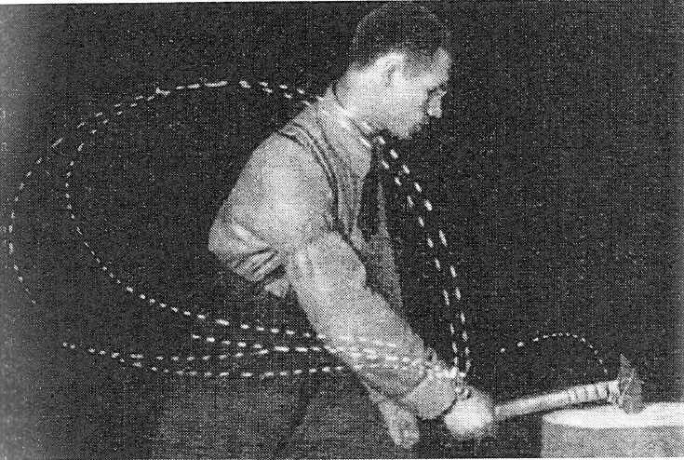
Nicholai Bernstein clarified the characteristics of Motion trajectories (Bernstein, 1967), (Figure 4).
At first our motion trajectories vary widely from time to time, but when we get close to our target object, our muscles harden and move together with our skeleton, forming a musculoskeletal system. Thus, it is easy to identify parameters and apply mathematical approaches. In short, we can “Control” our trajectories.
Then, why our motion trajectories vary so much at the early stage? This is because we need to adapt to the changing environments and situ- ations. We need to coordinate all body parts to balance our body to cope with these changes. Yes. we need to mobilize not only Motion but Motor as well. In fact, the movement of muscles play a crucial role at this stage.
To describe this in another way, what is valuable to us is how we can coordinate Motion and Motor to adapt to the changes. We have been pur- suing the results, so that we paid attention to “How”. But come to think, what is important in dreaming is a challenge. Challenge is the core and mainspring of all human activities. If we really make our dreams come true, then that’s the end. But if we note that challenge is important. we can chal- lenge again and again to make the cream come true. Thus, the “Process” is important.
If we notice how challenge is important for us, then, we will open up the new horizon.
Figure 4: Motion trajectories.
906 Fukuda
FROM DIGITAL TO ANALOG Today, DX (Digital Transformation) is getting wide attention. But if we note that when the Real World is changing drastically, we need to move from Digital world to Analog world. In fact, if we are going to coordinate all body parts, we need to mobilize muscles, which is analog.
Until now, apart from computing, we have relied on knowledge, which is a structured accumulation of our personal experience. One disadvantage is it is very much person and another disadvantage is it is digital. When, the changes become sharp, we need to anticipate what will come next and must be prepared for that. But knowledge is an assembly of discrete experiences, so we cannot predict the future. In other words, it is discrete mathematics. So, it is very much compatible with the current 0-basis computing.
But to solve the issues related to the Industrial Society, we need to shift our attention to “Emotion” and “Blood” and “Heart” play important roles as described above.
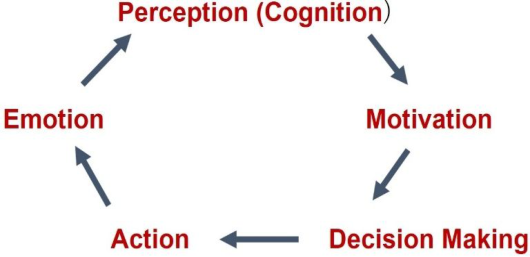
And we must note that “Emotion” and “Motivation” come from the same Latin “Movere”. Thus, we are living in such a way as shown in Figure 5. We perceive the Real World and then motivated and take actions to move out into the Real World to satisfy our “Emotion”. “Emotion” means “e = ex+Motion”. Thus, “Emotion”means to move out into the Real World. We must note that we often misinterpret the word “Artificial”. We think it is a fight against “Nature”. No. This is completely wrong. “Artificial” means the “Art” of living happily with “Nature”.
Jean Piaget proposed Cognitive Development Theory (Piaget, n.d.), and he clarified babies directly interact with the Real World and learn how to cope with it until two years old. In fact, babies learn to crawl, walk and speak within two years after they are born. They learn them all by themselves. How can they? It is inborn intelligence, i.e., Instinct. We have ignored “Instinct” up to now. Even when we talk about Engineering. We forgot to distinguish Engineering from Technology.
Engineering is our challenge to make our dreams come true. But what matters is the process of challenging. Not the outcome. Even if the challenge does not succeed. It means the failure brings us another happiness. To deve- lop another way of challenging. Thus, it creates another dream. Failure in
Figure 5: PMDAE cycle.
Mahalanobis Distance-Pattern Approach to Body Coordination in Motion 907
Engineering is not failure in the common sense. What it means is to “Learn from failures”. We repeat this process of Perceive = > Motivated = > Make decision = > Act=> Check emotional satisfaction. Thus, we enjoy challenging (Figure 5).
Technology, however, is very much different. It is to demonstrate how our idea can be truly and physically realized. Its value is based on quan- titative and objective evaluation. Thus, Technology expands in Euclidean Space, which requires orthonormality and interval base scale with unit. But we must note that “Unit” comes from our physical experience. Weight, for example, comes from our physical experience of lifting up. Length comes from our experience of walking. Thus, why we need to create movement to survive is to understand Nature and to live happily with it. Not to fight against.
In fact, in medical fields, we know very well blood flow plays a crucial role in diagnosis. True death is sentenced after our heart stops working and blood stops circulating. Even after our brain stops working, we can transplant our body parts to someone else. Attention is focused on the brain, but we need to reaffirm the importance of the heart. Remember Wordsworth’s poem “Our heart leaps up when we behold a rainbow in the sky”. If you let your heart be truly active, even the elderly will become mentally active and live dreaming of tomorrow. In fact, some people have lived up to 120 years old.
HOW CAN WE USE OUR INSTINCTS?
To coordinate all body parts including muscles, etc. we have to be physi- cally aware. The problem is, therefore, how we can. What becomes crucially important is to recognize the context holistically.
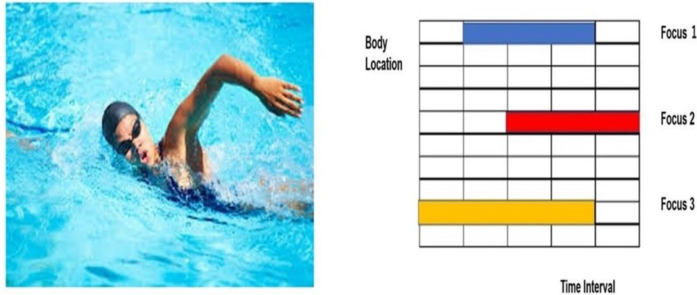
Let us take swimming as an example. Our body builds are different from person to person and the way we move our muscles also varies from one to another. And water changes continuously. So it agrees with the current drastically changing Real World.
Fourier Transform provides the answer to what is needed to make the most of our Instinct. When we pay attention to temporal domain, we cannot under- stand what message the other party is trying to convey. But if we change our perspective to frequency domain, we can understand the message. In fact, we succeeded in detecting emotion from face by introducing cartoon face model after many trials of applying image processing techniques. Image pro- cessing techniques are processing in temporary domain. But around 2000, most cartoons are still images, but still we can easily understand the emotion of cartoon characters (Kostov, 2001). Cartoon conveys messages in frequency domain.
We can produce such data sheet as shown in Figure 6, by putting wearable sensor on the swimmer. Each row corresponds to each muscle at that location. And recognizing the similarity of holistic muscle pattern, we can understand how we should coordinate our muscles.
For muscle coordination, what becomes necessary is ordinal based appro- ach. We need to find our goal. “What” we should do becomes crucial. P. C. Mahalanobis proposed Mahalanobis Distance (MD) (Mahalanobis,
1936). He developed MD to remove outliners from his datasets for Design of Experiments. But if we note it is ordinal, we can utilize it another way. If MD is increasing, it means that we are getting away from our goal. If MD is decreasing, the current way of moving our muscles is in the right direction. Thus, we can support our Instinct to find out how to make the most of our muscles.
REFERENCES
Bernstein, Nikolai. (1967). The Co-ordination and regulation of movements, Oxford, Pergamon Press. Deci, Edward L., & Ryan, Richard M. (1985). Intrinsic Motivation and Self-
Determination in Human Behavior. Berlin, Springer Science & Business Media. Kostov, Vlaho, Fukuda, Shuichi. Johnsson, Martin. (2001), Method for Simple Extraction of Paralinguistic Features in Human Face, Image & Visual Computing, the Journal of the Institute of Image Electronics Engineers of Japan, Volume 30, No. 2, pp. 111–125. Mahalanobis, Prasanta Chandra. (1936). “On the generalised distance in stati-
stics”. Proceedings of the National Institute of Sciences of India. Volume 2 No. 1, pp. 49–55. Maslow, Alexander Harold. (1943). “A theory of human motivation”. Psychological Review. Volume 50, No. 4. pp. 370–396. Piaget, Jean. https://en.wikipedia.org/wiki/Piaget’s_theory_of_cognitive_development
Read this individual research paper free through the original publisher, or explore the full digital proceedings book.
ISBN 978-1-958651-87-2
Explore this ISBN in the AHFE Bookstore ↗Listed in the July 2026 bookstore catalogue; search by ISBN to confirm current availability · Digital book purchase optional