Shuichi Fukuda (2025). Another AI - Analog Intelligence. In: Human Interaction and Emerging Technologies (IHIET-AI 2025): Artificial Intelligence and Future Applications. AHFE Open Access, vol. 161, pp. 41–46. https://doi.org/10.54941/ahfe1005895
Al is often thought of as something artificial, i.e., the man made world. However, we should remember that prompts are important in Al. In short, what Al did is it simply expanded search space due to advances in computing machines. Decision-making on how to set up the search space and how to search, that is, the strategy, is instructed by humans. The same is true for generative Al. A decision must be made as to how to carry out generation and it is humans that make such decisions. The current computing is based on 0-1, so digitalization is emphasized, but the real world is analog. Digitalization streamlines processing and enables objective, quantitative evaluation. Because of the emphasis on digitalization, the brain is attracting attention. As humans play a large role in Al, let us think about humans. It is generally believed that humans make decisions using their brains. But brains structure body experience into knowledge. Thus, knowledge is very much personal and there is a delay.However, even in our daily lives, the real world is constantly changing. To accurately grasp these situations and respond appropriately, we need wisdom, not knowledge. Furthermore, the real world is analog.e is true for generative Al. A decision must be made as to how to carry out generation and it is humans that make such decisions. Humans are made up of cells. Digitalization is being discussed at a cellular level, so to speak. But to discuss what we should do to cope with the continuously changing real world and make appropriate decisions, we should consider at the level of humans. Then, how can we process analog world with wisdom? The current industrial Society is product-centric. So, quantitative, objective approach is important. But as Maslow pointed out, human needs shift from material needs to mental needs with time and at the last stage, we pursue "Self- actualization".. We will be pursuing our own personal capabilities. This is subjective and qualitative. In short, we should move from Euclidean to Non- Euclidean approach. Mahanalobis who is a researcher of design of experiments develooped Mahalanobis Distance (MD) to remove outliers. But from another perspective, MD prioritize our decisions. In other words, it shifts our pursuit from how to what and why. i.e., from tactics to strategy. In our previous research, we succeed in immediate detection of emotion from face introducing cartoon pattern approach. Its basic idea is to introduce MD and pattern to make appropriate decision for analog objects. Here, this idea of Analog Intelligence is described.
Come to think, only humans create society. Animals world changes but it is only to adapt to the changes of the outside world.
So, let us consider how human society has been created as the current Industrial Society is coming to its end with many issues emerging. The greatest issue of them all is the excessive consumption of energy. Our energy resources are running out and we cannot sustain the current Industrial Society anymore. It is time now to consider and prepare for the next society,
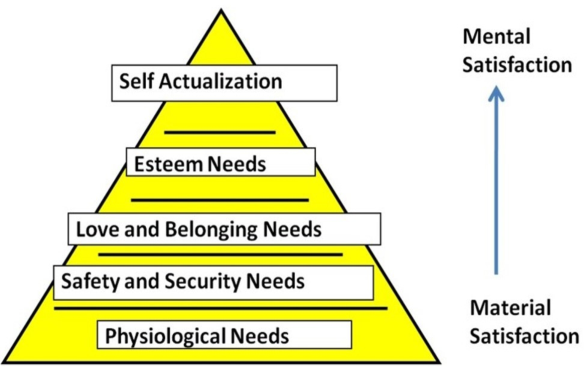
HUMANS AND ANIMALS—THEIR DIFFERENCE So, let us consider how humans and animals are different. Abraham Maslow made human needs clear (Maslow, 1943), (Figure 2).
Figure 2: Maslow’s human needs.
At first, humans and animals look for material satisfaction. Both need to satisfy their basic needs of food and loading. But once these material needs are satisfied, humans come to pursue mental (emotional) satisfaction. Animals, on the other hand, do not.
This difference comes from the fact that animals are four-legged. Humans used to be four-legged, but in the old time, we released two legs and changed them into arms. In the case of 4 legs, the center of gravity of the body is fixed. But when we started to stand up and walk, we were freed from this restriction.
Now that our center of gravity could move freely, we became able to move body more and more freely, from arms to hands and then to fingers.
Digital vs. Analog DX is getting wide attention these days. But the reason is that current computer processing is based on 0-1. We should remember that our world is changing every minute.
Another AI: Analog Intelligence 43
Thus, living things are called “Creatures”, because we create movement to survive. Movement is indispensable for our living. Knowledge processing has been considered important until today. But knowledge itself is a structured accumulation of personal experience. Only knowledge used in the field of computing stays the same and does not change. It is because the current computing is based on 0–1 basis.
AI is getting wide attention these days. But the current AI is, in short, making the most of the tremendoues space of search space created by the progress of computer hardware. Its goal is provided by the prompt.
We should also remember that our death is sentenced when our heart stops working. When our brain stops working, death is not announced. And further, we should remember that in medical diagnosis, blood flow plays an important and crucial role.
What is important in Maslow’s research is that we, humans, look for mental (emotional) satisfaction and it is “Self-actualization”. Our body builds, and how we move ourmuscles are different from person to person. Freedom from body constraints Freed from constraints, we are now able to construct a more diverse world and create a new society.
We were surprised when we find out that octopuses are not eight-legged, but their legs are only two and the other seemingly legs are arms. In vertebrates, only humans and some apes can recognize themselves in mirrors. But octopuses are only invertebrate that can recognize themselves in the mirror. Their heads are large, but their brain is small. It is the size of a dog. Dogs cannot recognize themselves in the mirror. Octopuses are known as the expert of escape. Indeed, they can escape even from a screwed container. They escape by trail and error. But it is not carried out in a random manner. They achieve the goal by avoiding the meaningless repetition. Their way is truly “Pragmatic”. Octopus is a symbol of “Pragmatism “ (https://en.wikipedia.org/wiki/Pragmatism).
“Pragmatism” is not “Knowledge”, It is “Wisdom”.
Knowledge vs. Wisdom The greatest difference between knowledge and wisdom is there is time delay in processing knowledge, while wisdom does without any delay. Immediate action can be taken in the case of wisdom.
Knowledge is a structured experience of individuals. Therefore, knowledge is very much personal. We should be aware that knowledge used in computing and that used in our daily life are totally difference. Knowledge used in current computing is based on the current computing based on 0-1. It is digital. That is why DX is considered important.
Knowledge used in our daily life, on the other hand, is analog. Knowledge in the current computing is, so to speak, the discussion of fuels. But what becomes important these days is humans. Humans are analog and the environments around us are all analog. Even the current AI needs “Prompts”. What the current AI provides is quantitative, objective and reproducible information. It is tactics, i.e., how.
44 Fukuda
What is truly needed in this drastically changing society is strategy, i.e., subjective, qualitative evaluation. We need to make the most of our instinct. We must consider what and why.
Analog Intelligence: How to Process It Here is the newly developed approach to process Analog information.
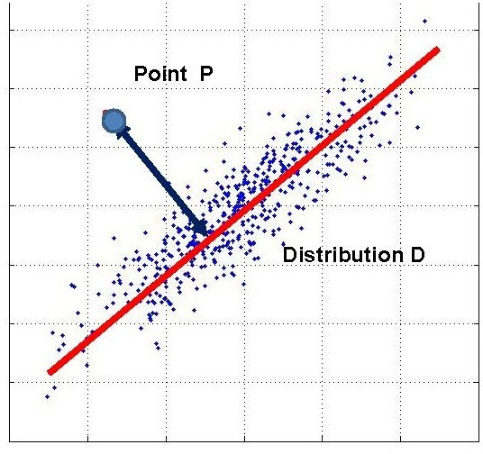
Mahalanobis Distance P. C. Mahalanobis, Indian researcher in the field of design of experiments developed Mahalanobis Distance (MD) to remove outliers from his data set (https://en.wikipedia.org/wiki/Mahalanobis_distance).
As the current society is a product-based Industrial Society, Euclidean approach has been applied It requires orthonormality and units. The evaluation is based on interval scale.
But the purpose of developing MD is to remove the outliers from such Euclidean dataset. MD just provides a distance from the individual data (Figure 3).
Figure 3: Mahalanobis distance.
Thus, Non-Euclidean evaluation was introduced. And we should note that MD can be used for ranking our decisions.
Pattern We used to challenge the issue of detecting emotion from face. We tried many approaches, but they took too much time and did not produce satisfactory results. During these challenges, Shuichi Fukuda suddenly realized that we
Another AI: Analog Intelligence 45
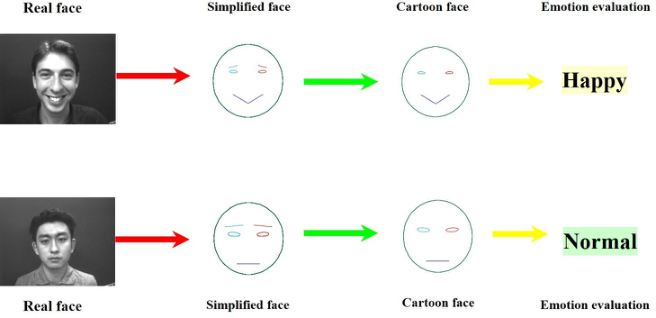
can detect emotion of characters in cartoons. It does not take time. We can immediately understand their emotions.
So, we created a model of human faces and compared them with cartoon patterns. Then, we can immediately detect emotion from human face (https://www.jstage.jst.go.jp/article/jsmec/44/2/44_2_515/_pdf), (Figure 4).
Figure 4: Detection of emotion from face.
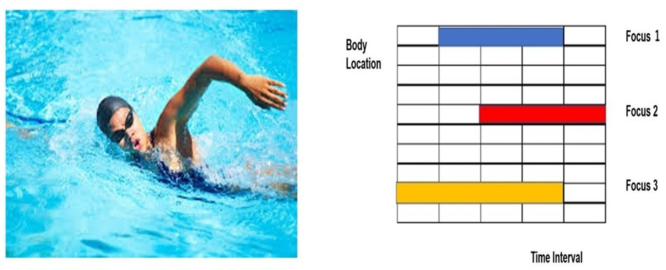
Malahanobis Distance-Pattern (MDP) Approach We combined MD and Pattern and makes it possible to process analog information. Let us explain how it works using swimming as an example (Figure 5).
Water changes every minute. So, we cannot express it mathematically. This is the same situation as that of the real world.
Our body builds and how we move our muscles vary from person to person.
So, we have no choice but to learn swimming on our own.
46 Fukuda
But if we put wearable sensors on the swimmer, we can produce such a table on the right. Each row corresponds to each wearable sensor at its location. Thus, we can obtain distance between time t1 and t2 and by dividing it by this time length we can obtain speed and again by dividing it, we can obtain acceleration. So, we know how we are moving our muscles.
Compare two tables, if MD is decreasing, we know we are moving the muscle in the right way and if it is increasing, then we need to change the movement of that muscle.
This way we can learn on our own how to swim. Although this is swimming, we can apply this approach to all human activities such as business, sports, etc.
The current Industrial Society is product-based. So, users are considered just as consumers. But users would like to be customers. They would like to customize their things in their own way. Recently, CX (Customer Experience) is getting wide attention. MDP approach enriches CX.
REFERENCES
https://www.jstage.jst.go.jp/article/jsmec/44/2/44_2_515/_pdf https://en.wikipedia.org/wiki/Mahalanobis_distance https://en.wikipedia.org/wiki/Pragmatism Maslow, A. H. “A theory of human motivation”. Psychological Review. 50 (4), (1943): 370–396.
LISTED IN THE AHFE DIGITAL BOOKSTORE CATALOGUE
Explore the complete digital volume
Human Interaction and Emerging Technologies (IHIET-AI 2025): Artificial Intelligence and Future Applications
Read this individual research paper free through the original publisher, or explore the full digital proceedings book.
ISBN 978-1-964867-37-3
Explore this ISBN in the AHFE Bookstore ↗Listed in the July 2026 bookstore catalogue; search by ISBN to confirm current availability · Digital book purchase optional