Shuichi Fukuda (2025). Toward Motivation-igniting Society. In: Intelligent Human Systems Integration (IHSI 2025): Integrating People and Intelligent Systems. AHFE Open Access, vol. 160, pp. 720–727. https://doi.org/10.54941/ahfe1005878
The current Industrial Society was introduced by the Industrial Revolution, which is developed to satisfy our material needs. But what characterized humans is we changed four legs to two legs and started to walk. Thus, we were By escaping the constraints of having four legs, that is, the situation in which the center of gravity of the body is fixed, the center of gravity of the body can now be freely moved, which means that the body balance can now be freely selected. Thus, we became able to move the two legs, which had become hands, freely, and unlike when we had four legs and was only able to engage in activities that suited the current environment and situation, it was now able to create the environment and situation that it desired. Thus, it became possible to dream the future and we made efforts to make our dreams come true. But what we pursued was to satisfy our material needs. When we were four-legged, we could not satisfy our material needs such as food and lodging as we wish. In four-leg days, we were only able to take measures within the current situation. But by standing up and walking, we are now able to take diverse actions As we became free to move and it became easier to satisfy our material needs, our material needs became increasingly sophisticated. However, as Maslow pointed out, humans are not satisfied with just the fulfillment of their material needs, and over time they begin to desire the satisfaction of their spiritual needs, and as he pointed out, ultimately we aim for self- actualization.Deci and Ryan proposed Self-Determination Theory and they pointed out that we get the maximum happiness and the feeling of achievement, when we achieve the job in our own way, which is internally motivated. In the Industrial Society product matters, so productivity and product performance were important. Therefore, we introduced mass production and we paid our efforts to improve product performance.Industrial society satisfied our material needs but not mental needs, and as everybody knows, society shifts from one to another. The industrial society is coming to an end, and various problems emerge. The biggest problem is excessive energy consumption. We cannot keep supplying it. AI has been discussed as a solution, but AI also consumes a huge amount of energy.Another big problem is aging is progressing rapidly in the developed countries. In the developing countries, population is increasing, but they have a problem of literacy, so we cannot secure workforce.Thus, we need to design and develop a new society for the next generation.The important point in the above discussion is how we can make our life self-sustaing and make our dreams come true. In the current product- centric ndustrial Society, objective quantification is important. But to achieve Self-actualization, what is needed is subjectiveness. It is qualitative, but we need to make decisions. It is a matter of strategy. The current society looks for better techniques.To express it another way, our society now is running on Euclidean approach. But next society calls for Non-Euclidean approach. So, we introduced Mahalanobis Distance and using this measure, we classified patterns, which we used for detecting emotion from face and succeeded in immediate detection. In short, it enables us to look forward to tomorrow with great enthusiasm, hoping that things will progress even further. Therefore, even the elderly can live looking forward to tomorrow.
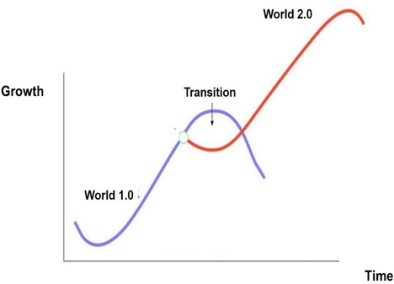
World 1.0 indicates the current Industrial Society. As it is coming close to its end, it is time now to design and develop the next society World 2.0. What we should do and how we can achieve this purpose is the topic of this paper.
WHAT CHARACTERIZES HUMANS World 0.0 is the society previous to World 1.0. But the human world and the animal world are completely different. So let’s start by thinking about how humans are different from animals.
There are many different types of animals, but here I would like to compare animals with four legs with humans. In ancient times, humans also got around on four legs. But maybe just like apes, humans came to stand up and started walking. They stood up on hind legs and let front legs free.
There are a little difference between apes and monkeys. Apes form societies, but monkeys do not particularly seek to form societies. So, let us compare apes and humans with four legged animals. I am not a zoologist, but a mechanical engineer, so I would like to discuss the issue from that perspective.
In the case of four-legged animals, the center of gravity of their body id fixed. Therefore, there is very little freedom of movement. We need to think about why living things are called “Creatures” in English. It comes from “Create movement to survive”. Therefore, many four-legged animal species will become extinct if the environment changes drastically. In other words, four-legged animals can only do their best to adapt to their current environment. However, by transforming their two front legs into hands, humans became able to freely change the center of gravity of their bodies. In other words, it became possible for them to move freely and to flexibly respond to changes in the environment. Therefore, although humans initially tried to satisfy the physical needs of food and lodging just like four-legged animals, they became over time primarily engaged in mental activities and try to realize their expectations by moving about in various ways. In short, four-legged animals live for now, but humans came to live for tomorrow. Humans can create the future.
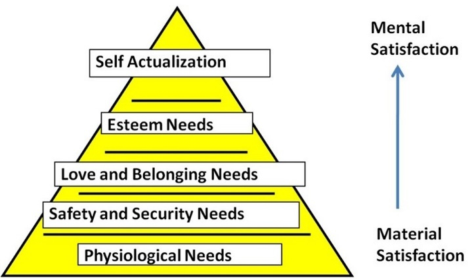
Abraham Maslow made human needs clear (Maslow, 1943), (see Figure 2).
Figure 2: Maslow’s hierarchy of human needs.
722 Fukuda
Maslow clarified human needs from the perspective of human motivation. So, I would like to consider the differences between humans and non-human animals from the perspective of motivation.
Animals other than humans can only live in the Tangible World in front of them. In other words, their motivation is derived from interacting with the real world.
That is to say, humans, like four-legged animals, are motivated by interaction with the tangible real world, but with two legs and the ability to move their bodies freely as they wish, they explore the intangible world. As a result, they are motivated to expand their own world, and move on to exploring the intangible world.
In short, the biggest difference between animals and humans is whether their motivation is tangible or intangible.
SELF-DETERMINATION THEORY After about 40 years later, Deci and Ryan proposed Self-Determination Theory (SDT) (Deci & Ryan, 1985). SDT points out that we, humans, are satified to the maximun when we do the job internally motivated and achieve it in our own way, i.e., they pointed out that intangible motivation plays a very important role in humans. They also added it is very closely associated with growth.
Indeed, we wish to grow. Growth brings us another world beyond the current tangible world.
WHAT ABOUT INVERTEBRATES?
The above discussion has focused on vertebrates. So, let us study invertebrates.
Then, you will be amazed to find out how excellent the capabilities of the octopus is. Octopuses are known to have eight legs, but in fact only two of them are legs and the remaining six are arms. Although octopuses have large heads, their abilities are on the same level as dogs.
However, octopuses are known to be “masters of escape”. They can escape from just about any environment or situation, even from a screwed container.
Of course, this is because they have suckers, but unlike humans, octopuses do not panic when they cannot cope with. They calmly deal with it through trial and error. And they do this trial and error with the least amount of effort, avoiding unnecessary repetition. In short, octopuses live their life on pragmatism ().
PRAGMATISM
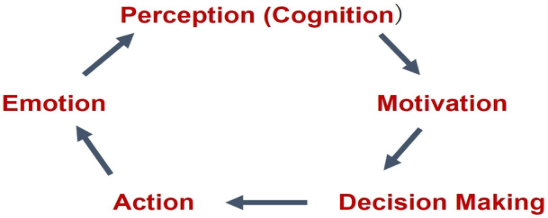
Figure 3 illustrates the basic idea of Pragmatism (2024) essence is Engineering, not Science. First, we perceive the current environment and situation. We became aware of them. Then, we are “motivated” and make a decision what action to take. If the outcome satisfies our emotion, then that’s fine. If not, we repeat the cycle until we are emotionally satisfied.
Toward Motivation-Igniting Society 723
We must note that this is very much subjective. Information is processed by trial and error. What matters is how we can avoid unnecesary trial and error and satisfy our emotion or expectation.
Science is objective. Reproducibility plays an important role. Ir ia tactivs. It pursues how. The process is importnat. But in Engineering, what matters is the outcome. And in Pragmatism, we do not care How or Reproducibility. If we can realize what we have on our mind, that’s excellent. Even if we cannot reproduce the process, it does not matter much.
EMOTION Let us discuss “Emotion”. We must remember “Emotion” and “Motivation” come from the same Latin “Movere”, i.e., “move”. Thus, “Emotion” means to move out that is to move out into the Real World to establish your own world.
Thus, when you carried out PMDAE cycle and if it does not satisfy your emotion, then you are motivated to repeat the cycle until your emotion is satified.
We must pay attention to the fact aht emotion is intangible. Maslow pointed out that human needs shift from tangible to intangible. Another important point we must keep on our mind is that the current Industrial Society is product-centric. In other words, the current society is composed of tangible things.
But what motivates us humans is intangible desire to make our dreams come true.
As the current tangible society is coming to its end and many issues are emerging. The greatest problem is energy is running out. We cannot sustain the current society anymore. We need to develop an intangible society.
Let us consider economy. The current economy is based on tangible assets. Banks provide loans based on tangible assets.
But, surprising enough, in Africa, you can buy products based on intagible “Trust”.
When you touch your smartphone to a store’s device, your credit rating is assessed and you can buy any item within the limits of your credit rating. This is intangible economy. We should develop such intangible economy and
724 Fukuda
society. Then, our society next will be self-sustaining and self-enjoying. This is nothing other than motivation-igniting society.
EMOTION EXPANDS YOUR WORLD IN TIME AND SPACE As the fact that Emotion and Motivation come from the same Latin word, “Emotion” motivates you to create your own world. This is what Maslow calls “Self-actualization”. And you would like to achieve this in your own way. This is what Deci and Ryan’s Self-Determination Theory.
Thus, many autonormous systems are being developed that can perform tasks with little human interaction. These efforts are also crucial in part because the rapid aging of the population means more people need this kind of support.
But, this is a response to “Decline”. Humans need “Growth”. Of course, there are also autonomous systems that help growth. However, most of them are based on digital intelligence. And they aim to artificialize brain activity. Thus, “Brain Intelligence” is getting attention.
We must remember Wordsworth’s poem, “Our heart leaps up when we behold a rainbow in the sky”. Emotion works in our “Heart”. Not in our brain.
In fact, true deatlh is sentenced when our heart stops working. Even when our brains stop functioning, our bodies continue to function.
FROM BRAIN-CENTERD DIGITAL APPROACH TO HEART-CENTERED ANALOG APPROACH From this perspective, this paper considers how to build a human-centered society and proposes one method toward this goal. Simply put, it is a perspective that considers emotion to be the source of life.
As emotion is so important. many autonomous systems are being developed. But they are paying attention to the brain. But brain processes “Digital Information”.
Remember Wordsworth Poem “Our heart leaps up when we behold a reainbow in the sky”. Emotions are related to our “Heart”, not “Brain”. Emotion is analog and “Heart” works in an analog way.
As pointed out, “Emotion” and “Motivation” came from the same Latin word “Movere”. i.e., movement. Our movement is analog. And we move to survive.
Remember that human world is quickly aging. Our next society will be full of seniors. Thus, while society is aging, human life spans are increasing, and the idea of a 120-year lifespan has begun to be emphasized.
Until now, we have thought that our life expectancy is 80 years, so how we spend the next 40 years has become important. Therefore, motivation to live these 40 years has become important.
We have spent the past 80 years working for society. However, the word “society” originally comes from the Greek word “friend.” In the next 40 years, we must make true friends and associates and build a new society.
Toward Motivation-Igniting Society 725
CHANGING COMMUNICATION In order to make friends, you need to communicate. Until now, society has been based on words. However, in fact, we, or rather animals, communicate primarily through movement. The word “Visualization” is often used. This is because images play an important role in helping us understand our environment and situations.
Elderly people in particular may forget words (the name of the person the name of a place, etc.), but they do not forget images. Therefore, to put it simply, it is expected that from now on image communication, rather than verbal communication, will play a more important role.
Until now, robots have given instructions, but from now on they will be able to observe people’s movements and provide the necessary support.
IMPORTANCE OF PATTERN Psychologically, images are deeply related to pattern recognition. We used to carry out reseach on detection of emotion from human face. We tried many techniques of image processing, but they took too much time and did not produce satisfactory results.
As Fukuda’sc team ontinued to take on these challenges, Fukuda realized that when he look at cartoons, he can instantly understand the emotions of the characters.
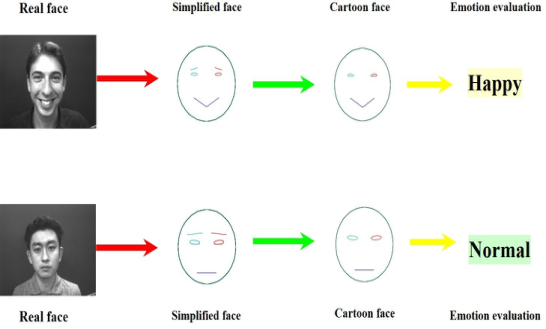
They then created patterns of human faces and compared them with cartoom patterns. Then, they could instantly understand human emotions (Kostov & Fukuda, 2003), (see Figure 4).
Figure 4: Pattern approach to detection of emotion.
IGNITING MOTIVATION Based on our previous discussions, a method to ignite motivation is developed. This approach is human-based, which makes it different from other autonomous systems.
726 Fukuda
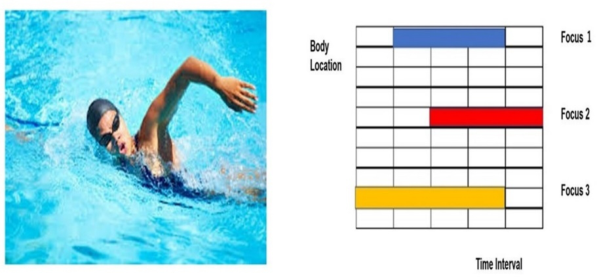
To make it easier to understand, let’s use swimming as an example. When you swim, the water around you is constantly changing, just like in the real world. Furthermore, each person has a different physique and the way they move their muscles is different. Therefore, there is no other way to learn swimming than by self-study.
If we attach wearable sensors to a swimmer who is trying to learn to swim, we obtain the table on the right of Figure 5. Each row represents the position where the sensor was attached. Thus, distance between Time T1 and Time T2 can be obtained. And dividing it with this time interval, we can obtain speed. And dividing it again with this time interval, we can obtain acceleration.
Thus, by referring to this table, we can understand muscle movements, and by following the table over time, we can understand how muscles change over time.
MAHALANOBIS DISTANCE-PATTERN (MDP) APPROACH The approach developed here is called “Mahalanobis Distance-Pattern (MDP) Approach”. As described, “Emotion” can be understood by using image or pattern, And Emotion is deeply associated with “ Motivation”. So, what is needed further is how we can evaluate the adequateness of our decision. Up to now, we have used “Euclidean Approach”because the current Industrial Society is product-based and we needed ojective abd quantitative approach.
But this paper is human-centered. So, we need subjective and qualitative measure to prioritize our decision.
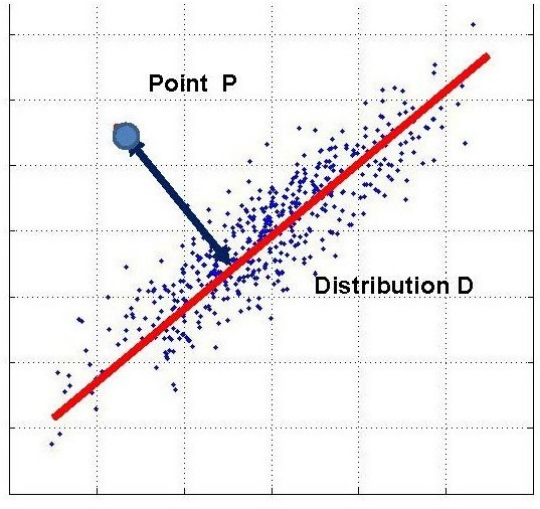
Mahalanobis, a researcher in design of experiements, developed Mahalanobis Distance (MD) to remove outliers. MD just shows how a point P is far away from the mean of the individual data. Thus, we can utilize it for priorizing our decisions (see Figure 6).
Toward Motivation-Igniting Society 727
Figure 6: Mahalanobis distance (MD).
Mahalanobis Distance-Pattern (MDP) Approach is human-centered and it will birng us the next society where we can live a self-sustrain and self-enjoying life.
REFERENCES
Deci, E. L., Ryan, R. L. (1985) Instrinsic motivation and self-determination in human behavior, Springer Science and Business Media. Kostov, V., Fukuda, S. (2003) Computer mediated emotional Intelligence, Journal
of Japan Society for Fuzzy Theory and intelligent Informatics, Vol. 15, No. 4, pp. 391–400. Maslow, A. H. (1943) A theory of human motivation, Psychological Review, Vol. 50, No. 4, pp. 370–396. Pragmatism (2024). https://en.wikipedia.org/wiki/Pragmatism
LISTED IN THE AHFE DIGITAL BOOKSTORE CATALOGUE
Explore the complete digital volume
Intelligent Human Systems Integration (IHSI 2025): Integrating People and Intelligent Systems
Read this individual research paper free through the original publisher, or explore the full digital proceedings book.
ISBN 978-1-964867-36-6
Explore this ISBN in the AHFE Bookstore ↗Listed in the July 2026 bookstore catalogue; search by ISBN to confirm current availability · Digital book purchase optional