Vesa Salminen, Matti Pyykkönen, Krista Salminen, Oliver Tian (2025). Human Intelligence and Artificial Intelligence Interaction in Start-Up Enterprise. In: Intelligent Human Systems Integration (IHSI 2025): Integrating People and Intelligent Systems. AHFE Open Access, vol. 160, pp. 119–131. https://doi.org/10.54941/ahfe1005817
Innovation capability is significant in the business environment, especially in start-up enterprises. This article emphasizes the growing complexity of technology and the need to manage the innovation process effectively. Integrating generative artificial intelligence tools using agent technology is essential for enhancing the efficiency of building start-up companies and innovation processes more broadly. Artificial intelligence (AI) supports team operations throughout all phases of the innovation process in start-up enterprises. The co-evolution of personal competence identification and team cohesion building is a crucial aspect of new entrepreneurship and start-up development. Data is recognized as a valuable currency in the innovation ecosystem, driving the data-driven innovation process. Human-oriented approach is necessary for capturing data from various sources and executing it in businesses. The strategic challenge is to apply a systematic approach using generative AI agents across all innovation phases. Overall, the abstract outlines the importance of human factors, team cohesion, artificial intelligence, and data-driven approaches in the innovation process, proposing a co-evolution framework for human and artificial intelligence interaction. The case study company analyzed is Husqtec Corp., a start-up company concentrating on situation and operational management. Use case is nature disaster management.
Innovation capability is significant in the business environment especially in the context of start-up enterprises. New technology development create opportunities for renewing innovation process. The integration of generative artificial intelligence tools using agent technology is highlighted as essential for enhancing the efficiency of building start-up companies and innovation processes more broadly.
Team cohesion is identified as crucial for achieving a competitive edge in the rapidly changing and complex business environment. The article suggests
that self-organizing teams with a common goal are essential for managing the innovation process effectively, especially in the face of increasing complexity and speed requirements.
The role of artificial intelligence (AI) is emphasized in supporting team operations throughout all phases of the innovation process in start-up enterprises. The co-evolution of personal competence identification and team cohesion building is highlighted as a crucial aspect of new entrepreneurship and start-up development.
Data is recognized as a valuable currency in the innovation ecosystem, driving the data-driven innovation process. The article suggests that a human- oriented approach is necessary for capturing data from various sources and executing it in businesses. The strategic challenge is to apply a systematic approach using generative AI agents across all innovation phases.
In this article has been analyzed various aspect of new entrepreneurship and start-up development. The case study company analyzed is Husqtec Corp., a start-up company concentrating on situation and operational management. Use case is nature disaster management. The article outlines the importance of human factors, team cohesion, artificial intelligence, and data-driven approaches in the innovation process, proposing a co-evolution framework for human and artificial intelligence interaction.
THEORETICAL FRAMEWORK The idea generation concentrated on the core problem of creating a suitable solution for situation management to manage various type of disaster situation.
‘Situation awareness is presented as a predominant concern in system operation, based on descriptive view of decision making’ (Endsley, 1995).
The Gen AI agent is an application that works independently in the background and is based on a language model created for its target field. This agent produces knowledge-based reports guided by predefined notes, parameters, criteria and prompts.
‘Gen AI can potentially 1) reduce the time for research and development; 2) support real-time testing of new products (and more generally, validate business model propositions); and 3) compress development costs through the use of digital prototypes’ (Mariani & Dwivedi, 2024). It might assist in generating a breakthrough in research related to the acceleration of new product development.
‘To effectively integrate Gen AI, HBR (Baier et al., 2024) proposes a new paradigm: Designing for Dialogue. It is rooted in the idea, that technology and humans can share responsibilities dynamically.’
‘Gen AI can generate new information based on already collected information. It can imitate human-generated outcomes, and therefore it can be applied in various sectors such as academic research, learning, teaching as well as marketing and customer service’ (Gill & Kaur, 2023).
‘Gen AI Agent is treated like a coworker than a static technology because it behaves more like a colleague than previous software tools’ (Baier et al., 2024).
Human Intelligence and Artificial Intelligence Interaction in Start-Up Enterprise 121
‘Fenwick & Jurcys (2023) give five dimensions of human authorship in creating works by using generative AI tools (i.e., conception, prompting, generation, refinement, and deployment). This can shed new light on the legal concept of human authorship, which recently has increasingly shifted focus from the author/innovator to the work.’
‘Five actionable steps to improve organizational learning with AI include simultaneously improving organizational and AI-specific learning, exploring with AI, accelerating learning with AI, choosing projects that promote learning, and learning responsibly’ (Ransbotham et al., 2024).
‘Al-khatib (2023) has demonstrated that the influence of compatibility and competitive pressures on Gen AI adoption are insignificant. It can positively impact on both exploratory and exploitative innovation.’
‘It is important to gather as much information as possible about the invention area and its potential market before making a final assessment. It is possible to question domain-specific problems and challenges as well as the technological possibilities of the solution from an generative AI agent. Innovation culture is changing via new opportunities provided by generative AI agent technology’ (Salminen et al., 2023).
‘From ideation to user testing, large language models are allowing companies to explore more ideas and iterate faster’ (Marion et al., 2024).
ChatGPT can undertake several tasks in the design thinking process: it can provide the design thinkers with an overview of the problem, guide them to a meaningful design challenge, and help them to solve the formulated design challenge’ (Fisher et al., 2023).
As summary from this theoretical framework, it can be stated that this applied research field is young and needs a lot of applied studies and basic research on this phenomenon of integration of human intelligence and artificial intelligence and how to form interaction between them. The main difficulty is the continuous development of methods, algorithms, and tools focusing on artificial intelligence. Generative AI and related AI- agents is just very promising field of nowadays development. In the business world, it is recognized as disruptive and probably very extensively applicable technology and opportunity also in applying it in the innovation process of a start-up company as this article introduces as case study implementation.
RESEARCH APPROACH AND RELATED QUESTIONS This research has concentrated on innovation process expediting by AI and particularly in the context of start-up enterprises The integration of generative artificial intelligence tools using agent technology is highlighted as essential for enhancing the efficiency of building start-up companies and innovation processes more broadly. The analyzed case study start-up company is Husqtec Oy. The analysis of the development of the start-up enterprise has been raised the following research questions:
How can AI be used in solution development and during innovation phases of start-up company?
How to use augmentation and simulation optimally in situation management training?
How to use AI to conduct risk assessment with disaster management
How to manage operation control various resources during a disaster?
This research has an action-based approach and uses a method based on grounded theory (Glaser and Strauss, 1999). It is partly constructive, conceptual, and analytical because it introduces a framework for the start- up company innovation process that is executed through cohesion-building opportunities in teamwork, supported by Gen AI. Data for this concept creation has been continuously collected from different AI-oriented research and development projects.
This action-type research approach may be seen as a type of applied science. Data has also been gathered from interviews and workshops executed during projects on a foresight and scenario planning basis. The background of Gen AI is so new, that it is not yet possible to collect exact data for statistical analysis. The use of Gen AI in the innovation process is still in the early stage of implementation. Data has been collected for conceptual feasibility analysis by comparing the various phases of the innovation process when AI has been used and AI has not been used.
USE CASE OF START-UP INNOVATION AND INNOVATION PROCESS In this action type of research it was analyzed a starting enterprise Husqtec Corp., and it’s dream team’s journey from product area idea to a proof-of- concept of product and service. The use case is the MobiJOPA™system which is a mobile and modular management unit developed by Husqtec Corp. The conscious need in market was to have better equipment and service for the management and control of various emergency situations such as natural disasters, search and rescue missions and large public events. The most important requirements for the system were to have own power generation capability, a data center, and versatile communication tools that enable independent operation or connection to external networks.
In the beginning it was important to figure main requirements and features sought for on the implementation of solution.
It should be a mobile and modular management unit that is quick to deploy (five minutes).
It provides the independent electricity production it needs with its generators, solar cells, batteries and versatile communication tools.
As a modular system, the system can be tailored to different scenarios, such as search and rescue tasks, operational situation management and training.
It should support national security by providing a relatively inexpensive and quick-to-deploy command post.
It should create its own telecommunication, communication and communication network even in remote locations with the help of a satellite connection and an organized network and radio technology.
The mobile situation management site should be agile to transport, and the system is quick to set up for use.
Human Intelligence and Artificial Intelligence Interaction in Start-Up Enterprise 123
It should be designed to work even in conditions where local infrastructures are damaged, and operation management cannot rely on local infrastructure.
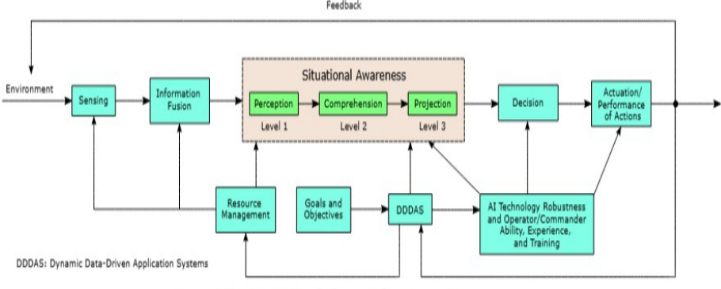
The decision-making process based on the situation analysis model consists of several steps that are integrated into a dynamic data-driven decision- making model (Figure 1, Munir et al., 2022).
Figure 1: Model of situation analysis and dynamic decision making.
The situation analysis model has three key levels: perception, comprehension and projection, which form the core of situation analysis. The first level (perception) focuses on perceiving the state of the environment. The second level (comprehension) processes information and understands the current context. The third level (projection) can predict future events and states in the environment. Artificial intelligence (AI) plays a key role in supporting the implementation of these stages (Munir et al., 2022).
Innovation Process Approach The ideation started with increasing of knowledge on available modern innovation processes. The best and suitable phased process seem to be the approach introduced by Itonics Corp. (Itonics, 2022). The team gathered to create the preliminary study and concept for related system modified a little bit the available process introducing more of human factors and new technology opportunities. During the ideation and innovation, it was used the modern process implementation with following systemic phased innovation approach from the viewpoint of human factors: (modified approach, Salminen & Pyykkönen, 2023).
1 – Personal Idea Phase: “New Insight for Solution” From the viewpoint of Ikigai (Figure 1) the experiential and influential aspects are profession, passion, mission and vocation. A person creates a domain-specific idea of an opportunity.
New Insight for MobiJOPA- Solution
Disaster as target area as domain-specific idea of an opportunity was created by an individual.
2 - Opportunity for Solutions: “Opportunity Space and Scenario Creation” Challenges and scenarios of solution opportunities are brought up during this phase.
Scenarios are illustrated based on real world use cases. Requirements for inventions are figured out. To assess the quality of an invention, it is important to consider the following factors “ChatGPT- answer for a question: How can I assess the quality of an invention for solution (Gill et al., 2023)
Originality: Is it an unique and novel idea?
Feasibility: Can it be realistically manufactured and marketed?
Demand: Is there a market need for the invention?
Functionality: Does it effectively solve the problem it was designed to address?
Usability: Is it user-friendly and accessible?
Patentability: Can it be patented and protected from infringement?
Cost-effectiveness: Can it be produced and sold at a competitive price?
It is important to gather as much information as possible about the invention and its potential market before making a final assessment. It is possible to question domain-specific problems and challenges and also the technological possibilities of the solution from an AI-related agent (e.g. ChatGPT). Innovation culture is changing via new opportunities provided by AI Agent technology.Opportunity Space and Scenario Creation for MobiJOPA
Problem area was re-framed
Challenges and scenarios of solution opportunities were brought up.
3 – Open Dialog for Simple Ideation: Synopsis and Sketch Description With the help of storytelling and describing scenarios according to usage situations, the functional content and sketches take shape. Simple implementation ideas and modeling the real world as realistically as possible into a digital form are easily structured with a draft or a concept for synopsis scripts. This is facilitated by the fact that the specifier has knowledge of both the domain area and the implementation technology. Motivation increases drive during this phase and unit cohesion starts to build up.
Synopsis and Sketch Description were created for MobiJOPA
Storytelling and describing scenarios on usage situations were created on the functional content
Nex were made sketches on solution opportunities
Concept Exploration and Development.
4 – Conceptual Design: Modeling conceptual and modular solutions (functional and structural concepts) in workshop teams.
During the conceptual phase the practical feasibility in terms of the applicability of the solution is verified in a modeling and simulation environment (e.g Unreal or UNITY virtualization engine and platform). In this applied research phase, it is possible to use resources (e.g., Universities
Human Intelligence and Artificial Intelligence Interaction in Start-Up Enterprise 125
or research teams) to help arrange open dialog and workshop sessions with various development partners (solution provider-, user- and client- representatives) making proof-of-concept proposals to be evaluated for the possible solution. The results of this feasibility prototyping are transferable for further refinement.
Functional and Structural Concepts for MobiJOPA were created
Concept Exploration and Development
Modeling conceptual and modular solutions in workshop teams
Validation and Testing.
5 - Requirements for Minimum-Viable-Product (MVP): Team Performance Requirements (Personal Competence Portfolio, Forming of Team).
Common team mission, forming cohesion, and objective definitions are created and defined during this phase. Based on the experiments and practical implementation work (virtual prototype), the proposal is defined from a user value point of view. This MVP-presentation/demo/prototype demonstrates the solution and the functionality of the product/service. A project portfolio is drafted during this phase and the decision is made to start selected projects (product, service, new business model). Depending on the created innovation, either a core team for start-up innovation or an operation team with engineering experts for project development is formed.
Iterative Requirement Refinement and Selected MobiJOPA- Concept Deployment
Team Performance Requirements were created
Personal Competence Portfolio, Forming of Team, Common team mission
Cohesion is formed, and objective definitions are created and defined.
6 - Conceptual Engineering: Business Model, Products, Services. In the case of start-up innovation, the core team is forming deep team cohesion with each other when deciding on the business model (e.g., Start-up Lean Canvas, Blank, 2013). In the case of an operation team, in development projects, the required cohesion ought to be formed based on task structure (task cohesion, Figure 2). The selected operation team chooses an innovation concept which consists of product and service plans that are offered to users and sold to customers. MVP products made for demonstration are used to collect customer feedback and experiences, based on which the actual business, product and service development projects are planned and formed. More detailed structural, functional, content and technology specifications are made for product development projects which form the project portfolio.
MobiJOPA- Concept Creation for Business Models, Products, Services
Implementation and Deployment
Monitoring by Using Metrics and Gathering User Feedback
In the case of start-up innovation, the core team is forming deep team cohesion with each other when deciding on the business model (e.g., Start- up Lean Canvas).
7 - Implementation Task, Functional and Life-Cycle Phase: Virtual and Self-Organizing Teams.
According to strategic alignment, an innovation roadmap is drawn up for practical implementation and business development. Individual experts from network partners are embedded in task-based teamwork cohesion based on their roles. It is important to define roles because of ownership, trust, and security reasons (knowledge and data).
MobiJOPA- practical implementation and service business development was started. Cohesion building between main participants was ensured with role definition and increasing trust that main partners were deeply involved with further development.
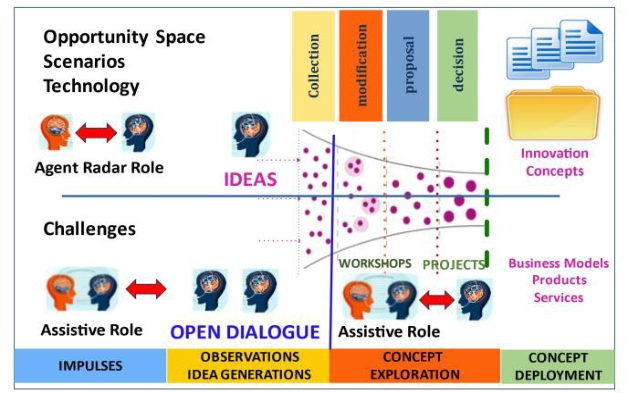
Innovation Process and Content Recognition Assisted by Gen AI The creative phase of innovation is crucial for generating novel ideas, exploring possibilities, and pushing boundaries. Gen AI can significantly augment this phase by providing unique perspectives, facilitating ideation, and assisting in the creation of innovative solutions. An example of an innovation process followed in some enterprises is described in Figure 2. A start-up company’s generic innovation process using AI assistance can be roughly described by the following process phases and related outcomes:
Figure 2: A systemic frame of agent-based gen AI assistive innovation process (Salminen et al., 2024).
Gen AI can be used on novelty assessment of selected ideas and refined concepts or to simulate potential outcomes and their feasibility, viability, and potential risks. The data content can be compared with available data from other sources.
Gen AI can inspire creative new thinking by introducing random topics or strange connections, bringing new associations for individuals to discuss in cohesive teams. Gen AI supports individuals through adaptive learning by providing them with challenges to help them develop their creative
Human Intelligence and Artificial Intelligence Interaction in Start-Up Enterprise 127
skills or tackle them better with disturbances. Generative AI has the potential to revolutionize the creative phase of innovation by offering new perspectives, facilitating collaborative ideation, and empowering individuals and teams to push the boundaries of creativity. By leveraging AI technologies effectively, organizations can unlock a wealth of creative potential and drive transformative innovation across various domains.
Idea generation with Gen AI is not easily done from the top down: A leader observes various opportunities or deficiencies in the business environment and aligns the strategy through those which influences on development projects. It can happen from the bottom up: Somebody in the organization tests Gen AI tools and recognizes that a problem can be solved, and their work can benefit dramatically by using these tools. With this realization, the organization’s best knowledge carriers can start a strategic development project to solve the problem. The use of Gen AI in the innovation process is still in the early stage of implementation.
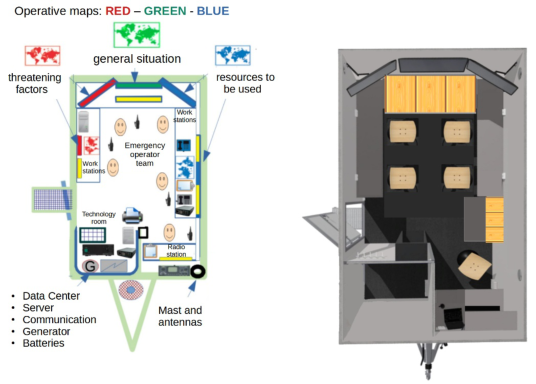
INNOVATION PROCESS AND SOLUTION DEVELOPMENT The use case is the MobiJOPA™system developed by Husqtec Corp, which is a mobile and modular management unit. In this action type of research, a starting enterprise Husqtec Corp. was analyzed, and it’s dream team’s journey from product area idea to a proof-of-concept of product and service was followed. The mobile and modular unit was designed for the management and control of various emergency situations such as natural disasters, search and rescue missions and large public events. The most important features of the system include its own power generation capability, a data center, and versatile communication tools that enable independent operation or connection to external networks. MobiJOPA™can be deployed quickly – in as little as five minutes – after arriving on site. Its modular design allows the use of different technologies, such as GPS, radio and satellite communications, and data processing equipment (Figure 3).
Figure 3: The created MobiJOPA™modular concept.
The created concept of MobiJOPA™has versatile uses in the management of emergency situations and exceptional conditions, as well as promoting public safety. It is specially designed for various operational situations, such as natural disasters (storms, floods, forest fires, earthquakes), search and rescue missions, large-scale accidents, police operations, security operations and security management of large public events. The system is also suitable for training and simulation use, where different exceptional situations can be practiced with the help of simulations.
In addition, MobiJOPA™’s modular structure and customization enable it to be used in many other areas, such as defense forces operations, crisis management and various emergency exercises. Its independent power generation and communication systems make it particularly useful in situations where local infrastructure is damaged or unavailable. The system’s ability to create its own communication, communication and telecommu- nications network in remote locations and its expandability with several units to form a network of situation management locations make it a very flexible solution for many types of crisis situations and exceptional circumstances affecting very large areas. MobiJOPA™is a mobile and modular situation management system specially designed to manage various emergency situations, including natural disasters.
THE FUNCTIONALITY IN THE USE CASE OF NATURAL DISASTERS In combating natural disasters, MobiJOPA™usability is based on key features:
System description: MobiJOPA™consists of a 1/4 shipping container- sized 1000kg trailer-mounted unit mounted on a trailer, which is easy to transport with common vehicles, for example an off-road van, and can be put into operation in up to five minutes. The system includes integrated power generation (aggregates, solar panels and batteries), which ensures operation even when the infrastructure is damaged. In addition, this arrangement includes a data center that covers usage needs and versatile communication tools, such as radio and satellite communication, as well as the possibility of creating your own local network. The modular structure of the system allows the integration of various technologies, such as GPS positioning, drone and sensor technology, and data processing equipment into a unified whole that covers situation management needs.
Use in the fight against natural disasters: MobiJOPA™acts as a mobile command center from which rescue and aid operations can be coordinated in rapidly changing situations. Its own power generation and communication connections ensure the continuation of operations even when the local infrastructure is damaged. The system can be used to effectively coordinate the activities of different actors and maintain a real-time situational picture. It can be used, for example, in the management of flood, storm, forest fire and earthquake rescue operations. The customization of MobiJOPA™allows it to adapt to different types of disasters, their complex situations and their specific needs.
Human Intelligence and Artificial Intelligence Interaction in Start-Up Enterprise 129
Features in the fight against natural disasters: The key features of the system in the fight natural disasters are its mobility and quick deployment, self-sufficient electricity production, compare against hensive communication options, modularity and customization, and supporting situational awareness. These features make it a very valuable tool in disaster management, especially in situations where infrastructure has been destroyed or available infrastructure is limited.
MobiJOPA™’s modular solutions offer significant support to the situation management team in disaster situations at different stages:
1. In the early stages of a disaster: A rapidly deployable, mobile unit ensures that emergency management can quickly arrive at the scene and begin operations immediately. Modularity gives flexibility in allocating resources according to the needs of the initial phase. Critical infrastructure, such as communication systems and power generation, can be put to use according to the needs of situation management quickly and independently, even without a functioning local infrastructure. This enables the rapid formation of a situational picture and effective coordination of the initial phase. 2. In an acute and expanding situation: MobiJOPA™’s modularity enables the system to be expanded with several management site units and to adapt to changing conditions. Additional units and technology can be integrated quickly, improving communication, data processing and maintenance of the situational picture. Different modules can be used to manage several tasks at the same time; for example, drones and sensors can be used for reconnaissance and improving the situational picture, while radio and satellite communication ensure communication between different actors, field teams. The capabilities of the data center support the creation and analysis of a real-time situational picture. 3. In repairing the damage in the disaster area: After the situation has calmed down, the modularity of MobiJOPA™allows the system to be adapted to reconstruction and recovery measures. Unnecessary modules can be removed, and the system can be used, for example, to coordinate relief efforts and distribute resources efficiently. The system’s own power generation and communication systems are especially important in places where the local infrastructure has been damaged. During the reconstruction phase, MobiJOPA™can act as a central communication and coordination center.
CONCLUSION
The article responds to the research questions through a qualitative case study analysis of a startup developing an AI-assisted disaster management system. While the specific AI algorithms aren’t detailed, the article demonstrates the potential application of AI across various innovation and disaster response phases, emphasizing its role in expediting development, enhancing real-time situational awareness, and improving resource management.
This article extensively explores how AI can be used in solution development and during innovation phases. It is highlighting generative AI’s
(Gen AI) potential to expedite research and development, support real-time product testing, and reduce development costs through digital prototypes. It emphasizes Gen AI’s use across all innovation phases, including idea generation, concept refinement, and risk assessment. The article details a systemic framework for AI-assisted innovation, showing how Gen AI can facilitate ideation, simulate outcomes, and inspire creative solutions. The case study of Husqtec Corp. and their MobiJOPA™system exemplifies this application, demonstrating AI’s role in various innovation phases, from initial ideation to minimum product viability development.
The phenomenon of continuously changing functionality in the interaction between human intelligence and artificial intelligence is difficult to study by collecting and analysing quantitative and statistical data. The continuously changing technology solution, rapid proof-of-concept implementations, and developing algorithms behind artificial intelligence and Gen AI lead to the use of action research and grounded theory methods in analyzing the phenomenon.
The article heavily focuses on the creation and development of the Husqtec startup and its MobiJOPA™product, detailing the innovation process from initial idea to proof-of-concept. The article describes how AI assisted this process, particularly in idea generation, concept refinement, and risk assessment.
The article implicitly addresses the use AI to conduct risk assessment with disaster management through the MobiJOPA™case study. While not explicitly detailing AI-driven risk assessment methods, it shows how AI could contribute to real-time situational analysis, prediction, and resource management in disaster contexts. The system’s features, including a data centre and versatile communication tools, suggest a capacity for data-driven risk assessment.
The MobiJOPA™system serves as a prime example of AI’s role in resource management during a disaster. Although AI’s specific role in resource allocation isn’t explicitly stated, the system’s features (integrated power generation, versatile communication, modular design) suggest its ability to facilitate data-driven, coordinated resource management within a disaster response scenario. The article highlights how the system allows for real-time situational awareness and coordination of diverse actors and resources.
REFERENCES
Al-khatib, A. (2023) Drivers of generative artificial intelligence to fostering exploitative and exploratory innovation: A TOE framework, Technology in Society. 75 (2023) 102403, Elsevier. https://doi.org/10.1016/j.techsoc.2023. 102403 Baier, P., DeLallo, D., Sviokla, J. (2024) Your organization isn’t designed to work with Gen AI. Harward Business Review, Spatial Issue, How to Thrive in a Gen AI, Fall 2024, November 5th, 2024. Endsley, M., (1995) Towards a Theory of Situation Awareness. Human Factors.
The Journal of the Human Factors and Ergonomics, March 1995, 37(1), 32–64. doi: 10.1518/001872095779049543.
Human Intelligence and Artificial Intelligence Interaction in Start-Up Enterprise 131
Mariani, M., Dwivedi, Y. K. (2024) Generative artificial intelligence in innovation management: A preview of future research developments, Journal of Business Research 175 (2024) 114542, Elsevier, Science Direct, https://doi.org/10.1016/ j.jbusres.2024.114542 Fenwick, M., Jurcys, P. (2023) Originality and the future of copyright in an age
of generative AI, Computer Law & Security Review: The International, Journal of Technology Law and Practice, Elsevier 51 (2023) 105892, https://doi.org/10. 1016/j.clsr.2023.105892 Fischer, M. Dres, S. Seidenstricker, (2023) Application of ChatGPT in Design Thinking. Application of Emerging Technologies, Vol. 115, 2023, 157–164. doi: 10.54941/ahfe1004312. Gill, S. S. and Kaur, R. (2023) “ChatGPT: Vision and challenges”, Internet of Things
and Cyber-Physical Systems, Vol. 3, pp. 262–271. Glaser, B., Strauss, A. (1999) Discovery of Grounded Theory: Strategies for Qualitative Research. Aldine Transactions. Marion, T., Srour, M., Piller, F. (2024) When Generative AI Meets Product
Development. MIT Sloa Management Review, Fall 2024, Boston. Munir, A., Aved, A., Blasch, E. (2022) Situational Awareness: Techniques, Challenges, and Prospects. AI · January 2022, MDPI, 3, 55–77. doi: 10.3390/ ai3010005. Ransbotham, S., Kiron, D., Khodabandeh, s., Chu, M., Zhukhov, L. (2024) Learning to Manage Uncertainty, With AI. MIT Sloan Management Review and Boston Consulting Group, November 2024, Boston. Salminen, V., Pyykkönen, M., Salminen, C. (2023) Spiral Innovation Automation and
Team Cohesion. AHFE International Open Access Publishing, Human Factors in Business Management and Society, Vol. 97, Issue 97, 2023, 78–86. doi: 10.54941/ahfe1003884. Salminen, V., Pyykkönen, M, Salminen, C. (2024) Co-Evolution of the Interaction of Human Intelligence and Artificial Intelligence in the Innovation Process. 30th International Conference on Engineering, Technology and Innovation, ICE/IEEE, 24–28 June, 2024, Funchal Madeira.
LISTED IN THE AHFE DIGITAL BOOKSTORE CATALOGUE
Explore the complete digital volume
Intelligent Human Systems Integration (IHSI 2025): Integrating People and Intelligent Systems
Read this individual research paper free through the original publisher, or explore the full digital proceedings book.
ISBN 978-1-964867-36-6
Explore this ISBN in the AHFE Bookstore ↗Listed in the July 2026 bookstore catalogue; search by ISBN to confirm current availability · Digital book purchase optional