Oliver Tian, Vesa Salminen, Bryon Tian (2025). Leveraging AI Technologies to Augment and Advance Human Expertise with JIT Learning. In: Human Factors, Business Management and Society. AHFE Open Access, vol. 176, pp. 203–217. https://doi.org/10.54941/ahfe1006318
The use of Artificial Intelligence (AI) technologies in decision-making and workflow automation is emerging as an obvious companion to the enterprise profession. Prominent businesses are integrating the use of both automation protocols to improve human performance. This increases operational efficiency with AI-powered automation, seamless experiences, and enterprise productivity to manage business complexity in a progressively dynamic business environment. One of the biggest issues facing organisations today is the worldwide lack of skilled technical personnel. This disparity is impeding innovation and, more importantly, is starting to affect companies' capacity to stay competitive in the quickly changing digital economy. However, it is possible that the same technologies that are causing this skills gap - in particular, AI technologies - will also provide ways to bridge it. By leveraging AI to augment and advance human expertise, companies can enhance productivity, optimize workflows, and maximize the value of their workforce. AI can help combat the shortage on human expertise and skills augmentation in innovative ways which can help the business – just in time. The goal of this article is to identify and understand circumstances leading to the need to supplement human expertise and explore how AI technologies can be leveraged to provide improved methods of corporate knowledge expertise. This research is partly constructive, conceptual, and analytical because it introduces the concept of AI-powered competency models and its adoption by organizations when they deal with the dynamic business opportunities in the marketplace.
Every learning outcome influences the business. It is our responsibility to formulate a precise hypothesis about how each learning effort contributes to the needs and objectives of a business and to evaluate that hypothesis on a regular basis using reliable data! With the advent of technology, and in particular AI technologies, current business leaders struggle to keep up with constant change of pace of the business. It’s been recently reported that
employees’ major complaint with organizational learning is that it’s no longer relevant.
What can and will leaders need to do differently to ensure learning opportunities are relevant for employees and the business? They must have a clear and agile learning strategy that aligns with the core metrics of their business.
Workflow and decision automation using AI technologies is growing in popularity among business employees. Through corporate productivity, AI- powered automation, and seamless experiences, this increases operational efficiency to manage business complexity in a business environment that is becoming more and more dynamic.
RESEARCH QUESTIONS AND METHODOLOGY APPROACH The goal of our article is to identify and understand circumstances leading to the need to supplement human expertise and explore how AI technologies can be leveraged to provide improved methods of corporate knowledge expertise. This research is partly constructive, conceptual, and analytical because it introduces the concept of AI-powered competency models and its adoption by organizations when they deal with dynamic business opportunities in the marketplace.
This article answers the research questions:
1. What are the critical human factors which can be considered in the design of talent development programs to enhance and supplement Human Expertise? 2. How can relevant technologies, such as AI, be leveraged to supplement and extend Human Capability to perform? 3. How can organizations establish a technology-enabled and suitable talent environment where Human and Agentic workforce can co-exist? 4. What can organizations do to prepare and embark on this talent development journey with JIT Learning?
This article will focus on identifying key psychological, cultural, and organizational elements necessary to align AI-powered programs with human capabilities. We will attempt to review and understand cognitive load, study how to foster adaptability and ensure inclusivity in the design of talent development programs.
We also explore the use of AI technologies, such as machine learning, natural language processing, and predictive analytics, to augment and enhance human expertise in operational efficiency, decision-making, and skills acquisition. As an important next step, we investigate how to establish a connected workplace where Humans and Agentic-AI systems can work together productively, as well as ethical issues, process integration, and how leaders may build trust.
Finally, we delve into practical approaches for deploying JIT learning, emphasizing real-time skill enhancement and adaptability. AI-powered learning platforms, microlearning modules, and dynamic content delivery are useful to individual and organizational needs.
Leveraging AI Technologies to Augment and Advance Human Expertise With JIT Learning 205
BENEFITS OF AI TECHNOLOGIES TO AUGMENT HUMAN CAPABILITIES AI is a game-changing technology that could improve efficiency, solve difficult issues, and improve human life. It is used in almost every industry, including healthcare, education, banking, entertainment, and transportation. However, its creation and application bring up significant ethical, societal, and governance issues, including decision-making responsibility, prejudice, data privacy, and job displacement.
In our opinion, AI should complement human abilities rather than replace them, in line with values that place a premium on equity, inclusion, and mutual gain. Responsible guidance of AI development is crucial, guaranteeing openness, responsibility, and compatibility with human values.
As a result of organizations going digital, the volume of data output has skyrocketed. Human specialists frequently find it difficult to swiftly evaluate and analyze such large datasets to arrive at prompt conclusions. AI-powered systems continue to examine consumer behavior across millions of transactions every day, offering useful information for inventory and marketing decisions. However, as a result of the workforce’s inability to keep up with new technologies and trends, rapid technological development leads to skill gaps. This calls for the incorporation of AI-powered solutions capable of filling these gaps.
Most contemporary business issues are multifaceted and call for interdisciplinary expertise. AI systems can provide comprehensive solutions by combining and analyzing data from several fields. Time and availability are constraints limited by the capacity of human skills. AI technologies provide scalable, round-the-clock solutions that guarantee ongoing support for business operations.
Sadly, out of complacency, humans must remain the “Masters of Technology” and avoid being replaced. The brave new future will be shaped by AI in robotics, and it’s time for people to learn from the way AI in robotics operate as machines discover how we think. Connecting technology to human values should our straightforward goal. We want to apply AI technologies by offering cutting-edge and creative technological solutions, and leverage AI dedicated to augment and advance human expertise.
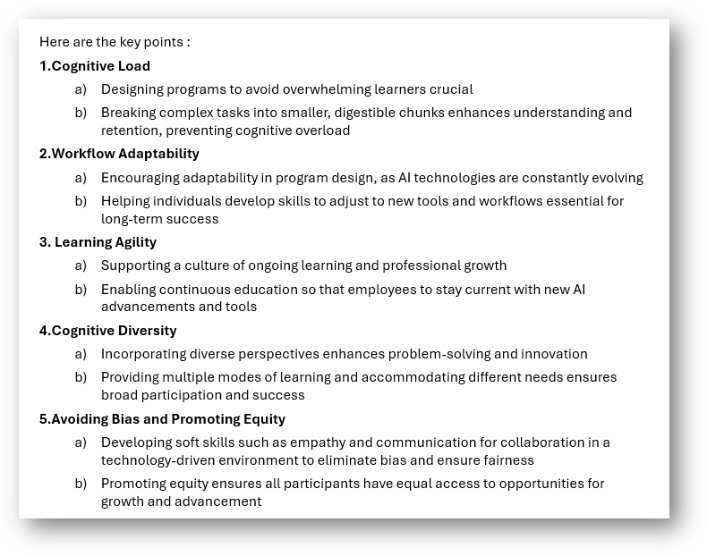
CRITICAL HUMAN FACTORS IN THE DESIGN OF TALENT DEVELOPMENT PROGRAMS Designing AI-powered talent development programs requires a focus on several human factors to effectively enhance human expertise. Key considerations include managing cognitive load to prevent overwhelming learners and breaking down complex tasks into digestible pieces for better retention. Fostering adaptability and promoting continuous learning are essential as AI technologies evolve. Inclusivity is vital, ensuring programs are accessible to individuals of diverse backgrounds, abilities, and learning styles, while AI systems should be designed to avoid bias and promote equity.
Engagement can be driven through intrinsic motivation, gamification, and real-time feedback, which enhance the learning experience. Emphasizing
emotional intelligence and human-AI collaboration also encourages deeper human-AI integration. Cultural sensitivity and contextual awareness ensure that the program is applicable in a range of contexts and sectors by tailoring the content to specific needs. Ethical considerations are equally important since transparency and ethical AI use promote trust.
Finally, mental and physical well-being should be integrated into the design, offering resources on stress management and work-life balance to maintain employee performance. By addressing these factors, organizations can create talent development programs that effectively augment human capabilities alongside AI technologies.
In Asia, different industries and nations have different rates of adoption of AI-driven solutions. Strong technology infrastructures in developed nations like South Korea, Japan, and Singapore enable the smooth integration of AI in business environments. Through national plans and financial programs, numerous Asian governments are aggressively advancing AI. China’s AI growth strategy, for instance, places a strong emphasis on the use of AI in a number of fields, including business management. Innovation and technical advancement are highly valued in many Asian societies. The adoption of AI technologies is facilitated by this cultural mentality to enhance human expertise.
Figure 1: A summary of our recommendations.
Leveraging AI Technologies to Augment and Advance Human Expertise With JIT Learning 207
LEVERAGING TECHNOLOGIES TO SUPPLEMENT AND EXTEND HUMAN CAPABILITY TO PERFORM The biggest promise of relevant technologies in the AI domain is to enhance human capabilities rather than replace them. AI-powered technologies, for instance, can help doctors diagnose patients more accurately. Creative professions already use AI to inspire and boost their productivity by generating code, packaging or music, or art. In areas such as manufacturing and space exploration, advanced intelligent robotics can enhance human physical and mental capabilities.
The future of AI depends on how it merges with our systems of aims and values. By fostering innovation while carrying a sense of ethical responsibility, it can be established that AI is becoming a tool for universal progress instead of a tool of division or harm. For instance, a maintenance technician maintaining a complex machine could rely on an AI-prompted AR headset that recognizes parts, provides step-by-step instructions, and highlights safety risks in real time. Simultaneously, the AI tracks their actions and offers feedback to improve precision, when necessary.
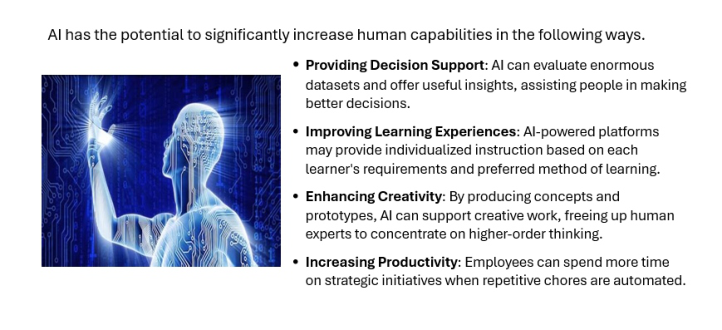
There are many ways that AI can help with extending human capabilities. AI is capable of analyzing huge datasets and offering actionable insights that enable humans to make better decisions. Powered by AI, platforms which emerge can be personalized for individual needs and learning styles. AI tools can help with generative work by creating new ideas and prototypes, so human experts can spend their time doing the higher order thinking. The optimal partnership between humans and AI leverages an adaptable framework which shall be discussed later.
Figure 2: A summary on how AI can be leveraged to increase human capabilities.
HOW CAN ORGANIZATIONS ESTABLISH A TALENT ENVIRONMENT WHERE HUMAN AND AGENTIC AI WORKFORCE CO-EXIST Using AI-driven solutions to augment human expertise in Asia’s dynamic and competitive corporate climate is becoming more and more apparent. Competency models driven by AI present a viable strategy for improving corporate knowledge management and allowing businesses to better address new possibilities and difficulties. Businesses can fully utilize AI to spur innovation and expansion by comprehending the conditions that call for such models and resolving the related issues.
AI adoption in business is not without challenges, but with the correct approaches, it can result in notable gains in talent development, productivity, and decision-making. The incorporation of AI-powered solutions will be essential in determining the nature of employment and business in the future, as Asia remains a center for technology growth.
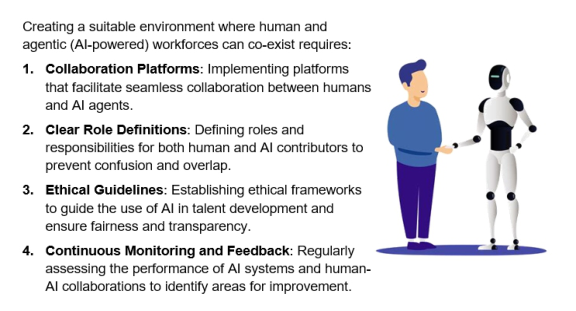
Creating a successful environment where human and AI-powered workforces can effectively coexist involves several key components. First, implementing collaboration platforms is crucial to enable smooth interaction between humans and AI agents, allowing for seamless communication and task-sharing. Additionally, clear role definitions are essential to ensure that both human and AI contributors understand their responsibilities, preventing overlap and confusion. Establishing ethical guidelines is another critical step, as these frameworks help to ensure the responsible and fair use of AI in the workplace, promoting transparency and accountability in decision- making. Finally, continuous monitoring and feedback are necessary to assess the ongoing performance of both AI systems and human-AI collaborations, enabling organizations to identify areas for improvement and adapt to evolving needs. Together, these elements foster a productive, balanced, and ethical work environment.
However, before organizations embark on an AI-powered talent development journey, they must carefully assess several critical conditions to ensure success. It is important to include a readiness assessment focusing on both the technological infrastructure and the workforce’s ability to adapt to new AI tools and processes. This involves evaluating the current systems in place and determining the organization’s capacity to integrate AI technologies effectively. Workplace cultural and technological savviness are key success factors in the adoption of AI systems.
Leadership commitment is also crucial, as strong support from top management is necessary to drive AI adoption, align it with the organization’s broader goals, and champion the change across all levels. Following which, organizations need to ensure that there is cultural alignment - organizations must cultivate a culture that embraces change, innovation, and lifelong learning to ensure employees are open to AI integration and the opportunities it brings. Lastly, ensuring proper resource allocation is key—this includes investing in the necessary technology, training programs, and change management initiatives to smoothly implement AI and support ongoing development efforts. Together, these conditions lay the foundation for a
Leveraging AI Technologies to Augment and Advance Human Expertise With JIT Learning 209
successful AI-powered talent development strategy where human and agentic AI can co-exist to derive optimal effectiveness.
HARMONIZING HUMANS AND AGENTIC-AI WORKFORCE To harmonize human and agentic AI workforce, it is important to leverage technology to enhance human expertise by creating valuable learning opportunities and boosting productivity. This can be done through adaptive tools, enabling learners to upskill faster with tailored content and practical on-the-job guidance via augmented reality or AI assistants. Such a model improves access to expertise through centralized repositories, collaborative platforms, and global mentorship, allowing the workforce to connect with experts and resources from anywhere. By automating repetitive tasks, it enables learners to focus on high-value activities like problem-solving, critical thinking, and innovation. For instance, automation of data analysis frees up time for strategic decision-making. Ultimately, the framework must support professional growth by combining technology and human potential to drive learning and productivity.
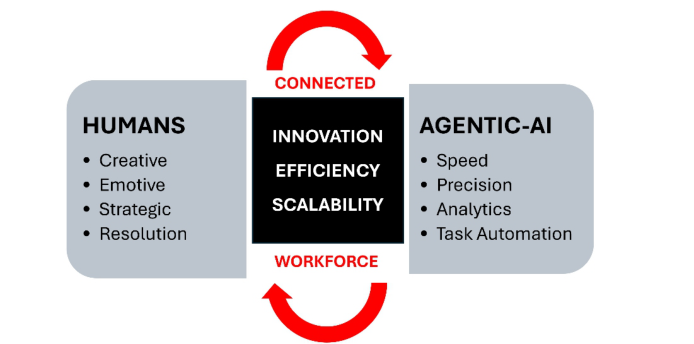
By combining humans and agentic AI, the connected workforce establishes a cooperative environment in which autonomous AI systems and human expertise cooperate to accomplish objectives. In this way a Connected Workforce Framework model which empowers humans and AI capability which promotes teamwork, innovation, and adaptability can be established. While agentic AI increases productivity through data-driven insights, task automation, and autonomous decision-making, humans still contribute to creativity, emotional intelligence, and strategic thinking. While humans apply these insights to complex settings, the AI assistant evaluates large data sets to enable educated decisions. This partnership makes use of AI’s speed, accuracy, and data-driven capabilities in conjunction with human creativity, emotional intelligence, and strategic thinking to promote innovation, efficiency, and scalability.
Key characteristics include data-driven synergy, where AI offers insights that people understand; autonomous task execution, where AI lessens manual burdens under human supervision; and symbiotic collaboration, where AI helps by automating repetitive chores. While humans upskill for more complicated roles, AI is guaranteed to advance through continuous learning. A dynamic, integrated workforce that combines AI and human strengths is produced by improved collaboration tools.
With the help of the Connected Workforce Framework, the workforce may use their practical skills, collaborate with others, and prepare for the future. Humans may securely apply theoretical knowledge, rectify gaps, and uncover strengths with the aid of simulations and real-time feedback. Collaboration tools facilitate cross-functional exposure and team learning, which helps students develop a wider range of skills. Such a framework is expected to leverage AI, IoT, and analytics to solve problems, fostering learning agility and an innovative mentality while preparing the human workforce for changing contexts. On the other hand, issues like overpowering technology,
worries about a lack of skills, and a diminished human touch as a result of automation can surface.
Team members’ beliefs must change before they can change their behaviour. It is impossible to anticipate long-lasting change without comprehensive understanding, hence a change in mindset. The framework must provide the human workforce with the resources they require to adapt, collaborate, and thrive in technologically sophisticated settings.
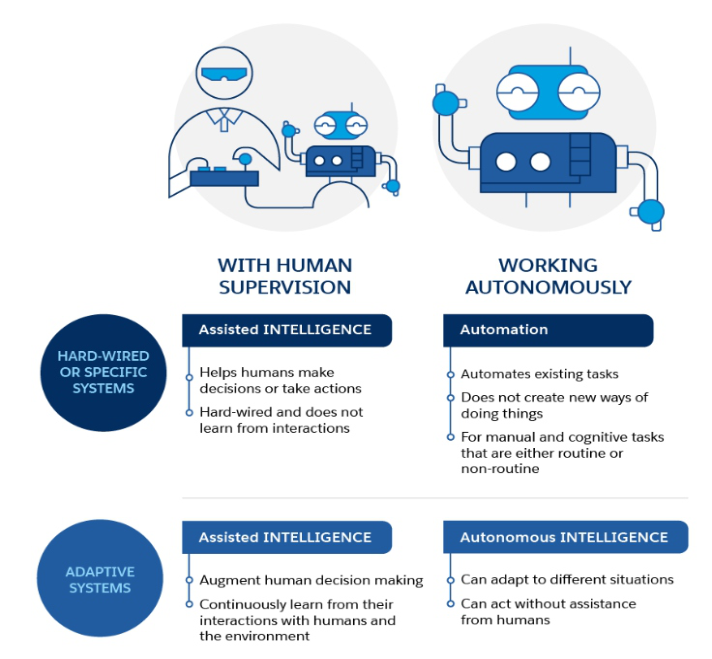
Figure 3: A matrix of how humans and different levels of intelligence can co-exist (Moftak Solutions, 2019).
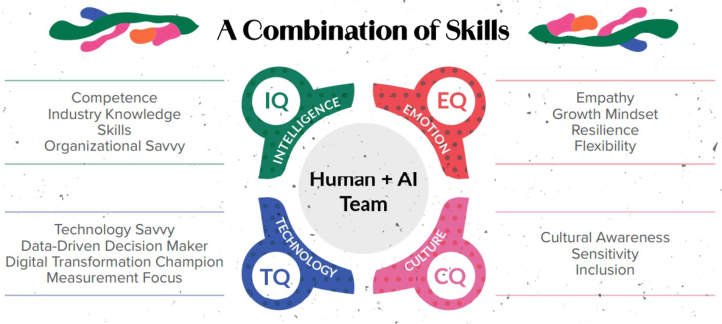
The connected workforce transforms traditional roles, enabling humans and AI to collaborate as partners, while addressing complex challenges in dynamic environments. Key features include symbiotic collaboration, data-driven synergy, and autonomous task execution, with AI performing tasks under human oversight. The framework also promotes continuous learning for both AI and humans, enabling adaptation and growth. Enhanced collaboration through connected platforms creates a dynamic, efficient workforce. This integration drives innovation, productivity, and scalability, leveraging the strengths of both humans and AI to achieve shared goals in a technology-driven world. There are four components to consider: Intelligence Quotient (IQ), Emotional Quotient (EQ), Technological Quota (TQ) and Cultural Quotient (CQ). These components are introduced by Clark in her latest article published in the Training Industry Magazine (Clark, 2025).
Leveraging AI Technologies to Augment and Advance Human Expertise With JIT Learning 211
Figure 4: A possible connected workforce framework.
To inspire confidence and seamlessly integrate technology, business leaders must embody both competence and connection. Their IQ, EQ, TQ and CQ give them the ability to do so. Competence is in their IQ, including skills, experience and wisdom, and in their TQ, or tech-savviness, the necessary non-negotiable skill. Connection lies in their EQ and CQ, ensuring they understand and lead the human side of change with empathy and insight. In this rapidly evolving landscape, leaders who masterfully blend these elements will empower and motivate and bring out the best of a combined human plus AI team.
While technical skills are critical to success, leaders don’t need to be programmers or memorize highly technical algorithms. However, some tech savviness is a must. That means incorporating new tools into the flow of work and encouraging team members to do the same. The increased efficiency of AI outcome affords the humans the opportunity to reallocate time and effort to validating information and assessing it with a critical eye.
Figure 5: The four components of the framework can interact together (Clark, 2025).
TALENT DEVELOPMENT WITH JIT LEARNING Research indicates that Just-in-Time (JIT) learning can be essential for supporting today’s changing business contexts. Coupled with an effective talent development framework, the workforce can avoid information overload, access knowledge when they need it, and apply what they’ve learned right away thanks to just-in-time (JIT) learning. The secret to overcoming the forgetting curve and giving employees autonomy over when and how they acquire knowledge is JIT learning (Frey, 2020).
In our ongoing research, the relevance of “Just-in-Time” Learning is validated in supporting the notion of a connected worker. A Connected Worker solution aims to empower the workforce by providing the environment for the co-existence of human and Agentic AI capabilities. Such a model supported by real-time knowledge enables respective jobs to be executed efficiently.
The Connected Worker (Tian et al., 2023), “integrated into the workplace environment by advanced networking technologies, is the human representation of digital transformation, interpreting networked and real- time data inputs collected across an organizational grid”manifests a powerful decision-making model that augment and enhance human expertise.
“The connectedness of workers does not only affect the people on the shop floor. Digital solutions change (and improve) the working environment of people at all levels of the company. While connected workers benefit the fast- response systems, digital solutions also bring many advantages for managers. Thanks to connectivity, they gain better insights into the shop floor processes as well as the complete order fulfillment cycle”.
A brief survey (Tian, 2020) amongst the new entrants to the industry suggests that a “large number of workforces find the acquired knowledge from college not-so-relevant to the job requirements”. Many times, “these young employees organize themselves to jump onto the learning train, again, to research for corroborative knowledge to supplement the task requirements or solve specific problems”. This just-in-case learning turned out to be counter-productive in their contributions to work (Bloom et al., 1956).
To reduce the apparent gap between learning and performance objectives, humans must be able to readily access pertinent learning material as they are trying to enhance the role of action and reflection. At this juncture, Agentic-AI can significantly contribute to enhancing and augmenting human competence. AI technologies can be used to enhance human performance assistance through “learning in the flow of work” (Bersin, 2018 & Bersin et al., 2019). Repetitive tasks are automated allowing professionals to focus on strategic and creative work while leveraging AI for insights and predictions. By combining human intuition with data-driven systems, it empowers organizations to innovate, adapt to change, and achieve greater productivity and resilience.
The AI system must be designed to be self-reliant and self-sufficient. Further, a human counterpart that enables the AI application to extend inductive and abductive reasoning without compromising human comfort. Therefore, AI technologies should require human oversight which
Leveraging AI Technologies to Augment and Advance Human Expertise With JIT Learning 213
brings us to the discussion on how oversight can be implemented or put into practice to guide AI. Hence reiterating again, the optimal model is to build a co-existent model leveraging AI technologies to augment and advance human expertise. Further, this model needs to embrace JIT Learning for sustainable effectiveness.
Figure 6: A tabulation of factors for a suitable environment for human and agentic-AI workforces to co-exist.
Learning must be F.U.N. (Tian, 2022; Tian et al., 2023; Tian et al., 2024) – “Flexible, Unlimited and Never-ending”. Learning should not be inhibited “if the learner asks too many questions, or questions outside the curriculum. Learning must be Flexible and not rigid, allowing learners to branch out where necessary without a strict curriculum”. Learning must be Unlimited – learning should not be contained only in the instructional materials … Learning MUST satisfy ‘curiosity’. Learning MUST trigger further efforts to look for corroborative and symbiotic knowledge. Learning is Never-ending.
To prepare for talent development using JIT learning, organizations can take several key steps. Firstly, implement microlearning modules that break down materials into smaller, manageable chunks for better retention. Next, use AI for content curation to tailor materials to roles and needs, enhancing relevance and efficiency. Then, apply learning analytics to monitor progress and continuously improve JIT strategies. Finally, foster a culture that values continuous learning and development. These steps can create an adaptive learning environment that supports employee growth and organizational goals.
Implementing JIT learning with Agentic AI faces several challenges. Ensuring data privacy and security is critical as AI platforms handle sensitive employee information. Resistance to change among employees can hinder the adoption of new technologies and learning methods. Maintaining content relevance and accuracy requires continuous updates to learning materials. Additionally, integrating JIT learning platforms with existing HR and knowledge management systems is often complex. Addressing these challenges is essential to unlock the full potential of AI-driven JIT learning.
BUILDING A SYMBIOTIC RELATIONSHIP WITH AGENTIC AI AI is increasingly seen not just as a tool, but as a crucial team member that enhances human capabilities. It excels at handling large data sets, identifying patterns, and making predictions at speeds humans cannot match. In collaboration with AI, humans can refine their decision-making and solve complex problems more efficiently. This partnership allows for the amplification of human abilities, enabling more effective outcomes when AI and humans work together.
AI also plays a significant role in creative collaboration, expanding the creative potential of individuals. Tools like GPT-4 enable various types of creators to push their boundaries, enhancing the creative process. While AI excels at data-driven problem-solving, humans contribute empathy, intuition, and deeper understanding. The value lies in integrating both, with AI providing analytical insights and humans adding context, resulting in more innovative and effective solutions through their interdependence.
To maximize the potential of AI-powered competency models, organizations in Asia are progressively planning to adopt several strategies. Investing in AI literacy is a MUST and will help employees understand and embrace AI, fostering innovation. Collaborating with AI experts and research institutions can expedite the development and deployment of effective AI solutions. Lastly, promoting continuous improvement by regularly updating and refining AI models is essential to keep up with evolving business needs and maintain their relevance and effectiveness over time.
In recent studies on leveraging AI technologies to build “expert systems”, the notion of Mixture of Experts (Cai et al., 2024) has been surveyed in the context of Machine Learning techniques. It is perhaps timely, to evaluate the Human expert as part of the equation. The future of human-AI collaboration will deepen as AI takes on more complex tasks, with humans continuing to serve as guides, teammates, and monitors. AI will evolve into a decision support system, assisting in managing finances, legal matters, and health, offering recommendations to aid human decision-making without replacing jobs. It will act as an assistant tool, providing individuals with necessary information to expand their capabilities, from education to healthcare, and creating more opportunities for success. However, as AI becomes more integrated into daily life, the need for ethical development grows, ensuring AI remains beneficial and constructive for society.
“Those are human capability, organizational capability and content knowledge competence,” (Salminen et al., 2015). There is a need to build a “common competence and capability portfolio of an expert service group”. In the article by Salminen, “work has been drafted a competence and capability portfolio of Smart Services” from which human expertise can leverage to provide greater support to human capabilities for local economy and industry. “The purpose is to disintegrate independent entities to see them separate as subsets. The deeper analysis of the competence portfolio in the Smart Services research unit will be done”by using relevant tools in respective domains. Such models are evolving and with new AI technologies, more mature and relevant models will quickly appear.
Leveraging AI Technologies to Augment and Advance Human Expertise With JIT Learning 215
FUTURE OF HUMAN-AI COLLABORATION In the future, can we expect AI models to supersede human capacity to perform? Thinking that AI systems may be arriving at this level of autonomy sounds scary. So far, in the field competency models, research programs are focusing on training models that can guarantee the safety of their own behaviour. However, governments and policy makers need to ensure safe use. Establishing a democratic process that makes sure individuals, corporations, even the military, use AI and develop AI in ways that are going to be safe for the society.
So, will it ever be possible to achieve the perceived level of AGI? Most computer scientists say there is no reason to think otherwise – it is a question of “when”, and not “whether”. Some have come forward to say that there are no theoretical impediments. While Melanie Mitchell, a computer scientist at the Santa Fe Institute in New Mexico, agrees. “Humans and some other animals are a proof of principle that you can get there,” she says. “I don’t think there’s anything particularly special about biological systems versus systems made of other materials that would, in principle, prevent non-biological systems from becoming intelligent” (Mitchell, 2020).
To quote Deloitte’s Human Capital Trends 2024 Report (Deloitte, 2024), “We live in a human-powered economy”.
The principle of human capital management, which seeks to get the most value from an organization’s workforce by treating it as a core business asset, is not new. However, for most organizations, the delivery mechanism is outdated, relying on manual processes and tools that no longer reflect the hiring needs, skills requirements, sentiments, or career progression of its employees. Typically built around rigid job roles and vulnerable to human bias, these traditional systems promote linear career progression and standardized learning pathways. But today’s work environment is anything but linear, and skills matter more than roles. That means people, rather than the roles they perform, are a company’s biggest asset—and the greatest judge of people is, well, people.
On the current level of research, the answer is obvious. There is a need to leverage AI technologies to augment and enhance human expertise – this is our way forward!
CONCLUSION AND FUTURE WORK The global shortage of qualified technical workers needs be supplement by leveraging AI technologies - this discrepancy is beginning to impact businesses’ ability to remain competitive in the rapidly evolving business environment, hindering innovation. Businesses may increase productivity, streamline processes, and optimise workforce value by utilising AI to complement and enhance human expertise in creative ways that can benefit the company just in time. From our research, we can conclude that businesses today need to investigate ways in which AI can be leveraged to enhance corporate competence.
In our continuing research, we will study the relationship between “Just- in-Time” Learning and performance objectives. Performance objectives are
both organizationally driven and personally aspired. We intend to study the feasibility of a digital tool – the Learning Companion – which is designed to help learners (young and matured) requiring JIT engagements to sustain productive and efficient management of resources in identifying, planning and achieving learning outcomes to attain desired performance objectives.
We also plan to explore the possibility of equipping every business mentor/coach with AI tools can enable managers in practice and learners to support content creation in a real-time feedback loop. Eventually, we plan to explore how AI tools can be translated to support human talents.
ACKNOWLEDGMENT
We would like to take this opportunity to thank the guidance provided by the leadership team of the Global Robot Clusters (GRC) and the network of members from the International Alliance of Robotics Associations (IARA). The respective country members contribution immense insights and practical perspectives on the role of AI applications to augment human expertise.
We would also like to express our appreciation to the Committee Members of CARES (Centre for AI & Robotics Education Services) within the supervision of APARA (Asia Pacific Assistive Robotics Association) for their kind consultation from 2021 to 2024.
REFERENCES
Accenture (2022): Digital Transformation Starts with the Connected Workers (2022) Beevers, K., Rea, A. and Hayden, D. (2019) Learning and development practice in the workplace. 4th ed. London: CIPD and Kogan Page. Bersin, J. (2018) “A New Paradigm For Corporate Training: Learning In The
Flow of Work”, https://joshbersin.com/2018/06/a-new-paradigm-for-corporate- training-learning-in-the-flow-of-work/. Bersin, J. and Zao-Sanders, M. (2019) Making Learning a Part of Everyday Work, Harvard Business Review, 19 February 2019. Bloom, B. S., Engelhart, M. D., Furst, E. J., Hill, W. H., Krathwohl, D. R. (1956). Taxonomy of educational objectives: The classification of educational goals. Vol. Handbook I: Cognitive domain. New York: David McKay Company. Cai, W. et al. (2024), A Survey on Mixture of Experts. https://arxiv.org/pdf/2407.
06204 Clark, L Leadership in the Age of AI, Training Industry Magazine, Winter 2025,
pp. 30–33. Deloitte (2024), Report on 2024 Global Human Capital Trends, https: //www2.deloitte.com/content/dam/insights/articles/glob176836_global-hum an-capital-trends-2024/DI_Global-Human-Capital-Trends-2024.pdf. Frey, T. (2020). Just-in-Case Learning vs Just-in-Time Learning The Future of Education Davinci Institute, 8 October 2020. Gaurav, R and Kersten, M (2022) myFT: Is ‘connected work’ the future of digital
transformation? https://www.ft.com/partnercontent/planview/is-connected-work -the-future-of-digital-transformation.html. Gopinath, R. (2021) Digital Transformation is Incomplete Without the Connected Worker, HBR 23 July 2021. https://hbr.org/sponsored/2021/07/digital-transfor mation-is-incomplete-without-the-connected-worker
Leveraging AI Technologies to Augment and Advance Human Expertise With JIT Learning 217
Illeris, K (2010) The fundamentals of workplace learning: understanding how people learn in working life. London: Routledge. Mitchell, Melanie (2020) On Crashing the Barrier of Meaning in AI AI Magazine,
41(2), 2020, 86–92, Association for the Advancement of Artificial Intelligence (AAAI). Moftak Solutions, 2019, 27 November, “How AI is reshaping the workforce management”, https://moftak.com/how-artificial-intelligence-is-reshaping-the- workforce-management/. Ogawa, K., Bartneck, C., Sakamoto, D., Kanda, T., Ono, T., & Ishiguro, H. (2018).
Can an android persuade you? In Geminoid studies: Science and technologies for humanlike teleoperated androids (pp. 235–247). Singapore: Springer. Salminen, V et al (2015) Competence portfolio assessment of research and development center for regional development 6th International Conference on Applied Human Factors and Ergonomics (AHFE 2015) and the Affiliated Conferences, AHFE 2015. Tian, O. (2020) Brief notes from roundtable discussions conducted during AIBotics 2019, 18 November 2019. Tian, O and Lee, F (2022) Notes on Next Generation Learning Models 2022. Tian, O. (2022) The FUN in Learning, presentation delivered and recorded during
Science Agora Workshop Series, Japan Science & Technology Agency, 20B16, 20 October 2022. Tian, O. (2022) The Impact of Technology on Learning, presentation delivered and recorded during Science Agora Workshop Series, Japan Science & Technology Agency, 26A16, 26 October 2023. Tian, et al. (2023) Unbundling Training towards Just-in-Time Learning and Re-
bundling to Discover Knowledge, presentation delivered and recorded during AHRE 2023 – San Francisco Session 188, Paper 402, 24 July 2023. Tian, et al. (2024) Aligning Just-in-Time Learning with Digital Transformation, presentation delivered and recorded during AHRE 2024 – Nice, France Session 116, Paper 448, 27 July 2024.
LISTED IN THE AHFE DIGITAL BOOKSTORE CATALOGUE
Explore the complete digital volume
Human Factors, Business Management and Society
Read this individual research paper free through the original publisher, or explore the full digital proceedings book.
ISBN 978-1-964867-52-6
Explore this ISBN in the AHFE Bookstore ↗Listed in the July 2026 bookstore catalogue; search by ISBN to confirm current availability · Digital book purchase optional