Henna Tanhuanpää, Heidi Ahokallio-leppala, Vesa Salminen (2026). Forecasting Future Skill Requirements for Education Staff with an AI Agent. In: Creativity, Innovation and Entrepreneurship. AHFE Open Access, vol. 206, pp. 15–27. https://doi.org/10.54941/ahfe1007379
Digitalization is changing the future of work and the skills required at work, which challenges the ability of educational organizations to anticipate skills needs. Häme University of Applied Sciences has launched development work to build an artificial intelligence agent to support experts in understanding future skills needs. Artificial intelligence operates as part of a complex adaptive system, in which the interaction between humans and artificial intelligence changes the dynamics related to educational planning and the anticipation of skills needs. This is a transformative change, in which a new actor changes structures, bringing with it adaptability, continuous learning and data-driven decision-making. This change has implications for roles, skills, processes and the logic of decision-making. The article examines how an artificial intelligence agent is changing the educational planning system, and what kind of skills or abilities its optimal utilization requires from both pedagogical leaders and teachers. In addition, we examine how artificial intelligence can support the building of unit and organizational competence.
According to the World Economic Forum Future of Jobs Report 2025, among the strongest forces shaping labor markets in 2025–2030 are AI, digitalization, and automation. AI will create 11 million new jobs and replace 9 million job roles. The biggest changes in the coming years will concern the reduction of routine and administrative tasks, while skills and roles related to AI, data analytics, technological literacy, creative problem- solving, and resilience will increase. The emphasis of work will shift toward human–technology collaboration, highlighting the necessity of continuous learning and the updating of competence, as well as organizations’ capacity to adapt rapidly to changing skill requirements. (World Economic Forum, 2025) Currently, AI is developing and reshaping society and working life faster than any other innovation that has shaken the information society. As part of the technical infrastructure, AI is becoming an increasingly integral part of organizational systems (Juuti, 2025). Therefore, AI should not be seen primarily as discrete technological solutions that are adopted process by process. Instead, the organizational core of AI utilization should shift toward
an overall architecture in which people and AI operate together—learning, reasoning, and improving the quality and speed of decision-making (Schrage & Kiron, 2025).
In Finland, the Council of Rectors of the Universities of Applied Sciences (Arene) has noted that the rapid development of generative AI has placed higher education institutions in a position where they must respond quickly at both the educational and organizational levels. Arene emphasizes that AI will affect all sectors and job roles, and that its adoption will advance significantly faster than previous technological innovations. This acceleration creates pressure to ensure that both staff and students possess adequate AI competence, as well as appropriate ethical and dataprotection practices. Arene also highlights that labormarket skill requirements are in constant flux, which demands agility and continuous learning from teachers and higher education institutions (Arene, 2024).
Häme University of Applied Sciences (HAMK) is a multidisciplinary university of applied sciences that educates experts in various fields for example engineering, social and health care, business, and information technology. AI will significantly impact on all the fields taught at HAMK. In some fields, we do not even know the professions into which graduating experts will be employed. Technological change will also transform the pedagogical operating environment and the teacher’s role. Teachers cannot be expected to master perfectly all future content, because the pace of change is so rapid in all fields that individual items of knowledge become outdated quickly. (Arene, 2024) This greatly affects the teacher’s role, which is moving from transmission of knowledge toward facilitation and the coaching of learning processes (European Commission, 2025).
According to Arene’s recommendations, the core of teacherhood to lie subject-matter expertise, but alongside it emerges the growing ability to anticipate and guide students toward meta-skills and lifelong learning. This requires teachers to be prepared to use AI and data for signal detection and to have the confidence to update their competence continuously. The teacher’s role is no longer limited to the transmission of knowledge, rather it involves creating learning environments that combine the foundations of the field with an understanding of future skill needs. In this sense, the teacher acts as a bridge-builder: they integrate their own expertise with technology-generated insights and supports students to develop capabilities that sustain them through their careers even as individual professions change or disappear (Arene, 2024; European Commission, 2025).
AN INTELLIGENT EDUCATIONAL PLANNING ENVIRONMENT To understand how these broader shifts appear in educational practice, it is important to examine the curriculum as the key system through which higher education institutions translate change into teaching.
The curriculum functions as a multi-layered system that steers education by integrating political guidelines, institutional strategy, teachers’ pedagogical autonomy, and students’ individual choices. Its role as a central steering mechanism is emphasized through its defines learning outcomes, structure,
Forecasting Future Skill Requirements for Education 17 and assessment practices, ensuring that education remains high-quality and relevant to working life (Happo & Perunka, 2023).
The operational curriculum process engages and allocates responsibility to groups and units at different levels of the organization. The decisions made within the process directly shape the kind of education offered to students (Annala & Lindén, 2025).
At HAMK, it has been observed that defining the competences needs guide curriculum work is challenging, as it concerns skills required in the future. Currently, the sources of information that informing curriculum development in given field include, among others, internal feedback, alumni perspectives, external evaluations, observations from field-specific networks, and insight generated by futures research and megatrend analyses. Together these sources provide an overall picture for assessing what kind of competence working life will require over a five- to ten-year horizon. The quality of a curriculum is evaluated, for example, by module feedback from students and the employment outcomes of graduates.
Retrospective information on how well education has met the needs of working life is obtained through career-tracking surveys. (Linko, 2023) In curriculum work, it is also essential to safeguard teachers’ well-being, as their sense of agency and professional identity forms a key foundation for the quality of collaborative planning. Teachers’ wellbeing and professional identity are strengthened when they have the opportunity to influence the development and implementation of the curriculum, which enhances teacher participation and agency (Vähäsantanen, 2014). Teachers contribute to the curriculum their pedagogical expertise, connections to working life, and experience in supporting learning. Through collaboration with other fields and actors in working life, they help ensure that the curriculum is up to date, feasible, and strategically aligned, thereby strengthening both its quality and its practical impact (Happo & Perunka, 2023).
As curriculum work becomes increasingly mediated by digital and AIdriven tools, its pedagogical and human foundations must be considered alongside the technological infrastructures that now codetermine how knowledge is produced and how decisions emerge. This shift leeds naturally to an examination of the broader of the ecosystem within which AI operates.
At the organizational level, it is essential to recognize that AI is no longer a single tool but part of a broader cognitive ecosystem in which people and AI operate side by side (Schrage & Kiron, 2025). This ecosystem, formed through the interactions among humans, AI systems, algorithms, data, and information infrastructures, can be understood as a complex adaptive system (CAS). A CAS denotes a dynamic whole in which diverse elements continuously influence one another, producing complex and nonlinear interactions. As a result of these interactions, emergent systemlevel properties arise—forms of understanding or behavior that cannot be directly inferred from individual components or any single actor (Janssen, 2025).
The transition toward a broader, technologically integrated ecosystem requires an overarching architecture that can be described as an intelligence environment. This concept refers to a system in which reasoning, learning,
knowledge formation, and interaction are designed so that humans and diverse AI agents can jointly generate strategic value. Such an environment does not emerge by merely automating existing processes; rather, it is created by redesigning the organization’s data structures, decision rules, and interaction mechanisms. This perspective aligns with Wolfram’s principles of computational complexity, semantic formalization, and rule-space translation, which suggest that intelligence arises from a functioning architectural whole rather than from isolated tools (Schrage & Kiron, 2025).
As this architectural view shifts the focus from individual tools to interconnected cognitive systems, it also reframes how the relationship between humans and AI should be understood. This transition makes it necessary to examine human–AI interaction not only as a technical interface but as a cognitive and adaptive partnership. In research on human–AI interaction (HAI). Human–AI cooperation should no longer be understood merely as technical integration but as a cognitive relationship. Humans bring analysis, creativity, intuition, and contextual understanding to decision- making, while AI contributes datadriven speed and computational capacity (Salminen, Peltomaa, & Varis, 2024).
AI itself is also a complex adaptive system. Although AI can be programmed and guided, its learning is based on selflearning mechanisms that make its outputs partly unpredictable. The results depend, for example, on the data provided to the AI system, on how users give feedback, how they intervene in its operation, and on the relationships that emerge between interacting AI systems. AI and the humans, data, algorithms, and technologies around it form a complex network in which every component affects the others. Therefore, AI is not merely the product of programming; it is the cumulative outcome of learning processes, data quality, user activity, and interactions with other systems (Janssen, 2025).
The behavior of complex systems cannot be predicted without running or simulating them. This makes traditional linear strategic planning insufficient (Schrage & Kiron, 2025). In such environments, interaction between humans and AI systems continuously generates new and partly unpredictable behaviors—characteristic of complex adaptive systems. In the same vein, Hoque & all, 2025, demonstrate that the organizational challenges in utilizing AI are not primarily technological; the greatest obstacles arise from cultural and organizational issues (Hoque, Davenport, & Nelson, 2025). AI does not operate within static structures; it requires a flexible and dynamic decisionmaking model in which the system is continually observed, interpreted, and adapted (Schrage & Kiron, 2025).
Likewise, Ransbotham et al. (2025), in their years of MIT AI research, have found that organizational AI capability increases only when organizations are able to engage in continuous learning, iterative decisionmaking, and situational interpretation, rather than treating AI as a projecttype deployment (Ransbotham, Kiron, Khodabandeh, Iyer, & Das, 2025). Based on these observations, an intelligence environment is not a document or a plan but a continually renewing system that learns through its operation.
An intelligence environment requires a shared semantic foundation which means precisely defined concepts that are computable, commensurable, and interpretable by both humans and AI systems (Schrage & Kiron, 2025).
Forecasting Future Skill Requirements for Education 19 Human–AI interaction is prone to interpretive errors and misunderstandings if the system lacks mechanisms that reconcile how each party constructs meaning (Salminen, Peltomaa, & Varis, 2024). Organizational success with AI presupposes conceptual clarity. Without clearly defined concepts, AI operates as if in a separate cognitive space, producing contradictions, misinterpretations, and unreliable decisions. Resolving this requires that meanings be made computable. Successful AI organizations share semantic structures across data, decisionmaking, and action. When concepts, metrics, and states are defined, AI can operate reliably, and humans are able to evaluate its reasoning (Schrage & Kiron, 2025).
Different intelligences - people, different AI models, and data-driven analytics systems - operate in different rulial space based on distinct computational logics. Collaboration between these systems does not arise naturally; it requires cognitive compilers that convert the meaning produced by one system into the internal logic of another (Schrage & Kiron, 2025). Organizations must also manage AI personas, AI agents with their own goals, boundaries, decision-making modes, and even identities (Hoque, Davenport, & Nelson, 2025).
AI agents represent their own cognitive worlds, and their operation must be aligned with human decisionmaking (Hoque, Davenport, & Nelson, 2025). AI projects seldom fail for technical reasons; they fail because rule spaces collide—that is, because organizational processes, data, decisionmaking practices, and the logic of AI models are asynchronous or differently meaningful. Cognitive compilers are the solution to this problem: they form the nervous system of the intelligence environment (Schrage & Kiron, 2025).
OBJECTIVES AND RESEARCH QUESTIONS This article examines how future skill needs can be anticipated with AI assistance. The focus was a development initiative launched at Häme University of Applied Sciences, where an AI agent was built communally and interdisciplinarity to support experts in understanding future skill needs. AI operates as part of a complex adaptive system, in which human–AI interaction changes the dynamics of educational planning and the anticipation of skill needs. This is a transformative change, where a new actor changes structures by bringing adaptability, continuous learning, and data-driven decision- making. This change will affect roles, competence, processes, and the logic of decision-making.
The objective of this article is to identify interaction between human and artificial intelligence.
How we understand the chance of education system planning with increasing implementation with AI?
What kind of competencies or skills will be needed that human-actors are able to have help from AI in planning process of curriculum?
What kind of architectural interfaces are needed to create systemic balance between humans and AI?
What capabilities or competences are needed from team-actors to benefit from artificial intelligence as part of a systemic whole?
This study was conducted as qualitative action research, in which the deployment of an AI agent was examined as part of curriculum and educational planning across different fields. The dataset consisted of communal events related to the development of the AI agent. The cyclic nature of these events formed a learning chain in which teachers, head of educations, and project implementers examined, analyzed, and modified results derived from AI source materials, thereby producing the correct knowledge base for the outcomes. The data used in this study comprises both piloting materials and notes from the actual development work, as well as outputs from different phases of communal work and transcripts created from recorded discussions (23 Sept., 21 Oct., 29 Oct., and 24 Nov. 2025). During the analysis phase, the reliability of the results was strengthened through two targeted interviews.
Educational Planning in a Complex Environment The empirical data show that the introduction of AI into curriculum work changes the nature of the work in ways best understood through the lens of a complex adaptive system (CAS) (Janssen, 2025). AI does not function as an “addon” to educational planning; rather, it transforms it into a networked and iterative process in which both humans and AI operate as partly autonomous actors that observe and adapt to one another. Curriculum work, traditionally grounded in linear and periodic review, becomes—with AI—a nonlinear and continuous construction of situational awareness, where decisions emerge from shared interpretation, multidisciplinary dialogue, and the joint analysis of signals.
In this development work, AIassisted futures information has thus far been piloted at the curriculum and studymodule levels. Based on AIgenerated material, a new study module was created for the social and health care field.
In the data, the AI-induced change in the system was particularly visible in how teachers and heads of education described an initial phase of enthusiasm, followed by uncertainty and strain, when AI’s semantic maps felt foreign and difficult to interpret. This emotional phase is typical of CASs, in which new elements—such as an AI agent—disrupt established operating logics and compel actors to reassess their interpretive structures. Gradually, as collaboration progressed, participants discovered how AI could act as a third conversational partner that does not replace subjectmatter expertise but broadens its field of view. As participants learned to read AI reports together, vagueness slowly turned into structured understanding. This transition from uncertainty toward collective confidence manifested emergence as described in CAS theory: novel operating models and shared concepts did not originate at the planning table but arose from practical interaction.
This change in the rhythm and nature of curriculum work required new types of competencies from the team. First, semantic and cognitive capability was needed to interpret AIgenerated highlights. AI analyses surfaced themes that were partly incommensurable with the concepts of different fields. For example, the actors in the social and health care field noticed that the
Forecasting Future Skill Requirements for Education 21 degree title diplomi-insinööri (DI, MSc (Tech)) appeared disturbingly often in their dataset, until it was discovered that the AI had misinterpreted the abbreviation ‘DI’ used for diagnosis (Diagnosi).
This simple example illustrates the necessity of cognitive compilers. When AI and domain experts operate within different semantic rule spaces, the system requires interpretive mediation to make meanings compatible (Schrage & Kiron, 2025). This is also a necessary capability in CAS: information produced by autonomous agents is always interpretive and system functionality depends on how well actors can make meanings compatible.
Second, a central area of competence concerned question formulation and data literacy. The pilot showed that small changes in keywords or scoping substantially altered the nature of the analysis. For example, in the health and social care field, topics related to management were emphasized over clinical competence when the query structure shifted. This made a key CAS principle visible: system behavior is sensitive to initial conditions. Actors had to adjust their questions dynamically and learn through feedback loops, observing how particular inputs produced particular responses and refining their queries so that the results would begin to support curriculum work.
In an intelligence environment composed of multiple human and machine reasoning systems, such shifts reflect differences in how distinct rule sets generate interpretations rather than actual changes in competence needs. Explanationoriented agentic component would act as a cognitive translator: it would reveal that the altered emphasis resulted from scoping-related semantic drift within the AI’s rule space, make this logic transparent, and help participants understand how the system processed their input. By clarifying, why the AI behaved as it did and supporting better question formulation, the component strengthens human–AI coreasoning without replacing it.
The third competence that became emphasized was polyphonic collaboration. AIgenerated information did not offer readymade conclusions. Understanding emerged specifically in situations where experts from different fields compared maps, questioned one another’s interpretations, and searched for shared structures of meaning. This corresponds to the logic of CAS systems, according to which diversity and interaction increase a system’s capacity to learn and renew itself. During the development work, the shared literacy of the material strengthened, and teachers began to view one another’s interpretations as a resource rather than a source of conflict. Crossdisciplinary discussions, in particular, enriched the interpretation of each field’s own material.
Fourth, AI surfaced a need for pedagogical–ethical judgment. AI might interpret as a deficiency content that was already strongly present in teaching but not explicitly visible in curriculum texts; or it might emphasize global phenomena that were not locally relevant. The ICT group observed this directly when the AI surfaced global technology themes that did not correspond to, nor align with, their local implementation environments. In such situations, human actors functioned as the internal regulatory mechanism of the CAS—ensuring the system did not drift in undesirable directions and that
educational and ethical values remained central to decisionmaking. In a multi-agent system, this task might belong to some kind of governance of regulatory agent-group, which includes human through feedback-loop.
The final competence cluster concerned metacognition and emotional competencies. The introduction of AI evoked feelings ranging from enthusiasm to frustration and insight. The ability to tolerate uncertainty and incompleteness emerged as a recurring theme in the workshops. This reflects the CAS view that uncertainty is not an error state but an essential part of how complex systems function. Emotional flexibility enabled the system to stabilize into a new mode of operation: AI no longer appeared as a disturbance but as one actor among others.
Human Expertise in AI-Assisted Educational Planning Based on the data, AI-assisted educational planning proved to be above all cognitive, semantic, and pedagogical work. Participant experiences emphasized that utilizing AI is not a technical skill but a multi-phase interpretive process in which human expertise is decisive. The teachers’ competence coalesced around four themes: data literacy and question formulation; semantic interpretive ability; pedagogical judgment; and metacognition.
Data literacy became visible especially in workshops where participants discussed what kinds of questions should be posed to the AI agent. Teachers described how even small changes in keywords or scoping altered the nature of the analysis and how finding the right level of precision required iteration and shared experimentation. This also generated emotional experiences: early unsuccessful searches caused confusion and mild frustration, but successful refinements were experienced as strongly insightful and empowering.
Semantic interpretive ability concerned how teachers translated AI highlights into curriculum language. Interviews and workshop interventions emphasized that AI does not recognize the intended level of abstraction in curriculum texts nor distinguish strategic concepts from pedagogical structures. The teachers’ task was to interpret why a theme had become significant and what its meaning was at the level of teaching. This required not only subject-matter expertise but also the ability to explain highlights to other fields. Shared literacy of the material deepened during the process and was visible as increased confidence among participants.
Pedagogical judgment clearly remains human responsibility. A concrete example in interviews showed how AI had interpreted as deficiencies competences already included in teaching but not visible as explicit words in curriculum texts. This sparked both concern and a professional need to verify participants wanted to ensure that AI-raised “gaps” would not be copied as such but that each theme would be evaluated relative to the actual content and goals of the education.
Metacognition, i.e., the ability to distinguish when AI supports thinking and when it begins to steer it too much, emerged as a special skill. Participants
Forecasting Future Skill Requirements for Education 23 repeatedly reflected on the degree to which they could trust the agent’s analyses, which could lead to the externalization of thinking. This reflection was not negative but a sign of responsible work and a desire to maintain pedagogical autonomy. Participants described AI as a “sparring partner,” but emphasized that final judgment always belongs to the human. This reduced fears that AI would replace their role and clarified AI’s role as support for thinking.
A Multi-Agent Architecture as the Basis for Human–AI Collaboration Future organizations need a multi-agent model in which human decision authority and AI capabilities form a complementary whole. At the core of the model, the human owns goals, values, and final judgment, ensuring that strategic choices remain human-centered even as automation increases. The human is part of an agent ecosystem that also includes a cognitive compliers that harmonizes organizational language and ensures commensurability across data sources and models; an analysis agent that builds the fact base for decision-making; and a decision agent that refines this information into options, scenarios, and reasoned recommendations. Explanation, governance, and orchestration agents bring transparency, ethics, and process fluency, which are critical prerequisites for system-level trust. Taken together, the multi-agent model provides a structure in which the human not only utilizes AI but acts as its strategic leader in a complex, continuously changing operating environment. In a multi-agent environment, feedback loops allow the human to steer and govern the agent system.
The research data indicate that successful human–AI collaboration in educational planning requires an architecture in which the roles of AI agents and human actors are clearly structured. A recurring observation in workshops and interviews was that although AI was able to produce broad clustering’s and dimensions, ultimate judgment, meaning-making, and direction-setting were always the responsibility of the human. This reflects Hoque et al.’s view that in an intelligence environment, the division of labor among agents centers on the human, who bears responsibility for both decisions and interpretation (Hoque, Davenport, & Nelson, 2025).
The data also strengthens the need for an analysis agent. AI-created semantic maps identified emerging phenomena and anomalies related to recurring themes that participants could not have detected by manually reading large datasets. This corresponds to the mechanism described by Schrage and Kiron (2025), in which an analysis agent could function as the system’s observation layer. However, the workshops showed that the knowledge produced by analysis required continuous human interpretation to assess which phenomenon was genuinely new.
The decision interface emerged particularly in interviews where participants noted that AI “helps interpret” but cannot make decisions on which content should be transferred into the curriculum. This reflects the task of a decision agent: AI can organize alternatives and assess their effects, but the final decision belongs to the human (Hoque et al., 2025). In the data, this
appeared concretely in how teachers used AI reports to outline directions but did not accept recommendations without their own pedagogical judgment.
Participants questioned AI reports when they were not transparent: they wanted to know why AI had highlighted a theme and on what data a claim was based. This mirrors the observation Ransbotham et al. that trust in AI solutions does not arise from technical performance but from the ability to understand the system’s reasoning (Ransbotham et al., 2025). The need for some kind of explanation agent consistent with an intelligence environment emerged in all workshops. An explanation agent could surface data sources and make explicit observations and inferences built from materials. Through a feedback loop, the human would be able to steer and correct the explanation agent’s inferences if the AI’s claim is not correct.
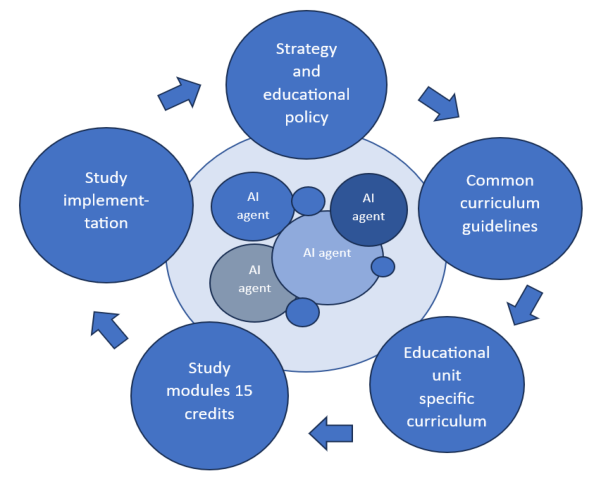
Figure 1 illustrates future education planning process which continues cycles in emergent environment. Education modules are changing in real- time based on AI-multiagent-system. AI agents are producing new data for example on technology of AI, which influences education content. Capability of students graduating should have newest knowledge to be implemented in the future tasks.
Figure 1: AI supported process for educational planning in the future.
The governance interface was visible especially in teachers’ critical stance. They evaluated AI suggestions relative to educational, local, and professional constraints, aligning with the role of a governance agent as the guardian of the system’s value base. In the pilot, teachers performed this task themselves: they rejected analytic highlights that contradicted the field’s practical reality. In a multi-agent system, a governance agent would ensure that options offered to humans have been assessed by the agent as valid according to relevant laws, regulations, and other constraints.
Forecasting Future Skill Requirements for Education 25 In the pilot’s summary discussions, teachers emphasized that AI-generated signals were often useful, but their significance became clear only in the shared interpretive process, where teachers related AI highlights to the curriculum structures of their own field.
CONCLUSION
This study shows that AI-assisted educational planning is not a technical reform but a holistic systemic change. AI shifts the logic of curriculum work from a linear process toward continuous, iterative, and collaborative ways of working best understood through the CAS framework. AI does not reduce complexity; it reveals and structures it in a new way.
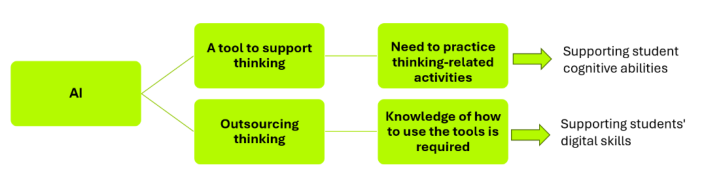
The most important finding concerns the role of metacognition. Working with AI compels teachers to continuously evaluate their own thinking: when does AI support understanding, and when does it begin to steer it too much? This distinction—whether AI is a support for thinking or an externalization of thinking—is a key pedagogical competence for the future.
Figure 2: AI in two roles.
The Figure 2 visualize AI in two roles (externalization vs. support of thinking), has significant analytical value here. It illustrates the core claim of the study: the impact of AI does not arise from what AI does, but from how the human positions themselves in relation to AI-generated knowledge.
Empirical observations showed that teachers’ intellectual work becomes a semantic and reflective process in which data literacy, commensuration of concepts, pedagogical judgment, and emotion regulation interweave. Enthusiasm, uncertainty, confusion, and finally insight formed a metacognitive learning cycle typical of CASs: the system seeks a new equilibrium when a new actor, the AI agent, appears. This affective cycle—enthusiasm, uncertainty, confusion, and insight—was a central part of the change and reflected the CAS-typical construction of a new balance.
The results also show that one AI agent is not enough. A multi- agent architecture is needed in which different agents handle analysis, commensuration of concepts, decision support, explainability, and ethical oversight. This enables AI to be utilized in educational planning transparently and pedagogically justifiably. From this study, the following key areas emerged for further development:
1) a multi-agent intelligence architecture that supports analysis and decision-making
2) a shared semantic foundation that reduces misinterpretations and improves AI quality 3) a new teacher competence profile that emphasizes data literacy, ethical judgment, and metacognition 4) an iterative educational planning process based on signals, interpretation, and continuous learning 5) structures that support emotions and identity change, as the transformation touches the core of teacherhood. 6) sstructures that enable multidisciplinary dialogue based on AI-generated material.
In summary, AI-assisted educational planning gives rise to a new kind of intelligence environment in which humans and AI form a complementary, dynamic, and learning whole. The change requires both technical architecture and cultural maturity, yet its potential is substantial: it strengthens the labor- market relevance of education, improves the anticipation of future skill needs, and lays the foundation for more flexible and higher-quality teaching.
REFERENCES
Annala, J.; Lindén, J. (2025). “Curriculum as part of the work of a higher education teacher.” in: A well-being and pedagogically competent higher education teacher, (in Finnish). Parpala;& L. Postareff (Ed), pp. 205–221). DOI: https://doi. org/10.58181/VP9789523972704. Arene (2024). Arene’s recommendations on the utilization of artificial intelligence
for universities of applied sciences. (Retrieved 6.2.2026) https://arene.fi/ wp-content/uploads/PDF/2024/tekoalysuositukset/Arene%E2%80%99s%20 recommendations%20on%20the%20use%20of%20artificial%20 intelligence%20for%20uni-versities%20of%20applied%20sciences%202024. pdf?_t=1731419903 Einola, K.; Khoreva, V. (2023). Best friend or broken tool? Exploring the co-existence of human and artificial intelligence in the workplace ecosystem. Human Resource Management, Advancing Human Research and Practice. DOI: https://doi. org/10.1002/hrm.22147. European Commission. (2025). Education and Training Monitor 2025,
Comparative report. Brussels. https://op.europa.eu/en/publication-detail/-/ publication/30c1ccaa-bfdd-11f0-a612-01aa75ed71a1/language-en Happo, I.; Perunka, S. (2023). A competency-based curriculum describes the required competence and assessment precisely - what does it require from curriculum work in higher education? (in Finnish) Oamk Journal 144/2023. Hoque, F.; Davenport T.H.; Nelson, E. (2025). Why AI Demands a New Breed of
Leaders. MIT Sloan Management Review. Janssen, M. (2025). Responsible governance of generative AI: conceptualizing GenAI as complex adaptive systems. Policy and Society, 44, 38–51. DOI: https://doi.org/10.1093/polsoc/puae040. Juuti, P. (2025). Artificial Intelligence and Leadership - A Critical View of the
Relationship Between Technology and Humans (in Finnish) Keuruu: Basam Books. Linko, L. (2023). OPS is a data-based forecast of future working life needs (in Finnish) (Retrieved 6.2.2026) HAMK website: https://hameenamk.sharepoint.com/sites/ strategia-ja-johtaminen/SitePages/OPS-on-tietoon-perustuvaa-ennakointia- tulevaisuuden-ty%C3%B6el%C3%A4m%C3%A4n-tarpeista.aspx?stay=true
Forecasting Future Skill Requirements for Education 27 Pernaa, H.-K. (2020). The desired future of well-being. Vaasa: University of Vaasa. Ransbotham, S.; Kiron, D.; Khodabandeh, S.; Iyer, S.; & Das, A. (2025). The Emerging
Agentic Enterprise: How Leaders Mus Navigate a New Age of AI. Boston: MIT Sloan Management Review. Salminen, V.; Peltomaa, J.; & Varis, J. (2024). “Creative and Effective Human Artifical Intelligence Co-Evolution-Interactive Front-End Content Generation” in: Human Factors, Business Management and Society, Vol 135, pp. 209−217. AHFE. Schrage, M.; & Kiron, D. (2025). Stop Deploying AI. Start Designing Intelligence.
MIT Sloan, Management Review. Vähäsantanen, K. (2014). Professional agency in the changing tide of working life.
(in Finnish) Aikuiskasvatus 34(2), 129–133. DOI: https://doi.org/10.33336/ aik.94088.
LISTED IN THE AHFE DIGITAL BOOKSTORE CATALOGUE
Explore the complete digital volume
Creativity, Innovation and Entrepreneurship
Read this individual research paper free through the original publisher, or explore the full digital proceedings book.
ISBN 978-1-964867-82-3
Explore this ISBN in the AHFE Bookstore ↗Listed in the July 2026 bookstore catalogue; search by ISBN to confirm current availability · Digital book purchase optional