Heikki Ruohomaa, Vesa Salminen (2026). The Significance of Regional Ecosystems for the Global Business Chain in Responding to Sustainability Challenges. In: Human Factors, Business Management and Society. AHFE Open Access, vol. 215, pp. 132–140. https://doi.org/10.54941/ahfe1007594
The global operating environment has reached a point where traditional linear supply chains can no longer meet sustainability requirements or market volatility. We are moving from a linear development phase towards exponential growth in technological integration. This transformation is not merely an incremental improvement but a radical rethinking where digital technologies merge to form flexible, decentralized, and truly circular value networks. This report aims to analyze the strategic synergy of Additive Manufacturing (AM), Artificial Intelligence (AI), XR technologies, and robotics. These technologies do not operate in a vacuum; their true value and ability to achieve ambitious ESG goals, such as minimizing Scope 3 emissions, arise from their seamless integration.Shifting toward carbon neutrality aligns with the “Carbon Neutral Uusimaa 2035 -roadmap; by reusing parts, the project directly cuts both direct and indirect emissions arising from new production.
As companies develop, the efficient operation of international supply chains, the efficient operation of product-related support and service, and environmental friendliness have become of primary importance. A key tool and change factor has been digitalization, which has enabled the simulation and planning of product and production supply chains from the product design stage onwards. On the other hand, digitalization has also enabled the emergence of new technologies and the development of circular economy business models enabled by digitalization (e.g. product as a service, extending product life, etc.).
Customer awareness of global warming, energy efficiency, material efficiency are also reflected in consumer behavior. For this reason, companies are also expected to highlight “green values”. Since profitable business is essential for companies, “green values” and new “green” operating models must support the company’s competitiveness and profitability.
The Significance of Regional Ecosystems for the Global Business Chain 133 On the other hand, “Green values” cannot be the only goal of developing product supply chains and services, but also the efficiency of supply chains, materials, energy efficiency, delivery times, delivery reliability, quality, etc. Therefore, the development of “green values” in the supply chain must start from the comprehensive development of the supply chain, which has a business basis.
Optimizing individual functions and objectives in the supply chain leads to partial optimization and inefficient “green solutions” from the perspective of the whole. For this reason, planning should also include product design, production design and supply network design, so that the entire product value chain can be effectively optimized from the perspective of business results as well as from the perspective of “green values.”
Since comprehensive planning is essential from the perspective of the entire supply chain/network, it is particularly important that key suppliers are also part of the planning, not only in the design of the product, but also in the design of the related service and supply chain.
In addition to efficient planning, collaboration enables new innovations to emerge more easily (innovations arise at the customer interface), and provides opportunities for long-term product development and R&D.
New technologies such as AM (additive manufacturing)/3D-printing, AI, XR technologies and robotics create new opportunities for radical renewal of supply chains and thereby achieving significant reductions in emissions, energy consumption, materials and transportation. (Scope 3) Radical reforms (utilizing new technology) in supply chains also shape the structure of the operating environment and cause pressures for change in the business structure and expertise. which can be responded to through ecosystem development. From the perspective of local business/industry development, it is essential that companies are capable and willing to innovate to operate effectively in the subcontracting network.
A nearby subcontracting network provides good support for the main supplier’s product and production planning, while a service network close to customers creates a foundation for the development of services and new circular economy business models.
THEORETICAL FRAMEWORK Trends
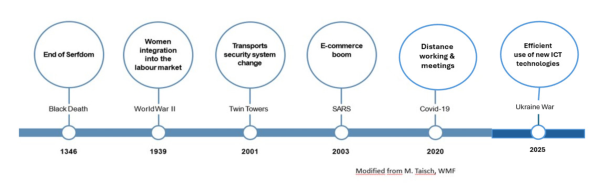
The development of new technologies and the resulting improvements in reliability, price reductions, and successful ‘use cases’ are transforming the adoption of new technologies from linear growth to exponential growth through new business models and implementations. On the other hand, crises in society have historically produced significant leaps in the application and adoption of new technology. New technologies already exist, but eg. the war in Ukraine is accelerating their adoption, creating new use cases and renewing and enhancing the supply chain based on value creation.
Figure 1: New technology influences new product structures, virtual services, value network structures, and business models. [Taisch, 2021, modified].
There are radical changes transforming society. One is a human created, rapidly worsening systemic, ecological and social crisis. The other is a continuously evolving, deeply systemic, human-created digital technology revolution. This has influenced on a need for transformation of the economy systems from the linear model to circular one. COVID- pandemic did influence business evolving towards virtual direction on virtual products and services and on virtual business (Figure 1). Ukrine war will give huge impact to robotic, etc. On the human history big crises have triggered big fundamental change. The crises themselves have not made a difference, but the crises have largely forced them to make the changes that society has or that technology makes possible. (Figure 1).
The mainstreaming times of new technologies are well known and the rate of change (s-curve). As a result of development, the physical world mixes with the virtual world. As virtuality evolves, so do traditional value chains and business models that take advantage of virtuality and even replace value chains of traditional physical world (Ruohomaa & Salminen, 2021).
Although new technology and societal shocks do not in themselves reduce emissions or increase recycling, they do introduce new technology and create understanding that can be utilized in the circular economy.
Scope 3 Emissions Scope 3 emissions are indirect greenhouse gas emissions generated throughout a company’s value chain that are not directly owned or controlled by the company, but are caused by its operations, such as purchased products, transportation, travel, waste and use of sold products, typically constituting the majority – often even more than 70–90% – of the company’s overall carbon footprint.
Scope 3 emissions are divided into upstream and downstream of the value chain. Scope 3 is important because:
Big picture: It covers the majority of a company’s climate impact.
Risk management: Helps identify risks and opportunities related to emissions in the value chain.
Strategic tool: Provides information on emission reduction targets and supports sustainable development.
Reporting: An increasingly important part of sustainability reporting (e.g. EU directives).
The Significance of Regional Ecosystems for the Global Business Chain 135 Until recently, most companies have focused on measuring emissions from their own operations and electricity consumption. But what about all of the emissions a company is responsible for outside of its own walls—from the goods it purchases to the disposal of the products it sells? In fact, the majority of total corporate emissions come from Scope 3 sources, which means many companies have been missing out on significant opportunities for improvement.
The Scope 3 Standard provides a methodology that can be used to account for and report emissions from companies of all sectors, globally. It is accompanied by a suite of user-friendly guidance and tools developed by the GHG Protocol to make Scope 3 accounting more easy and accessible.
Life cycle thinking is more than the foundational skill underlying LCA, it has much broader applicability by encouraging a wider systems approach to thinking about impacts of products and services from material extraction to end of life. (Purvis, 2026) Additive Manufacturing
The Additive Manufacturing Technology (AMT) allows a good integration of the technology itself and the circular economy approach, thanks to the opportunities that can be leveraged throughout the value chain: energy consumption reduction, less amount of materials used from maintenance to re-use, from the rework to recycling.
The rapid evolution of AM/3D-printing has begun to reshape traditional supply chain models across multiple industries. By enabling localized, on-demand, and customized production, AM/3D printing challenges conventional approaches to sourcing, inventory management, and logistics. (Saber et al, 2025).
AM/3D printing is an innovative manufacturing technique that allows the creation of three-dimensional objects directly from a digital model. Its key features are precision and versatility, as AM/3D printers can produce a wide variety of parts from different materials, such as plastics, metals, and composites. In addition, AM/3D printing enables the creation of complex and customized shapes that would be challenging or expensive to manufacture using traditional methods. The process is often fast and cost- effective for small batches or prototypes, making it popular in industries such as manufacturing, medicine, and design. Another feature of AM/3D printing is the ability to personalize and customize products, which increases its flexibility for different applications.
The main environmental benefits allowed by the use of additive manufacturing technologies in industrial manufacturing consist on lower energy consumption of printers during the manufacturing process, ease of the decommissioning and disposal of the products, reduced waste and increased recycling rate of raw materials. (Angioletti et al, 2017).
Additive manufacturing is no longer advancing on a single, uniform growth curve. What we see in Wohlers Report 2026 (Swan, 2026) is an industry adjusting to tighter capital conditions, more selective investment, and higher expectations for utilization and return. Growth continues, but it is more uneven, more regional, and more closely tied to real production outcomes.
The challenge today is turning intentions into action by building strong, meaningful engagement with all our suppliers. (Sweep.net, 2026, page 20).
Calculating the carbon footprint is currently difficult and labor-intensive, and carbon footprint calculation is primarily based on reducing greenhouse gases.
The calculation itself does not take into account delivery time, quality, design, etc., whose significance in the supply chain from the customers’ perspective is much more meaningful. For this reason, examining the supply chain solely from the perspective of carbon neutrality does not provide sufficient ‘motivation’ for developing carbon neutrality. In other words, the primary goal of supply chain development should be to eliminate all steps that cause inefficiency, wasted time, material waste, additional work, storage, transportation, energy waste, and on the other hand, generate emissions.
Novel manufacturing methods such as additive manufacturing promotes resource efficiency and cost efficiency which already is offered by Lean Manufacturing. Artificial Manufacturing also aids in further waste minimization through light weighting, reduced scrap rate, shorter lead time, digital inventory, and energy efficient parts. (Lakshmana et al, 2023).
Effectively engaging your suppliers in your decarbonization strategy is key to achieving your climate targets. It may seem like a daunting task, but with the right education, efficient data collection and collaborative reduction activity, you’ll have the foundations of a sustainable value chain. Mapping your supply chain contributors is crucial as it gives you a clear picture of the activities, processes, and systems involved in the entire chain. It also helps you identify your top emitters. The Corporate Value Chain (Scope 3) Accounting and Reporting Standard allows companies to assess their entire value chain emissions impact and identify where to focus reduction activities. (Sweep.net, 2026, page 19).
Since the speed of digital transition is fast, it is important to have a clear vision, which gives direction for development, since the new technologies are continuously developing. There is neither clear understanding about the outcome nor the new business models which will take place in future. (Ruohomaa, 2020).
Cultivate strong supplier partnerships to accelerate the influx of Scope 3 data. Start by right-sizing requests to avoid overwhelming suppliers out of the gate. Then, focus on Tier 1 suppliers who are both easiest to reach and often responsible for the largest share of emissions. Finally, automate data capture with sustainability software to accommodate the scale of subsequent tiers.
RESEARCH APPROACH The main goal of this applied research has been to analyze the utilization of the new technology to improve the efficiency of supply chains and improve the sustainability of the supply chain in manufacturing. The main research questions are:
- How AM/3D printing, AI, XR technologies, and robotics create new opportunities for radically rethinking supply chains, thereby enabling
The Significance of Regional Ecosystems for the Global Business Chain 137 significant reductions in emissions, energy consumption, materials, and transportation? (Scope 3) - How are the changes addressed through the developing networked business model, targeting for continuous sustainable growth?
Data for this concept creation has been continuously collected from different sustainability-oriented research and development projects from interviews and workshops executed during projects also on a foresight and scenario planning basis. This action-type research approach may be seen as a type of applied science.
ADDITIVE MANUFACTURING IN REDESIGNING SUSTAINABLE SUPPY CHAIN Additive Manufacturing (AM) is a critical enabler of the circular economy model, transforming how materials are used and value is created. However, the strategic benefits of AM must be unlocked at the design stage; without “Design for AM” thinking, the technology’s potential remains unfulfilled.
Additive Manufacturing Additive manufacturing (AM) is widely applicable to different types of materials, both in the manufacturing of products and in maintenance.
The spread of new digital technologies usually occurs first as linear growth and later as exponential growth. AM/3D printing is not yet widespread, but its growth can be expected to enter an exponential phase in the coming years.
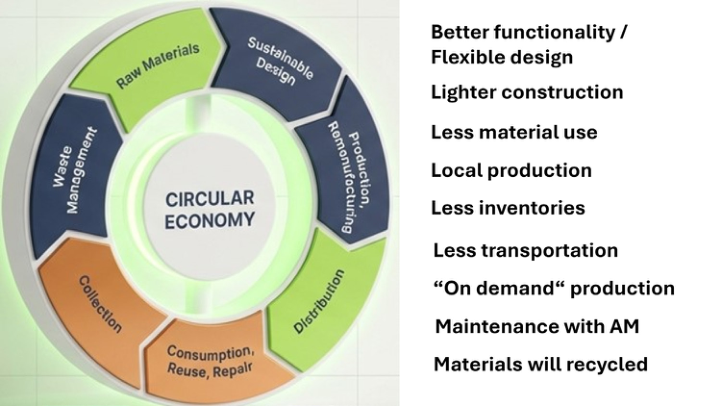
The accompanying diagram illustrates the benefits of AM/3D printing at different stages of the product life cycle and the technical capabilities they create, as well as the emissions caused by product manufacturing, transportation, storage, recycling, etc. (Figure 2).
Figure 2: New additative technology influences new product structures.
138 Ruohomaa and Salminen AM’s full potential in supply chain is unleashed only when starting from designing and integrated into a broader technological ecosystem. This “digital thread” connects design, manufacturing, and maintenance.
* AI as an Orchestrator: AI not only optimizes AM process parameters and material efficiency but also enables generative design, creating extremely lightweight and durable structures impossible for humans to design. AI manages predictive maintenance and analyzes real-time data in the manufacturing network. * XR Technologies (Extended Reality) in Visualization and Operation: XR technologies enable the visualization of complex digital models and PBF process data globally. They are critical in supporting remote maintenance and repair construction, allowing experts to guide local manufacturing from anywhere in the world, minimizing the need for travel. * Robotics and Automation as Scalers: Robotics is essential in the post- processing and quality assurance of AM production. It makes local on-demand manufacturing economically competitive and enables a high degree of automation, which is a prerequisite for a decentralized production model.
The synergy of technologies enables a shift away from the resource- intensive “take-make-dispose” model. The circular economy model—less raw material, less waste, fewer emissions—is realized as follows:
* Scope 3 Emissions: Indirect emissions in the supply chain are radically reduced as transportation and massive central warehouses are replaced by local on-demand production. The focus of logistics shifts from moving physical goods to data transfer. * Energy Consumption: Weight minimization through AM design (e.g., in the aerospace and automotive industries) reduces energy consumption throughout the product’s life cycle. The optimized manufacturing process itself consumes less energy per finished component. * Resource Circulation and Waste Management: The process is designed to minimize residual waste. Collection and waste management are integrated back into the raw material cycle, where, for example, defective parts or decommissioned components can be reground into raw material for the PBF process (Powder Bed Fusion), closing the loop completely.
The Role of OEMs and Resiliency Nationally, security of supply has become a major concern, as the importance of maintenance of machinery and equipment increases during times of crisis and uncertainty arises in international supply chains. For this reason, local versatile manufacturing is important, as well as maintenance and care of critical equipment.
From the perspective of large international main suppliers, environmental issues have a growing image value, but economic realities for the supply chain are critical, such critical issues include security of supply, delivery time,
The Significance of Regional Ecosystems for the Global Business Chain 139 quality, the ability to produce new products for the market, maintenance efficiency, etc.
Radically renewing supply chains by utilizing new technology brings significant strategic and business benefits and reduces risks related to international supply chains, while at the same time achieving circular economy goals.
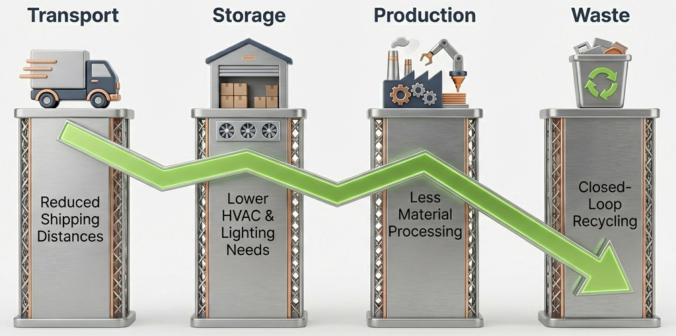
Figure 3: Economic and environmental benefits at supply chain.
In design, the maintainability and life extension of the produced product should be taken into account, as extending its lifespan (Figure 3) affects all of the emissions mentioned above. For this reason, the role of design in the supply chain is crucial. In this case, design refers to planning the entire process, starting from product design, production planning, and supply chain planning to the planning of services and recycling, thereby avoiding sub-optimization in terms of profitability, materials, and emissions.
CONCLUSION
Changes in customer behavior/awareness due to environmental issues and the emergence of new tested technologies enable the redesign of operations in products, production chain and maintenance, etc. Sudden crises in society often force the introduction of new technology and the testing of new use cases.
Radically reforming supply chains is no longer a choice but a necessity. The seamless integration of additive manufacturing, artificial intelligence, XR, and robotics provides companies with the tools to build supply chains that are simultaneously sustainable, flexible, and profitable. Success in this new era requires the courage to abandon linear processes and move towards a digitally driven ecosystem aimed at complete circular economy.
We are just changing HOW we make things. We are changing where they are made, HOW they are designed and HOW LONG they will last, (Swan. Wohler Report, 2026).
REFERENCES
Angioletti, C., Sisca, F., Luglietti, R., Taisch M., Rocca, R. (2017) Additive Manufacturing as an opportunity for supporting sustainability through implementation of circular economies. XXI Summer School “Francesco Turco” - Industrial Systems Engineering. https://www.researchgate.net/publication/312626449. Joshari, M., Raza, J. (2025). Developing A Business Model For Sustainable Additive
Cleaner Engineering and Technology. Volume 13, April 2023, 100620.https://doi. org/10.1016/j.clet.2023.100620 Purvis, B. (2025) Bridging the UK Skills Gap in Life Cycle Assessment. A Report from Working Group 5 of the Life Cycle Assessment Regulatory Science and Innovation Network (LCA-RSIN). https://sites.google.com/sheffield.ac.uk/lca- rsin/resources/outputs Ruohomaa, H., Salminen, V. (2021). Towards sustainable service value economy.
RESER (The European Association for REsearch on SERvices) 2021- conference, FIAO- publication, 14-15.10.2021, Heilbronn, Germany, pages 85-90. Ruohomaa, H. (2020) Ecosystem-based development in the transition of fourth industrial revolution. Acta Wasaensia, University of Vaasa. Saber, D., Alghamdi, H., Alhuthali, G., Alqurashi, R., Alshaikh, L., Alzahrani, M.,
AL-Malki, R., Aljoudi, J. (2025). Additive Manufacturing (3D printing) and the Future of Supply Chains: Opportunities, Challenges, and Trends. Global Journal of Engineering and Technology Advances. https://doi.org/10.30574/ gjeta.2025.25.3.0336 Sphera.com (2026) The 2026 Scope 3 Report: Meeting Acceleration with Certainty. Swann, L. (2026) Wohlers Report 2026- Growth Continues, But Caution Defines the AM Market. Wohlers Associates Publishing. https://platform.wohlersassociates. com/insights/wohlers-report-2026 Sweep.net (2026) Scope 3 Emissions Playbook Supply chain carbon accounting and
compliance for businesses https://www.sweep.net/guides/2025-scope-3-emissions- playbook-navigating-carbon-accounting-and-compliance? (read 18.2.2026 Taisch, M. (edited) (2020). The 2020 World Manufacturing Forum Report, Back to the Future: Manufacturing Beyond COVID19. Key Findings for a Resilient Manufacturing Sector in the New Normal. Retrieved from https://www. worldmanufacturingforum.org/
LISTED IN THE AHFE DIGITAL BOOKSTORE CATALOGUE
Explore the complete digital volume
Human Factors, Business Management and Society
Read this individual research paper free through the original publisher, or explore the full digital proceedings book.
ISBN 978-1-964867-91-5
Explore this ISBN in the AHFE Bookstore ↗Listed in the July 2026 bookstore catalogue; search by ISBN to confirm current availability · Digital book purchase optional