Heikki Ruohomaa, Vesa Salminen, Minna Takala (2022). Smart Countryside Community in Quadrable Helix Development. In: Human Factors, Business Management and Society. AHFE Open Access, vol. 56, pp. 80–88. https://doi.org/10.54941/ahfe1002255
The Fourth Industrial Revolution will bring unprecedented change to countryside and its society and business environments. Countryside has to compete with large centers and cities that are evolving rapidly and providing new opportunities for their residents.Forssa Town, which is located in the heart of three of Finland's largest cities, has decided to build innovation ecosystem to support their development work. Use case introduced in this article is physical and data infrastructure of traffic environment.During the study has been applied an ecosystem development approach, in which the city, the university, businesses and residents form a quadrable helix entity. It was ought to create a rapid development approach to the development and regeneration of rural cities.The goal of this article has been to implement an ecosystem- based approach for countryside city to develop it’s competitiveness and vitality under the pressures of urbanization in large cities. This research has used qualitative and quantitatively analytic methodology. The data analyzed has been tuned in terms of human behavior and values of the inhabitants moving on the area.
The Fourth Industrial Revolution will bring unprecedented change to societies, education organizations and business environments. It challen- ges the countryside environment to compete with large centers and cities that are evolving rapidly and providing new opportunities for their resi- dents. Sparsely populated areas need to develop their own attractions and approach competition from a new angle. Change is complex and unpre- dictable, so change cannot be approached with traditional development models.
The case study area is Forssa Town, which is located in the heart of three of Finland’s largest cities, where the attractiveness of large cities attracts young people and thus affects the region’s business life and the interest of companies in locating the region due to labour force availability insecurity.
During the study has been applied an ecosystem development approach, in which the city (administration), the university, businesses and residents form a quadrable helix entity. It was ought to create a rapid development approach to the development and regeneration of rural cities.
Smart Countryside Community in Quadrable Helix Development 81
In Forssa Town case, the municipalities together in the region have formed the basis for strategic development, which is based on a vision, a goal, a common will, development levels and resources for future development.
The university and research center HAMK Smart is at the heart of the inno- vation ecosystem. It gathers the latest knowledge and skills for development. It also creates beginning for new development and proof-of-concept stage. At the same time, rapid pilots and experiments are being created, which provide a basis for decision-making and the rapid implementation of a new approach.
Successful change is not complete until the implementation is successful. The development of new data-based technologies and services requires the understanding and simultaneous development of different (digital) ecosystem levels. Implementation in a successful digital revolution requires data-related harmonization. It is important that it is agreed on data generation, ownership, and utilization.
Managing of complex change in complex environments requires rapid experimentation in “real life environments”. Therefore, cities should offer themselves as such pilot environments. In this way, it is laid the foundation for development and people, and that enables the creation of services at a competitive price.
THEORETICAL FRAMEWORK According to a global estimate by Gartner in 2018, up to 60% of SMEs will disappear by 2025. The reason for this is the weak ability of companies to innovate in relation to changes in their operating environment and markets. (Troni et al. 2018).
Digitalization, “the sociotechnical process of applying digitizing techni- ques to broader social and institutional contexts that render digital technolo- gies infrastructural” (Tilson et al., 2010), has unleashed new opportunities to inform, organize or interact and create the world of growing interdependence.
“The business ecosystem produces goods and services of value to custo- mers, who are themselves members of the ecosystem” (Moore, James F., 1996). Dramatic changes in organizations’ business ecosystems occurs, because digital business make them, more complex, larger and essential to strategy (Burton Besty, 2017).
These business ecosystems are dynamic networks of entities to create and exchange sustainable value for participants by interacting with each other. Every organization exists in multiple business ecosystems. How the organi- zation will survive and thrive in its ecosystem, is the challenge (Kasey, Panetta, 2017). Ecosystems are also complex adaptive systems. In Knowledge Driven Entrepreneurship, Andersson, Curley and Formica (2003) define a business ecosystem as a network or coalition of resources, competencies, potential, energy, commitments, and promises to realize a shared profitable future. Geo- graphical or virtual ecosystems can span or traverse a number of business ecosystems.
There are many interlinked ecosystems, or an “ecosystem of ecosystems” (Valdezde-Leon, 2017). This means that every entrepreneur and business
organization need to have a better knowhow, how to build up digital ecosy- stems. Ecosystem leaders need to be able to create the right incentives (financial and other kinds), as well as systems to support participants. They must decide how their ecosystem, and not competing ecosystems, will create more value for users and ecosystem participants (Valdez-de-Leon, 2015).
It is risk, for a company not having an ecosystems strategy or taking part in digital ecosystems. As ecosystems become deeply rooted and conquer more of the available markets, those companies outside may find it hard to compete (Gawer, 2009).
Innovation Ecosystems Innovation ecosystems as complex adaptive systems have managerial impli- cations. The ecosystem, as a concept, is biological and in ordinally means “an interactive system established between living creatures and their environment in which they live” (Krause, Razavi, Moschoyiannis, and Marinos, 2009). The innovation ecosystem can be extensively determined as a set of organiza- tions which produces a comprehensive, connected technological system (e.g., smart watches, personal computers, and online marketplaces) that creates value for customers (Teece, 2007; Agerfalk and Fitzgerald, 2008).
Commensurate with the biological origins of this metaphor, some scho- lars have emphasized the indispensability of the keystone (Iansiti and Levien, 2004) or “platform leader” (Cusumano and Gawer, 2002) that lies at the core of the innovation ecosystem. The keystone’s role is to regulate the ove- rall function of the ecosystem and as a consequence its actions influence the success of all other members. However, empirical descriptions of inno- vation ecosystems often identify the importance not only of collaborating, but also of competing actors (Hannah and Eisenhardt, 2018) and competing technologies and standards (Arthur, 1989).
Moore (2007) has introduced a BDP- model of Digital Business Ecosystem structure where the business ecosystem and digital ecosystem are coupled to form a viable dynamic innovation ecosystem. The digital ecosystem influe- nces enterprises, their social and business networks, and the business ecosy- stem affects the organisms of the digital ecosystem (Innovation Ecosystem Initiative).
Triple Helix (Model of Innovation) The evolutionary triple helix model was developed by Etzkowitz and Leydes- dorff (1995). Triple Helix model represent different characters and degrees of cooperation between the three main actors involved in innovation: govern- ments, universities and industry.
The theory on “systems of innovation”is strongly ruled by the institutional list approaches with focus on the structural aspects of the innovation systems (e.g., “triple helix” of government-academia-industry, infrastructure, policy and political environment) (Jucevicius G. and Grumadaite K., 2014).
The quadruple helix framework describes university-industry-government- public-environment interactions within a knowledge economy. In innovation
Smart Countryside Community in Quadrable Helix Development 83
helix framework theory, first developed by Henry Etzkowitz and Loet Leydes- dorff and used in innovation economics and theories of knowledge, such as the knowledge society and the knowledge economy, each sector is represented by a circle (helix), with overlapping showing interactions.
“Smart specialization is an innovation policy concept that aims to boost regional innovation, contributing to growth and prosperity by helping and enabling regions to focus on their strengths. Smart specialization is based on partnerships between businesses, public entities and knowledge institutions.” (Marie Curin Accossiation 2018).
RESEARCH QUESTIONS This research has focused its goals on ecosystem-based approach for develo- pment of competitiveness and vitality of countryside city.
The main research questions are a) How ecosystem-based development process is applied in rural areas? b) How is implementation and data utilization managed in ecosystem-based development on countryside city environment
This research has used qualitative and quantitatively analytic methodology. The data analyzed has been collected from history data, regional and city strategies complemented by technological trend and developments data. This data analyzed has been tuned in terms of human behavior and values of the inhabitants moving on the area.
This article introduces a concept model for utilizing new technology envi- ronment in co-operative business towards the new service economy on the basis of digital symbiosis.
ECOSYSTEM AND QUADRABLE HELIX BASED DEVELOPMENT Digitalization and new technology change traditional business environment and is a big opportunity to find out competitive advantage in new busi- ness. Universities and educators have a good opportunity and central task in supporting the growth of business on the area of digitalization and ecosystem–based development. The co-operation between enterprise and uni- versities and government, is important to succeed in co-evolution when building up cumulative knowhow in creation of solutions for digitalization by benefiting digitalization in it. It is also important to have a common vision and commitment to direct the local authorities and funding. Otherwise, the activities can splinter as small pieces (Ruohomaa, 2020).
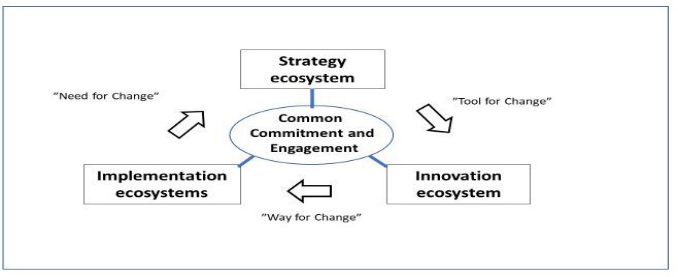
Organization exists in multiple business ecosystems (Figure 1). These busi- ness ecosystems are dynamic networks of entities communicating with each other to create value for participants. The challenge is deciding how your organization will survive and thrive in its ecosystem. The degree of openness within ecosystems is managed by strategies, common goals and shared inte- rest. An ecosystem may be hybrid, private or public. Organizations often participate in a hybrid of public and private ecosystems (Dimensions of Business Ecosystems).
Figure 1: Ecosystem-based development framework.
This article has been concentrating on implementing of ecosystem-based approach for countryside city to develop it’s competitiveness and vitality under the pressures of urbanization in large cities.
The basis for future ecosystem development is the digital ecosystem, on which new business ecosystems with new innovations, value chains, products and services and a new business model are built.
However, the opportunities offered by digitalization and the digital ecosy- stem do not transform into new services or business models by itself. An innovation ecosystem is needed between the digital ecosystem, which enables through own development work to obtain profitable new business elements and models.
For this reason, it can rightly be argued that the foundation for ecosystem work is created by harmonizing data, owning and sharing data, and leve- raging new technologies as they enable new business models, value chains, and products and services in the business ecosystem. Ecosystem development cannot be driven solely on innovation by linking existing business ecosy- stem actors as the digital foundation required for new business is not strong enough and enable rapid scaling of new business. Without the ability to scale and innovate quickly, business ecosystems will not be able to compete in a changing market, without the presence of a functioning digital ecosystem.
Ecosystem-based development is a spiral process, where several ecosystems are involved, and they are continuously changing according current needs and objectives (Fig. 1).
Strategic Ecosystem In this article, the “strategic ecosystem”interlinks key actors, that collaborate closely, based on their own long-term interests, strategies or duty towards the same goal. These are actors that are able to set long-term goals and allocate resources required for development.
Innovation Ecosystem In this article “innovation ecosystem” is seen as an ecosystem which acti- vely develops new innovation in order to support change. The innovation
Smart Countryside Community in Quadrable Helix Development 85
ecosystem is directing its activities according guidelines set by strategic ecosystems, which also allocate the resources for activities.
Implementation Ecosystems In this article the “implementation ecosystem” describes how the different ecosystems interact at the moment of change. It also shows how we can improve the performance of a business ecosystem or create new offerings or products, e.g., by developing digital ecosystems
FORSSA REGION The Forssa region is located in the center of the triangle formed by Fin- land’s three largest cities, and thus competes against the attraction formed by large cities. The Forssa area is rural in nature. For this reason, the Forssa region (municipalities and other stakeholders) has to approach its develo- pment work through ecosystem development, which means that all resources can be used and allocated correctly as well as possible. Hence municipalities have concentrated development resources through a Regional development company/Business Park Forssa to coordinate.
In its own development work, the Forssa region has allocated the distri- bution of resources through a local development company so that the deve- lopment work is not fragmented into small entities. One of the key roles in development work is cooperation with various stakeholders (University, vocational education, companies, government etc.), which, with its own pre- sence and expertise, enables new issues to be raised, piloted and experimented with. The main financiers of the co-operation measures are the municipalities and the Regional Council of Häme (EU funding).
Development of mobility and promoting digitalization are selected as key areas for development. The focus here is on mobility cooperation in parti- cular, with the long-term goal of developing the attractiveness of the Forssa region as an area of employment (securing the workforce) as well as the attra- ctiveness of Forssa as a place to live and visit. The development of mobility is to be approached on a broad scale, with the aim of engaging all actors, in line with QH thinking.
The strategic ecosystem for development is thus formed by municipalities and stakeholders (financier and polytechnic, etc.), which directs development measures and allocates the necessary goals and resources to achieve the goals. Reducing CO2 emissions and developing the region’s attractiveness are key objectives for transport development.
The innovation ecosystem for development consists of the municipally owned Business Park Forssa, the University of Applied Sciences Research Center (HAMK Smart), companies and other stakeholders, and local resi- dents. The innovation ecosystem is central to the design and implementation of development and produces the pilots and “proof of concepts” needed for renewal.
However, the change has only materialized once it has been satisfactorily implemented and accepted to use by customers and stakeholders. For this
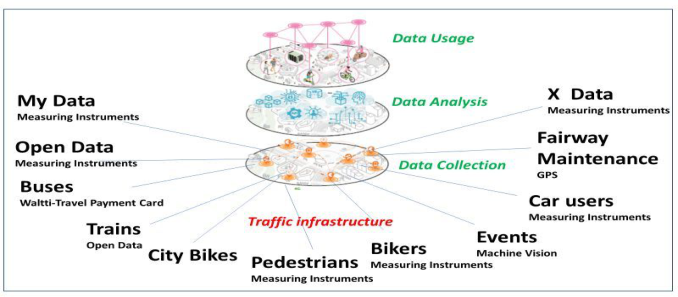
Figure 2: Different sources for data collection (Adapted from Kestävän kasvun liikennejärjestelmä VN 2021/60).
reason, the implementation of change must also be seen as an ecosystem process, implementation ecosystem.
Traffic digitalization is managed by leveled structure consisting of infra- structure, data collection, platform and service layers (Fig. 2). The effective implementation of new mobility services requires development at all levels supporting their coordination and understanding. However, the founda- tion for efficient transport services and smooth, low-emission transport is being created by the digital ecosystem and the associated data and data availability.
Mobility-related data is widely available and plays a key role in exploiting and developing new services. The availability of data plays a key role in the development of traffic, in addition to the data collected by traffic, open data also plays a key role.
However, the available data primarily tells how people are moving now and with current tools within current schedules. The data collected does not tell about the needs or desires of the citizens to move, but about how they move with the given opportunities.
The development of the most efficient transport services is also essential for the customer’s own participation and the customer’s own participation in the development process.
There are many ways in which a citizen/customer can participate:
opening the customer’s own movement data (MyData) to traffic development actors
opening up information collected on users of transport services to transport developers
Data collected from potential customers in different ways When the development of mobility services for municipalities, universi- ties, companies, and local residents/customers provides new opportunities for the development of new transport services, but it also enables faster implementation of new services.
Smart Countryside Community in Quadrable Helix Development 87
CONCLUSION
The rapid growth of data creates new opportunities for the development of new mobility services. The development of new mobility services into public services in a complex and rapidly changing environment brings a develo- pment process in which different ecosystems play different roles. In this article the use of strategic ecosystem, innovation ecosystem and implementation ecosystem has intended to show the special nature of ecosystems and their interactions. They also emphasize the importance of deployment as part of the change process.
In Forssa Town case implementation, in real life environment, quadrable helix co-operation between different actors enables the emergence of new innovations and the development of new services. The involvement of local residents/customers in the development of their services is key to the deve- lopment of transport. The development of new mobility services and the implementation and introduction of services in a rural context is essential to increase the vitality of small towns.
REFERENCES
Agerfalk, P.J. and Fitzgerald, B. (2008), “Outsourcing to an unknown workforce: Exploring open sourcing as a global sourcing strategy”, MIS Quarterly, Vol. 32 No. 2, pp. 385–409. Andersson, T., Curley M., and Formica P. (2010), Knowledge-Driven Entrepreneur-
ship: The Key to Social and Economic Transformation 2010: Springer. Arthur, W. B. (1989), Competing technologies, increasing returns, and lock-in by historical events. Econ. J. 99 (394), 116–131. Burton, Besty (2017), Eight dimensions of business ecosystems, Gartner, June
2017 https://www.gartner.com/smarterwithgartner/8-dimensions-of-business-eco systems/ Cusumano, M.A. and Gawer. A. (2002), “The elements of platform leadership” MIT Sloan Management Review, Vol. Spring, pp. 51–58. de Toni Alberto F., Siagri Roberto & Battistella Cinzia (2017): Corporate Foresight.
Anticipating the future. N.Y., USA: Routledge. Dimensions of Business Ecosystems https://www.gartner.com/smarterwithgartner/8dimensions-of-business-ecosystems/ Etzkowitz, H. and Leydesdorff, L. (1995), “The Triple Helix: university-industry-
government relations. A laboratory for knowledge based economic development”, EASST Review. European Society for the Study of Science and Technology, Vol. 14, No. 1, pp.18–36. Gawer, A. (2009), Platforms, Markets and innovation: an Introduction, in Gawer, A.
(ed.) Platforms, Markets and Innovation. Cheltenham: Edward Elgar. Hannah, D.P. and Eisenhardt, K.M. (2018), How firms navigate cooperation and competition in nascent ecosystems. Strateg. Manag. J. 39 (12), 3163–3192. https://doi.org/10.1002/smj.2750. Innovation Ecosystems Initiative, http://www.digital-ecosystems.org Kasey Panetta, Gartner (July 12, 2017), Eight Dimensions of Business Ecosy-
stems https://www.gartner.com/smarterwithgartner/8-dimensions-of-business- ecosystems/ Krause, P., Razavi, A., Moschoyiannis, S., and Marinos, A. (2009), Stability and Complexity in Digital Ecosystems. Proceedings of 3rd IEEE.
Marie Curin Accossiation (2020), (https://www.mariecuriealumni.eu/newsletter/def inition-day-smart-specialisation-strategy) Moore J.F. (1993), “Predators and Prey: A New Ecology of Competition,” HARVARD BUSINESS REVIEW, vol. 71, 1993, pp. 75–83. Ruohomaa, H. (2020) Ecosystem-based development in the transition of fourth
industrial revolution. http://urn.fi/URN:ISBN:978-952-476-931-0 Teece, D.J. (2007), “Explicating dynamic capabilities: The nature and micro foundations of (sustainable) enterprise performance”, Strategic Management Journal, Vol. 28, pp. 1319–1350. Tilson, D., Lyytinen, K., and Sørensen, C. (2010), “Research Commentary - Digital
Infrastructures: The Missing IS Research Agenda,” Information Systems Research (21:4), pp. 748–759. Valdez-de-Leon, O. (2015), Elements and Enablers: How to Develop an Operator IoT Ecosystem. Ericsson Business Review. Accessed May 14, 2019. https://www.slideshare.net/omarvl/elements-andenablers-how-to-develop- an-operator-iot-ecosystem Valdez-De-Leon, O. (2019), How to Develop a Digital Ecosystem: a Practical Framework. Technology Innovation Management Review August (Vol. 9, issue 8).
LISTED IN THE AHFE DIGITAL BOOKSTORE CATALOGUE
Explore the complete digital volume
Human Factors, Business Management and Society
Read this individual research paper free through the original publisher, or explore the full digital proceedings book.
ISBN 978-1-958651-32-2
Explore this ISBN in the AHFE Bookstore ↗Listed in the July 2026 bookstore catalogue; search by ISBN to confirm current availability · Digital book purchase optional