Minna Takala, Taina Tukiainen, Marina Weck, Vesa Salminen (2025). Regional Innovation Valleys Enhancing Place-Based Innovation. In: Human Factors, Business Management and Society. AHFE Open Access, vol. 176, pp. 15–25. https://doi.org/10.54941/ahfe1006299
The Regional Innovation Valleys (RIVs), a cornerstone of the New European Innovation Agenda, were launched in 2023 to catalyze regional innovation across Europe. In June 2024, over 150 regions, including Kanta-Häme, were designated as RIVs to bolster their research and innovation (R&I) capacities. These valleys aim to foster a vibrant European innovation ecosystem focused on critical areas like climate adaptation, circularity, healthcare, food security, digital transformation, and energy independence.Kanta-Häme, renowned for its bio and circular economy expertise, boasts a robust industrial base and cutting-edge research. Key circular economy sectors, including bioeconomy, food, construction, and waste management, are thriving. The region's three eco-industrial parks (Envitech, RiiCycle, and Industrial Park MORE) provide exceptional platforms for industry networking and the development of innovative business models.This paper examines three regional development projects that prioritize stakeholder engagement and collaboration within innovation ecosystems.The "Häme Goes into Ecosystems" project assessed the efficacy of participatory approaches in fostering understanding and motivation among stakeholders. A key outcome was the "Häme Ecosystem Guidebook for SMEs," designed to encourage SME participation in research, development and innovation activities.The "Häme Regional Innovation Valley" project emphasizes international collaboration and the visibility of regional research, development and innovation services in order to enhance placed-based innovation activities.The CIRC-2-ZERO project, involving Baltic Sea region partners, accelerates carbon emission reduction among SMEs in the electronics and wood industries. It promotes advanced manufacturing practices by facilitating the adoption of digital tools and solutions for circular economy transitions. HAMK leads the Resilience Transformation Hub, serving as the central point of contact for regional SMEs and stakeholders.These case studies underscore the effectiveness of participatory approaches in driving stakeholder engagement and collaboration, fostering place-based innovation. By convening diverse stakeholders and facilitating open dialogue, these approaches cultivate a shared vision for the innovation ecosystem and contribute to the development of sustainable and resilient economies and regions.
The Regional Innovation Valleys (RIVs) initiative, launched in 2023 as a cornerstone of the New European Innovation Agenda (NEIA), represents a strategic effort to unlock the full innovation potential across European regions. By connecting more and less innovative regions, the initiative aims to bridge the innovation divide and address pressing societal challenges
through cutting-edge technology. In June 2024, over 140 regions, including Kanta-Häme, were designated as RIVs, committing to strengthen their RDI ecosystems, enhance policy coordination, and engage in interregional collaboration. These RIVs are expected to drive innovation in areas such as climate adaptation, circularity, healthcare, food security, digital transformation, and fossil fuel reduction, fostering knowledge exchange and joint initiatives across borders.
Innovation serves as a fundamental driver of both business and societal advancement, acting as a catalyst for transformative change. In the business realm, innovation fuels competitive advantage, enabling organizations to adapt to evolving market demands, enhance operational efficiency, and develop novel products and services. This dynamic process extends beyond mere technological advancements, encompassing improvements in business models, organizational structures, and strategic approaches. Beyond the corporate sphere, innovation plays an equally critical role in societal development. It addresses pressing social challenges, such as climate change, healthcare disparities, and resource scarcity, by generating solutions that enhance quality of life and promote sustainable practices. The regional and place-based innovation require collaboration at strategy, development and at implementation levels (see e.g., Asheim, 2019; Burns, 1961; Markkula, 2015; Ministry of Education, 2009; Ruohomaa, 2020; Salminen et al., 2022; Takala et al., 2012; Takala et al., 2024; Tukiainen et al., 2022).
The article aims to share experiences of Kanta-Häme’s strategic initiatives, research and development activities, and collaborative efforts, contributing to a broader understanding of how regional innovation ecosystems can address complex sustainability challenges.
THE THEORETCICAL FRAMEWORK This research applies a multi-faceted theoretical lens, integrating systems theories, regional development theories, organizational theories, and specific innovation ecosystem models to analyze the innovation ecosystem of Kanta-Häme. This theoretical framework provides a foundation for understanding the complex dynamics that drive regional innovation and sustainability.
We draw upon General Systems Theory (GST), to conceptualize the interconnectedness and interdependence of actors across innovation ecosystems. GST allows us to examine how universities, industries, government, communities, and startups interact and influence each other, recognizing the holistic nature of the system. Eco-industrial parks, in this context, are viewed as systems, where resource inputs and outputs are optimized to minimize waste, demonstrating the principles of systemic efficiency. Furthermore, Complex Adaptive Systems (CAS) theory is applied to recognize the dynamic and evolving nature of innovation ecosystems. CAS highlights the characteristics of uncertainty, non-linearity, and self- organization that are inherent in such systems. Eco-industrial parks and startup activities are analyzed as adaptive systems that respond to changing market conditions and technological advancements, emphasizing
the importance of adaptability, resilience, and distributed intelligence (Hammond, 2003).
To understand the drivers of regional economic growth and innovation, we utilize Smart Specialization (S3) theory which provides a framework for analyzing how Kanta-Häme identifies and leverages its competitive advantages. The region’s focus on material cycles in bio and circular economy, sustainable food systems, smart processes & services, and sustainable design reflects the principles of S3, demonstrating a strategic concentration of resources and efforts to enhance innovation capacity (Asheim et al., 2019).
Organizational Learning Theory (Senge, 1990) emphasizes the significance of learning and adaptation in organizational and regional development. Innovation ecosystems, eco-industrial parks, and startup activities are conceptualized as learning environments where stakeholders acquire new knowledge and skills. This theoretical lens underscores the importance of fostering a culture of continuous learning to enhance innovation and sustainable development in Kanta-Häme.
Finally, Appreciative Systems Theory by Vickers (1968) emphasizes the importance of identifying and amplifying both facts and values of the regional innovation ecosystem to drive change. This theory highlights the value of building on existing strengths and fostering a culture of appreciative collaboration and innovation over the time, contributing to the overall resilience and dynamism of Kanta-Häme’s innovation landscape.
In addition to these core theories, we incorporate specific models relevant to innovation ecosystem analysis. The 5-Helix model underscores the critical role of collaboration among academia, industry, government, civil society, and the environment in driving innovation. This model provides a comprehensive understanding of how diverse stakeholders can effectively collaborate to build a sustainable innovation ecosystem (Hofecker, 2019). System Models, such as Elke den Ouden’s Value Model (2012), offer a structured approach to analyzing the complex interactions within the innovation ecosystem. These models aid in identifying key value flows and potential areas for improvement, enabling stakeholders to optimize their collaborative efforts. These theories and frameworks provide valuable insights into the dynamics of Kanta-Häme’s innovation ecosystem and guide the region’s efforts to foster collaboration and drive innovation.
RESEARCH QUESTIONS AND METHODOLOGY The aim of this article is to describe how regional innovation valleys can enhance place-based innovation. This article sets the scene for long-term action research with the following research questions:
How do the participatory innovation ecosystem activities contribute to the long-term sustainability and effectiveness of regional innovation initiatives?
How can these activities be scaled and replicated in other Regional Innovation Valleys?
Research methodology is based on action research principles and case studies – (Yin, 1989) collecting information in several research and development projects. The “Häme Goes into Ecosystems,” “Häme Regional Innovation Valley,” and “CIRC-2-ZERO” projects represent a critical juncture for Kanta-Häme’s innovation trajectory. While these initiatives are in their early phases, their potential importance lies in establishing the groundwork for enhanced collaboration and knowledge exchange. This article serves to contextualize their significance, emphasizing the potential role they play in fostering a cohesive and dynamic regional innovation ecosystem. By actively promoting stakeholder engagement, facilitating international partnerships, and driving the adoption of sustainable practices, these projects set the stage for Kanta-Häme’s successful integration within the broader European Regional Innovation Valley landscape, ultimately contributing to the region’s long-term economic growth and sustainability.
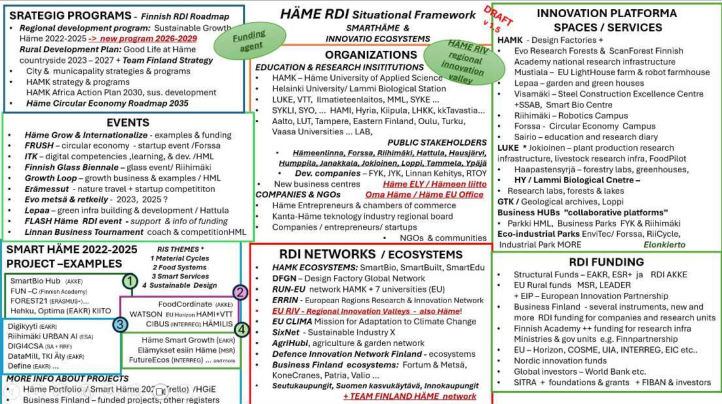
This RDI (Research, Development, and Innovation) Situational Framework is a structured approach to understanding and analyzing the context in which RDI activities take place. It helps to identify the key factors that influence the success or failure of RDI initiatives, enabling organizations and regions to make informed decisions and develop effective strategies (applied from Ouden (2012)). The RDI Situational Framework was created in collaborative workshops with regional stakeholders in the Häme Goes into Ecosystem project. The RDI Situational Framework–describes the key elements of regional innovation ecosystems supporting and enabling place-based innovation. The intent was to provide a holistic picture of the regional innovation ecosystem.
Figure 1: RDI – Research, Development and Innovation situational framework.
The RDI Situational Framework includes the following elements:
The strategic programs that steer the strategic regional long tern development – including Regional Development Program 2022–2025 and Circular Economy Roadmap 2035.
Events for collaboration.
Regional Innovation Strategy themes and examples of development projects, links to project portfolios for more information.
Organizations operating in the region.
RDI networks and ecosystems – interregional and international.
Innovation platforms, facilities and services offered in Häme Region and RDI funding opportunities.
By applying a RDI Situational Framework, organizations and regions can gain a deeper understanding of their RDI environment, enabling them to make informed decisions and achieve their innovation goals.
Kanta-Häme offers several research and development infrastructures, including the Evo forests research platform, eco-industrial parks and startup acceleration activities. These platforms provide valuable opportunities for researchers and businesses to collaborate on cutting-edge research and development activities.
CASE STUDY FINDINGS Kanta-Häme’s strategic approach to innovation is deeply rooted in the principles of place-based innovation. By leveraging its regional assets, such as its expertise in bio and circular economy and its robust industrial base, the region can develop tailored solutions to address complex sustainability challenges.
The eco-industrial parks serve as critical platforms for fostering collaboration and driving innovation, providing companies with access to cutting-edge research and development facilities.
The Evo Forests serve as a unique research platform for climate, forest and soil data collection and analysis, supporting the development of innovative solutions for sustainable forest management.
The startup activities across the Kanta-Häme aim to support new business development and enhance entrepreneurial discoveries.
These three case studies are presented in the following chapters.
Eco-Industrial Parks and Support for SME’s Kanta-Häme, Finland, is leveraging its eco-industrial parks—Envitech in Forssa, RiiCycle in Riihimäki, and Industrial Park MORE in Hämeenlinna— as pivotal hubs for driving circular economy practices and fostering regional sustainability. These parks represent an active effort to integrate industrial activities with ecological principles, creating synergistic ecosystems where resource efficiency, waste reduction, and collaborative innovation are paramount. This case example explores how these parks are contributing to Kanta-Häme’s broader sustainability goals.
The eco-industrial parks in Kanta-Häme are designed to facilitate the exchange of materials, energy, and information among resident companies, thereby minimizing waste and maximizing resource utilization. Envitech with its focus on environmental technologies, provides a platform for companies specializing in waste management, bioenergy, and water treatment. RiiCycle emphasizes recycling and material recovery, fostering a closed-loop system where waste streams are transformed into valuable resources. Industrial Park MORE with its diverse industrial base, promotes cross-sectoral collaboration and the development of innovative circular economy solutions.
The eco-industrial parks play a crucial role in advancing Kanta-Häme’s regional sustainability goals. By promoting resource efficiency and waste reduction, they contribute to minimizing the region’s environmental footprint. Moreover, they stimulate economic development by attracting investments, creating jobs, and enhancing the competitiveness of local businesses. The parks also serve as showcases for sustainable industrial practices, attracting visitors and fostering knowledge exchange with other regions.
The eco-industrial parks in Kanta-Häme align with broader sustainability goals at the national and European levels. By demonstrating the viability of circular economy practices, they contribute to the development of sustainable industrial models that can be replicated in other regions. Their focus on resource efficiency, waste reduction, and collaborative innovation supports the transition towards a low-carbon, resource-efficient economy, contributing to the achievement of climate change mitigation and adaptation targets.
Kanta-Häme’s eco-industrial parks—Envitech, RiiCycle, and Industrial Park MORE—represent a strategic approach to fostering circular economy practices and advancing regional sustainability. They serve as examples for other regions seeking to integrate industrial activity with ecological principles, demonstrating the potential of eco-industrial parks to contribute to a more sustainable and resilient future.
A key development challenge for Kanta-Häme’s eco-industrial parks is to strengthen their collaboration and knowledge exchange among the parks in Finland and Europe even further. There has been several national collaborative RDI projects with research institutions, and public sector organizations, fostering a culture of open innovation and continuous improvement. Workshops, seminars, and networking events provided opportunities for stakeholders to share best practices, exchange ideas, and explore new collaboration opportunities. This collaborative approach enhances the effectiveness of circular economy initiatives and accelerates the transition towards a more sustainable industrial ecosystem.
Development activities are needed also outside of eco-industrial parks. The CIRC-2-ZERO project, managed by Häme University of Applied Sciences (HAMK), has secured significant Interreg Baltic Sea Region funding, aimed at accelerating the transition of SMEs in the Baltic Sea Region to a circular economy and reducing their carbon dioxide emissions. The project involves 13 partners and 10 associated partners from seven countries in the Baltic
Sea Region, including universities, development companies, public sector representatives, and businesses.
The project’s primary target group is SMEs in the electronics and wood industries, to whom training, mentoring, and technical support will be provided. The aim is to strengthen advanced manufacturing practices and promote the adoption of digital tools and solution simulations for circular economy business models. The project will establish a transnational network of six regional Resilience Transformation Hubs, which will promote sustainable innovation and collaboration between researchers, businesses, and policymakers. The project is expected to significantly promote the internationalization of SMEs, sustainable development, and the transition to a low-carbon economy in the Baltic Sea Region.
Evo Forests as an Example of Place-Based Innovation Arena Evo Forests, a designated national research area in Finland, stands as a paradigm for place-based climate adaptation research and innovation. This unique ecosystem, located in the Kanta-Häme region, serves as a case study for multidisciplinary scientific inquiry, technological development, and educational advancement, all aligned with the objectives of the EU Mission for Adaptation to Climate Change. By integrating long- term ecological monitoring, advanced technological infrastructure, and collaborative research initiatives, Evo exemplifies a comprehensive approach to understanding and mitigating the impacts of climate change on boreal ecosystems. The area’s rich history of forestry education and ecological research, dating back to the establishment of Finland’s first Forestry College in 1862, underscores its long-standing commitment to sustainable forestry practices. Evo’s role as an arena for place-based innovation, highlights the synergy between historical land use, contemporary research projects, and educational programs, and its contribution to fostering regional resilience and informing broader climate adaptation strategies.
Evo’s designation as a national research area has fostered a collaborative ecosystem that transcends disciplinary boundaries. The convergence of academic institutions, research institutes, and governmental agencies at Evo has facilitated the development of multidisciplinary research projects focused on climate change impacts and adaptation strategies. This collaborative environment enables the integration of diverse perspectives and methodologies, enhancing the robustness and applicability of research outcomes. A cornerstone of Evo’s research capabilities is its commitment to long-term ecological monitoring. The SCAN FOREST research infrastructure, funded by the Finnish Academy, exemplifies this commitment by providing detailed, multi-temporal data on forest ecosystem dynamics. This infrastructure facilitates the study of complex ecological processes, such as tree growth allocation and carbon sequestration, enabling researchers to develop predictive models and inform adaptive management strategies.
Evo hosts a range of research initiatives that address critical aspects of climate change adaptation. Projects such as UNITE, POOL, and FUN-C demonstrate the diversity of research conducted at Evo, encompassing
areas such as forest resilience, wetland ecology, and soil carbon dynamics. Furthermore, Evo serves as a testbed for innovative technologies, including drone-based remote sensing and robotic systems, which enhance the efficiency and accuracy of ecological monitoring and data collection. Evo’s historical legacy of forestry education continues to inform its role as a center for knowledge transfer and capacity building. Educational programs, such as HAMK’s Sustainable Forest Management program and the FOREST21 project, provide opportunities for students and professionals to acquire the skills and knowledge necessary to address climate change challenges. By fostering a culture of learning and knowledge sharing, Evo contributes to the development of a skilled workforce capable of implementing climate adaptation strategies. Evo Forests also host biannual the Finnish Scout’s Leaders’ Campfire Summit, which collect over 3000 people committed to learn together of sustainable leadership principles. This unique event is open for all people interested people in collaborative leadership practices in the forest workshops, lectures and presentations.
Evo’s integration of research activities with recreational opportunities, such as the Evo Hiking Area, fosters community engagement and public awareness of climate change issues. By providing accessible nature experiences, Evo promotes a deeper understanding of the importance of ecosystem conservation and sustainable land management practices. Evo Forests serves as a model for place-based climate adaptation research and innovation, aligning with the objectives of the EU Mission for Adaptation to Climate Change. By integrating long-term ecological monitoring, advanced technological infrastructure, and collaborative research initiatives, Evo contributes to the development of robust adaptation strategies and the enhancement of regional resilience. The insights gained from Evo’s research and educational activities provide valuable lessons for other regions seeking to enhance their resilience to climate change impacts, demonstrating the potential of place-based research and innovation to address the complex challenges of climate change.
Kanta-Häme’s Startup Ecosystem: Fostering Innovation and Entrepreneurship Across the Region Kanta-Häme region is cultivating a startup ecosystem through targeted initiatives across its key cities: the Linna Business Tournament in Hämeenlinna, the FRUSH event in Forssa, and the DEFINE ecosystem activities in Riihimäki. These initiatives collectively provide a comprehensive support structure for aspiring entrepreneurs, fostering innovation, and driving economic growth throughout the region. This case example highlights how these distinct, yet interconnected activities are contributing to Kanta- Häme’s emergence as a dynamic hub for startup development.
The Linna Business Tournament, held in Hämeenlinna, serves as a pivotal platform for early-stage startups and more developed companies with new business ideas. This program offers intensive coaching, mentoring, and networking opportunities, empowering entrepreneurs to refine their business ideas and develop their business plans. By providing access to experienced
mentors and industry experts, the tournament equips startups with the essential tools and knowledge needed to navigate the challenges of launching and scaling a business. The tournament’s focus on practical training and real- world application ensures that participants gain valuable insights into market dynamics, financial management, and strategic planning. The best business ideas in three series (Ideas, Growth, Acceleration) compete of financial grants in the final session.
The FRUSH event in Forssa is designed to ignite innovation and foster collaboration among startups, investors, and industry professionals especially related to circular economy solutions. This annual event provides a platform for startups to showcase their innovative solutions, pitch their ideas to potential investors, and connect with key stakeholders. FRUSH encourages the exchange of ideas and the formation of strategic partnerships via expert presentations and discussions, workshops and project exhibition.
The DEFINE ecosystem activities in Riihimäki focus on strengthening the region’s capabilities in defence and dual-use technologies. This initiative provides specialized support for startups developing innovative solutions in areas such as cybersecurity, robotics, and advanced materials. By fostering collaboration between startups, research institutions, and defence industry partners, DEFINE creates a unique environment for the development and commercialization of cutting-edge technologies. The ecosystem’s focus on dual-use applications ensures that innovations developed in the defence sector can also benefit civilian industries, driving economic diversification and technological advancement. There has been hackathons and competitions in collaboration with Business Finland funded e-Alliance ecosystem coordinated by Patria defence and technology company.
The Linna Business Tournament, FRUSH event, and DEFINE ecosystem activities are interconnected, forming a support structure for startups across Kanta-Häme. Entrepreneurs can leverage the resources and networks provided by each initiative, gaining access to a wide range of expertise, funding opportunities, and market insights. This interconnected approach ensures that startups receive the support they need at different stages of their development, from initial ideation to market entry and scaling. These startup initiatives are playing a crucial role in driving regional economic growth. By supporting the development of innovative businesses, they aim to create new jobs, attract investments, and enhance the competitiveness of Kanta-Häme’s economy. The focus on emerging technologies and sustainable business models ensures that the region’s startup ecosystem is aligned with global trends and contributes to the development of a resilient and future-proof economy.
CONCLUSION
Kanta-Häme’s participation in the RIV initiative underscores its commitment to interregional collaboration. By working with other RIVs, the region aims to strengthen European innovation cohesion and address the innovation divide. The RUN-EU network provides a valuable platform for knowledge exchange and joint innovation projects. Collaborations with regions in
Austria, Belgium, Hungary, Ireland, the Netherlands, Spain, Sweden and Portugal, along with the Western and Southern Finland regions, demonstrate the region’s commitment to building strategic partnerships and promoting knowledge exchange. The region’s participation in the DG REGIO Community of Practice for Circular Economy and other EU-level initiatives further highlights its commitment to fostering collaboration and sharing best practices.
The region’s commitment to research and development is further exemplified by its participation in inter-regional projects such as CIRC-2- ZERO, which focuses on enhancing advanced manufacturing practices and enabling the simulation and implementation of digital tools and solutions in the transition to circular economy business models. These projects highlight the region’s capacity to drive innovation and address complex sustainability challenges.
The region’s commitment to place-based innovation is further exemplified by its participation in the EU Joint Research Centre’s initiative Preparatory Action “Innovation for place-based transformation”. Based on the study we suggest that long-term sustainability and effectiveness are achieved through inclusive, collaborative approaches that leverage regional strengths and address specific challenges. Scaling and replication involve understanding these underlying principles and adapting them to the unique context of other Regional Innovation Valleys.
ACKNOWLEDGMENT
The authors would like to acknowledge the support of the EU, particularly the Mission on Adaptation to Climate Change for its technical assistance, the DG REGIO Peer-to-Peer Community of Practice (P2P CoP) for facilitating inter-regional collaboration, and the active participation of regional and local stakeholders.
REFERENCES
Asheim, B. T., Isaksen A. Trippl, M. (2019) Advanced Introduction to Regional Innovation Systems. Cheltenham: Elgar. Burns, T., and G. M. Stalker (1961), The Management of Innovation. Oxford, 1994; online edn, Oxford Academic, 3 Oct 2011. https://doi.org/10.1093/ acprof: oso/9780198288787.001.0001 Hammond, D. (2003) Tehe Science of Synthesis: Exploring Social Implications of
General Systems Theory. University of Oklahoma Press. ISBN: 978–0870817229. Hofecker, E. (2019) Understanding Innovation Ecosystems. A Framework for Joint Analysis and Action. Cambridge. MIT D-Lab. Markkula, M. and Kuhne, H. (2015) Making Smart Regions Smarter: Smart
Specialisation and Role of Universities. Technology Innovation Management Review. Vol. 5, Iss. 10. Ministry of Education (2009) The evaluation of the Finnish Innovation System.
The Policy Report. Taloustieto Oy. ISBN 978-951-628-490-6 Helsinki University Print. Ouden, E. (2012) Innovation Design - Creating Value for People, Organizations and Society. Springer. ISBN: 978-1-4471-2267-8.
Ruohomaa, H. (2020) “Ecosystem-based development in the transition of fourth industrial revolution” Academic dissertation. ACTA WASAENSIA 452. http:// urn.fi/URN: ISBN:978-952-476-931-0 Salminen, V., Ruohomaa, H., Takala, M. (2022) Future Ecosystem Ensuring
Competitiveness in Continuous Co-Evolution. Human Factors, Business Management and Society, Vol. 56/2022, 1–9. doi: 10.54941/ahfe1002245. Senge, P. (1990) The Fifth Discipline: The Art and Practice of the Learning Organization. New York: Doubleday/Currency. Takala, M.; Ing D.; Emery, M.; Hammond, D. and Metcalf G. (2012) Revisiting
the Socio-ecological, Socio-technical and Socio-psychological Perspectives. pp. 5–24. International Federation for Systems Research IFSR Conversation 2012 Proceedings SEA-Publications: SEA-SR-32 Institute for Systems Engineering and Automation ISBN 978-3-902457-32-5. Takala, M., Tukiainen, T., Salminen, V. (2024). Strengthening Co-creation Competencies and Engaging Innovation Ecosystem Partners Through Ecosystem Games and Innovation Camps. Human Factors, Business Management and Society. Vol. 135. 22–32. http://doi.org/10.54941/ahfe1004927 Takala M. and Tukiainen T. (2022) Regional Innovation Ecosystems Fostering Sustainable Development. Human Factors, Business Management and Society, Vol. 56, 2022, 17–24. doi: 10.54941/ahfe1002247. Tukiainen, T., Hongisto, P. (2020) Sustainable Baltic Sea Region – Towards Economic
Transformation by Smart Specialisation Strategies. Aalto University. Helsinki. Vickers, G. (1968) Science and Appreciative Systems. Human Relations. Vol. 21, Iss. 2. https://doi.org/10.1177/0018726768021002 Yin, R. K. (1989) Case Study Research - Design and Methods, Newbury Park, CA,
Sage Publications.
LISTED IN THE AHFE DIGITAL BOOKSTORE CATALOGUE
Explore the complete digital volume
Human Factors, Business Management and Society
Read this individual research paper free through the original publisher, or explore the full digital proceedings book.
ISBN 978-1-964867-52-6
Explore this ISBN in the AHFE Bookstore ↗Listed in the July 2026 bookstore catalogue; search by ISBN to confirm current availability · Digital book purchase optional