Turgut Refik Caglar, Dogan Efe, Fatih Zor, Elena Andrushchenko, Roland Jochem (2025). PDCA-Based Smart Problem-Solving Process for Systematic Failure Management in SMEs. In: Human Factors, Business Management and Society. AHFE Open Access, vol. 176, pp. 146–156. https://doi.org/10.54941/ahfe1006312
Small and medium-sized enterprises (SMEs) face persistent challenges in failure management due to limited resources, inadequate methodological support, and the absence of digital assistance systems. Current practices often rely on reactive, fragmented approaches with insufficient documentation, leading to recurring problems, inefficiencies, and increased quality costs.This paper presents a digitally supported, Plan-Do-Check-Act (PDCA)-based smart problem-solving process tailored to the specific needs of SMEs. Rooted in the principles of quality management, lean management, and failure management, the proposed process systematically integrates selected quality methods into the sub phases of the PDCA cycle. The selection and integration of these methods—based on their cognitive simplicity, practical relevance, and compatibility with SME constraints—enable structured decision-making directly on the shop floor.A key innovation lies in the development of a knowledge-based assistant system that provides context-sensitive guidance for each PDCA phase. The system not only supports users in applying appropriate quality methods but also enables the dynamic development of a failure knowledge base through structured documentation and systematic root cause analysis. In cases of unknown failure patterns, an interactive problem-solving platform enables users to identify suitable methods and interpret results through dialog-based interaction. This fosters organizational learning and builds a reusable knowledge infrastructure for failure prevention.The approach encourages a proactive failure culture in SMEs, transforming failures into learning opportunities. By facilitating low-threshold access to structured problem-solving and leveraging digital assistance, the system strengthens the methodological capabilities of employees and contributes to long-term quality improvement and cost reduction.The findings underscore the potential of method-integrated, digitally enhanced frameworks for transforming failure management into a sustainable strategic capability in SME production environments.
PDCA-Based Smart Problem-Solving Process for Systematic Failure Management in SMEs 147
form. Due to limited resources, many SMEs are unable to implement comprehensive digital failure management systems, resulting in incomplete or absent failure documentation (Kukulies et al., 2019). This gap is critical, as unresolved process failures can compromise product quality and lead to substantial financial losses. Studies suggest that manufacturing failure costs can account for approximately 2.8% of annual revenue – equating to about €115,000 per month for a company with €50 million in revenue (Günther et al., 2020).
In practice, however, failure data is often used only for basic descriptive analysis rather than for proactive improvement initiatives, contributing to persistent quality issues and inefficiencies (Kukulies et al., 2019). Resource constraints exacerbate this situation, as SMEs typically have limited budgets for Quality Management (QM) and restricted access to specialized support. Moreover, employees frequently lack the time to engage with complex problem-solving processes alongside their daily operational tasks (Hornfeck et al., 2011). This shortage of time and training complicates the establishment of effective continuous improvement routines (Plach et al., 2012).
Organizational culture can further hinder failure management efforts: when mistakes are stigmatized rather than regarded as opportunities for learning, employees may conceal failures, preventing systematic root cause analysis. In contrast, fostering a positive failure culture – one that encourages openness and learning – is critical for continuous improvement. When staff feel safe to report issues and appropriate tools are available, the threshold for documenting and addressing failures is significantly lowered (Berning, 2021; Brückner, 2021). As a result, data capture becomes more complete, and problems can be resolved more quickly, even within the time constraints typical of SME environments.
Given these challenges, there is a clear need for a systematic yet practical approach to failure management that is specifically tailored to SMEs. Such an approach should enable data-driven problem solving without overburdening employees or requiring extensive resources. One established framework for structured continuous improvement is the Plan-Do-Check-Act (PDCA) cycle. Also known as the Deming cycle, PDCA offers a simple, four-stage iterative model: in the Plan phase, problems are defined and solutions are planned; in Do, solutions are implemented; in Check, results are evaluated; and in Act, successful solutions are standardized, or the cycle is repeated if necessary (Kamiske, 2012).
A key advantage of PDCA lies in its applicability across all organizational levels – from the shop floor to management – and its iterative nature, which enables corrective action when initial measures prove insufficient. By adopting a PDCA-based approach, even resource-constrained organizations can introduce a disciplined problem-solving process that continuously drives performance improvements.
This paper proposes a PDCA-based smart problem-solving process for systematic failure management in SMEs. The term “smart” refers to the integration of proven quality improvement methods into each phase of the PDCA cycle, delivered through an interactive digital tool. The aim is to guide SME users through a structured workflow for addressing production
failures – from problem identification to solution implementation – by employing a curated set of analytical and decision-support methods at each step.
This approach directly addresses the challenges outlined above: it offers a streamlined process that reduces complexity for employees, integrates quality tools to enhance data analysis, and promotes a proactive failure management culture. In doing so, it seeks to improve failure data capture and analysis, increase production process efficiency, and enhance product quality in a manner practical for SMEs. The following sections describe the development of the PDCA-based methodology and tool, illustrate its application through a case study, and evaluate its implications for quality improvement and organizational learning within SMEs.
METHODOLOGY
The methodology is based on the PDCA continuous improvement cycle, which serves as the structural backbone for the failure management process. PDCA was selected for its simplicity and widespread recognition in quality management, making it accessible even to SMEs without extensive quality engineering expertise. Each of the four PDCA phases was enhanced with appropriate quality methods and tools to form a comprehensive problem- solving toolkit. By integrating these methods, the traditional PDCA cycle is transformed into a “smart” process that systematically supports users in analyzing and solving problems. The development involved two major steps: constructing a catalog of relevant problem-solving methods, and mapping these methods to the PDCA phases.
Developing a systematic failure management approach for SMEs began with constructing a comprehensive method catalog of quality tools and problem-solving techniques. Selecting appropriate methods for a given problem is known to be a major challenge for companies. To address this, an extensive literature review was conducted to identify proven tools from QM and related domains. Linß (2011), for example, had mapped a set of important quality methods to the phases of the PDCA cycle. Similarly, Kersten and Ehni (2014) compiled a list of over 90 problem-solving methods and evaluated their suitability for SMEs using a multi-criteria utility analysis. Building on these foundations, Schober (2019) proposed a structured filtering of methods to focus on those most relevant for SMEs. Schober’s approach defined three exclusion criteria to tailor the toolset to SME needs: methods requiring information gathering efforts deemed too time-consuming for SMEs’ limited resources (i.e. impractical alongside daily operations), methods used only to fulfill external stakeholder requirements (e.g. for compliance) and not part of a dynamic internal QM cycle, and methods that are substantially substitutable by other techniques, where redundancy can be reduced by keeping the more widely cited tool.
Applying these criteria led to the elimination of abstract, indirect, or resource-intensive approaches, yielding a refined set of 20 methods ideally suited for the digital problem-solving toolkit. This selected set encompasses a diverse range of quality improvement and analysis techniques while focusing
PDCA-Based Smart Problem-Solving Process for Systematic Failure Management in SMEs 149
on practicality for SMEs. For instance, the final catalog includes tools for data collection and visualization (e.g. failure collection lists and histograms), root cause analysis (e.g. fishbone diagrams and 5-Why analysis), decision support and prioritization (e.g. Pareto analysis, cost-benefit analysis, Kano model), idea generation (e.g. mind mapping, affinity diagrams), performance analysis (e.g. process capability studies), and lean continuous improvement practices (e.g. Muda waste checklist and Gemba Walk checklist). All chosen methods are well-documented in quality engineering literature and can be applied without extensive expert training, a crucial factor for SME applicability. By curating a manageable yet comprehensive method catalog, the approach ensures that SME users have access to proven problem-solving techniques that are feasible under typical SME constraints of time, personnel, and expertise.
Having identified the set of SME-appropriate methods, the next step was to integrate these tools into a PDCA-based problem-solving process. Each of the 20 selected methods was assigned to one phase of PDCA, aligning the tool’s purpose with the activities and goals of that phase. To determine the optimal assignment, established mappings from literature were consulted and the logical flow of using multiple methods in sequence was considered (see Figure 1). In prior work, different authors sometimes placed the same method in different PDCA phases, highlighting the importance of contextual understanding. For example, Linß (2011) categorized FMEA (Failure Mode and Effects Analysis) under the Act phase (as a follow-up action to prevent recurrence), whereas Kersten and Ehni (2014) included FMEA in the Plan phase as a preventive planning tool. Such discrepancies were reconciled by examining each method’s typical inputs and outputs and how it contributes to problem-solving progression. If one method produces results that feed into another, this connection guided their placement to ensure a seamless flow of information and decisions (Kamiske, 2011). In light of these considerations and the literature comparisons, a final mapping was developed (see Table 1), assigning every method to the PDCA phase where it would be most effective.
Table 1: Assignment of methods to the PDCA cycle.
Table available in the original PDF paper.
Plan Affinity Diagram Tree Diagram Box Plot Diagram Failure Collection List Histogram Fishbone Diagram Kano Model Cost-Benefit Analysis Mind-Mapping Utility Analysis Pareto Diagram Portfolio Diagram VOC-CTQ-Matrix Failure Mode and Effects
5-Why analysis
Analysis
Do Machine Capability Study Process Capability Study
Check Matrix Diagram
Act Gemba Walk Checklist Muda Waste Checklist
Under this scheme, the Plan phase encompasses the majority of the analytic and conceptual tools, since this phase involves defining the problem, gathering data, and identifying causes and solutions. Methods such as the failure collection list, histogram, and box plot support systematic data collection and visualization of the problem symptoms. Techniques like the fishbone diagram, 5-Why analysis, affinity diagram, and tree diagram facilitate structured brainstorming to uncover root causes and organize ideas. Additionally, prioritization and decision-making tools (e.g. Pareto chart, cost-benefit analysis, Kano model, VOC-CTQ matrix) are included in the Plan stage to help teams focus on critical factors and set improvement targets. The Do phase is focused on implementing the chosen solution and often involves controlling or optimizing the process. Here, statistical tools for validating improvements are applied – notably the machine capability analysis and process capability analysis, which verify that processes perform within acceptable limits after changes. The Check phase covers evaluation of the results. In the developed framework, this phase was associated with a matrix diagram, which can be used to compare and correlate factors or to ensure that all causes and effects have been addressed. Finally, the Act phase focuses on standardizing and sustaining the improvements. To reinforce this, practical checklist-based methods from lean management were allocated to Act – specifically the Gemba Walk checklist which encourages managers to go to the shop floor to observe processes and verify that new standards are followed and the Muda checklist that helps identifying and eliminating residual wastes. These Act-phase tools help institutionalize the lessons learned and ensure the problem does not recur, completing the PDCA cycle of continuous improvement. This structured mapping ensures that the chosen methods are not used in isolation, but rather as part of a coherent, iterative process. It also mirrors the logic of more advanced frameworks like Six Sigma’s DMAIC (Define-Measure-Analyze-Improve-Control), thereby ensuring completeness, while staying simpler and more flexible for SMEs. The end result of the methodology design is a PDCA-based “toolbox” that guides users through each step of failure management with relevant techniques, fostering a systematic approach rather than ad-hoc firefighting.
Overall, mapping the 20 selected methods into the PDCA framework creates a structured yet flexible roadmap for problem-solving in SMEs. Not every step in every cycle must employ a formal tool — the framework allows teams to skip tools when unnecessary for a particular problem, provided they can effectively proceed without them. However, the availability of this toolkit ensures that whenever systematic support is required, a relevant method is readily available. Integrating these methods into PDCA transforms the cycle from an abstract concept into a concrete sequence of guided actions.
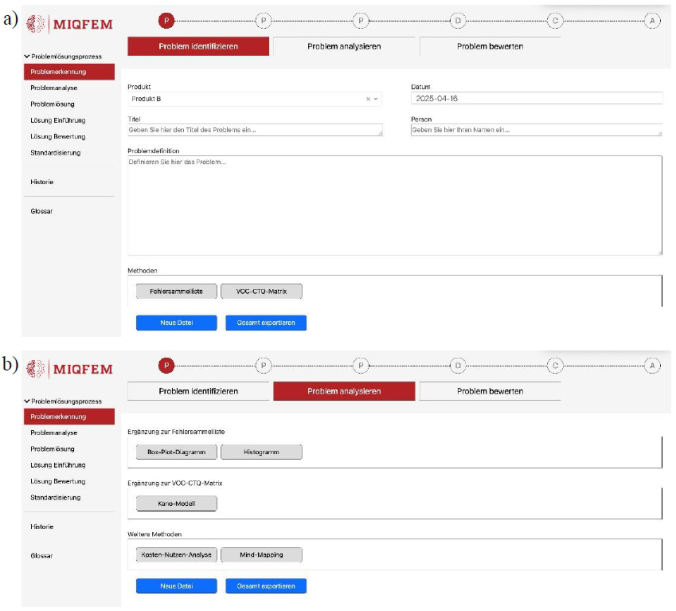
To facilitate practical adoption of the PDCA-based methodology in SME settings, the framework was implemented as an interactive web-based application. While the detailed technical implementation is outside the scope of this paper, the essential idea was to embed the PDCA cycle and the selected methods into a user-friendly digital tool. The interface leads the user through the four PDCA stages, prompting them to input information (e.g. problem description, data collected, actions taken) and suggesting appropriate
PDCA-Based Smart Problem-Solving Process for Systematic Failure Management in SMEs 151
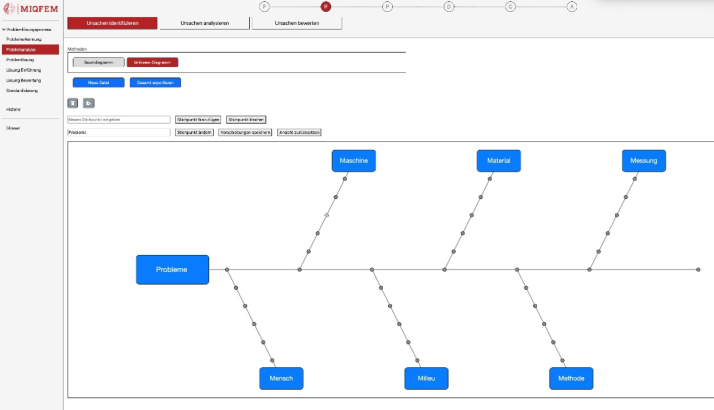
methods from the catalog at each stage (see Figure 1). For example, in the Plan phase the tool can recommend starting a failure collection list or constructing a fishbone diagram (see Figure 2) based on the nature of the problem being addressed. Each method in the catalog is accompanied by a concise description of its purpose and step-by-step instructions or templates for its use, effectively serving as a built-in glossary and guidance system for users. This means even team members who are unfamiliar with a particular technique can follow the provided instructions to apply it correctly within the problem-solving process. The tool also records each step taken and the results (e.g. charts, lists, identified causes, chosen solutions), building a structured log of the entire problem-solving project. Upon completing the cycle, the tool allows exporting or saving the report of the problem-solving process, creating an organizational knowledge base of resolved issues. Such documentation can be stored for future reference, enabling learning from past failures. The digital implementation thus operationalizes the methodology: it reduces the complexity of method selection and application for the user suggesting them next steps, ensuring consistency in following the PDCA workflow, and capturing valuable data on failures and fixing for continual improvement.
Figure 1: Web-based application: a) first stage problem description with suggested methods, b) second stage with methods for further problem analysis.
This approach leverages modern information technology to support quality management in SMEs, echoing calls in the literature for computer- aided selection of quality methods. In summary, the methodology consists of selecting a tailored set of problem-solving methods suitable for SMEs, structuring their use according to the PDCA continuous improvement cycle, and implementing this structured process in a digital, easy-to-use format. This ensures that systematic failure management becomes accessible and ingrained in day-to-day operations of SMEs despite their limited resources.
Figure 2: Digital fishbone diagram.
DISCUSSION
The proposed PDCA-based problem-solving process provides substantial theoretical value by integrating continuous improvement principles with digital tools. It extends the classic PDCA cycle into a smart, systematic framework for failure management. This theoretical integration demonstrates how quality management methods can be coupled with data- driven analysis to create a structured approach for failure reduction in SMEs. By mapping diverse problem-solving methodologies to each phase of the PDCA cycle, the approach offers a unified model that guides users through identifying root causes, implementing solutions, and standardizing improvements. This contributes to the literature on continuous improvement by showing a practical way to digitize PDCA and enhance its effectiveness in modern production environments.
In terms of practical benefits for SMEs, the PDCA-based digital process addresses common resource and knowledge constraints. It provides a clear step-by-step mechanism for capturing and analyzing failure data, which is especially valuable for SMEs that often lack comprehensive failure management systems. The approach is expected to reduce failure-related costs and improve product quality, outcomes that align with prior studies
PDCA-Based Smart Problem-Solving Process for Systematic Failure Management in SMEs 153
of digital problem-solving tools in production settings (Plach et al., 2012; Kukulies et al., 2019; Hornfeck et al., 2011). By preventing repeat failures through systematic root cause analysis and by preserving lessons learned in a knowledge base accessible to all employees, companies can avoid recurring mistakes and the associated wastes. In turn, fewer failures and more consistent processes lead to higher efficiency and better-quality outputs, which ultimately enhance customer satisfaction and competitiveness. This structured process ensures that even with limited budgets or expertise, SMEs can implement a form of continuous improvement that is methodical and data-informed, turning reactive troubleshooting into proactive failure prevention.
The PDCA-based system also has notable cultural and organizational impacts. Implementing a formal failure management tool can foster a positive failure culture in which mistakes are viewed as opportunities for learning rather than causes for blame. This cultural shift encourages openness in reporting and discussing failures, which increases overall transparency and communication within the organization. A supportive failure management environment, combined with easy-to-use reporting tools, lowers the threshold for employees to document problems. Over time, employees become more willing to share issues and collaborate on solutions, which improves morale and engagement. This observation is consistent with research indicating that a positive failure culture and the right tools boost employee openness and satisfaction (Berning, 2021). Moreover, the use of guided problem-solving methods can increase staff motivation and productivity across all levels of the company (Miˇcieta et al., 2021). Workers are empowered to take part in continuous improvement, as the tool provides them with methodological knowledge and hands-on experience. The uniform application of techniques and the PDCA cycle’s structured format help employees learn problem-solving methods directly through practice, reinforcing their understanding and skills (Debara, 2021; Lewis et al., 2021). This practical learning-by-doing approach not only enhances individual competencies but also builds a shared understanding of improvement practices company-wide.
An important outcome of this process is the stimulation of a continuous learning mindset among employees. As team members observe positive results from systematic problem-solving, their curiosity for additional improvement tools and techniques tends to grow. This intrinsic motivation is crucial for sustaining long-term improvements. Prior studies suggest that when organizations provide learning opportunities and encourage experimentation, employees become more eager to develop new skills and engage with improvement initiatives (Lewis et al., 2021; Wilson, 2023). The PDCA-based platform’s encouragement of trying various methods can spark interest in further training or exploration of advanced quality techniques. Over time, this can lead to an engaged workforce that proactively seeks knowledge and embraces change. Additionally, the introduction of a digital tool inherently brings more structure and transparency to workflows. By standardizing how problems are logged and addressed, the process ensures that improvement steps are documented and traceable. This leads
to clearer organization of tasks and better visibility of ongoing problem- solving activities, which facilitates coordination across teams. Research has noted that digital problem-solving systems tend to standardize processes and improve documentation, resulting in more clarity and a collaborative atmosphere (Lewis et al., 2021; Brückner, 2021). In summary, the PDCA- based smart problem-solving approach not only achieves tangible process improvements for SMEs but also instills a culture of continuous improvement and openness. It bridges theoretical quality management concepts with day- to-day practice, providing both a framework for systematic improvement and a catalyst for cultural change toward learning and innovation.
CONCLUSION
A PDCA-based smart problem-solving process offers substantial relevance and benefits for small and medium-sized enterprises by combining structured continuous improvement with digital technologies. The approach presented in this paper is broadly applicable to SMEs seeking to strengthen their failure management practices. It enables organizations to systematically identify root causes, implement effective solutions, and institutionalize lessons learned. As a result, SMEs can reduce error-related costs, enhance product quality, and improve operational efficiency, thereby reinforcing their competitive position.
Equally important, the approach fosters a constructive failure culture by encouraging openness, employee participation, and the consistent application of best practices. The findings demonstrate that integrating a digital PDCA cycle with appropriate problem-solving methods supports SMEs in overcoming typical limitations such as scarce expertise and limited resources, offering a clear and guided pathway for continuous improvement and knowledge sharing.
Looking ahead, further development may focus on the integration of artificial intelligence (AI) to enhance the system’s capabilities. AI and machine learning could automate aspects of failure analysis, detect emerging patterns, and propose preventive measures in real time. These predictive functions would make the process more proactive and data-driven. Additionally, expanding the range of available methods would allow teams to address a broader variety of problems, encourage creative solutions, and generate new insights through method combinations.
Future improvements could also enhance usability and customization. Features such as voice-based input or personalized dashboards tailored to company-specific indicators could increase user engagement and support broader adoption. Over time, regular use of the tool may positively influence organizational culture by promoting constructive reflection on errors. Longitudinal studies could explore how this shift affects collaboration, openness, and sustainable improvement. Complementary measures like training and workshops may help anchor these changes within the company.
Although this process was developed for SMEs, its principles are adaptable to larger enterprises and other sectors. With suitable modifications to the method catalog and digital tool, the approach can address
PDCA-Based Smart Problem-Solving Process for Systematic Failure Management in SMEs 155
sector-specific requirements and scale to more complex organizational environments. The underlying potential remains consistent: to enable structured improvement, reduce failure-related costs, enhance quality, and establish a supportive error culture across a wide range of settings. Further development and sector-specific adaptations could enhance its effectiveness and extend its applicability to a broader organizational landscape.
ACKNOWLEDGMENT
The IGF project 22530 N, titled MIQFEM (Employee-Oriented Quality Control Loops in Production for Smart Failure Management), of the Research Association for Quality (FQS), is supported by the Federal Ministry for Economic Affairs and Climate Action (BMWK) through the DLR-PT as part of its Industrial Collective Research (IGF) funding program, based on a resolution of the German Parliament.
REFERENCES
Berning, W. (2021). Leadership competence and motivation: Steering and evaluating leadership success (in German). Wiesbaden: Springer Gabler. Brückner, C. (2021). Quality management and error culture: Dealing profitably with
errors (in German). Munich: Carl Hanser. Debara, D. (2021). “How to Improve Your Problem-Solving Skills (and Show Them Off in Your Job Hunt)”, in: The Muse. Available at: https://www.themuse.com/ advice/problem-solving-skills-workplace-job-search. Günther, R., Wangerow, K., Schmitt, R. H. (2020). “Error Management 4.0: Efficient
error correction and prevention using artificial intelligence”, in: Quality and Reliability (QZ), Issue 12, pp. 18–21. Munich: Carl Hanser Verlag (in German). Hornfeck, R., Plach, A., Höhn, J. (2011). “Knowledge-based entrepreneurial error management system: Error knowledge is power”, in: Quality and Reliability (QZ), Issue 16, pp. 64–65. Munich: Carl Hanser Verlag (in German). Kamiske, G. F. (2012). Handbook of QM Methods: Selecting the right method and
implementing it successfully (in German). Munich: Carl Hanser. Kamiske, G. F., Brauer, J. P. (2011). Quality management from A to Z, 7th ed. (in German). Munich: Carl Hanser. Kersten, W., Ehni, M. (2014). Holistic quality management system for logistics
(LQMS), Final Report, IGF Project 17256 N/1, Institute for Logistics and Corporate Management at the Hamburg University of Technology (in German). Kukulies, J., Pohlmann, G., Wangerow, K. (2019). “Error management benefits from digitalization: Error management via app and web browser”, in: Quality and Reliability (QZ), Issue 10, pp. 52–55. Munich: Carl Hanser Verlag (in German). Lewis, A., Long, J., Molloy, J. (2021). Strategies to Develop Agile Employees.
Harvard Business Publishing. Linss, G. (2011). Quality management for engineers, 3rd ed. (in German). Munich: Carl Hanser. Miˇcieta, B., Howaniec, H., Biˇnasová, V., Kasajová, M., Fusko, M. (2021).
“Increasing work efficiency in a manufacturing setting using Gemba Walk”, in: European Research Studies Journal, 24 (Special Issue 4), pp. 601–620.
Plach, A., Hornfeck, R., Rieg, F., Roth, J. (2012). FAMOS – A holistic approach to error management, funded by the Federal Ministry of Education and Research. Georg-Simon-Ohm University of Applied Sciences Nuremberg – University of Bayreuth (in German). Schober, J. (2019). Systematic method application in dynamic quality management
in SMEs, Dissertation. Stuttgart: Fraunhofer Verlag (in German). Wilson, S. N. (2023). “Curiosity in the workplace: How to unlock innovation and problem-solving”, in: Sarah Noll Wilson. Available at: https://sarahnollwilson.com/blog/curiosity-in-the-workplace-how-to-unlock- innovation-and-problem-solving/.
LISTED IN THE AHFE DIGITAL BOOKSTORE CATALOGUE
Explore the complete digital volume
Human Factors, Business Management and Society
Read this individual research paper free through the original publisher, or explore the full digital proceedings book.
ISBN 978-1-964867-52-6
Explore this ISBN in the AHFE Bookstore ↗Listed in the July 2026 bookstore catalogue; search by ISBN to confirm current availability · Digital book purchase optional