Turgut Refik Caglar, Elena Andrushchenko, Lennart Frederik Müller-stein, Christopher Wijayanto, Roland Jochem (2025). E-Learning as a Catalyst for Competence Development in Smart Failure Management: A SME-Focused Approach. In: Human Dynamics, Product Evaluation and Quality. AHFE Open Access, vol. 172, pp. 79–87. https://doi.org/10.54941/ahfe1006272
The accelerating pace of digitalization and the growing need for flexible production processes present significant challenges for small and medium-sized enterprises (SMEs), particularly in managing failures and implementing systematic problem-solving processes (PSPs). This paper explores the integration of e-learning technologies for competence development within a smart failures management system. Central to the approach is the design of an interactive, gamified learning platform that supports employees in acquiring and applying problem-oriented methods. Based on the principles of the Berlin Problem-Solving Cycle, the platform combines digital learning tools with practical case studies, video tutorials, and a dialog-driven method selection process. The approach aims to reduce barriers to method adoption, automate routine tasks, and sustainably enhance employees' problem-solving capabilities. Leveraging innovative technologies such as Natural Language Processing (NLP) and Transfer Learning (TL), the platform optimizes method selection while offering a cost-effective alternative to traditional training. Results demonstrate that e-learning plays a pivotal role in improving problem-solving competence and fostering a positive error culture in SMEs. This paper provides a practical perspective on the potential of digital learning environments for workforce development and their critical importance in supporting SMEs' success within a digitalized production landscape.
In today’s competitive global marketplace, businesses face unprecedented pressure to deliver products and services that are not only cost-effective and high-quality but also swiftly brought to market. This trifecta of quality, cost, and time is essential for securing a competitive edge. However, a significant obstacle in maintaining this balance is the prevalence of failures during production processes. Such failures can halt operations, necessitating additional labor for corrective actions or leading to the scrapping of defective products. This not only increases costs but also extends production timelines, reducing overall cost-effectiveness. Furthermore, when these failures go
undetected and products reach customers, it results in complaints and returns. These not only incur direct costs associated with repairs and replacements but also inflict significant indirect costs by damaging the company’s reputation for quality.
The difference between more successful and less successful enterprises often hinges on their approach to managing and leveraging failure knowledge. Despite its critical importance, systematic failure management is often inadequately addressed within many organizations, particularly in small and medium-sized enterprises (SMEs), where the topic of failure knowledge is largely unexplored and is often considered taboo (Rüßmann et al., 2019; Hornfeck et al., 2011). This gap highlights a need for all employees to be involved in a comprehensive problem-solving process (PSP) (Kamiske, 2015). The demands of modern production—characterized by increased complexity and a diverse array of product variants—necessitate a flexible approach to production, which significantly burdens employees, especially during problem-solving tasks (Deuse et al., 2019). Simplifying this complexity and empowering employees to make effective decisions within the PSP are crucial for minimizing failures, reducing costs, and improving product quality (Kamiske, 2015).
Considering these challenges, it becomes evident that enhancing problem- solving abilities through innovative methods and technologies is essential (Kersten et al., 2014). In response to these challenges, this paper advocates the enhancement of problem-solving skills through the integration of innovative educational tools and technologies. There is a recognized need for systematic failure management that incorporates empirical knowledge into the PSP to maintain product quality and operational efficiency. Many companies, particularly SMEs, lack both a systematic approach and the necessary technical infrastructure to support such endeavors. These deficiencies can be effectively addressed through the application of problem-solving methods and the innovative use of digital technologies, such as e-learning platform.
METHODOLOGY
This research employs a systematic approach to develop and integrate a smart failure management system coupled with an e-learning platform tailored for SMEs. This system utilizes advanced pedagogical techniques, including gamification, to enhance the problem-solving competencies of shop floor employees. The methodology unfolds as follows:
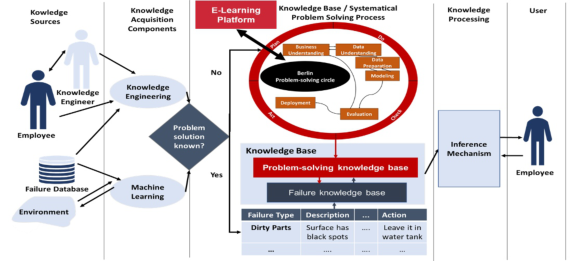
1. Initial System Development and Integration: The process begins with a comprehensive review of existing methodologies and empirical research, leading to the adaptation of the Berlin Problem-Solving Process. This process was integrated with a digital e-learning platform, as demonstrated in Figure 1. The system is designed to facilitate a structured approach to error documentation and resolution. Employees log error details, including location and date, into the digital system via an input form. The system then checks if the failure pattern matches any existing records in the knowledge database.
E-Learning as a Catalyst for Competence Development in Smart Failure Management 81
Figure 1: Implementation of the smart failure management system with Berlin problem-solving circle and e-learning platform (based on (Ertel, 2021; Caglar et al., 2024)).
If a problem is recognized, the system provides problem-solving tools with associated probabilities of causes and measures, facilitating quick and effective resolution. For unrecognized problems, it triggers a systematic Problem-Solving Process (PLP), utilizing the phases of the Berlin Problem- Solving Cycle to guide employees through resolution (see Figure 1).
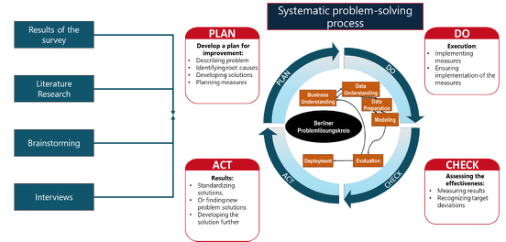
2. Implementation of the PDCA Cycle: To support and structure the PLP, the Plan-Do-Check-Act (PDCA) cycle is implemented, serving as a framework for continuous improvement and fostering a proactive failure culture where employees are encouraged to engage actively in problem-solving. This cycle is instrumental in refining the problem- solving process through continuous evaluation and iterative adjustments. The integration of various problem-solving tools from different sources within this cycle is detailed in Figure 2 and in Figure 3.
Figure 2: Methodical approach to the selection of problem-solving tools and their allocation to phases of the Berlin problem-solving circle.
A targeted survey and a series of workshops were conducted to gauge the specific needs and challenges faced by SMEs regarding failure management systems. Insights from thirty companies, gathered by December 31, 2023, were crucial in shaping the development of the e-learning platform. These insights ensured that the platform was tailored to meet the operational and
learning preferences of shop floor employees, enhancing its relevance and effectiveness (MIQFEM, 2024).
In the subsequent step, the predecessor-successor relationships among individual tools were analysed. Subsequently, a rating matrix was created to compare the tools within the Berlin Problem-Solving Cycle based on various criteria such as complexity and data intensity.
Table 1 presents the structured integration of the CRISP-DM and PDCA models into the Berlin Problem-Solving Process. It systematically assigns phases from each model to specific problem-solving steps and aligns them with selected quality management and data mining methods. This alignment supports the methodological basis for a knowledge-based assistance system in smart failure management.
Table 1: Steps and tools of Berlin problem-solving circle.
Table available in the original PDF paper.
Step Main Phases (CRISP-DM & PDCA)
PDCA CRISP-DM QM Methods Data Mining Methods Business Understanding
1 Business Understanding (CRISP-DM)
Data collection plan
Data collection plan
Project charter, Stakeholder analysis 2 Data Understanding (CRISP-DM)
Problem identification
Data acquisition
3 Data Preparation (CRISP-DM) / Plan (PDCA)
Validation
Failure check lists, Voice of Customers, Quality Control Charts, network plan 4 Data Preparation (CRISP-DM)
5 Plan (PDCA) Problem analysis
Histogram, Boxplot, Pie chart, Scatterplot, Time series analysis
Description Histogram, Boxplot, Mind mapping, SIPOC, Trend diagram, Process performance analysis, Kano model
6 Plan (PDCA) Problem prioritization
Pareto chart
Description Pareto chart, Pairwise comparison
7 Plan (PDCA) Root cause identification
Clustering, Classification
k-means, Decision tree
Ishikawa diagram, 5 Whys, Flow chart, Fault tree analysis Continued
E-Learning as a Catalyst for Competence Development in Smart Failure Management 83
Table 1: Continued Step Main Phases (CRISP-DM & PDCA)
Linear regression, Apriori association, Correlation analysis, Hypothesis testing 9 Plan (PDCA) Root cause prioritization
Portfolio diagram, Input-output matrix, Pairwise comparison 10 Plan (PDCA) Solution development
Affinity diagram, Design of Experiments 11 Plan (PDCA) Solution prioritization
Solution-cause matrix, Ranking procedure 12 Do (PDCA) Solution implementation
Solution evaluation
Implementation plan 13 Evaluation (CRISP-DM) / Check (PDCA)
Standardization Deployment Checklists
Evaluation Quality control charts, Machine capability analysis, Process capability analysis 14 Deployment (CRISP-DM) / Act (PDCA)
To systematically support competence development in failure management, we developed a structured method matrix aligning the Berlin Problem-Solving Process with the established frameworks of CRISP-DM and PDCA. The aim of this integration is to unify quality-oriented and data- driven problem-solving strategies in a modular way that can be practically applied by shop floor employees, especially.
The table (see Table 1) presents a stepwise assignment of selected methods to the respective sub-phases of CRISP-DM and PDCA within our hybrid process model:
1. Steps 1–4 focus on the initial understanding and data preparation, derived from the CRISP-DM phases. Here, traditional quality tools (e.g., project charters, stakeholder analysis, failure check lists) and foundational data acquisition techniques are applied to structure the problem context and collect relevant information.
2. Steps 5–11 represent the analytical core of the PDCA cycle and are enriched through a dual-methodological perspective: classical quality management (QM) tools (e.g., Pareto charts, Ishikawa diagrams, ANOVA) are supplemented by five data mining techniques (description, clustering, classification, regression, association analysis) to increase the analytical depth and interpretability of root causes and solution alternatives. 3. Steps 12–14 transition into the implementation, evaluation, and standardization phases. Here, process implementation plans and checklist-based deployments ensure structured execution and sustainability of problem resolutions, while evaluation relies on control charts and capability analyses.
By mapping each sub-phase to both problem-oriented quality methods and scalable data mining techniques, the table provides a methodological bridge between traditional shop floor practices and digital transformation. This systematic classification enables context-sensitive tool recommendations within the developed e-learning platform, fostering method literacy and autonomy among employees. Moreover, it supports the system’s ability to offer tailored guidance through NLP-driven method selection and intelligent tool suggestions.
3. Gamification and E-Learning: The integration of gamification and e-learning is emphasized due to their proven effectiveness in enhancing engagement, motivation, and knowledge retention. The e-learning platform utilizes the Berlin Problem-Solving Circle to simplify the complex process of diagnosing and resolving failures, making the methodology robust yet user-friendly (Caglar et al., 2024).
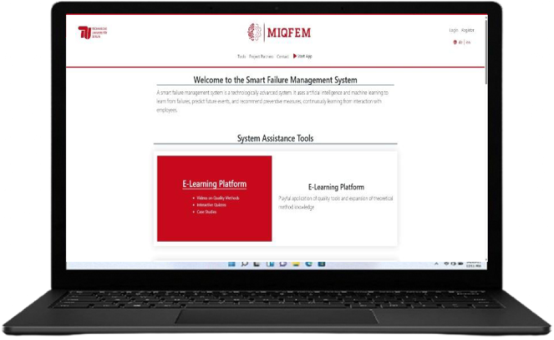
In the next step the selected problem-solving tools were classified according to the “Plan-Do-Check-Act” (PDCA) cycle. Further, for these quality tools, case studies were developed to facilitate a systematic approach to complex problem-solving. Users can employ these tools in a specified sequence to address intricate issues effectively. Each tool was augmented with educational resources including videos and quizzes, encompassing multiple choice, single choice, true/false, and drag-and-drop formats, to enhance interactive learning. The entire e-learning platform has been integrated into a web application, as illustrated in Figure 3.
In conclusion, the methodological framework developed in this study addresses the traditional challenges faced by SMEs through the strategic development of gamified e-learning platforms within smart failure management systems. This approach not only addresses the immediate needs for failure resolution but also fosters a continuous learning environment that enhances the problem-solving capabilities of employees, enabling them to react more effectively to failures and anticipate potential disruptions before they escalate.
E-Learning as a Catalyst for Competence Development in Smart Failure Management 85
Figure 3: User interface for the e-learning platform.
RESULTS
The implementation of the smart failure management system coupled with the e-learning platform has yielded significant results, demonstrating marked improvements in the problem-solving capabilities of employees and operational efficiencies within SMEs. This section presents a detailed analysis of the outcomes observed following the deployment of this innovative approach.
Quantitative Improvements in Problem-Solving Efficiency One of the primary objectives of integrating the smart failure management system was to enhance the efficiency and effectiveness of problem-solving processes among shop floor employees. Data collected over a six-month period post-implementation shows a reduction in the time required to identify and diagnose failures.
Moreover, the rate of recurring problems has decreased, suggesting that the solutions implemented were more effective and sustainable, likely due to the enhanced problem-solving skills fostered by the e-learning platform. This result aligns with the objective to not only address failures more efficiently but to also instill a deeper understanding and capability among employees to prevent future occurrences.
Enhanced Employee Engagement and Competency Development The gamification elements integrated within the e-learning platform have significantly increased employee engagement in the training modules. Participation rates in voluntary problem-solving training sessions increased. Feedback collected through surveys indicates that the most of employees found the gamified elements motivating and reported an improved understanding of the problem-solving tools available to them.
The competency assessments conducted before and after the training sessions reveal an improvement in the employees’ ability to apply the correct
problem-solving techniques to the scenarios presented. This improvement is a direct indicator of the efficacy of the interactive and gamified learning approaches used.
Operational Impact and Cost Savings The integration of the smart failure management system has also led to notable cost savings related to failure management. The reduction in failure identification time and the decrease in the incidence of recurring problems have collectively resulted in a reduction in costs associated with failure management. This includes savings from reduced downtime, lower costs of rework, and decreased waste from scrapped products.
Additionally, the survey indicates that the most of employees felt more confident in their problem-solving abilities, which correlates with a lower frequency of errors and an enhanced culture of proactive problem management. This cultural shift has not only improved operational efficiency but has also contributed to a more positive workplace atmosphere, further promoting continuous improvement and innovation.
Stakeholder Feedback and Future Prospects Feedback from SME owners and management has been overwhelmingly positive, with many highlighting the dual benefits of improved operational efficiency and employee skill development as transformative for their business practices. The success of the smart failure management system and the e-learning platform has encouraged other SMEs in the industry to consider similar implementations, indicating a potential shift towards more technology-integrated and education-focused approaches in SME operations.
In summary, the results from the implementation of the smart failure management system and the e-learning platform have demonstrated substantial benefits across various metrics including problem-solving efficiency, employee engagement and competency, operational cost savings, and overall business impact. These outcomes affirm the value of integrating advanced pedagogical techniques and smart technologies in enhancing the capabilities and sustainability of SMEs.
CONCLUSION
The integration of a smart failure management system coupled with an e-learning platform has effectively enhanced problem-solving capabilities and operational efficiencies within small and medium-sized enterprises (SMEs). This study has highlighted the significant improvements in diagnostic speed and problem resolution efficacy, the reduction of recurrent issues, and the increase in employee engagement and competency development. Furthermore, these benefits have translated into substantial cost savings and heightened organizational agility, underscoring the transformative potential of combining advanced digital tools with educational strategies.
The results of this implementation showcase not only immediate operational improvements but also long-term benefits in cultivating a proactive, resilient, and innovative organizational culture. This shift is crucial
E-Learning as a Catalyst for Competence Development in Smart Failure Management 87
for SMEs striving to maintain competitiveness in a rapidly digitalizing global market. By fostering an environment that encourages continuous learning and problem-solving, SMEs can better adapt to and overcome the complex challenges they face.
ACKNOWLEDGMENT
The IGF project 22530 N, titled MIQFEM (Employee-Oriented Quality Control Loops in Production for Smart Failure Management), of the Research Association for Quality (FQS), is supported by the Federal Ministry for Economic Affairs and Climate Action (BMWK) through the DLR-PT as part of its Industrial Collective Research (IGF) funding program, based on a resolution of the German Parliament.
REFERENCES
Caglar, T.; Anndrushchenko, E.; Müller-Stein, L.; Jochem, R. (2024): Development and Validation of a Smart Failure Management System for SMEs in Manufacturing, International Conference on Industrial Engineering and Engineering Management (IEEM), Bangkok. Deuse, J.; Weisner, K.; Hengstebeck, A.; Busch, F. (2019): Design of production systems in the context of Industry 4.0. Ertel, W. (2021): Basic Course Artificial Intelligence, Computational Intelligence.
A Practice-Oriented Introduction. Hornfeck, R.; Plach, A.; Höhn, J. (2011): Knowledge-based Entrepreneurial Error Management System: Error Knowledge is Power (in German), Qualität und Zuverlässigkeit, no. 16. Kamiske, G. F. (2015): Handbook QM Methods: Selecting the right method and
implementing it successfully (in German), 3, aktualisierte und erweiterte Auflage, Hanser Verlag München, https://doi.org/10.3139/9783446435865. Kersten, W.; Koller H.; Lödding H. (2014): Industry 4.0 How intelligent networking and cognitive systems are changing our work (in German), Berlin, p. 144. MIQFEM (2024): Current State of Failure Management, Problem-Solving Methods,
SFM, and the Use of AI Technologies in SMEs, Survey, URL: https://umfragen.tu- berlin.de/index.php/428132?lang=de. Rüßmann, M.; Haghi, S.; Bergstein, D.; Schmitt, R. H. (2019): Smart Error Management on the Shop Floor. A Solution Approach for SMEs. In: Work 4.0 in SMEs: Opportunities and Challenges of Digital Transformation for SMEs (in German), Bosse, C. K.; Zink, K. J. (eds), Springer Gabler, Berlin, Heidelberg, pp. 267–278.
LISTED IN THE AHFE DIGITAL BOOKSTORE CATALOGUE
Explore the complete digital volume
Human Dynamics, Product Evaluation and Quality
Read this individual research paper free through the original publisher, or explore the full digital proceedings book.
ISBN 978-1-964867-48-9
Explore this ISBN in the AHFE Bookstore ↗Listed in the July 2026 bookstore catalogue; search by ISBN to confirm current availability · Digital book purchase optional