Wirachai Ausombun, Nonthaporn Phrommet, Sirilak Jittrisin, Orawee Pirugjanyakun, Nattawud Trangkanon, Thitirat Siriborvornratanakul (2025). Lean Development of a Mobile Application for Advergames. In: Human Dynamics, Product Evaluation and Quality. AHFE Open Access, vol. 172, pp. 29–38. https://doi.org/10.54941/ahfe1006267
Graduate School of Applied Statistics, National Institute of Development, Administration, 148 SeriThai Road, Klong-chan, Bangkapi, Bangkok 10240, Thailand ↗
Advergames refer to the gamification of product and brand advertisements. AdsPlay is a mobile application designed as a multi-brand advergame platform. The application was developed using the Lean Product Development (LPD) framework and guided by User Interface (UI) design principles, incorporating brand-sponsored rewards to drive user engagement. Through a mixed-methods approach combining both qualitative and quantitative techniques, a series of Minimum Viable Product (MVP) prototypes were iteratively created and tested with target users. The final prototype received evaluation scores of 8 and 9 out of 10 for perceived value and ease of use, respectively. The successful design and development of this application contribute to the body of knowledge on advergames, particularly within the underexplored context of Thailand.
Advancements in technology, widespread internet access, improved data infrastructure, and evolving customer behavior have driven the need for more sophisticated online marketing strategies. In Thailand, online advertising budgets grew by over 15% annually from 2013 to 2021, reaching approximately 22.8 billion Baht in 2021 (DAAT, 2021). However, in-depth interviews revealed that customers often find online ads intrusive, offensive, and privacy-invasive—risks that may negatively affect brand perception. This calls for alternative marketing approaches that foster positive user experiences.
Advergames—gamified advertisements—offer a promising solution. They not only entertain users but also enhance engagement, brand loyalty, and brand awareness (Lucassen & Jansen, 2014; Mattke & Maier, 2020). Global advergame revenues are projected to grow by 20% annually between 2020 and 2025, reaching approximately USD 11 billion (van Berlo et al., 2021). In parallel, the Thai gaming market has shown strong growth at 14% annually since 2017 and was expected to reach USD 38.9 billion by 2022 (DEPA, 2020). This study investigates user feedback and market testing of a mobile
advergame prototype that integrates real brand rewards. The findings expand the limited literature on advergames in the Thai context and offer practical guidance for brand owners aiming to attract and retain customers through interactive marketing experiences.
RELATED WORKS Advergames—games developed for brand promotion—are a gamified form of digital advertising designed to deliver marketing messages while enhancing user experience, brand awareness, and purchase intention (Yu & Huang, 2022; Smith et al., 2014; Terlutter & Capella, 2013). As an advancement in digital marketing, (Smith et al., 2014) suggested three forms of advergames: associative, which integrates brand elements into users’ lifestyles through game visuals; illustrative, which highlights the product as the game’s central theme; and demonstrative, which allows players to interact with virtual product trials, such as Volkswagen’s Real Racing GTI (Siridorothy, 2018). Successful advergames require well-balanced game mechanics—clear rules, rewards, social interaction, and customization—as well as strong technical execution and seamless integration of the brand within the gameplay (Pour et al., 2020).
Lean Product Development (LPD) applies lean principles derived from the Toyota Production System, emphasizing waste elimination and value-added activities. It aims to either create new products or improve existing ones to better meet market demands (Rauch et al., 2016). Central to LPD is the prioritization of customer needs, with product testing embedded from the early stages through to completion to ensure the final outcome aligns with what customers are willing to pay for (Popowska & Nalepa, 2019). Rather than focusing solely on gaining market share, LPD emphasizes building long-term market relevance (Zhou, 2019). The approach involves iterative cycles of testing, measuring, and learning from user feedback throughout the development process (Roshan et al., 2019). Customer discovery, often through interviews, plays a critical role in identifying user pain points, segmenting customer groups, and forming hypotheses for new product development (Popowska & Nalepa, 2019).
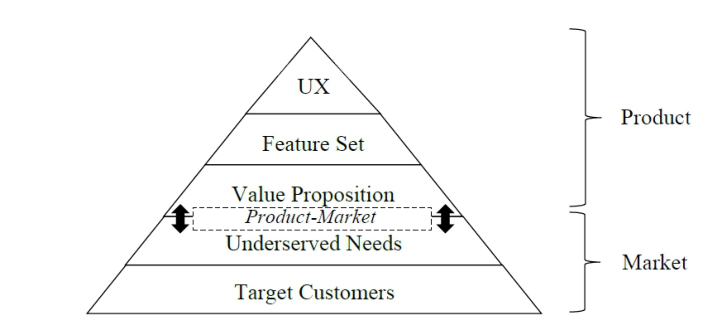
The Product-Market Fit Pyramid (Figure 1) is a framework designed to address poor market responses by systematically aligning product development with customer needs. The pyramid is divided into two sections: the lower part focuses on identifying target customer segments and uncovering their underserved needs, while the upper part emphasizes defining a compelling value proposition and selecting product features that address those needs. User Experience (UX) plays a key role in validating market response, with a product prototype serving as a crucial tool in this evaluation process (Olsen, 2015; Siriborvornratanakul, 2017).
Lean Development of a Mobile Application for Advergames 31
Figure 1: Product-market fit pyramid (adapted from (Olsen, 2015)).
METHODOLOGY
AdsPlay is a mobile platform that leverages advergames to help marketers boost brand awareness, foster loyalty, and drive purchase intention among target customers. To attract user traffic, the app offers a variety of real brand rewards—both cash-equivalent (e.g., discounts, coupons) and non-cash (e.g., privileges, product samples)—to players who meet brand-defined conditions. The app is designed following Lean Product Development and UI principles. A series of user studies and iterative usability tests have been conducted with target users, aligned with successive revisions of high-fidelity prototypes (Figure 2).
Figure 2: Interface samples of AdsPlay prototype.
Figure available in the original PDF paper.
Based on the Product-Market Fit Pyramid (Figure 1), the process begins by identifying target users and their unmet needs, then defining product value through key features. A prototype is developed and tested to gather user feedback using both qualitative and quantitative methods. According to the Digital 2021 Thailand Report (Kemp, 2022), 74.3% of the Thai advertising audience is aged 18–44, with 33.9% aged 25–34, 22.7% aged 18–24, and
17.7% aged 35–44. To create user personas and understand common pain points, preliminary in-person interviews were conducted. Three personas were developed (see Table 1), all sharing four key issues with current online ads: being forced to watch, feeling annoyed, irrelevant offers, and privacy concerns.
Likes fun games and worthful rewards. Time is money.
to kill time and boresome. A play-to-earn is great!
game difficulty is a must. A nice graphic and a smooth play are expected.
Target customers: A quantitative questionnaire survey was conducted to further investigate mobile game players’ behaviors, given that AdsPlay is a mobile advergame platform. Online questionnaires were randomly distributed in March 2022, resulting in 101 valid responses. The survey results revealed that the majority of Thai gamers are male (52.48%) and primarily aged between 25 and 34 years (65.34%), with most holding a Bachelor’s degree (63.37%) and earning no more than 45,000 THB per month (75.24%). Mobile phones are the predominant means of accessing the Internet (100.00%), whereas desktop computers are the least preferred (27.72%). Interestingly, we found that 54.45% of respondents use the Internet for more than 10 hours daily, although less than 6 of those hours are devoted to gaming.
Underserved needs: Based on the pain points identified in the preliminary interview, respondents were asked to rate the dimensions of satisfaction and importance on a 10-point Likert scale. The ratings were then converted to percentages and used to calculate the opportunity to add value (Olsen, 2015) in Eq. 1. For our results, the opportunity values ranged from 0.38 to 0.53, with “forced to see” ranked highest (0.53) and “in risk of privacy disclosure” ranked lowest (0.38).
Opportunity = Importance × (1 −Satisfaction) (1) Value proposition: According to (Olsen, 2015), product values can be categorized into three benefits: must-have, performance, and delighter. AdsPlay’s values were discussed and rated by respondents on a 10-point Likert scale. Table 2 shows the survey results from 101 valid responses. On average, brand rewards (mean = 6.80) garnered the most attention, while privacy received the lowest importance score.
Feature set: AdsPlay features were derived from literature on mobile game apps and team brainstorming. Using LPD principles and gamification, each feature was mapped in a 2×2 grid to ensure alignment with both frameworks
Lean Development of a Mobile Application for Advergames 33
(Table 3). These features were then included in a survey, where respondents rated their importance on a scale of 1 to 10.
Prototype: Prototypes were developed based on prioritized AdsPlay features using the Return on Investment (ROI) concept from (Olsen, 2015), where return was the feature’s importance and investment was its development time. Table 4 outlines the MVP development plan through usability tests. MVP1 was a low-fidelity prototype with top ROI features, while MVP2 and MVP3 were high-fidelity prototypes created using Figma.
Notification support Community Teammates, Challenging, Leaderboard,
Progress
Invitation
Social share
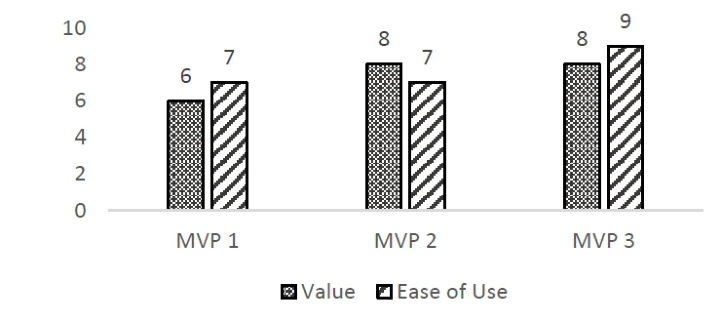
USABILITY TEST RESULTS Usability tests of AdsPlay followed (Nielsen, 1989) recommendation of 3–8 users per iteration, with 15 users in total covering nearly all product perspectives. Three test rounds, each with 5 users, were conducted through in-depth interviews with 15 Thai users (6 male, 9 female, aged 22–35). MVP prototypes were used to collect feedback on features, UX, and messaging, with a discount coupon as the brand reward. Users rated the app’s value and ease of use on a 10-point Likert scale. Each interview lasted about 30 minutes, and the results are shown in Figure 3.
Iteration 1: MVP1, a low-fidelity prototype, was tested with one male and three females aged 24–35. The average scores for application value and ease of use were 6 and 7, respectively. The prototype received positive feedback on UX design, with 40% of users noting that it was neat and familiar, and 20% appreciating the clear marketing message on brand awareness. Notably, 40% of participants suggested that the game platform should feature animations, such as a movable avatar and pop-up notices for new games, as animation would make the game feel livelier. However, there was negative feedback on offline mode, graphic mode, update mode, and privacy setting, as follow:
Lean Development of a Mobile Application for Advergames 35
Figure 3: Average scores of prototype revisions.
“…The offline mode sounds nice, actually, but I’m a bit worried if it supports a team-play mode or the rewarding system, and when turns the online mode, my scores would be updated…” (Female, aged 35).
“…Even the graphic mode is a good choice, I won’t waste my time setting it because usually I play a game with a default setting. I rarely adjust things…” (Female, aged 28).
“…The update mode is needed, but I love to see it just only when there’s a new version to be updated. Else, it gonna be great if you make it automatic…” (Female, aged 24).
“…Sounds good, but better you can detail what I can set up with my privacy. Usually, I see only about a location...” (Female, aged 27).
These negative reactions were useful and brought to improve the prototype in the next iteration of a usability test.
Iteration 2: MVP2, a high-fidelity prototype, was tested with a group interview of 2 males and 3 females, aged 22–30. It received higher average scores of 8 for value and 7 for ease of use. However, all participants noted the need for a back/home button. New features were generally well-received, but technical features remained a weakness, with 60%–80% of users deeming them unnecessary. This indicated that previous issues had not been fully resolved. Feedback included: “… I think only high resolution / low resolution is just enough. I can do the rest in my phone setting…” (Male, aged 26).
“… It don’t need to update at the app, I do it via App Store…” (Female, aged 24).
“… I quite don’t care about privacy setup, I did it already at my phone setting…” (Female, 30).
Based on this feedback, offline mode, graphic mode, update mode, and privacy settings were removed, and the prototype was revised accordingly.
Iteration 3: The MVP3 prototype was tested with 5 participants (3 males, 2 females, aged 24–35). It received scores of 8 for value and 9 for ease
of use. Feedback highlighted the importance of a back/home button, with 40% suggesting it should be available on every screen. Additionally, 60% commented on the poor button arrangement. Despite higher scores, there were negative reactions to two features: notification and feedback messages, as follows: “… It’s nice to have the notification, but I think you better make it able to activate or deactivate…” (Male, aged 24).
“… I don’t care about it. I am just worried if it annoys while playing a game, or not…” (Male, aged 28).
DISCUSSION
In-depth interviews conducted during usability testing provided several valuable insights for application developers, marketers, and UX researchers. One of the key findings was that personal privacy is not a primary concern for Thai gamers. This observation is significant for mobile game developers planning to launch a game platform in Thailand, as overemphasizing privacy settings and related features could potentially become an annoyance to users, thus leading to a waste of their time. Another important discovery was that animation could enhance the game’s environment and increase user engagement. A game developer should consider incorporating animations or other movable game elements to make the game more lively and attractive to users.
While the feature of social sharing was theoretically suggested, the study revealed that users tend to avoid using this function. This behavior is likely driven by concerns that sharing might disturb others. This insight contrasts with the survey results, where the graphic, offline, and privacy modes were rated as important. However, when implemented in the prototypes, these features were regarded as unnecessary, particularly by female users. This suggests that female players may not place high importance on technical features in mobile game applications.
Implication: The study also provides several implications for brands planning to use advergames to engage customers, expand market reach, and increase brand awareness. The findings suggest that users generally prefer a minimalist UI design that still maintains a strong brand image. This insight is particularly relevant for brands looking to utilize advergames as a new marketing strategy.
Limitations: Despite its contributions, the study has several limitations. First, brand rewards were a critical element in attracting users to AdsPlay. While discount coupons were used as an example in the prototypes, the study did not explore the impact of other types of rewards, including non- cash incentives. Different types of rewards could influence user satisfaction and the overall evaluation of the application, suggesting that further research should consider a wider range of reward options.
Second, customer behaviors and preferences can vary significantly across different product categories. However, the design of AdsPlay did not account for these differences, which may have led to the oversight of valuable insights. Additionally, the study focused solely on the end-users of the platform,
Lean Development of a Mobile Application for Advergames 37
without involving brand owners. As platforms like AdsPlay are monetized by both product customers and brand owners, future research could benefit from examining the brand’s perspective, particularly in terms of investment and return on the application.
Finally, the study did not address factors influencing user engagement among both regular game players and non-gamers. Understanding the engagement dynamics of these two groups could provide valuable insights for future advergame designs.
CONCLUSION
The overall assessment of AdsPlay improved throughout the usability tests (see Figure 3, indicating that the development process was appropriate and met a satisfactory standard. This suggests that AdsPlay is well-suited for the Thai market. The removal of certain technical features led to higher ease-of- use scores. Additionally, incorporating brand rewards proved to be a valuable addition to the advergame.
REFERENCES
DAAT (2021). Thailand Digital Advertising Spend 2020–2021. Retrieved Feb 11, 2022, from https://www.daat.in.th/digital-ad-spend. DEPA (2020). Gaming Industry. Investment Quarterly. Retrieved Feb 11, 2022, from https://www.depa.or.th/storage/app/media/file/investment-quarterly- gaming-industry220164-Final.pdf. Lucassen, G. & Jansen, S. (2014). Gamification in consumer marketing - future or
fallacy?. In Procedia - Social and Behavioral Sciences, 148, 194–202. doi: 10.1016/ j.sbspro.2014.07.034. Mattke, J. & Maier, C. (2020). Gamification: Feature-rich mobile applications, brand awareness, and loyalty. In Proceedings of the European Conference on Information Systems (ECIS), 1–16. Nielsen, J. (1989). Usability engineering at a discount. In Proceeding of the 3rd
International Conference on Human-Computer Interaction on Designing and Using Human-Computer Interfaces and Knowledge-based Systems, 394–401. Olsen, D. (2015). The lean product playbook: How to innovate with minimum viable products and rapid customer feedback. Hoboken, New Jersey: Wiley. Pour, M. J., Sadeghi, S., & Yahyaei, E. (2020). Identifying the success factors of
advergames: A mixed-method approach. Arts and the Market, 10(3), 205–220. doi: 10.1108/AAM-03-2020-0006. Roshan, M., Tuunainen, V. K., & Hekkala, R. (2019). How mobile game startups excel in the market. In Proceedings of the 52nd Hawaii International Conference on System Sciences, 5400–5409. doi: 10.24251/HICSS.2019.650. Siriborvornratanakul, T. (2017). User interface and interaction design. Bangkok,
Bangkok: National Institution of Development and Administration. (in Thai). Siridorothy, R. (2018). Game Advertising to Brand Communication in Digital Era.
Journal of communication and innovation NIDA, 5(2), 20–45. (in Thai). Smith, M. W., Sun, W., Sutherland, J. & Mackie, B. (2014). Game advertising: A conceptual framework and exploration of advertising prevalence. The Computer Games Journal, 3(1), 95–124. doi: 10.1007/BF03395948. Terlutter, R. & Capella, M. (2013). The gamification of advertising: Analysis
and research directions of in-game advertising, advergames, and advertising in social network games. Journal of Advertising, 42(2/3), 95–112. doi: 10.1080/ 00913367.2013.774610.
van Berlo, Z. M. C., van Reijmersdal, E. A., & Eisend, M. (2021). The gamification of branded content: A meta-analysis of advergame effects. Journal of Advertising, 50(2), 179–196. doi: 10.1080/00913367.2020.1858462. Yu, N. & Huang, T. (2022). Why do people play games on mobile commerce platforms? An empirical study on the influence of gamification on purchase intention. Computers in Human Behavior, 126, 1–10. doi:10.1016/ j.chb.2021.106991. Zhou, Y. (2019). Research on lean marketing management of mobile games. Modern
Economy, 10, 86–95. doi: 10.4236/me.2019.101006.
LISTED IN THE AHFE DIGITAL BOOKSTORE CATALOGUE
Explore the complete digital volume
Human Dynamics, Product Evaluation and Quality
Read this individual research paper free through the original publisher, or explore the full digital proceedings book.
ISBN 978-1-964867-48-9
Explore this ISBN in the AHFE Bookstore ↗Listed in the July 2026 bookstore catalogue; search by ISBN to confirm current availability · Digital book purchase optional