Zixian Zhu, Jiun-yao Cheng, Idris Jeelani, Masoud Gheisari, Raymond Issa (2025). VR-Orient: Design and Usability Study of a Mobile Construction Site Orientation Application. In: Usability and User Experience. AHFE Open Access, vol. 194, pp. 1–11. https://doi.org/10.54941/ahfe1006663
Construction site orientation is essential for providing newcomers, such as new employees or AEC students, with fundamental knowledge of team roles, site layout, safety policies, and regulations. Traditional in-person methods can be time-consuming, potentially hazardous, and have a limited scope, especially on large projects. While existing digital platforms offer convenient online access, they often lack the immersive, engaging elements needed for effective learning. This study introduces VR-Orient, a mobile application that offers semi-immersive site orientation for smartphones and tablets. The application’s conceptual design was refined through expert panel interviews, resulting in developed content that meets site orientation learning objectives. The technical development of VR-Orient integrates virtual characters, virtual site layouts, and user interfaces that facilitate interaction and reinforce learning on mobile devices. A tablet-based usability study evaluating learning outcomes, system usability, mobile application functionality, informality, and presence indicates that VR-Orient meets usability expectations. It shows promise for advancing construction education, gamified training, and outreach projects, with potential for broader adoption in other labor-intensive sectors.
Construction site orientations prepare new employees on their first day by providing essential site-specific information. They typically cover key personnel, site layout, equipment, common hazards, safety policies, and emergency procedures (CCOHS, 2023), ensuring workers understand potential risks and know how to use proper tools and equipment. These orientations also familiarize newcomers with company rules and procedures, fostering a safer and more efficient work environment (Kinn et al., 2000). Traditionally, orientations are delivered in person through on-site tours, sometimes supplemented by written manuals (CIRSA, 2014). However, multiple construction phases and subcontractors can make these sessions limited in scope and time-consuming, potentially leading to incidents among
different worker groups (Andony, 2021; GoContractor, 2017). In response, emerging trends in digital or mixed-delivery methods seek to address these limitations (AMFAM, 2024; GoContractor, 2017; myComply, 2023). Yet, existing online platforms lack the tangible experience of being on-site and do not provide truly interactive, immersive learning, which can diminish learning focus and effectiveness. Virtual Reality (VR) has gained traction as a powerful onboarding tool, allowing users to explore 3D environments with instant feedback and practice activities that are too costly or complex to implement in the real world (Chauvergne et al., 2023). Despite widespread mobile device use, most VR applications for construction focus on head-mounted displays (HMDs) or desktop devices (Zhang et al., 2020). To address this gap, this research developed VR-Orient, a VR-based site orientation application for mobile devices and evaluated its usability on a tablet by examining learning outcomes, system usability, mobile application functionality, informality, and presence. Results indicate that VR-Orient can be an efficient tool for newcomers in construction by offering semi-immersive simulations on smartphones and tablets, thereby broadening accessibility and enhancing the learning experience. This work also paves the way for future innovations in construction education, gamified training, and outreach initiatives, and can be adapted for other labor-intensive industries.
BACKGROUND
In the construction industry, new employees typically undergo site orientations that provide an overview of the project, explain safety rules, and include a guided tour (CCOHS, 2023). Although no universal standards exist, these programs generally focus on safety and job-specific topics to improve productivity, reduce turnover, and help new hires quickly contribute to their teams (Stein and Christiansen, 2010). However, on-site orientations often face logistical challenges—such as coordinating multiple contractors on different schedules—and content inconsistencies that can lead to gaps in worker safety knowledge (Rees, 2016). Managing orientation records manually adds further complications. In response, many firms are turning to online and virtual platforms (AMFAM, 2024; GoContractor, 2017; myComply, 2023), which allow workers to complete training before arriving on-site. Yet, these solutions mostly rely on text, images, or videos, offering limited immersive experiences. To address these limitations, this study employs virtual reality (VR) functionalities to deliver a more comprehensive digital induction for the construction workforce. VR has been widely applied in construction education due to its immersive environments, user-friendly interfaces, and enhanced engagement (Beh et al., 2021). VR accessible through desktops or mobile devices, is more cost-effective and broadly available. Mobile devices such as smartphones and tablets offer flexibility, affordability, and ease of use, eliminating the need for high-end VR setups while retaining spatial interactivity, often yielding stronger user engagement and loyalty than desktop-only applications (Al-Ansi et al., 2023) Mobile VR also mitigate physical discomfort associated with HMDs, including neck strain and visual fatigue (Kim and Shin, 2021). Given these advantages,
VR-Orient: Design and Usability Study of a Mobile Construction Site Orientation Application 3
this study focuses on mobile VR applications to deliver construction site orientations. Leveraging the widespread availability of smartphones and tablets among the construction workforce ensures greater accessibility, practicality, and scalability for future implementations.
METHODOLOGY
This study aims to develop a VR construction site orientation application for handheld devices—VR-Orient—that provides orientees with realistic construction site experience and essential information before entering actual sites, all easily accessible from mobile devices such as phones or tablets. Accordingly, the study was conducted in two main phases: (1) Conceptual Design and (2) Application Development. Detailed methodologies are discussed in the following sections.
Conceptual Design The conceptual design of VR-Orient was structured in two main steps:
VR-Orient Components Analysis The main goal of this phase is to preliminarily identify a list of essential components of typical construction orientations. A review of existing literature and construction orientation resources was conducted, yielding a preliminary checklist of common components for construction orientations that was subsequently evaluated and refined through interviews from an expert panel. The expert panel consists of 11 construction experts with an average of 28.7 years of construction industry experience (SD = 9.77). Each panelist participated in interviews to provide detailed feedback on the checklist. Based on the expert panel’s reviews and suggestions, the finalized checklist of essential components for VR-Orient was established (Table 1).
Table 1: Checklist of essential components for VR-Orient.
Table available in the original PDF paper.
Components Description Topics
Disclaimer
Learning objectives
Introduction Disclose that project information may vary based on different project conditions. Includes learning objectives to provide orientees with a general overview.
Key personnel and responsibilities
General Introduce general roles and site layouts that are commonly applicable to construction sites.
Site layout and important locations
Communication protocol on site
Traffic restrictions
Traffic control measures
Traffic flow Outlines traffic restrictions and flow management on construction sites.
Continued
Table 1: Continued Components Description Topics
Table available in the original PDF paper.
Safety and health hazards on site
Safety Covers safety requirements and regulations to ensure compliance on construction sites.
PPE Requirements
Emergency procedures
Employee workplace right
Employee participation
Environmental concern
Housekeeping and hygiene issues
Addresses sustainable practices, mitigation of environmental impacts, and compliance with environmental regulations.
VR-Orient Content Generation To address the essential components outlined in the checklist, this phase aimed to generate elements that enrich the content of VR-Orient, including learning objectives, key characters, and important locations. Based on the checklist established in the previous phase, learning objectives were incorporated at the beginning of the orientation to provide orientees with a clear overview:
1. Understand the roles and responsibilities of key project and field personnel on-site. 2. Familiarize themselves with the general layout of a typical construction site, including important locations. 3. Learn about site safety policies, identify common hazards, and understand proper PPE usage. 4. Comprehend site rules and regulations to ensure compliance.
A detailed narrative for VR-Orient was developed based on learning objectives, featuring dialogues, scenarios, and embedded quizzes for knowledge evaluation. This narrative was generated by integrating key characters (such as project managers and safety superintendents) typically found on construction sites, with the locations where traditional in-person orientations guide newcomers. The narratives were then refined to ensure that VR-Orient comprehensively addressed all the essential components identified in the checklist and met the learning objectives. Following this, a five-question quiz was created for each learning objective to allow orientees to assess their knowledge during the orientation. Finally, the narratives and quizzes were submitted to an expert panel for final validation, ensuring that the VR-Orient experience is grounded in thoroughly vetted content.
Application Development Once the conceptual design was finalized and validated by the expert panel, the next phase focused on the technical development of the VR-Orient application, with an emphasis on user experience. The VR-Orient experience was developed in 3 steps, which are discussed in detail below:
VR-Orient: Design and Usability Study of a Mobile Construction Site Orientation Application 5
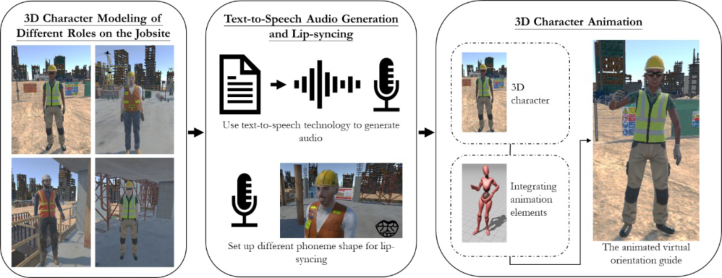
Creation of Virtual Key Characters The virtual key characters in VR-Orient include the virtual orientation guide and the key personnel identified during the content generation phase. The key personnel modeled during this phase introduce themselves and describe their responsibilities when users meet them. The Unity game engine was used to model these characters because of its ability to design realistic 3D human models with a variety of nonverbal behaviors, including facial expressions, body orientation, gaze, proxemics, posture, and gestures. Modeling software such as Daz 3D and Blender, along with facial expression animation provided by the Lipsync Pro API, enabled the characters to exhibit natural and contextually appropriate nonverbal behaviors during interactions (Figure 1).
Figure 1: Creation of virtual key characters.
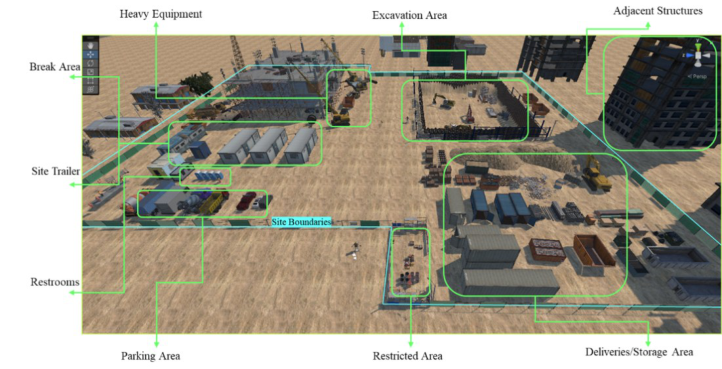
Creation of Virtual Orientation Site The virtual orientation site layout was designed to include all critical locations typically found on construction sites, as identified in the content generation phase (Figure 2).
To model this site in a virtual environment, various 3D models representing different construction elements were incorporated, carefully arranged, and animated to create an immersive and realistic construction site.
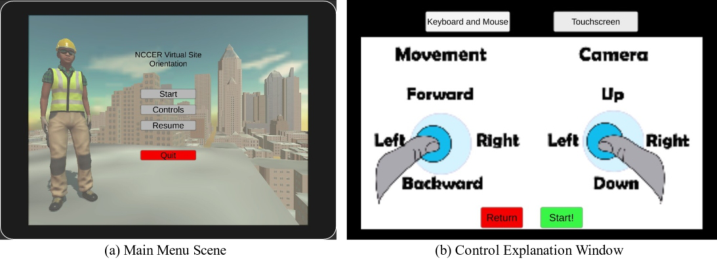
Development of VR-Orient User Interfaces After creating the virtual key characters and the orientation site, these elements were integrated into the VR-Orient application based on the narrative. To enhance user engagement, the application was designed to include interactive user interfaces that allow orientees to freely explore and interact with the virtual environment. Upon launching the VR-Orient application, users are presented with the main menu, which allows them to start the orientation session, access information about the control system, resume a previously paused session, or quit the application (Figure 3(a)). After the user selects “Start,” gesture-based instructions guide them through the navigation and interaction methods before proceeding (Figure 3(b)).
Figure 2: Virtual orientation site layout and visualization of important locations on site.Figure 3: User interface for main menu.
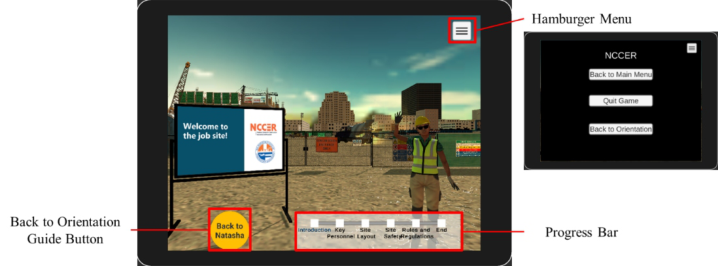
Within the orientation scene (Figure 4), users can navigate the virtual construction site using touchscreen. A progress bar displayed at the bottom shows the current progress and topic of the orientation content. To assist users who may lose their way or stray too far from the designated path, a “Back to Orientation Guide” button is positioned in the lower-left corner, enabling them to teleport back to the orientation guide’s location. In addition, a hamburger menu in the top-right corner allows users to pause the orientation at any time. This menu provides options to return to the main menu, quit the orientation, or resume the session.
Quizzes, as generated in the previous phase, are integrated into the experience following each orientation section to assess the users’ understanding of the content at the conclusion of each orientation section. Finally, VR-Orient was compiled as a standalone application for commonly seen mobile device operating systems, including Android, iOS, and Windows. By supporting multiple operating systems, VR-Orient maximizes its reach and usability, providing an adaptable and user-friendly solution for delivering construction site orientations.
VR-Orient: Design and Usability Study of a Mobile Construction Site Orientation Application 7
Figure 4: User interface for orientation scene.
Usability Assessment The assessment of the usability of VR-Orient received approval from the University of Florida Institutional Review Board (IRB#: ET00041425). The target group for this study consisted of individuals with limited knowledge of and no prior experience on construction sites. The 12 valid data sets collected satisfied the 10±2 rule for the number of participants required for usability evaluation (Hwang and Salvendy, 2010). All participants were invited to the same room and used the same device, a 6th Gen iPad Pro with iOS 17.4.1, to complete the full virtual site orientation process using VR-Orient. After completing the orientation, participants filled out assessment scales on Qualtrics using the same device and provided qualitative feedback about their experience. The usability measurements and results are detailed below:
Knowledge Test (Embedded Quiz) The knowledge test was based on the embedded quizzes in the VR-Orient application after each learning session, consisting of 5 questions, totaling 20 questions for the entire virtual site orientation. The average quiz score was 17.83 out of 20, indicating an 89.17% accuracy rate. Out of the 20 questions, participants achieved 100% accuracy on 13, and only one question had an accuracy lower than 50%. Regarding the learning outcomes for each learning objective, the Site Layout section achieved 100% accuracy among all participants. The accuracy for sections of Key Personnel, Site Safety, and Rules and Regulations were 78.3%, 85%, and 93.3%, respectively, indicating that users successfully achieved the majority of the intended learning outcomes.
The System Usability Scale The SUS is a 10-item, 5-point Likert scale designed to provide a global perspective on subjective usability assessments, which has proven to be a robust, reliable, and valuable evaluation tool widely used in education- al/training technologies and mobile applications (Kaya et al., 2019). The overall SUS score for VR-Orient is 82.08 ± 11.53 (Mean ± SD). According to Bangor et al. (2008), this mean SUS score falls within the 4th quartile range, representing an excellent rating and high acceptability, indicating that
participants found the VR-Orient mobile application to be highly usable in terms of effectiveness, efficiency, and satisfaction.
uMARS – Functionality Subscale The uMARS (Stoyanov et al., 2016) has been demonstrated as a reliable method to assess the quality of mobile health applications from end-users, and its use extends beyond health to other domains. In this study, the functionality subscale measures 4 items of mobile application performance using a 5-point Likert scale: ease of learning, navigation, flow logic, and gestural design. The functionality overall result of VR-Orient is 4.29 ± 0.45 (Mean ± SD), with a high mean score and small standard deviation, suggesting that users generally perceive the VR-Orient features and components to work efficiently. The user interface is easy to use, transitions and movement between scenes are smooth, and the gestural functions with touchscreen components are consistent and functional.
uMARS – Information Subscale The uMARS information subscale measures 4 items related to the quality and quantity of information, visual explanations, and the credibility of the information source received during the virtual site orientation. The information subscale overall result of VR-Orient is 4.38 ± 0.48 (Mean ± SD), also shows a high mean score and small standard deviation, suggesting that users generally perceive the VR-Orient as providing comprehensive yet concise, high-quality information from a credible source, with clear visual presentation.
SPES - Self-Location Subscale Spatial presence is a key concept in psychology and communication, often associated with constructs relevant to training content in virtual environments. The SPES self-location subscale (Hartmann et al., 2016) includes four items assessing users’ feelings of “being there” in the media environment, with responses rated on a 5-point Likert scale. The SPES results show a relatively high score of 3.85 ± 1.07 (Mean ± SD), suggesting that users perceive a moderately high sense of “being there” or “being physically present” in the media environment, specifically the virtual construction site during orientation using VR-Orient.
DISSCUSSION AND RECOMMENDATIONS Statistical results and user feedback highlight VR-Orient’s effectiveness and potential for enhancements to meet diverse user needs.
Construction Onboarding VR-Orient provides an accessible, efficient way for new employees to learn essential construction site information. With 83.3% of participants scoring, it at 75 or higher on the System Usability Scale (SUS), users described it as “simple but good for learning” and “very comprehensive.” Future
VR-Orient: Design and Usability Study of a Mobile Construction Site Orientation Application 9
adaptations can accommodate various construction scenarios, real-time project updates, and multiple languages to serve a diverse workforce
Enhance Learning Experience for Education While most users achieved intended learning outcomes, some requested additional references (e.g., “Possible to cite sources”). Adding clear source citations and streamlining content can bolster credibility and prevent information overload.
Game Development and Outreach Programs The platform can evolve into a gamified application appealing to users intrigued by construction operations or role-playing scenarios, potentially introducing a wider audience to the AEC industry. More immersive features could heighten realism and engagement.
Other Industry Implementations Beyond construction, VR-Orient’s framework can be customized for other labor-intensive sectors, including manufacturing, mining, logistics, and energy. Its flexible design supports tailored virtual agents, self-guided exploration, and quizzes relevant to different job functions and work contexts.
CONCLUSION
This study introduced VR-Orient, a mobile-enabled application for handheld devices that delivers construction site orientation content in a virtual reality environment. The study involved conceptual design, technical development, and a usability assessment. The usability study with novice users showed high overall acceptance, effective learning outcomes, and positive ratings for mobile application functionality and informativeness. This highlights VR-Orient as a pioneering effort to develop a mobile application framework for construction site orientation, demonstrating the system’s feasibility and effectiveness and positioning it as a reliable platform for advancing construction education, gamified training, outreach projects, and broader adoption in other labor-intensive industries. There are also limitations to the current study. The 12 individuals in the usability study were mostly younger than the average construction industry workforce. While this sample size is sufficient for an initial usability evaluation, a larger and more diverse group would offer broader insights, especially for older new employees who are less familiar with mobile-based application interfaces. The user interface could benefit from additional customization, such as subtitles, adjustable controls, and flexible review options, to address various learning preferences and needs. More adaptive learning paths could also be implemented, tailoring content difficulty and depth to individual user requirements and thereby enhancing overall engagement and knowledge retention.
ACKNOWLEDGMENT
This material was produced under the grant from National Center for Construction Education and Research (NCCER) and based upon work supported by the National Science Foundation under Grant No. 2024656. The research team would like to extend its thanks to Anderson Allen and Miles Haase from the University of Florida for their contributions to VR development.
REFERENCES
Al-Ansi, A. M., Jaboob, M., Garad, A., Al-Ansi, A., 2023. Analyzing augmented reality (AR) and virtual reality (VR) recent development in education. Social Sciences & Humanities Open 8, 100532. https://doi.org/10.1016/ j.ssaho.2023.100532 AMFAM, 2024. Safety orientation for your job site|American Family Insurance [WWW Document]. URL: https://amfam-prod-2sgywzve7- american-family-insurance.vercel.app/resources/articles/loss-control-resources/ site-safety-orientation (accessed 11.20.24). Andony, B., 2021. Contractor Orientations: The Foundation for Safe Work in Construction [WWW Document]. myComply. URL: https://mycomply.net/info/ blog/contractor-orientations/ (accessed 9.13.22). Bangor, A., Kortum, P. T., Miller, J. T., 2008. An Empirical Evaluation of the
System Usability Scale. International Journal of Human–Computer Interaction 24, 574–594. https://doi.org/10.1080/10447310802205776 Beh, H. J., Rashidi, A., Talei, A., Lee, Y. S., 2021. Developing engineering students’ capabilities through game-based virtual reality technology for building utility inspection. Engineering, Construction and Architectural Management 29, 2854–2877. https://doi.org/10.1108/ECAM-02-2021-0174 CCOHS, 2023. CCOHS: Employee Orientation Checklist [WWW Document].
URL: https://www.ccohs.ca/oshanswers/hsprograms/orientation.html (accessed 7.23.23). Chauvergne, E., Hachet, M., Prouzeau, A., 2023. User Onboarding in Virtual Reality: An Investigation of Current Practices, in: Proceedings of the 2023 CHI Conference on Human Factors in Computing Systems, CHI ‘23. Association for Computing Machinery, New York, NY, USA, pp. 1–15. https://doi.org/10.1145/ 3544548.3581211 CIRSA, 2014. Safety orientation guide for new employees. GoContractor, 2017. How to Create the Perfect Contractor Orientation | Staff Orientation | initiafy [WWW Document]. GoContractor. URL: https:// gocontractor.com/blog/site-specific-versus-master-inductions/ (accessed 4.11.23). Hartmann, T., Wirth, W., Schramm, H., Klimmt, C., Vorderer, P., Gysbers, A.,
Böcking, S., Ravaja, N., Laarni, J., Saari, T., Gouveia, F., Maria Sacau, A., 2016. The Spatial Presence Experience Scale (SPES). Journal of Media Psychology 28, 1–15. https://doi.org/10.1027/1864-1105/a000137 Hwang, W., Salvendy, G., 2010. Number of people required for usability evaluation: The 10±2 rule. Commun. ACM 53, 130–133. https://doi.org/ 10.1145/1735223.1735255 Kaya, A., Ozturk, R., Altin Gumussoy, C., 2019. Usability Measurement of Mobile Applications with System Usability Scale (SUS), in: Calisir, F., Cevikcan, E., Camgoz Akdag, H. (Eds.), Industrial Engineering in the Big Data Era. Springer International Publishing, Cham, pp. 389–400. https://doi.org/10.1007/978-3- 030-03317-0_32
VR-Orient: Design and Usability Study of a Mobile Construction Site Orientation Application 11
Kim, E., Shin, G., 2021. User discomfort while using a virtual reality headset as a personal viewing system for text-intensive office tasks. Ergonomics 64, 891–899. https://doi.org/10.1080/00140139.2020.1869320 Kinn, S., Khuder, S. A., Bisesi, M. S., Woolley, S., 2000. Evaluation of Safety
Orientation and Training Programs for Reducing Injuries in the Plumbing and Pipefitting Industry. Journal of Occupational and Environmental Medicine 42, 1142. myComply, 2023. Online Construction Orientations [WWW Document]. myComply. URL: https://mycomply.net/info/projects/online-construction- orientations/ (accessed 7.23.23). Rees, L., 2016. Contractor Orientation: 3 Common Challenges and Solutions [WWW Document]. Safeopedia. URL: https://www.safeopedia.com/2/4366/ information-resources/contractor-orientation-3-common-challenges-and- solutions (accessed 1.29.25). Stein, M., Christiansen, L., 2010. Successful onboarding. McGraw-Hill Professional
Publishing. Stoyanov, S. R., Hides, L., Kavanagh, D. J., Wilson, H., 2016. Development and Validation of the User Version of the Mobile Application Rating Scale (uMARS). JMIR mHealth and uHealth 4, e5849. https://doi.org/10.2196/mhealth.5849 Zhang, Y., Liu, H., Kang, S.-C., Al-Hussein, M., 2020. Virtual reality applications
for the built environment: Research trends and opportunities. Automation in Construction 118, 103311. https://doi.org/10.1016/j.autcon.2020.103311
LISTED IN THE AHFE DIGITAL BOOKSTORE CATALOGUE
Explore the complete digital volume
Usability and User Experience
Read this individual research paper free through the original publisher, or explore the full digital proceedings book.
ISBN 978-1-964867-70-0
Explore this ISBN in the AHFE Bookstore ↗Listed in the July 2026 bookstore catalogue; search by ISBN to confirm current availability · Digital book purchase optional