Joe Cecil, Miguel Pirela-Cruz (2026). An Information-centric and AI-based Digital Twin framework for the design of Human-Robotic Interactions (HRI) in orthopedic surgery. In: Accessibility, Assistive Technology and Digital Environments. AHFE Open Access, vol. 202, pp. 161–172. https://doi.org/10.54941/ahfe1007307
This paper outlines a foundational framework to design a Cyber-Human-Physical (CHP) process for robotic orthopedic surgery. The key elements of this information centric framework include components including principles and technologies from various fields including Cyber-Physical Systems, Extended Reality and 3D Digital Twins modeling, Information driven Enterprise models, Human-Computer Interaction (HCI) / Human-Robotic Interactions (HRI) based design, Systems Engineering and Artificial Intelligence (AI). This CHP framework is cantered around the design and use of 3D Digital Twins to support cross-functional design of the overall robotic surgery framework as well as for training residents and surgeons. The creation of Information Intensive Process Models based on systems engineering methods provides a structured foundation for understanding the complexities of the surgical process and for designing the overall approach to support the cyber-human-robotic interactions. AI based tools can play a key role in automating various tasks including generation of 3D robotic path plans and to assess learning/training patterns among residents and surgeons. The 3D Digital Twins can be created using Virtual and Mixed Realty technologies to train residents and budding surgeons as well as to serve as interfaces to control the robotic surgery activities.
In this paper a new framework and approach to support the design and accomplishment of Cyber-Human-Physical (CHP) activities in robotic aided orthopedic surgery is proposed. An information centric framework is necessary to support such a complex CHP medical context (such as orthopedic surgery), where close interaction and harmonious cooperation is needed between medical teams (surgeons and nurses), cyber (or software) tools, medical robots, monitoring cameras and sensors, and other peripheral devices. The role of the assisting cyber or software components is very crucial
162 Cecil and Pirela-Cruz as they serve as the data / information-based glue integrating the activities involving target surgical procedures (or processes) which is part of the needed medical treatment to patients.
The overarching foundation for such a unique perspective involves principles and technologies from several fields including Simulation Based Design (SBD), Artificial Intelligence (AI), 3D Digital Twins, Human- Computer Interactions (HCI), Human-Robotic Interactions (HRI), Systems Engineering and Enterprise Modeling. The design of such a next generation cyber-human- physical framework discussed in this paper is one of the long-term goals of the ARAMM initiative. ARAMM is an acronym for AI frameworks in Robotic Aided Medicine and Manufacturing (ARAMM). The motivation for the ARAMM initiative comes from the notion of ‘aram’ in Tamil culture (Aram, 2026). Aram is a foundational concept in Tamil culture which refers to virtue, righteousness, duty, and moral conduct; while there are similarities between aram and the Sanskrit term dharma, aram is more comprehensive than dharma and emphasizes a holistic way of living that prioritizes ethics, compassion, and unconditional giving (Kural, 2026). It emphasizes the desire to do good, which is the overarching guiding theme of this ARAMM initiative.
At a time when researchers and industry leaders the world over are moving rapidly towards the adoption of AI approaches in various fields, there is a need to reiterate the elements of goodness and service to others, which are important aspect of humanity and civilized behaviour. It is important for AI based systems and tools to adhere to such behavior and not misuse their abilities to hurt human society. This includes only acting in the interests of human society, protecting human life, and not adopting any unethical practises of any kind against humanity. Such an emphasis on ethical and moral behavior needs to be adhered to by AI based systems, which is necessary to ensure that humanity is protected.
In this ARAMM initiative, the primary goals are to serve humanity through the ethical design of AI and other cyber tools and technologies in medicine and manufacturing. The long-term objective is to develop innovative frameworks and technologies to help humans address problems in society, especially in the field of medicine and manufacturing involving robotic and related cyber- physical-human technologies. The accomplishment of the various activities outlined are undertaken with a conscious adherence to human values and ethical principles.
In this proposed framework, the Robotic surgical process itself is accomplished through cyber-human-physical (robotic) tasks which rely on three categories of agents or actors: human agents, cyber agents and physical agents Human agents include surgeons and nurses. Cyber agents include software resources involved in the planning, simulation and accomplishment of the robotic surgical activities. They include algorithms for path planning, and task tracking, among others. Physical agents include robotic devices, sensors, cameras, surgical instruments, tool changers, fixtures etc.
The role of Virtual Reality (VR) in creating simulators to support various surgical processes has been investigated by various researchers in literature
An Information-Centric and AI-Based Digital Twin Framework for the Design 163 (Aggarwal, 2008; Vankipuram, 2010; Rosenblum, 2000; Tsai, 2011; Cecil, 2018). 3D Digital Twins can be described as an Extended Reality based Virtual Prototypes which seek to mimic the form, fit and function of any target process or system. Virtual Prototypes are not a new concept and have been the focus of researchers in engineering and manufacturing for more than two decades. The characteristics of such Digital Twins emphasize the ability to look and behave like the target process they seek to simulate and have been used recently by researchers in advanced manufacturing and medicine (Cecil, 2017; Gupta, 2023). The role of Virtual Reality (VR) in creating simulators to support various surgical processes has been investigated by various researchers in literature (Aggarwal, 2008; Vankipuram, 2010; Rosenblum, 2000; Tsai, 2011; Cecil, 2018). The foundational framework which supports the proposed approach has several contextual facets:
adoption of an information centric process, which is represented explicitly as information centric process model (this is created using systems engineering approaches and information modeling languages such as engineering Enterprise Modeling Languages eEML) (Cecil and Cruz, 2013).
Creation of 3D virtual augmented and mixed reality (VR/AR/MR) based Digital Twins, where surgical ideas/plans are proposed, analyzed / modified and validated; modeling and simulating the various surgical tasks involving the robotic devices, surgeons and nurses can be accomplished at various levels of abstraction or detail.
3D digital twins are used as the basis to study various HCI issues and attributes (affordance, cognition, cognitive load) of the various cyber human physical activities (Gannina, 2024; Gupta, 2023; Gupta, 2022).
Digital Twin based Training environments can be created to train residents and surgeons to work collaboratively with the surgical robots (‘cobots’). These are termed 3D digital training twins (DTTs), Such environments have been created for digital manufacturing contexts (Cecil, 2017).
Cybersecurity protocols need to be in place to prevent nefarious activities, including attacks on the cyber - human- physical framework and infrastructure (Dahle, 2026; Keoh, 2014).
Advanced Networking component provides the communication background to support the exchange and transfer of data information and knowledge throughout the life cycle of this process including training of the residents/surgeons and the actual implementation of the surgery (Bousnah, 2025; Cecil, 2018).
While tracking and monitoring is an integral part of this robotic context, the networking and communication protocols proposed aim to support, remote surgery with surgeons with patience in other locations. The two aspects of emphasis of this networking approach would be the support high gigabit data exchange as well as low latency during the communication
164 Cecil and Pirela-Cruz between the cyber human and physical components involved in these robotic surgical activities.
The adoption of the overall information centric process leads to several tangible outcomes (which are the outcomes after the creation of the CHP framework and supporting CHP environments):
the 3D layout of the robotic surgery components and the overall cyber- human-robotic activities involving the patient (in essence, this is the 3D Digital Twin of the orthopedic surgical scene with resources and cyber tools)
the design of the robotic approach; to accomplish the target surgery, including details of the cyber-human-robotic interactions involving sequential and/or Concurrent tasks performed by the 3 categories of agents (humans, cyber, physical).
the design of the medical robot itself (manipulator, tool changers, sensors), the necessary software modules (for monitoring /tracking, surgical tool path planning, 3D paths, obstacle avoidance)
a detailed information centric process model, which guides the accomplishment of various activities underlying cyber-human-physical activities for the entire robotic surgical context This information centric process can be modeled and represented from a system’s engineering perspective Cecil and Cruz, 2013). Such an information centric system’s engineering (ICSE) approach enables the identification of the various activities along with the information and physical inputs for each task to be accomplished, various controlling factors or criteria that influence each step, the performing agents for each of these tasks and the specific outcomes after the accomplishment of each task. Such an information centric process model (or simply information model) can provide a detailed representation of the functional relationships, as well as the temporal relationships between the activities and sub-activities. This approach provides a needed systems engineering perspective and an information centric basis for designing (or if necessary modifying the overall process or a specific sub process within the target surgical procedure) as well as help design software systems to accomplish specific activities in the overall target surgical procedure (or process).
In today’s information centric medical environment, there is a need to create such a next generation cyber-human-physical (CHP) framework and an approach to support the robotic accomplishment of specific surgical activities. While the initial surgical domain of interest is orthopedic surgery, this framework can be the foundation for accomplishing other surgical procedures.
AI based approaches (and algorithms) can play a significant role in assisting, tracking and monitoring of various activities as well as can play a major role in assessing the robotic accomplishment of the surgery itself, including detecting patterns and problems during the completion of the CHP activities (Ifthikar, 2024; Alsaifi, 2026; Varghese, 2024). They can also play a role in the design of the HCI and HRI based approaches and environments,
An Information-Centric and AI-Based Digital Twin Framework for the Design 165 which seeks to reduce the cognitive load of the humans in the interactions while improving the efficacy of the HCI and HRI based activities.
The 3D digital twins provide the platform for training residents and surgeons (Cecil, 2018 a, b; Cecil, 2025, 2026). They also can be used to accomplish the simulation-based validation of the overall CHP approach including the detailed cooperative accomplishment of each o the surgical steps involving the robots, the medical team and the associated software modules. As mentioned earlier, the residents can be trained using Virtual/Augmented and Mixed Reality based Digital Twins to work with the collaborative robots (‘cobots’) to accomplish a surgical step. The learning patterns, knowledge and skills levels of the residents can be measured, problem areas identified and improved by creating 3D surgical challenge scenarios which can assess the level of surgical preparation of the residents. The entire surgical process can be simulated in the 3D Digital Training Twins using human avatars (or patient mannequins), with a detailed 3D surgical room equipped with the same detailed medical equipment, instruments and other resources along with the medical team of nurses, doctors (such as anaesthesiologist) who will interact with the orthopedic resident being trained.
Simulation Based Design and the Role of 3D Digital Twins to Support Cross-Functional Process Design of the Robotic Surgery Process The simulation-based design approach involving the 3D digital twins provides an effective 3D context to propose process/medical alternatives, compare/analyze feasibilities of alternatives in a cross-functional manner, modify / select the most feasible plan or design, and finally validate the entire process details of a given or target surgery. Such an approach will allow designers of a medical robot to work closely with surgical experts and others to propose to new ideas to design and build robotic devices in a safe and effective environment (the 3D Digital Twin environment). This approach supports downstream participatory design and enables to design the process details from the surgical layout to the identification of the cooperative roles of nurses and others, how the sensors and cameras will be used along with the software modules (for executing the algorithms AI based planning and assessment tasks). This is different from other approaches where a robot is purchased and its made to adapt to the surgical environment. Such an SBD approach allows the cross-functional surgical design team comprised of doctors, engineers and software specialists to conceptualize plans and ideas, which can then progress to generating a detailed surgical process plan including identifying the various surgical steps, how to accomplish them with the necessary resources. The level of abstraction or details can be controlled ranging from focusing only on the robotic device and surgical setup to the entire 3D layout of the surgical room. In such an approach, alternate robotic designs and 3D layouts of the surgical scene can be studied not only from the form, fit and function but also from HCI and HRI perspectives which seeks to address the interactions between the cyber, human and physical/ robotic resources for a given target surgery. From a functional perspective, the capabilities of a robotic device design can be studied and analyzed in
166 Cecil and Pirela-Cruz terms of the following: can the various target paths or points be accessed without collision? Can a fixture hold the bone appropriately to during the accomplishment of a specific step? (e.g.: during drilling or sawing) such an analysis will involve determining the cutting forces coming into play and how to clamp the bone to ensure stability during the drilling process (for example). Several of these analysis highlights the similarities in a surgical process to a manufacturing or assembly process; in orthopedic surgery, some of the processes including sawing a bone, drilling holes to attach a plate, grinding or milling parts of a bone to support attachment of plates, among others.
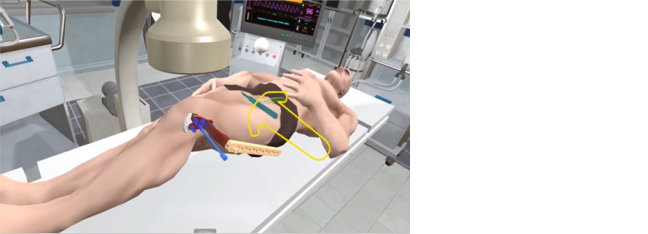
The design of the interface itself, as well as the process interactions can be planned and studied virtually well early in the cyber-human-physical design cycle. The process details can also be validated virtually. The surgical path plan can be determined and validated using algorithms such as AI algorithms) such as A* algorithms and others); validation can include ability to access targe plans or positions, ensuring there are no collisions between a robotic drilling device or tool with fixtures, avoiding critical entities such as veins, etc. Such a validation of the process design details can be accomplished using the 3D Digital Twin simulation-based design approach. Figure 1 provides a view of a 3D Digital Twin (DT) for condylar plating surgery; Figure 2 shows a resident interacting with this DT as part of HCI based analysis of the environment.
Figure 1: A 3D Digital Twin of a surgical scene.Figure 2: Resident interacting with DTT.
An Information-Centric and AI-Based Digital Twin Framework for the Design 167 Role of Information Intensive Process Models and Their Creation Using eEML
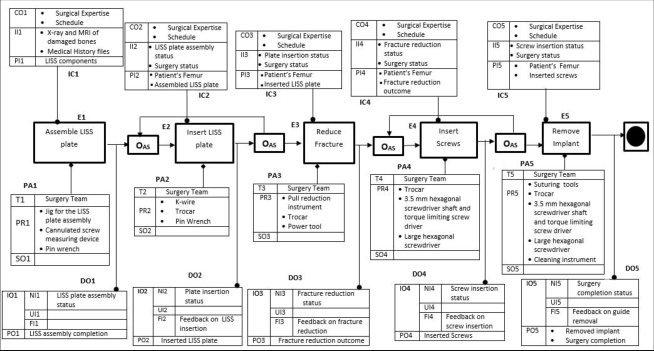
The creation of information models plays a critical role in the overall approach and framework. The information intensive process model (IIPM) was created using engineering Enterprise Modeling Language (eEML). eEML allows capturing the functional and temporal relationships of the various activities in any process and has been used in prior medical projects and to support participatory design (Cecil and Cruz, 2013; Cecil, 2017). The creation of such IIPMs provides a structured foundation to plan and design the cyber-human-physical activities and enables the identification of the various relationships between the various activities. In the context of a surgical process, these relationships include identifying the information and physical inputs to each surgical step, the criteria or controlling factors which influence the accomplishment of that step, and the resources or agents needed to accomplish that step (including software, a human resource such as a surgeon, nurse or an entire team or a physical resource such as a surgical instrument, etc). The specific outcomes of each step can also be explicitly modeled.
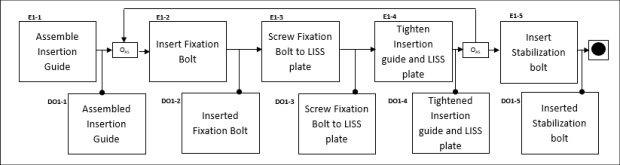
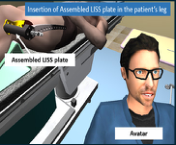
The basic modeling unit for such an IIPM is a process unit, which can be decomposed at various levels of detail of abstraction. Figure 3 shows the top-level process unit and a decomposition for one of the steps in LISS plating surgery process; LISS plating surgery is a surgical procedure to treat patients who have suffered fractures of their femur bone. Assembling the LISS plate is one of the key tasks, which is decomposed in figure 3. The primary attributes which can be modeled for such a process unit is also shown. The temporal relationships can be represented using AND/ OR junction boxes to reflect synchronous or asynchronous accomplishment of tasks; in the figure the symbol shown is OAS, which is an asynchronous OR junction (in this example, it refers to two states being satisfied asynchronously before the subsequent state or process can begin); in the elided decomposition only the decision outcomes (DO’s) are indicated (elided versions need not represent all the categories of modeled information). The digital twin which was created to support this understanding of the steps is shown in Figure 4. A surgical avatar helps the user accomplish the task inside the VR environment. For a Mixed Reality (MR) digital twin, a user can interact with the physical setup wearing the MR headset which allows the user to see the simulated steps in their virtual world (displayed on their headset) while also being able to see and interact with a physical setup in the physical or real world.
Figure 3: eEML model of the procedure ‘Perform LISS plating surgery’.Figure 4: Elided decomposition of process ‘Perform LISS plating surgery’.Figure 5: Digital Twin for the steps involving assembling the LISS plate.
The first step involves the assembly of LISS insertion guide and components (see figure 4), followed by insertion of fixation bolt through the appropriate distal hole in the insertion guide attachment and then subsequently by the insertion of a stabilization bolt with insertion sleeve (which stabilizes the LISS plate and the guide).
The decision outcomes are outcomes or changes in the overall cyber- human-physical cycle after that accomplishment of a task. These can include physical change (such as the completion of a specific step in this surgery) or newly generated information (reporting the status of completion of a surgical task), which can serve as the crucial input to the next step in the surgery. An elided version of the decompositions can also be used as a starting point to map out a set of procedural steps at a higher level which can also be useful for brainstorming and for process modifications.
An Information-Centric and AI-Based Digital Twin Framework for the Design 169 THE DESIGN PROCESS INVOLVING THE 3D DIGITAL TWINS
A multiple phase process for the overall CHP design process is elaborated in this section.
Phase One: Build a structured information intensive process model of the target surgical procedure. This IIPM model is an outcome of the participatory design process. The modeling team works closely with the medical experts (surgeons), nurses, engineers and simulation experts to build a very detailed model of the entire surgical process, which includes identifying all the surgical steps and how to accomplish them (as discussed earlier).
Phase 2: Study the overall flow of activities and identify the cyber human physical requirements off the target surgical procedure Phase 3: Build a VR and MR simulator (digital twin) to study and understand the intricacies of the surgical steps. This enables the team to get a better understanding of the process details and nuances.
Phase 4: Develop up overall design of the robotic device, the overall surgical layout, as well as identify the needed software capabilities (modules and algorithms needed by the robot and the humans in accomplishing the surgical procedure): This phase includes proposing and comparing various robotic designs or devices, design/compare interfaces. Fixtures with respect to the patient on the surgical table and other process details (the home position of the robotic device, the fasteners or screws, clamps, retractors, etc). Other key tasks include identifying and detailing various algorithms and software modules for surgical planning (3D path planning of the drilling tool, for example), obstacle avoidance and fixture designs. The Overall layout of the surgical setup can be studied (optimized if possible), visualized, analyzed and modified by the CHP team using the digital twin.
Fiure 5: Digital Twin created to support LISS plating orthopedic surgical procedures (HCI based criteria was also conducted to assess impact on cognition, knowledge and skills acquisition).
Phase 5: HCI and HRI based analysis of CHP surgical process: This task is to study user friendliness of interface and process interactions while reducing the cognitive load users. This analysis can involve studying aspects such as: What is the impact on the cognitive load of residents and surgeons? Can the introduction of a surgical avatar improve the overall HCI and HRI?
Phase 6: Feedback and final testing: Based on the HCI and HRI analysis, the design of the CHP interactions can be modified as well. Subsequently, robotic devices can be manufactured or assembled. In contexts where a
170 Cecil and Pirela-Cruz robotic device has already been selected, the overall surgical layout can be proposed and analyzed and feedback obtained from surgeons and residents. In this final testing activity, two categories of users can be involved: the orthopedic residents and the experience orthopedic surgeons. During these interactions, the MR Digital Twin with the help of a surgical avatar is the context for the users to complete a target surgery using the simulated system (or CHP created). The Feedback from these users can be used to modify various nuances of the CHP interactions.
DISCUSSION
Digital Twins were created of several orthopedic surgical processes including LISS plating and condylar plating surgery [REFS here]. HCI and HRI based studies were conducted to assess and modify the cyber-human-physical interactions coming into play. eEML based information models were created of the target surgical procedures as well as used as a foundation to plan, design and build the Digital Twin based environments. The CHP environment (robotic work cells, sensors and controllers, software modules and other resources) were used to assemble micro sensors. The design of the micro gripper and the robotic work cells is beyond the scope of this paper.
CONCLUSION
In this paper, a cyber-human-physical framework to support robotic surgery activities for orthopedic surgery is proposed. The foundational aspects of this framework involves principles and technologies from several fields including Simulation Based Design (SBD), 3D digital twins, cyber-physical systems, HCI/HRI, systems engineering, and AI. The SBD approach involving the Extended Reality based digital twins provides an effective 3D context to propose process/medical alternatives and compare/analyze feasibilities of process layouts/surgical alternatives and robotic device designs, followed by the overall design which is most feasible by a cross functional team of surgeons, engineers and others. AI based algorithms and planning approaches (based on A* and genetic algorithms) enable the automation of various tasks such as 3D robotic path planning, fixture design and other tasks (Cecil, 2017; Gupta, 2023). AI can also be used to assess the impact on training and performance of residents and others who train using the cyber-human-physical environments created as part of this framework. Such a cross-functional approach will allow designers of a medical robotic device to work closely with surgical experts to propose, analyze and validate new design ideas to support automation of the surgical devices with the help of cameras and sensors.
ACKNOWLEDGMENT
Some of the research activities discussed in this paper was funded by grants from several agencies including the National Science Foundation (grant numbers 1256431, 1257803, 2050960).
org/wiki/Kural Aggarwal, R., Balasundaram, I., & Darzi, A. (2008). Training opportunities and the role of virtual reality simulation in acquisition of basic laparoscopic skills. Journal of Surgical Research, 145(1), 80–86. Alsairefi S, Alawadhi R, Abdulaziz S, Al Hashemi R, Alqallaf N, Mohammad J, Albutti
B. Use of Artificial Intelligence in Preoperative Planning in Surgery: A Narrative Review. Cureus. 2026 Jan 24;18(1):e102187. doi: 10.7759/cureus.102187. PMID: 41737108; PMCID: PMC12926784. Cecil, J., Pirela-Cruz, M., A Digital Twin enhanced Cyber-Human-Robotic framework for orthpedic surgery, 8th International Conference on Human Systems Engineering and Design: Future Trends and Applications (IHSED 2026), Paris, France, September 22–24, 2026 Cecil, J., Vasavi Gannina, Tentu Sriram Kumar, Study of Perception and Cognition
in Immersive Digital Twins for Robotic Assembly Processes, Proceedings of the 2024 International Conference on Human-Computer Interaction, Washington DC, June 29 - July 4, 2024. Cecil, J., Gupta, A., Pirela-Cruz, M., & Ramanathan, P. (2018). An IoMT-based cyber training framework for orthopedic surgery using next generation internet technologies. Informatics in Medicine Unlocked, Vol. 12, 2018, pp. 128–137. Cecil, J., Gupta, A., Pirela-Cruz, M., (2018), Virtual Reality based Training
Environments for Orthopedic Surgery, Surgical Research and Reports, November 2018, Vol. 1 (1), pp. 1–6. Cecil, J., Gupta, A., Pirela-Cruz, M., An Advanced Simulator for Orthopedic Surgical Training, International Journal for Computer Assisted Radiology and Surgery, February 2018, Volume 13, Issue 2, pp. 305–319. Iftikhar M, Saqib M, Zareen M, Mumtaz H. Artificial intelligence: revolutionizing
robotic surgery: review. Ann Med Surg (Lond). 2024 Aug 1;86(9):5401–5409. doi: 10.1097/MS9.0000000000002426. PMID: 39238994; PMCID: PMC11374272. Lin, Y., Wang, X., Wu, F., Chen, X., Wang, C., & Shen, G. (2014). Development and validation of a surgical training simulator with haptic feedback for learning bone- sawing skill. Journal of biomedical informatics, 48, 122–129. Keoh, S.I., Kumar, S.S., and H. Tschofenig, “Securing the Internet of Things: A
Standardization Perspective,” IEEE Internet Things J., vol. 1, no. 3, pp. 265–275, 2014. Kong, M. X., Du, Z. J., Sun, L. N., Fu, L. X., Jia, Z. H., & Wu, D. M. (2006, January).
A robot-assisted orthopedic telesurgery system. In 2005 IEEE Engineering in Medicine and Biology 27th Annual Conference (pp. 97–101). IEEE. Rosenblum, L., Macedonia, M. (2000), Virtual orthopedic surgery training. IEEE Computer Graphics and Applications, 20(3), 6–9, IEEE Cecil, J., Pirela-Cruz, An information model for designing virtual environments for
orthopedic surgery, Proceedings of the 2013 EI2N workshop, OTM Workshops, Gra. Cecil, J., Albuhamood, S., Cecil-Xavier, A., Ramanathan, P., An Advanced Cyber Physical Framework for Micro Devices Assembly, IEEE Transactions on Systems, Man, and Cybernetics: Systems, August 2017, Vol. 49, No.1, pp. 92–106. Gannina, V., Cecil, J., Pirela-Cruz, M., Kennison, S., Study of Perception and
Cognition in Mixed Reality Training Environments, Proceedings of the 2024 IEEE SeGAH, Funchal, Portugal, August 7-9, 2024.
172 Cecil and Pirela-Cruz Gupta, A., Cecil, J., & Pirela-Cruz, M., A Multi-Level HXRI-Based Approach for
XR-Based Surgical Training, Proceedings of the IEEE Systems Man Cybernetics (SMC) conference, Hawaii, USA, Oct 1–4, 2023. Gupta, A., Cecil, J., Pirela-Cruz, M., and Kennison, S., “Identification of Human Centered Design Factors and their impact on Design of Cyber-Human training environments for orthopedic surgery,” 2022 IEEE 10th International Conference on Serious Games and Applications for Health (SeGAH), Sydney, Australia, 2022, pp. 1–7. Marwaha, J.S., Raza, M.M. & Kvedar, J.C. The digital transformation of surgery. npj
Digit. Med. 6, 103 (2023). https://doi.org/10.1038/s41746-023-00846-3 Tsai, M. D., Liu, C. S., Liu, H. Y., Hsieh, M. S., & Tsai, F. C. (2011, May). Virtual Reality Facial Contouring Surgery Simulator Based on CT Transversal Slices. In Bioinformatics and Biomedical Engineering, (iCBBE) 2011 5th International Conference on (pp. 1–4). IEEE. Vankipuram, M., Kahol, K., McLaren, A., & Panchanathan, S. (2010). A virtual
reality simulator for orthopedic basic skills: A design and validation study. Journal of biomedical informatics, 43(5), 661–668. Varghese, C., Harrison, E.M., O’Grady, G. et al. Artificial intelligence in surgery. Nat Med 30, 1257–1268 (2024). https://doi.org/10.1038/s41591-024-02970-3 z, Austria. Vol 8186, Lecture Notes in Computer Science, 2013, page 218–227.
Springer
LISTED IN THE AHFE DIGITAL BOOKSTORE CATALOGUE
Explore the complete digital volume
Accessibility, Assistive Technology and Digital Environments
Read this individual research paper free through the original publisher, or explore the full digital proceedings book.
ISBN 978-1-964867-78-6
Explore this ISBN in the AHFE Bookstore ↗Listed in the July 2026 bookstore catalogue; search by ISBN to confirm current availability · Digital book purchase optional